
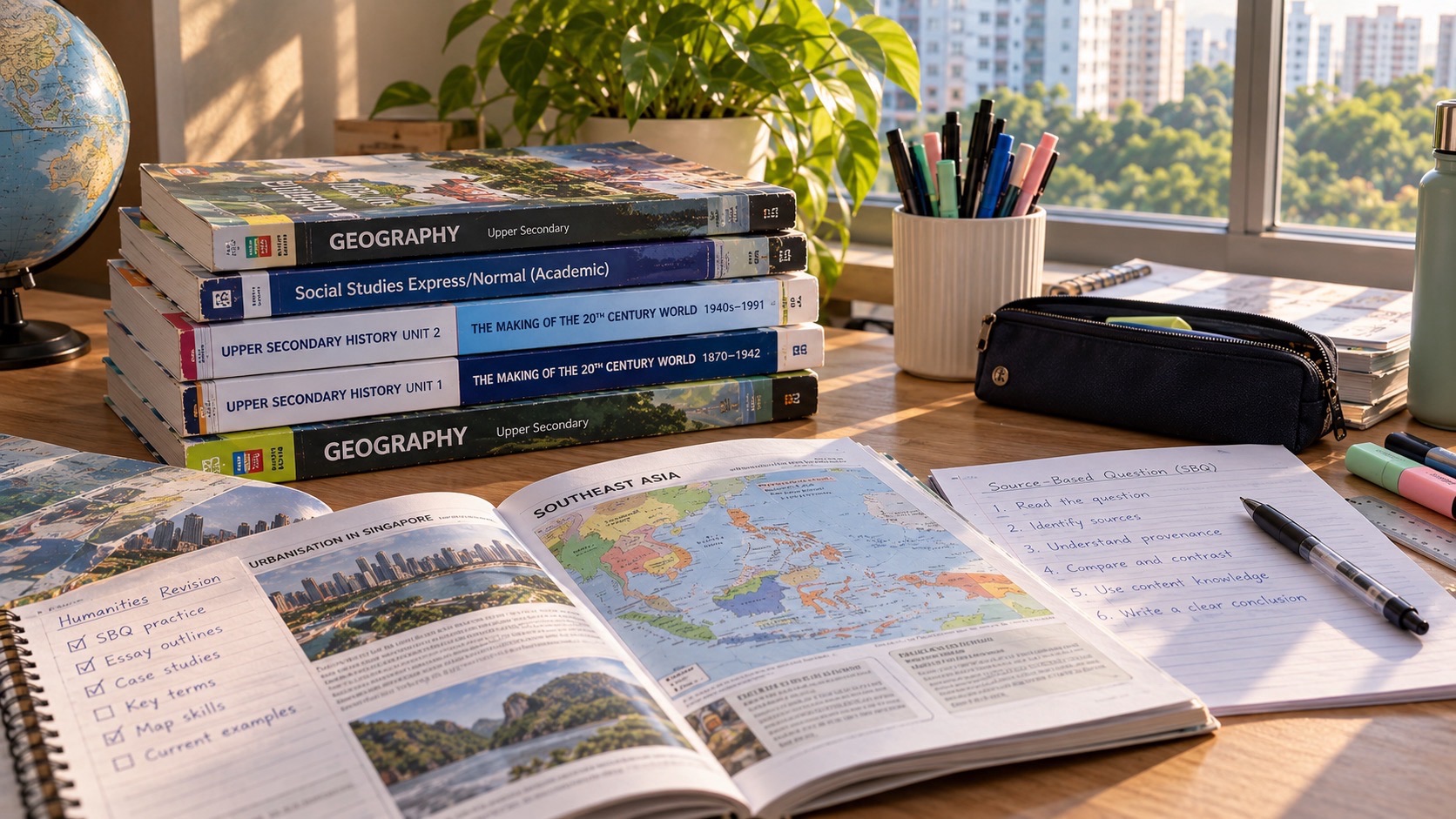
A Punggol student admitted through Posting Group 2 (PG2) can learn G2 History of the Japanese Occupation by creating an accurate chronology of the fall of Singapore, examining how military rule affected civilians, and using trustworthy sources to explain hardship, resistance and remembrance. PG2 is a Secondary 1 admission grouping, while G2 History is an individual subject level offered under Full Subject-Based Banding. The essential dates are 15 February 1942, when British forces surrendered Singapore, and 12 September 1945, when the formal Japanese surrender ceremony was held here. Between these dates, people faced violent repression, shortages, fear and profound disruption.
The story has a direct Punggol connection. The National Heritage Board identifies Punggol Beach, near today’s Punggol Point Park, as a site of killings during the Sook Ching operation in February 1942. Historians and heritage publications differ on some victim estimates, so a school answer should cite a specific source rather than invent a precise settled total. MOE’s updated lower-secondary G2/G3 History syllabus includes civilian experiences under the Japanese Occupation, repression and resistance, hardship, and subsequent progress towards self-government. This guide helps families study those subjects through accurate evidence, respectful discussion and carefully distinguished personal memories; it does not treat a modern beach photograph as direct proof of a wartime event.
- PG2 versus G2: admission group and Humanities subject level are different.
- Dates: Singapore fell on 15 February 1942; the formal surrender ceremony was on 12 September 1945.
- Military rule: Japanese authorities renamed Singapore Syonan-to and imposed coercive controls.
- Sook Ching: a violent purge targeting Singapore’s Chinese community, with historic killing sites including Punggol Beach.
- Hardship: wartime food shortages, rationing, inflation, black markets, fear and difficult survival choices.
- Resistance: different groups and individuals opposed occupation under dangerous conditions.
- Evidence: distinguish photographs, occupation notices, personal interviews, later histories and official markers.
- Remembrance: discuss Punggol Beach and memorial sites respectfully without sensationalising deaths.
- Next step: make one sourced timeline and explain one civilian experience using two different evidence types.
Definition lock: PG2 does not determine historical knowledge
Posting Group 2 is part of the Secondary 1 admission system. G2 refers to the level of an individual subject, and school offers may differ among pupils with the same original posting group. The Japanese Occupation is a lower-secondary History topic, not a separate school posting path. Families should confirm that the child is currently studying the relevant unit and use the actual school’s textbook, teacher materials and assessment instructions.
A pupil may know the date of surrender but be unable to explain food scarcity or the consequences of military rule. Another may have memorised a description of resistance without knowing the sources. These are different weaknesses. Good teaching begins with the question being asked, the evidence required and the first inaccurate inference. The goal is to understand past people’s experiences respectfully rather than memorise a dramatic story for examination effect.

What the period 1942–1945 means
Singapore came under Japanese military occupation following the British surrender on 15 February 1942. The formal surrender ceremony in Singapore took place on 12 September 1945, after Japan’s decision to surrender in August. Students should distinguish the February defeat, the August global end-of-war developments and the September ceremony. These are not three alternative dates for the same event.
A timeline helps show how military invasion, occupation, Japan’s surrender and the return of British administration are related but separate developments. The exact timing also shapes what a personal diary or official notice could record. A source written in 1943 belongs to wartime rule, while a reminiscence recorded decades later has a different perspective. Chronology is necessary for responsible source interpretation.
The Japanese advance began before February 1942
Japanese forces attacked British Malaya in December 1941, and the campaign moved down the Malay Peninsula towards Singapore. The Battle for Singapore followed in February 1942. National Heritage Board materials describe the land invasion, British defences and the eventual surrender. A student who begins with 15 February alone may miss how military decisions and shortages developed before that date.
Ask what a timeline of the campaign should include and which events belong before Singapore’s fall. An explanation might discuss the movement of forces, pressure on supplies and the vulnerability of defences, but it must use historical sources rather than generic claims that one side simply fought harder. This is the difference between naming an outcome and explaining a military development.
British confidence and the fall of Singapore
Singapore had been described within colonial defence planning as a strategic fortress, and its defeat undermined confidence in British power. The collapse of British military authority was an important turning point for many residents. Yet a strong historical explanation must distinguish the expectations before the war from what actually happened during the campaign, including the wider Malayan fighting.
Ask which sources reveal pre-war confidence, military preparations or civilian expectations. A post-war account may know the outcome and make it seem inevitable; a diary from early 1941 may show uncertainty. The learner should avoid hindsight and recognise the difference between information available to people at the time and a later historian’s reconstruction. Such awareness makes causal explanations more credible.
15 February 1942 is a specific historical turning point
The British surrender on 15 February 1942 marked the defeat of the forces defending Singapore and the start of Japanese occupation of the island. It changed the authorities governing residents, the security environment and daily conditions. The date did not instantly explain every later hardship, but it created the military and political setting in which occupation policies were imposed.
A good History answer says what changed, for whom and why the event mattered. Merely writing ‘Singapore was conquered’ gives the broad result without explaining consequences. A careful learner can connect the surrender to changes in administration, military policing and civilian life while leaving specific claims to appropriate records. A turning point is meaningful because of its effects, not just because it is memorable.
Syonan-to was an imposed occupation-era name
The Japanese administration renamed Singapore Syonan-to, commonly translated as ‘Light of the South’. The name appeared in occupation-era communications and propaganda. Naming did not make civilian conditions peaceful or safe. National Heritage Board museum materials describe forced language policies, repression and attempts to promote Japanese imperial ideology during this period.
Ask the student what the name tells us about the administration’s public messaging and how that compares with documented experiences of occupation. A propaganda phrase represents an intended image or assertion, not neutral proof of popular wellbeing. A strong answer uses the contrast to study power and historical sources without mocking languages or cultures. Responsibility for wartime policies should not be confused with assumptions about people living today.
Military occupation affected civilian rights
Under Japanese military rule, people in Singapore faced serious restrictions, surveillance and violent punishment. The Kempeitai, or military police, became feared for arrests, coercion and abuses. The severity of experiences varied by person, group and circumstance, but the occupation created an environment of profound insecurity. Students should not treat a military occupation as merely a change in the flag above an office.
Ask what daily choices might be affected when people fear arbitrary punishment or informers. Use documented evidence rather than writing an invented victim’s dialogue as historical fact. The distinction between actual testimony and classroom illustration matters especially in this topic. History should develop empathy grounded in the record, not speculative melodrama.
What Sook Ching was
Sook Ching was a purge conducted by Japanese military authorities shortly after the fall of Singapore, directed primarily at the Chinese community and those alleged to be anti-Japanese. Screening and detentions were followed by the killing of many civilians. National Heritage Board and National Museum resources describe the operation as a grave wartime atrocity, not as an ordinary administrative inspection.
A responsible school answer identifies who organised the operation, who was targeted and how the event affected civilians. It should not describe victims as proven enemies of Japan merely because they were selected in screenings. The accusations and methods were part of the coercive occupation, and many individuals were arbitrarily targeted. Accurate wording protects both historical understanding and the dignity of those who suffered.
Why the screening process cannot be called fair
Japanese authorities ordered Chinese men in specified age groups to attend screening centres and used vague classifications of suspected hostility to select people. National Museum materials describe the arbitrary nature of selections and the involvement of military police and informants. The existence of a screening process did not make the subsequent killings lawful or justified.
Ask the learner to distinguish the occupiers’ stated rationale from the evidence about what occurred. In History, reporting a government’s stated aim is not the same as endorsing it as fact or accepting its moral validity. A careful explanation may say the authorities claimed to be identifying opponents, while documentary evidence describes arbitrary persecution and mass violence. The two statements serve different evidential roles.
Punggol Beach is an officially marked historic site
National Heritage Board’s Roots historical marker for Punggol Beach Massacre identifies the northeastern shore at Punggol Point Park as one of the sites of Sook Ching killings. Its marker page states that around 400 Chinese civilian victims were killed there on 28 February 1942. This is a source-specific figure, not permission to announce that every historical publication uses exactly the same estimate.
Punggol is therefore not simply a scenic contemporary waterfront in this History topic. The place carries difficult wartime memory. Parents can help teenagers understand the historical evidence and the purpose of a marker without organising sensational outings or asking students to reconstruct violence at the site. Historical remembrance demands accuracy and respect.
Why published Punggol victim figures can differ
A separate National Heritage Board historical narrative on Punggol recreation describes around 300 victims at Punggol Point on the same date, while the Roots historic marker gives around 400. Such differences in published estimates should not be hidden or resolved by an unsupported personal guess. Estimates of the broader Sook Ching death toll also vary because complete records are not available.
Teach the child to name the source and its estimate where a number is required. If the examination question does not demand a precise victim count, the accurate central statement is that Punggol Beach was a documented killing site during the Sook Ching atrocities. The uncertainty concerns an estimated quantity, not whether the atrocity happened. Historical judgement includes distinguishing well-established events from uncertain numerical details.
A memorial marker and a wartime eyewitness source are different
A contemporary heritage marker is an authoritative public interpretation that brings together prior historical research. A diary, wartime notice or firsthand witness account was created closer to the event, but carries its own limitations of perspective and knowledge. Students should not treat all sources as though they were produced at the same time or for the same purpose.
Ask who created the source, when, for what audience and what claim it supports. A current memorial can identify a recognised historic site, while a surviving witness statement may illuminate an individual’s experience. One cannot automatically replace the other. A strong historical answer chooses relevant evidence and explains why it is appropriate to the question being asked.
Modern Punggol photographs are not pictures of 1942
A current photograph of Punggol’s waterfront might show paths, park facilities or modern buildings. It cannot, on its own, establish what the site looked like during February 1942 or exactly where a particular event occurred. Shorelines, infrastructure and access arrangements can change over decades. Historical location claims should come from archival maps, official markers and suitable research.
A teenager can use a present-day landscape as a prompt to ask how places acquire layers of meaning, but should not label every current feature as a wartime relic. Avoid creating fake archival captions. The distinction between illustrative modern imagery and historical evidence is essential for responsible WordPress publication and for History assignments.
Life under occupation included food scarcity
Food imports and normal trade were severely disrupted during occupation, contributing to shortages and rising pressure on households. National Library Board’s BiblioAsia research draws on oral histories to describe rationing, queues and difficulties securing enough food. Residents’ experiences differed, and accounts of survival should be attributed rather than presented as identical for every family.
Ask what changed in supply and distribution, and how that affected people’s choices. A full explanation might link interrupted trade, military control and limited availability to hardship. Students should not assume that a ration coupon guaranteed the entitled food was actually obtainable. The distinction between a stated allocation and a practical outcome is an important lesson in using wartime records.
Rationing records show both policy and experience
An occupation-era rationing notice can explain how authorities claimed food would be distributed. A resident’s recollection may describe queues, shortages or incomplete rations. Together these sources can reveal differences between policy and actual experience. National Library Board materials note that quantities available to civilians declined during the occupation and that obtaining food could be difficult even with the relevant entitlement.
Ask the child which source answers the question ‘What did the rules state?’ and which addresses ‘What happened when a family tried to obtain food?’ These are related but distinct questions. Reading them together supports a more complete account than copying an official notice and assuming everyone received the announced amount.
The black market reflected scarcity and demand
Where official distribution could not meet needs, goods were sometimes exchanged through unofficial markets at much higher prices. Such activity could be a survival response to shortages, but circumstances and consequences varied. A student should not turn the black market into a romantic adventure or claim it solved hardship for everyone. People faced unequal access, financial constraints and risks.
Ask what conditions made informal trade attractive and why some residents could not afford the prices. A causal answer connects scarcity, rationing and purchasing power. It does not need invented anecdotes about a particular Punggol household. Economic hardship can be analysed through sourced accounts without implying every transaction or resident followed the same pattern.
The phrase banana money needs context
Japanese-issued currency used during the occupation became widely known as ‘banana money’ because banana-tree motifs appeared on some notes. National Library Board sources explain the severe inflation and loss of purchasing power associated with wartime monetary conditions. Students should not interpret the nickname as evidence that the notes were made from bananas or that all transactions used fruit.
A strong response connects money supply, scarcity and inflation to the difficulties of purchasing essential goods. If the task presents a photograph of a banknote, the picture identifies an object; it does not alone establish its real purchasing power at a particular date. Economic interpretation requires additional historical evidence. Correctly explaining terminology is more useful than memorising a nickname.
Inflation changed how households experienced prices
When prices rose sharply and currency value eroded, ordinary incomes and savings could lose purchasing power. The consequences were not identical for every household because access to goods, occupations, assets and social networks differed. A student should avoid inventing a neat price table without a reliable source and then treating the figures as universal for wartime Singapore.
Use a fictional arithmetic example only if it is explicitly labelled hypothetical. For actual economic history, consult trustworthy accounts and records. Ask what an increase in prices means when food is already scarce. This connects economic mechanisms with the lived experiences described in oral history while preserving the difference between a model and measured evidence.
People improvised ways to obtain food
Oral histories document different ways residents tried to survive, including growing food, exchanging goods and making do with limited ingredients. Some communities were moved to agricultural settlements such as Endau and Bahau under occupation-era arrangements. These responses reflect adaptation to difficult conditions, but students should not imply that coping strategies made occupation safe or pleasant.
A respectful explanation can describe the practical choices while recognising the coercive wider situation. Ask which experience the source actually documents and whether it is representative of one person or a larger group. The term resilience should not be used to erase fear, hunger or the responsibility of occupying authorities. History can recognise human resourcefulness without glorifying suffering.
Schooling was altered under the occupiers
Japanese-language instruction and the promotion of Japanese culture and ideology formed part of occupation policy. National Museum teaching resources describe language rules and media propaganda during the period. The fact that classes or cultural activities continued under military occupation does not mean that education took place under ordinary free civic conditions.
Ask what the authorities intended to change through schooling and communication. An occupation notice may provide direct evidence of a required activity, while a student’s personal recollection can show how they experienced it. Do not assume all pupils attended school continuously or learned under identical arrangements. War altered access and everyday life in many ways.
Propaganda should be read as persuasion
Occupation authorities used newspapers, films, symbols and controlled messaging to promote official narratives. A propaganda poster or film is evidence of what the issuer wanted people to believe, not necessarily of what the public experienced or accepted. The very polished appearance of a message can conceal its coercive setting or the gap between official claims and civilian conditions.
Teach the learner to identify author, audience, purpose and content. Does the source emphasise success while omitting shortages or violence? What other sources could test the claim? The same source-analysis method applies beyond wartime history when students read advertisements or public messages. A reliable explanation uses propaganda as evidence of communication strategy without adopting its assertions as neutral fact.
The Kempeitai and the climate of fear
Japanese military policing during occupation involved surveillance, arrests, intimidation and violence. Historical sources describe the fear created by informers and coercive interrogation. This climate could influence what residents said publicly, whom they trusted and how they navigated ordinary life. Students should not need graphic detail to understand the severity of repression.
Ask what behavioural consequence might follow from credible fear of arbitrary punishment. A learner can connect policy, coercion and civilian response while distinguishing documented facts from psychological inference about a particular unnamed person. Responsible History recognises how insecurity changes society without manufacturing vivid personal scenes as though they were quotations from survivors.
Resistance had several forms
Resistance to occupation included organised intelligence work and armed or clandestine activity, as well as differing forms of civilian assistance and survival. Force 136 is among the documented resistance networks associated with the region, and the figure Lim Bo Seng is recognised in National Heritage Board accounts. The actions and circumstances of different organisations should not be flattened into one story.
Ask which group a source discusses, what its objectives were and what risks its members faced. An intelligence organisation’s activity is not identical to an ordinary household’s survival decision. A student should not assign all documented resistance acts to one famous leader or imply everyone had the same opportunities to participate. History rewards precise attribution.
Lim Bo Seng is a documented resistance figure
National Heritage Board materials describe Lim Bo Seng’s involvement in anti-Japanese work and Force 136 intelligence operations. He suffered arrest and abuse and died while imprisoned. His story can illustrate the danger of resistance, but it should be understood through the available historical record rather than embellished with invented dialogue or unsupported accounts of his final words.
Ask what the source actually records about his role and circumstances. If the task concerns a different group or local community, do not insert his story merely because the name is familiar. A specific example is valuable when it supports the historical point being made. Respectful biography does not require presenting a person as the only individual who resisted occupation.
Prisoners of war and civilians experienced different conditions
After Singapore’s fall, Allied prisoners of war faced confinement, forced labour and severe hardship, while civilian communities experienced occupation policies, rationing and repression. These experiences intersected but were not identical. The Changi Chapel and Museum’s educational material and National Heritage Board records can help pupils distinguish different categories of affected people.
A student should identify whose experience a source records before generalising. A prisoner’s diary is not automatically a representative account of every civilian household, and a rationing notice for residents does not describe conditions in a prisoner camp. Historical empathy grows through accurate attention to people in their particular circumstances. Broad claims that ‘everyone had exactly the same life’ are usually indefensible.
Different communities faced distinct risks
The Sook Ching operation particularly targeted the Chinese community, while other groups and individuals experienced different forms of colonial and wartime coercion, economic hardship and political pressure. Sources also discuss Indian National Army activities and various communities under occupation. A responsible account does not assume that all residents were treated identically or that one individual’s experience defines an entire ethnic group.
Ask which policy or event the question concerns and whose perspective the source represents. Avoid stereotypes and generalisations. There is no contradiction in explaining an atrocity directed at one group while also recognising wider hardship and differing experiences. Accuracy requires both specificity and breadth where relevant.
Personal oral histories add important evidence
The National Archives of Singapore and NLB preserve oral history accounts recorded from people who lived through wartime years. These voices can reveal details of hunger, fear, family decisions and daily adaptation that are not always apparent in official notices. But memory can be selective, and interviews recorded many years later have different limitations from a dated wartime document.
Ask who is speaking, when the interview was recorded and what the person directly experienced. An oral account can be invaluable without proving that every resident lived the same way. A good school explanation attributes the testimony and uses it for the claim it can substantiate. Students should not invent a first-person survivor quotation merely to make an essay sound moving.
Distinguish original records from later interpretation
A photograph taken during occupation, an official notice from the period and a modern museum article are all sources, but their relationship to the event differs. The notice shows an authority’s instruction, the photograph records a visible moment, and the museum account interprets several records. None should be treated as an unrestricted window into every aspect of historical life.
Have the child write a short provenance note for each source: creator, date, purpose and potential limitation. Then ask what question the source can help answer. An old image cannot automatically establish a person’s private thoughts; a later essay can contextualise events but should identify its evidence. This practice turns source awareness into a usable historical method.
A historic marker is about public remembrance
A marker at a recognised wartime site helps explain why a place is remembered and what happened there according to published historical research. Its presence today is evidence of a decision to commemorate, not a physical recreation of the 1942 surroundings. The National Heritage Board maintains information on the Punggol Beach Massacre marker and other sites of wartime remembrance.
Ask how remembrance differs from reliving an event. A respectful visitor reads the historical explanation and behaves appropriately at the site. The learning goal is to understand evidence and the experiences of victims, not to stage re-enactments of killings or collect sensational pictures. Public history should preserve dignity as well as accurate facts.
The 1945 end-of-war dates require care
Japan announced its acceptance of surrender terms in August 1945, while the formal surrender ceremony for Singapore occurred on 12 September 1945 at the Municipal Building, now associated with City Hall. A student should not mistake one date for the other. The military and political transition also involved practical difficulties as administration and supply arrangements changed.
Use a timeline to distinguish the international surrender developments, the return of British forces and the local formal ceremony. An archival source written before 12 September may reflect uncertainty about the transition even after the August announcements. Chronology helps prevent historical accounts from treating occupation as ending through one simple event experienced identically by everyone.
Hardship did not necessarily end instantly
The formal end of occupation did not immediately resolve every food shortage, economic problem or social disruption. Restoring administration, trade, employment and services required time, and people had to adjust to a changed political environment. The lower-secondary History syllabus connects wartime experiences to later debates about self-government and the future of British rule.
Ask which effects were immediate and which persisted after the occupation. A careful answer distinguishes the end of military rule from recovery of everyday conditions. Students should avoid claiming that every family returned to a normal life on the day of surrender. Historical change often occurs through several overlapping processes rather than one neat date.
The occupation influenced later political thinking
The defeat of British forces undermined a widely held image of colonial invulnerability and shaped post-war debates about governance and Singapore’s future. The precise political consequences developed through later events, including economic recovery, unrest and elections. The Japanese Occupation was a significant factor, but it did not automatically produce independence in a single step.
A good explanation identifies the connection and the intervening developments rather than leap from 1942 to 1965 as though nothing else happened. The MOE syllabus’s subsequent topics help students trace those changes. Understanding a turning point means explaining how it influenced later possibilities, not attributing every later decision solely to one wartime experience.
How Punggol families can study this responsibly
Start with the relevant school chapter and one trustworthy National Heritage Board or NLB resource. Identify the event, date and source before discussing broader implications. The Punggol Beach marker offers a direct local connection, but the educational task can be completed through reliable online material without requiring a site visit. If visiting, follow current park access rules and respect the commemorative purpose.
Parents should avoid making the lesson overly graphic or treating victims’ deaths as entertainment. The topic can be emotionally difficult, and age-appropriate teaching should be clear and compassionate. Ask the teenager which evidence supports the historical claim and what remains uncertain. Accuracy, empathy and careful language are stronger outcomes than the ability to repeat disturbing details.
A fictional timeline-correction exercise
Imagine a fictional student, Hana, who places the formal Singapore surrender ceremony in August 1945 because she remembers Japan’s announcement that month. Her teacher asks her to distinguish the international decision from the ceremony in Singapore. Hana revises the timeline to include 15 February 1942, the August 1945 surrender developments and 12 September 1945 as separate events.
The example is invented. Its lesson is chronological precision: two dates can both be important without being interchangeable. A fresh question could ask what changed for the authorities and for civilians at different stages. A pupil who can explain the distinction has learnt more than one corrected date.
A fictional source-comparison exercise
Imagine a student reading an occupation-era ration notice and a much later oral history account of queues. The notice states an official rule, while the witness describes struggling to obtain supplies. The pupil initially concludes one source must be false because the two differ. A teacher explains that a declared entitlement and what people actually received can both be historically relevant and unequal.
The student learns to ask what each source was created to show. An official announcement may document intention or policy; a personal recollection may document lived experience. The example is an original teaching scenario, not a fabricated survivor testimony. It illustrates how careful comparison can reveal complexity without forcing a simple choice between sources.
A fictional Punggol memorial question
Imagine an assignment asking why a current Punggol Beach historic marker matters. A weak answer says the beach is important because it has a nice waterfront. A stronger response identifies the documented 1942 atrocities, acknowledges the victims and explains how the marker preserves public memory. The pupil could also say that modern landscaping does not substitute for a historical source about the wartime event.
This scenario is a fictional task, not an actual examination question. It teaches students to connect historical significance with evidence and ethical remembrance. The aim is not a dramatic photograph or a made-up speech by a survivor. A restrained, accurately sourced explanation can be deeply meaningful without sensationalism.
Why figures should be attributed
Historical sources may report different estimates for the number of people killed in the Sook Ching purge. For the Punggol site, National Heritage Board publications themselves include estimates of roughly 300 and 400 in different accounts. A pupil should not silently select whichever number sounds most dramatic or present a rounded estimate as a precise census result.
Write ‘according to the NHB historic marker’ when using that page’s figure, and acknowledge where relevant that another reputable account differs. The student should distinguish uncertainty over exact numbers from the firmly documented atrocity. Responsible historical writing can state a difficult truth while honestly representing limitations in the surviving evidence.
A ten-day study route through the occupation
Begin with a timeline of the campaign, fall and surrender. Next, read a source explaining military rule and Sook Ching. Then study food rationing, monetary hardship and civilian coping through properly attributed accounts. Later examine one resistance story and a public memorial, identifying differences between original records and later interpretation. End with a fresh question about significance and consequences.
This is an optional home routine, not an official school schedule. Parents should follow the assigned syllabus and manage emotional sensitivity appropriately. If the student struggles to distinguish dates, repair chronology before demanding a long evaluation. If the learner knows the facts but uses unsupported assertions, focus on provenance and reasoning. The goal is accurate, independent History thinking.
What a good History tutor should correct
A student may reverse the dates, present a propaganda claim as neutral fact, generalise from one oral history account or claim victim counts are definitively settled when sources disagree. Each error needs a different intervention. A responsible tutor finds the first mistaken inference and shows how a relevant source should be interpreted. Then a changed question allows the learner to apply the principle independently.
Parents should look for clear reasons, correct attribution and respectful language rather than sheer volume of handwritten notes. The value of studying wartime history is not only examination preparation. It also develops an evidence-based understanding of coercion, choices, suffering and remembrance, while discouraging casual distortion of the past.
The correct syllabus and examination cohort
MOE’s lower-secondary G2/G3 History syllabus includes Singapore’s struggle for independence from 1942 to 1965, including civilian experiences of occupation and progress towards self-government. SEAB’s 2027 G2 History and Humanities examinations are for students graduating in that year. A child starting Secondary 1 in 2027 follows the actual school programme and a later national examination timeline.
The family should not assume every Secondary 1 History lesson requires full upper-secondary SEC answer lengths or a particular graduating subject combination. Establish the current learning task, use appropriate sources and build the ability to explain evidence. That durable skill transfers across later History assessment formats and topics.
Official sources and Your Next Step
MOE’s updated lower-secondary G2/G3 History syllabus covers experiences under occupation. The National Heritage Board documents the fall of Singapore and the Punggol Beach historic marker. NLB’s Wartime Victuals provides careful evidence about rationing, while Voices That Remain explains oral history sources.
For general chronological reasoning rather than this particular wartime topic, see the PG2 History chronology guide. Your next step is to build a sourced timeline of three occupation-era events, then ask the child to explain one civilian experience and cite the evidence without inventing testimony.
Frequently asked questions about PG2 G2 History and Japanese Occupation
Did Singapore fall on 15 February 1942?
Yes. British forces surrendered Singapore on that date, beginning Japanese military occupation.
Was the official surrender ceremony in Singapore also in February?
No. The formal Japanese surrender ceremony in Singapore was on 12 September 1945.
What was Sook Ching?
A violent purge under Japanese occupation directed primarily at Singapore’s Chinese community.
Was Punggol Beach a documented killing site?
Yes. NHB identifies Punggol Beach at Punggol Point as a Sook Ching massacre site.
Why do sources give different victim estimates?
Incomplete evidence and differing historical estimates; state the source for any numerical claim.
What does Syonan-to refer to?
The name imposed on Singapore by the Japanese occupation administration.
Why were food supplies difficult?
Wartime disruption, military control, shortages and distribution problems contributed to severe hardship.
What does banana money mean?
The nickname for Japanese-issued occupation currency, associated with severe inflation.
Are oral histories always identical to official notices?
No. They record different perspectives, purposes and conditions, so each needs contextual interpretation.
Should students visit Punggol Beach to reenact events?
No. Study the history respectfully through sources and memorial information without sensationalising victims’ experiences.
Editorial note: November 2026. This article handles wartime violence through restrained, source-attributed description. It contains no invented survivor quotations. NHB publications differ in some local victim estimates; they are not represented as a precisely settled figure.


