
Updated 1 November 2026. NLB fees and borrowing rules checked against its published schedule. The rates are dated references for 2027–2028 planning, not a forecast of future increases or a claim about an individual borrower.
When an NLB book is overdue or missing, check the exact item and your genuine library account first. NLB’s current schedule lists a 21-day book loan, a S$0.15 daily overdue fine per book and separate charges for lost or damaged items. An item returned late and a book actually lost are different situations with different remedies.
Lost-item charges are more than the cover price. NLB lists the replacement cost plus a GST-inclusive S$7.28 administration fee and says an independently purchased replacement book is not accepted. Before paying, review the item’s identifier, loan record and the library’s official instructions. The library also has specific reservation and digital-loan rules.

The 60-second answer
- Check the current NLB Mobile account and exact borrowed item’s due date.
- Ordinary physical books are due after 21 days; renewal has conditions and must be confirmed.
- NLB currently lists S$0.15 per day for overdue books and S$0.50 for audio-visual items.
- Lost or damaged items can incur item cost and a S$7.28 administrative charge.
- Buying a replacement copy yourself does not satisfy NLB’s lost-item process.
- Physical reservations can have a S$1.58 fee and a three-day collection window.
- Use genuine NLB payment methods and reconcile account restrictions promptly.
- Teach family members a simple return routine and review live rates in 2027–2028.
Key decisions at a glance
| Situation | What NLB says now | Practical step |
|---|---|---|
| Physical book nearing deadline | 21-day loan; eligible 21-day renewal | Check due date and renew before overdue. |
| Book returned late | S$0.15 per item per day | Return and settle actual account balance. |
| AV material returned late | S$0.50 per item per day | Check item type and due date. |
| Item lost or damaged | Item cost + S$7.28 admin, other applicable charges | Ask NLB for official assessment. |
| Physical reservation allocated | 3-day collection window, S$1.58 fee where applicable | Collect promptly or check cancellation before allocation. |
The book and the account are the two things to check
A child may say they returned a book while the family’s National Library Board account still lists it as borrowed. The physical item and the digital loan record answer different questions. Before a parent pays a charge or accuses library staff of losing an item, check the actual title, item identifier, due date and account that borrowed it.
Books may move between school bags, tuition bags, a home bookshelf and a grandparent’s house. A simple home search can resolve many misunderstandings, but it should be conducted without postponing official inquiries when an item is already overdue. The resident remains responsible for what has genuinely been borrowed under the relevant account.
NLB’s current lending and fine pages provide the relevant framework. Do not substitute a university library’s penalty schedule or an old news article claiming every overdue charge was abolished. Singapore’s public NLB system still lists overdue fines and lost-item charges on its current website.
A normal book loan lasts twenty-one days
NLB’s ‘What you can Borrow and Reserve’ page currently states a 21-day loan period for books. It also says a book may be renewed for another 21 days if it has not been reserved and is not overdue. This is useful for families who borrow several books for school-term reading, but the actual due date on each loan remains the safest reference.
Do not assume every item from the library has the same loan and renewal arrangements. Audio-visual materials, eBooks, music scores and special collections may differ. A student can have a physical book with a printed return date and a digital item that follows another service’s rules.
Record the due date displayed in the NLB Mobile app or loan receipt immediately after borrowing. A household reminder should prompt a check against the live account rather than be treated as proof that a return has already occurred.
Basic membership includes separate physical and digital quotas
NLB states that Basic Membership currently includes up to sixteen physical loan items and sixteen eBooks or eAudiobooks. Partner Membership for qualifying PAssion Card holders has different privileges, and certain eligible users may hold Accessible Membership. Those numbers can change through promotions or membership arrangements, so the account display is important.
Reaching a physical loan quota does not mean a family cannot explore every digital resource. Conversely, borrowing an eBook does not necessarily clear space for one more physical book if the physical limit is already reached. Ask which collection and quota the item belongs to.
Children may use their own library memberships with appropriate family support. A parent should not treat another person’s account as an unlimited shared borrowing card without consent or assume that records of one member are automatically visible in another’s app.
NLB overdue fines are item- and day-based
NLB’s current Types of Fines/Charges page lists S$0.15 per day for each overdue book, magazine or CD-ROM with accompanying book, and S$0.50 per day for each overdue audio-visual item. Those are official NLB public-library figures at the time checked, not rates borrowed from NUS, NTU or a school library.
A hypothetical two books returned four days late would generate eight book-days of lateness. At the stated rate, eight multiplied by S$0.15 would equal S$1.20. This is an illustrative calculation, not a statement about a particular family’s account, rounding rule or dates.
The best prevention is returning or renewing by the actual due date rather than treating a small per-day amount as unimportant. Several overdue items can affect borrowing privileges, and the account needs to be reconciled before the next planned family visit.
Borrowing privileges can be suspended when charges remain
NLB’s official payment guidance states that borrowing privileges will be suspended once charges are incurred and restored when outstanding charges are paid. A parent who attempts to check out new books may therefore encounter an account restriction even though the child has been reading responsibly in other respects.
Check the genuine account’s charges screen and identify whether the outstanding amount relates to overdue items, lost or damaged materials, or a reservation. Those are distinct events and may require different explanations. A failed borrowing attempt does not by itself prove the membership was cancelled or that the child has been banned permanently.
Use NLB’s genuine payment process and retain the receipt. If the balance does not update as expected, contact NLB rather than attempting multiple payments through unfamiliar links in a supposed recovery message.
Lost and damaged items have a different calculation
NLB’s Types of Fines/Charges page says a lost or damaged item can attract the cost of the item plus a GST-inclusive administrative charge of S$7.28 per item. For affected audio-visual materials and attachments, a stated casing charge of S$1.07 can also be relevant. These are specific published figures as of November 2026.
Do not assume the price of a book in an online marketplace is automatically the replacement amount NLB will charge for the exact lost library copy. The item’s actual library record and official charges determine the position. A child finding a paperback at home may have borrowed a different edition or another copy with its own identifier.
Ask the library for an itemised explanation where the account entry is unclear. Keeping the identifier, title and any communication makes that question easier to answer without claiming the library’s valuation is dishonest.
Buying an identical book does not replace an official lost-item payment
NLB explicitly says replacements for lost or damaged items are not accepted. A family should not purchase another copy from a bookstore and assume it can be handed over in place of the amount due. Library copies, cataloguing and processing belong to the institution’s own collection-management system.
This can be disappointing to a student who wants to solve the problem through a new book. Explain the difference between returning the particular item actually borrowed and purchasing a separate object. The new copy may be useful for the family’s reading but does not automatically close the library loan.
Before paying an external seller, check the current NLB rule. A small expense can become larger if the family buys an unnecessary replacement and then still owes the official charges.
A book found after a lost-item payment may not produce a refund
NLB’s published terms state that a lost-item payment is not refunded if the material is found later. That makes it worth conducting a careful, timely search and clarifying the item identifier before concluding a book is permanently missing. However, the family should not delay indefinitely while overdue charges or account restrictions continue.
Search likely locations methodically: school bag, home shelves, car, study table, an authorised caregiver’s home and a book return bag. The goal is a reasonable search, not an intrusive inspection of a child’s classmates’ belongings or a demand that a teacher prove the book was never left at school.
If the item truly cannot be found, seek the official charge and follow the library’s process. Explain to the child that resolving a mistake is part of responsible borrowing, rather than treating a lost storybook as a moral failure.
Returning a book is not the same as recording the return
A book may physically pass through a library return slot while the patron is unsure whether the system has processed it. If the app continues to list the item, retain the date, location and any available evidence and contact NLB for advice. Do not assume that an unupdated record proves staff misconduct.
Some return points are automated and may require particular handling. Follow the posted instructions rather than stuffing material into a full slot or forcing a book through machinery that is not accepting it. Protect the borrowed item until it can be returned properly.
Where a parent and child share responsibility, one adult can verify the app after the visit. A simple completed check is more reliable than two relatives each remembering that the other put the books into a bag.
Renewal is an action that should be verified
NLB’s renewal rules for ordinary books allow another 21 days where the item has not been reserved and is not overdue. The presence of a renewal button does not make every loan indefinitely renewable. Check whether the action succeeds and note the new due date displayed by the account.
A family should not keep a borrowed book past its due date merely because it intended to press renew that evening. Another reader may have reserved it, or the item may have another constraint. If the option is unavailable, arrange proper return or seek NLB’s guidance instead of repeatedly trying the same button.
This is a useful learning habit for pupils: confirm what the system actually says after an action. The difference between a plan, a request and a successful renewal applies to many other digital services.
eBooks follow a different renewal window
NLB’s current page states that eBooks and eAudiobooks have a 21-day loan period and a 21-day renewal option during the last three days of that period, provided the item has not been reserved. This differs from the rules for ordinary physical books and should not be generalised to every e-resource or borrowing platform.
A digital file may stop being accessible at its due date rather than needing a physical return. The reader should use the official NLB Mobile app or e-resource interface for the actual item. Avoid purchasing a new commercial copy merely because the user did not understand the digital loan’s expiry.
Where a child needs a digital title for a school assignment, plan the reading time around the real due date and check whether access remains available. A failed renewal should lead to a backup study plan, not an assumption that the library owes unlimited extension.
Audio-visual materials may have no renewal option
NLB states that standard audio-visual materials have a 21-day loan period and no renewal. It also lists the higher daily overdue rate for audio-visual items. A family borrowing DVDs or similar materials should pay particular attention to the printed and digital return date rather than expect the same renewal flexibility as a printed book.
Check whether an item includes a disc, case or other attachment before putting it into a return bag. A missing accessory can turn an otherwise ordinary return into a damage or missing-material inquiry. Do not remove protective packaging to save space if it forms part of the borrowed item.
If an item is scratched, unreadable or incomplete on receipt, tell the library promptly. An early factual report is more useful than waiting until the end of the loan and then arguing over whether the damage occurred at home.
Reservation fees are another type of charge
NLB’s current page lists a GST-inclusive S$1.58 fee for certain physical-item reservations, while reservations of eBooks, eMagazines and eAudiobooks are free under its stated rules. Accessible Membership has an exemption for relevant reservation fees. The category and membership type therefore matter when reading a transaction.
A parent should not mistake a reservation fee for an overdue penalty simply because both appear in the same account. Read the item and service description. Some families may choose to wait for a physical book to become available without placing a paid reservation, depending on their needs.
If reserving, check the actual pickup notification and how long the item will be held. A reservation is a commitment that can create a charge even if the family later decides it no longer wants the book.
Allocated reservations must be collected promptly
NLB states that a reserved item allocated to a patron must be collected within three days of notification. If the item is not collected, the reservation charge may still apply. The site also explains that a reservation may be cancelled before allocation, but the position changes after the item has already been set aside.
Check the email or NLB Mobile app notifications associated with the actual account. An adult with a busy schedule should not reserve several physical titles for different children and assume there will be unlimited time to collect them. Plan the trip or decide whether a reservation is necessary.
A family with transport or accessibility needs can check the relevant library collection options in advance. The purpose is to match a reservation to a realistic pickup plan rather than create repeated uncollected items.
Punggol Regional Library offers useful local services
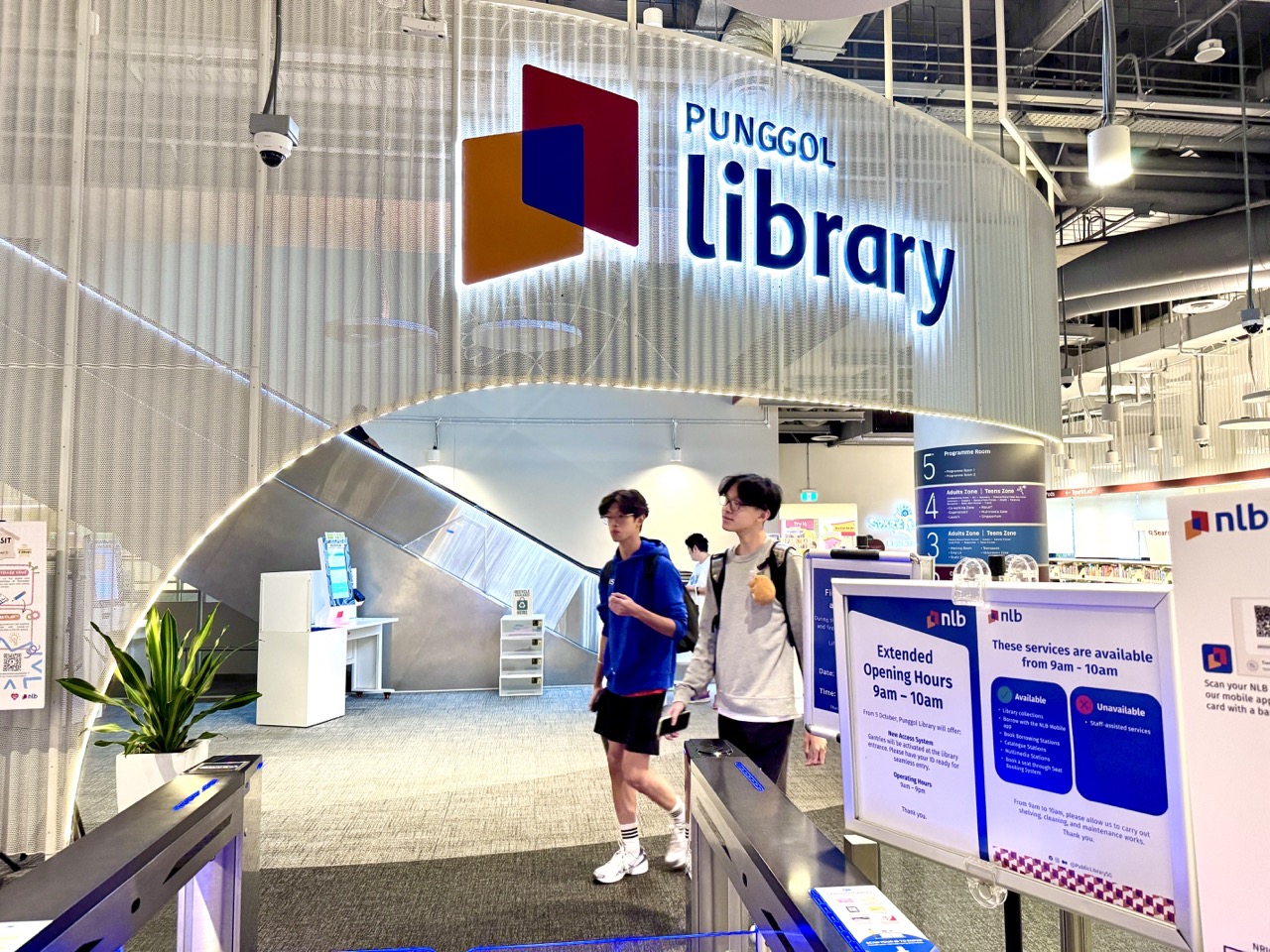
NLB describes Punggol Regional Library as a five-storey library at One Punggol, with spaces and resources for children, teens, adults, seniors and persons with disabilities. Its facilities include accessible collections and other learning environments. Residents need not travel across Singapore to begin practising responsible library borrowing.
Choose a reading plan appropriate for the household rather than borrowing the maximum allowed items at every visit. A Primary 2 reader may enjoy several short books, while a Secondary 3 student may need one longer source for an assignment. The loan quota is a limit, not a target that proves enthusiasm.
A family should check current opening hours, return points, programmes and accessibility instructions before a planned trip. A venue may close a particular facility for maintenance without every public-library service being unavailable.
There are also library collection points beyond the main library
NLB’s public page describes Grab-n-Go library initiatives and a library collection node at Punggol Coast Mall, with its own borrowing arrangements and operating conditions. This can be convenient for residents travelling around Punggol Coast, but its details should be checked against the current service rather than assumed identical to every floor of Punggol Regional Library.
Do not attempt to return an item through a kiosk that is not designed or authorised to receive it. Read the onsite instructions or ask the operator. A location offering book borrowing or reservation pickup does not necessarily have every return or payment facility.
Plan the route according to the child’s age, transport needs and actual due date. The most convenient service is the one that legitimately accepts the required action and provides a verifiable account record.
NLB and school libraries are different systems
A pupil may borrow a picture book from the school library and another book from NLB. The labels may look similar, but the loan accounts, due dates and loss rules belong to different institutions. Parents should not apply NLB’s public-library fine rates automatically to a school library or vice versa.
Check the ownership marks and the original loan record before returning a book. A school-owned copy may not be processed correctly by an NLB bookdrop, and a public-library book should not simply be left on a teacher’s desk without the right arrangement.
Maintain separate folders or labelled return bags where helpful. The objective is to prevent confusion while keeping reading enjoyable, not to introduce a bureaucratic process around every page of a child’s book.
A household with several borrowers needs clear ownership
A family may share a shelf holding books borrowed by a parent, two children and a grandparent. The books look like a common collection, but each is attached to a specific account. If one goes missing, that account holder needs to know how to resolve the matter.
An unobtrusive system can use separate return bags or a simple card listing which member borrowed each book and the due dates. Do not write sensitive identification numbers on the outside of the bags. Use first names or an agreed household code that is meaningful only to the family.
An adult can help a child learn responsibility without making the child handle payments or personal account credentials. The member should know which books need returning; an authorised adult can manage complex account issues when appropriate.
Small children may damage books through ordinary use
A toddler may tear a page, spill water on a cover or colour inside a borrowed book without understanding that the material belongs to a public collection. Parents can supervise book handling according to age, offer a suitable reading surface and keep food and liquids away from books that are not meant to get wet.
If damage occurs, do not attempt an aggressive home repair with tape, heat or glue that could make the book worse. Contact NLB or follow its official damage-reporting instructions. The library decides what repair or replacement arrangements apply to its collection.
Teach the child an honest simple message: tell an adult, keep all pieces together and seek the right help. This turns an incident into a lesson about shared resources rather than creating fear of borrowing another book.
Heavy school bags and lost books: a practical routine
A child may carry a library book in a school bag all week, where water bottles, sports clothes and worksheets compete for space. A separate protective sleeve can help keep the book clean, provided it does not obscure important identification or become a lost item itself.
On a chosen day, empty the bag together and identify materials belonging to school, NLB, tuition or the family. Do not rely on a parent rummaging through it only after a fine appears. A consistent quick review can uncover books that were believed returned or forgotten in a side pocket.
Keep the routine proportionate. A family can build accountability while respecting the child’s growing independence and privacy. The goal is a reliably returned book and a positive reading habit, not a household inspection that turns every loan into conflict.
A late return should be handled promptly, not hidden
If the due date has passed, check whether renewal remains possible under the specific item rules. NLB says ordinary book renewals are not available once an item is overdue. A family should arrange return as soon as reasonably possible and settle the actual account charge through the genuine service.
Do not keep the book for weeks because the child is embarrassed about a small fine. The amount may continue to accrue and borrowing privileges can remain restricted. Explaining that mistakes can be corrected often helps the child tell the truth early.
Where the account displays an unexpected amount, ask for an itemised explanation using the item’s identifier and dates. Avoid posting a child’s library account screenshots publicly; the appropriate library service can help reconcile the issue.
When payment is needed, use NLB’s genuine channels
NLB describes online payment through a myLibrary account and NLB Mobile, including debit or credit card and PayNow QR options. It also describes payment at appropriate self-service borrowing stations. A real outstanding charge should be checked and paid using the official system, not a link in an unsolicited debt-collection message.
The member should confirm the account, amount and purpose before paying. If a payment appears successful but the borrowing restriction remains, retain the receipt and ask NLB to investigate. Do not automatically pay the same item several times merely to restore access faster.
Keep financial information private. A library employee or technical helper should not need a household bank password or Singpass OTP to explain which book is overdue.
A fictional case: a returned book still shows on the app
A Punggol family returns several books in the morning. That evening, one title still appears borrowed. Rather than accusing a staff member or declaring the entire return system broken, the parent notes the date and return location and checks the item identifier against the original account.
They contact NLB through the official route and explain what was observed. The library can review the record and advise on further steps. The family does not invent a return receipt or ask a child to enter restricted staff areas.
This fictional scenario illustrates how a factual timeline and the exact item are more useful than a broad claim that a book has vanished.
A fictional case: the child loses a book before an exam
A Primary 6 student cannot find a borrowed reference book two days before a school assessment. The parent checks likely locations and the NLB account without allowing the search to consume the student’s whole revision period. They arrange appropriate alternate learning resources and contact the library if the item remains missing.
The family learns that the current lost-item rules involve the item’s cost and a separate administrative charge, and that purchasing another paperback is not automatically accepted as replacement. They make the necessary official arrangements without blaming the child’s intelligence or effort.
The case is hypothetical. It shows the difference between protecting the child’s immediate learning and settling an administrative responsibility.
A fictional case: an uncollected reservation costs money
A reader reserves a physical novel but leaves town shortly before the collection notification arrives. The item becomes allocated, and the family misses the stated three-day collection window. NLB’s reservation rules explain that a fee may apply even when the item is not collected.
Next time, the reader places reservations only when they can realistically collect them, or checks whether a free digital reservation would meet the need. A missing collection does not mean a librarian has secretly sold or withheld the book.
This fictional example illustrates why a reservation is a distinct library service with its own timing and charges.
A fictional case: family account confusion
A grandparent borrows several large-print books while a child borrows picture books. Both sets are returned in the same bag, but a relative accidentally places one book on a private shelf rather than into the library return pile. The grandparent’s account later shows it overdue.
The family identifies the borrower from the library app, finds the item and returns it promptly. They adopt separate return bags labelled with first names, without storing personal identification numbers on the outside.
Nobody is shamed for the mistake. The new system supports both independent reading and a straightforward account process.
A simple 2027 reading-and-return plan
Before the first 2027 school term, review each family member’s library account, loan quota and current charges. Save the genuine NLB Mobile app instructions and identify a practical return point used regularly. The family need not borrow the maximum number of books to benefit from Punggol Regional Library.
Choose a weekly home review of due dates and place all borrowed items in a known location when they are ready for return. If renewal is needed, complete it while the item is eligible and verify the new due date. Check that the account reflects each successful return.
Teach older children to ask about fees or missing books early. A routine built around accurate information prevents avoidable charges and leaves more family attention for reading itself rather than administration.
Recheck current NLB rules before 2028 decisions
NLB’s lending quotas, reservation charges, daily fines and digital platforms may change. Before relying on exact amounts in 2028, use the live official fines and loan-privileges pages. A dated article is a planning aid, not a contract guaranteeing a particular future price or app design.
Review the household’s actual needs as children grow and older relatives become interested in different resources. Some will prefer digital reading or audiobooks; others may need an accessible physical collection. The right borrowing plan should remain flexible and respectful of each reader.
The lasting principle is simple: know the account, confirm the due date, return or renew correctly and resolve a real charge with NLB’s genuine process. That protects the shared collection while keeping the library a welcoming place to learn.
Frequently asked questions
How long can I normally borrow a physical NLB book?
NLB currently lists twenty-one days, with an eligible further twenty-one-day renewal.
What is the overdue fine for a book?
The current official NLB schedule lists S$0.15 per day per overdue book.
What is the rate for an overdue audio-visual item?
The official schedule lists S$0.50 per day per overdue audio-visual item.
What happens if I lose a library item?
NLB lists the item’s cost plus a S$7.28 GST-inclusive administrative charge and relevant additional charges for certain AV materials.
Can I buy an identical replacement book instead?
NLB says replacements for lost or damaged items are not accepted.
Will I get a refund if I find the lost book after paying?
NLB says no refund is made once the lost-item payment has been made.
How long is the physical reservation pickup window?
NLB currently says three days after notification when an item is allocated.
Are physical reservations free?
Certain physical reservations have a S$1.58 GST-inclusive charge; e-resource reservations and eligible Accessible Membership can differ.
Can I renew an overdue book?
The listed ordinary renewal is available only if the book is not overdue or reserved.
Does this article predict library fee increases in 2027?
No. The rates are dated 2026 references and should be rechecked.
Official NLB sources
These NLB resources support the quoted charges, loan conditions and payment processes. The exact amount for a particular account or future year should be confirmed directly through the current official service.
- NLB: Types of Fines and Charges (Overdue, Lost, Damage, Reservations)
- NLB: What You Can Borrow and Reserve
- NLB: Payment Methods and Restoration of Borrowing Privileges
- NLB: Loans and Reservations Overview
- NLB: Punggol Regional Library Information
- NLB: Mobile Library App and Account Access
Related Punggol reading
One practical family action
Open the library account that actually borrowed the book, confirm each due date and assign a realistic return day. Keep separate return bags for different account holders so that learning continues without avoidable fines or lost books.


