
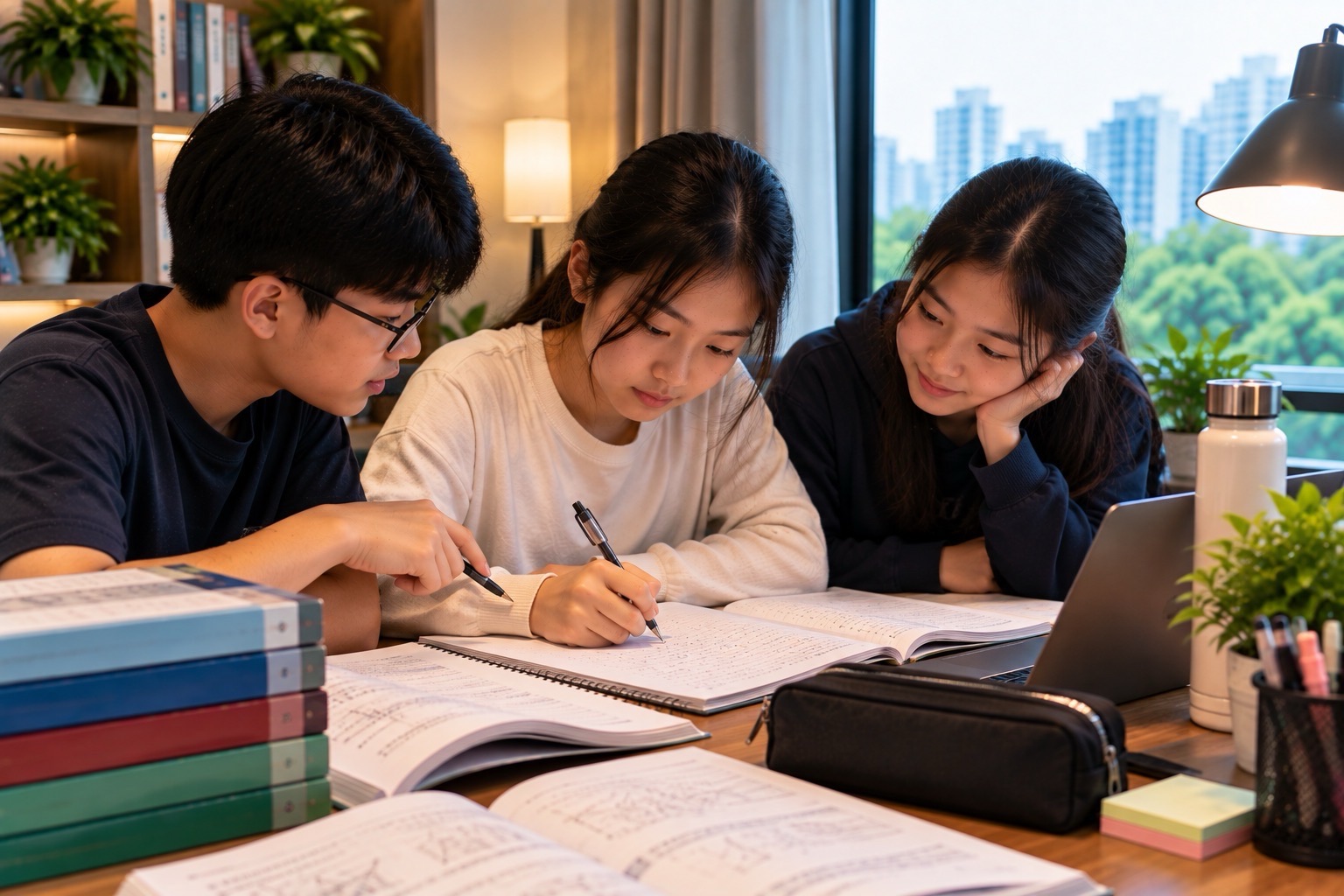
Bartley Secondary School at 10 Jalan Bunga Rampai, Singapore 538403, is a government co-educational school near Bartley MRT that Punggol families may consider through Posting Group 2 (PG2). The school’s completed 2026 Secondary 1 intake recorded a historical PG2 PSLE Score range of 22–25, with 25 the last admitted score. That figure describes the previous exercise; it is not a guarantee of admission or a known 2027 cut-off. Check the child’s actual permitted Posting Group and the latest MOE SchoolFinder data before ranking Bartley, and consider whether the journey across Singapore is manageable on regular school and CCA days.
Bartley’s 2026 signature Applied Learning Programme is unusual: Chemical and Applied Sciences (Fragrance). Secondary 1 pupils explore fragrances and the scientific principles behind extracting essential oils, alongside computer-aided design, 3D printing and micro:bit coding. In Secondary 2, the programme extends to perfume formulation, design thinking and testing prototypes. Its Learning for Life Programme develops Community Youth Leadership through an Acquire–Act–Advocate approach and school kindness projects. Bartley has announced an open house for Saturday 28 November 2026, 8.00 am–1.00 pm. These experiences can help a PG2 pupil discover strengths without converting the original admission group into a permanent subject level or promising a place in selected enrichment.
- School: Bartley Secondary School, 10 Jalan Bunga Rampai, Singapore 538403.
- Historical 2026 PG2 range: 22–25, last admitted 25; not a fixed future threshold.
- Transport: Bartley MRT on Circle Line CC12 and bus connections listed on the school’s current contact page.
- 2026 open house: Saturday 28 November, 8.00 am–1.00 pm, as advertised on the official homepage.
- ALP: Chemical and Applied Sciences (Fragrance), connecting chemistry, design, investigation and technology.
- Secondary 1 ALP: Fundamentals of fragrances, safe school-supervised separation experiences, CAD/3D design and micro:bit.
- Secondary 2 ALP: Perfume formulation, a design-thinking process and prototype evaluation.
- Selected upper-secondary opportunities: STEM enrichment, competitions, attachments, learning journeys and a relevant Advanced Elective Module.
- CurioSTÉ Club: A STEM-related CCA with deeper activities; particularly relevant to the school’s fragrance DSA talent route.
- LLP: Community Youth Leadership, described through an Acquire–Act–Advocate framework and 70 Acts of Kindness.
- Full SBB: PG2 identifies the entry route; the pupil’s formal G2/G3 subject offers and readiness are separate.
- Parent next step: Compare programme content, safety, CCA, current subject levels and real travel before choosing.
Definition lock: PG2 does not mean a permanent stream
Posting Group 2 is used for Secondary 1 admission under Full Subject-Based Banding. It is not a complete description of a child’s talents. G2 refers to the level of one subject, while a pupil may study another eligible subject at a different General level under the school’s formal offer. The distinction prevents parents from using an original PSLE aggregate as a lifelong judgement.
Bartley’s fragrance programme illustrates the point. A child who initially finds algebra difficult might be keen to investigate scents and the extraction of compounds from plants. Another may enjoy calculations but need support interpreting chemical observations or writing a clear report. Each has different strengths and needs. Neither should be reduced to “PG2 ability” as if a student were equally strong or weak in all learning.
At the same time, an interest in Chemistry is not automatic entry to a G3 Science class or a specialised post-secondary course. Academic subjects, CCA selection, school programmes and later admissions each follow different rules.
This article is the Bartley-specific PG2 profile, focused on its actual fragrance ALP, leadership and practical family questions. National posting and post-secondary formulae are explained in separate guides.
What the completed 2026 PSLE range can and cannot say
The historical 2026 PG2 range for Bartley was 22–25. Lower PSLE totals represent stronger aggregate performance; 25 was the last admitted result for that completed exercise. A family whose child obtains score 25 might consider the school worth investigating, but cannot treat a previous score as a reserved seat.
The next exercise may have different applicants, choices and vacancies. Where pupils share a score at the boundary, MOE’s tie-break rules still apply. The observed cut-off is an outcome determined after posting, not a permanent number announced by the school in advance.
A second caution concerns the right Posting Group. Bartley’s historical PG3 and PG1 figures are not interchangeable with PG2. A pupil with a permitted choice between PG2 and another group needs to understand the academic implications before selecting one. Do not shop among unrelated numbers to produce an attractive prediction.
Parents should record school, year, group, source and the child’s genuine preference. A school comparison without those distinctions can become misleading even when each individual number is copied correctly.
The Punggol-to-Bartley commute

Bartley Secondary sits at Jalan Bunga Rampai, with Bartley MRT on the Circle Line identified as a transport reference. The school’s official contact page also lists buses and nearby stops. A Punggol pupil may reach the area through a combination of rail, bus and walking, but the actual route depends on where the household lives and the time of travel.
Test the morning journey before ranking the school. Include the walk to transport, waiting, transfers and reaching the school gate. Try a return trip after CCA, when the child may be tired and carrying additional equipment. A straight-line map does not measure the actual effort of daily travel.
A distinctive fragrance programme may be a meaningful reason to consider a campus farther from Punggol. But the family should decide whether the education and environment are worth the time cost. Rest, homework, meals and relationships depend on the ordinary week, not just an exciting open-house visit.
The teenager should know a safe backup route, a reasonable arrival buffer and how to contact an adult if transport is disrupted.
Why fragrance science is a serious applied-learning theme
Fragrance is not merely a product that smells pleasant. It raises scientific questions about chemical compounds, mixtures, physical properties, extraction, concentration, perception and the design of products for real users. Bartley uses this subject to connect STEM with familiar everyday experiences.
A parent may ask why a school chooses scent rather than robots. The learning objective is not the gadget; it is helping pupils investigate, make accurate observations, apply scientific concepts and think through a practical design. Fragrance can motivate curiosity because pupils have encountered different scents in food, flowers and household products, although individual sensory experiences vary.
The activity must be understood as supervised school science, not a suggestion for children to experiment unsafely with concentrated oils, volatile chemicals or heating equipment at home. Fragrance materials can create sensitivities and safety considerations, so the school’s instructions govern actual participation.
A useful project teaches the student to explain what was observed, what mechanism is plausible and which evidence supports the conclusion. An impressive bottle label is not enough.
Secondary 1: introducing fragrance concepts
Bartley’s May 2026 ALP page says Secondary 1 pupils learn the fundamentals of fragrances and conduct school-supervised separation experiences to obtain essential oils from flowers, spices or fruits. These are practical contexts for understanding mixtures, physical processes and scientific observation. The activities occur within the school’s teaching and safety arrangements.
A student should learn to distinguish the plant material, the substance of interest and the scientific process used to separate components. The child should not assume that every substance with a pleasant smell is safe to apply to skin or inhale in concentrated form. Appropriate precautions and supervision are integral to the educational task.
The strongest reflection identifies a scientific relationship rather than simply saying a sample smelled good. What was changed? What was observed? Could another condition affect the outcome? Why might two materials yield different experiences?
These questions support the transition to secondary Science, where clear reasoning and accurate terminology matter more than memorising a glamorous product name.
Scientific observation versus a personal scent preference
Fragrance introduces a particularly useful distinction between objective observation and subjective response. Different pupils may describe the same scent differently because preference, familiarity and individual perception vary. An opinion about which fragrance is nicest is not necessarily a scientific result about a measurable property.
A good school investigation might keep separate records of the procedure, observable physical result and individual feedback. The student should not turn a few classmates’ preferences into a universal claim about what all consumers will enjoy. If surveys are used, sample size and context matter.
This is valuable reasoning beyond the laboratory. A child learns that evidence must match the claim. A personal response can be honestly reported without pretending it establishes a universal scientific fact.
Parents can encourage their teenager to explain which parts of the task could be measured and which depend on the person providing feedback. Accuracy begins with knowing the difference.
Separation techniques and laboratory safety
The school’s programme mentions separation techniques for extracting essential oils, but a family article should not substitute for an actual laboratory manual. Equipment, temperature control, chemical handling and supervision are determined by qualified school staff. Fragrance extraction can involve safety risks, so pupils should not improvise procedures from a short online summary.
The educational principle can be described without unsafe detail: a mixture contains components that may have different physical properties, and a suitable technique can exploit those differences. Students learn to choose and explain a method appropriate to the substance and goal.
A pupil should also learn to document what happened accurately and report unexpected results. A missed step or an unfamiliar smell should be communicated to the teacher rather than concealed to preserve the appearance of success.
The broader lesson is that good scientific work combines careful reasoning with responsible conduct. Safety is a condition for learning, not a separate administrative nuisance.
CAD and 3D printing: the design side of fragrance
The Secondary 1 ALP also includes computer-aided design and 3D printing. This may appear unrelated to Chemistry until the student considers the design of a container, holder, product display or related prototype. The programme connects scientific concepts with user-centred engineering.
A design should respond to a practical constraint: size, stability, accessibility, material use or clarity of purpose. An attractive digital model may look convincing but fail to fit its intended use. Testing a prototype reveals whether the dimensions and interactions are realistic.
Parents can ask what changed between the first digital model and the final version. Did a part fail to connect? Did the shape create a usability problem? Did the pupil correct a measurement? These details reveal more learning than a photograph of a polished object.
A child need not own a 3D printer. The school decides the tools and safe operation; the educational objective is developing judgement through design.
Micro:bit and computational thinking
Bartley’s ALP uses micro:bit coding as another route into STEM. A pupil may learn to construct instructions and observe how an output changes in response to an input. The central skill is to predict, test and explain—not merely copy a working program.
A useful beginner task might involve a simple condition. If a reading exceeds a given value, the program displays an alert; otherwise it does something different. The student should know what is being compared and why the threshold was chosen. If the system behaves unexpectedly, the learner can isolate a likely error.
This develops logical reasoning that can also support Mathematics. A child who checks each step in code may become more aware of the need to verify algebraic working.
The family should not equate successful completion of a Code for Fun task with formal eligibility for advanced Computing or a technology diploma. Those have separate subject and admission requirements.
Secondary 2: moving towards perfume formulation
In Secondary 2, Bartley’s current ALP description includes applying concepts to perfume formulation, deeper CAD design and micro:bit work, and a design-thinking process called EDIPT: Empathy, Define, Ideate, Prototype and Test. The progression moves from discovering techniques to designing for a theme and a user.
A pupil who creates a fragrance concept may need to consider audience preferences, usability, presentation and scientific constraints. The aim is not for teenagers to produce unregulated commercial cosmetics. The learning environment is school-supervised and does not guarantee that a product will be sold or safe for arbitrary public use.
The student’s reasoning matters. Who would use the product? Why was a particular idea chosen? What evidence was gathered during testing? Which aspect would need revision? A clear explanation of limitations is part of a strong project.
This connects Chemistry with empathy and design. The learner learns that technical capability becomes more valuable when used to solve an appropriate human problem.
What EDIPT teaches about iteration
The EDIPT process begins with empathy, asks pupils to define a need, create ideas, represent a solution and test it. The order matters because students can become attached to a design before understanding the user or the real constraint.
Suppose a team proposes a product for a hypothetical group of users. The pupils may discover that the original scent intensity, container shape or packaging is unsuitable. Rather than defending their first design as a matter of pride, they can use feedback and revise it. This is evidence-based learning.
Parents can ask their child what the first idea got wrong. A pupil who identifies a clear weakness and changes the design has gained an important skill even if the final product looks less impressive.
This habit transfers to academic work. The ability to recognise an incorrect step and make a justified correction is more valuable than pretending that a first attempt was perfect.
CurioSTÉ Club: a deeper STEM option
Bartley’s CurioSTÉ Club is a CCA focused on Science, Technology and Engineering. The school describes learning journeys, competitions, leadership and VIA activities that extend the broad fragrance ALP. The club name comes from the French word for curiosity, and the educational purpose is to develop that habit through sustained practical work.
A pupil genuinely interested in experimenting and engineering may wish to investigate the club, but CCA selection and current membership rules must be checked. The existence of a school-wide ALP does not automatically give every child a CurioSTÉ place.
Students may learn to cooperate with peers, document investigations and persist when projects fail. The parent should ask about the actual schedule and academic workload, especially if the child travels from Punggol.
A club should be evaluated by what the learner will practise, not simply which photographs or certificates appear on a public achievements page.
The DSA fragrance pathway and its commitment
Bartley publishes a Direct School Admission talent area in Chemical and Applied Sciences (Fragrance). Its official 2026 DSA page describes interest in Science or Mathematics, diligence and relevant activities as factors for consideration, while noting that previous experience is not automatically required or a guarantee.
An important condition is that pupils accepted into Bartley through this ALP DSA pathway are required to join CurioSTÉ Club. This is a real commitment to consider before ranking a DSA offer. The pupil should understand the weekly training and long-term interest, not simply seek a school place by presenting an attractive portfolio.
A Confirmed Offer remains conditional on the pupil qualifying for a Posting Group offered by the school. DSA does not erase PSLE compatibility rules, and a successful student is expected to honour the talent programme.
Families preparing for 2027 should obtain the new exercise dates rather than copy the school’s completed 2026 application and interview windows.
Selected upper-secondary STEM enrichment
Bartley’s ALP page describes optional or selected opportunities for pupils with stronger interest and ability from Secondary 3 onwards. Examples include STEM competitions, industrial or educational visits, study attachments and an Advanced Elective Module at Singapore Polytechnic related to Perfumery and Cosmetic Science.
These details should not be marketed as guaranteed placements for every PG2 child. Eligibility, priority and capacity are determined by the school and its partners, with CurioSTÉ Club members receiving priority for some experiences.
A teenager interested in the pathway should understand that advanced applied science may require careful laboratory work, written documentation, quantitative reasoning and awareness of safety or regulation. The experience is not solely about creating pleasant scents.
Parents can ask which school-wide foundations are available before selection and what criteria matter for the later extension. An informed pupil can work towards genuine learning without assuming the opportunity is already promised.
Bartley Scholars Programme: a separate opportunity
The school’s 2026 Special Programmes index also names a Bartley Scholars Programme, involving development in leadership, STEM and the arts. This is separate from the ordinary PG2 admission route and the broad-based fragrance ALP. A school may provide several enrichment tracks, but they should not be blended into one supposed package awarded automatically to every newcomer.
Parents should read the current selection and programme information rather than infer it from the word *scholar*. A pupil may have a legitimate interest in deepening learning without meeting the criteria for one selective programme. The absence of a particular award does not prevent other forms of development.
A stronger educational question is what the teenager wants to learn and which formal opportunities are realistically accessible. Projects, CCAs, classroom challenge and independent reading can all support intellectual growth.
No school should be chosen solely because adults assume a named enrichment programme guarantees later prestigious admission.
Community Youth Leadership at Bartley
Bartley’s Learning for Life Programme focuses on Community Youth Leadership. Its 2026 page presents an A3 progression—Acquire, Act and Advocate—and refers to 70 Acts of Kindness. The school aims to develop pupils who recognise needs and take responsibility for the people around them.
The stages suggest moving from understanding an issue to taking meaningful action and then communicating responsibly about it. A teenager may learn that a service idea needs evidence and partner feedback before implementation. The best project is not necessarily the largest event; it is the one that actually helps.
A family should distinguish school-wide character education from selected student-leader positions and any external projects. The formal timetable, recognition and roles belong to the school.
The LLP complements the fragrance ALP by encouraging technical learning with social responsibility. A pupil can use scientific curiosity to investigate and compassionate judgement to decide how an idea might be useful.
What 70 Acts of Kindness should mean
A school kindness initiative can create positive attention, but its educational value depends on actions that are appropriate and meaningful. A kind act should respond to another person’s actual needs rather than become an opportunity for public display or competition.
A pupil might help a new classmate find the correct lesson, organise a shared resource responsibly or support an approved service event. Not every act needs a photograph, and a student should never reveal another person’s private difficulty merely to demonstrate kindness.
Ask the child what was learned from the person involved and whether the action was helpful. If an idea turned out to be unsuitable, the pupil can revise it. That reflection teaches empathy and judgement.
An LLP should be recognised for developing sustained habits, not merely producing a numerical tally. Formal VIA or LEAPS records remain subject to school and MOE criteria.
Bartley’s values: Courage, Optimism, Respect and Excellence
Bartley describes its school culture through Courage, Optimism, Respect and Excellence, spelling out the acronym CORE. Courage can mean asking for help or attempting a difficult problem. Optimism should involve realistic action rather than denying a genuine concern. Respect includes treating classmates with different strengths fairly. Excellence means making work accurate and meaningful, not measuring worth by one competition prize.
A parent should ask how these values appear in ordinary instruction and relationships. When a child makes a laboratory mistake, is feedback clear? If a pupil feels excluded, whom can they approach? Does an academic support programme diagnose the real difficulty?
The values should also be applied to public communication. A student who reports an experiment honestly even when the result is unexpected is practising integrity through careful work.
The school environment may appeal to families who value these behaviours, but the child’s own experience remains important evidence of fit.
Full SBB at Bartley
Bartley’s current school information includes a Full Subject-Based Banding page and school-specific procedures for pupils offered subjects at a more demanding level. A PG2 pupil may be offered an eligible subject at G3, while other subjects remain at G2 or their appropriate level. The actual offer and timetable must be read before materials are purchased.
The school’s 2026 Secondary 1 registration instructions used Parents Gateway to communicate subject-level and Higher Mother Tongue acceptance forms. Those dates and procedures were for that completed cohort; parents entering in 2027 should wait for the new official notices.
Mixed form classes and levelled lessons can require a child to manage several classrooms and teachers. A clear timetable and reliable assignment record help develop independence.
A strong performance in an ALP project does not by itself change the pupil’s examined subject level. Progression follows current academic rules and readiness evidence.
Science reasoning: a pleasant smell is not a conclusion
Fragrance provides useful material for G2 Science because it requires pupils to separate observations, explanations and preferences. “This sample smelled stronger to me” is one kind of response; a claim about a measurable property requires appropriate methods and evidence. The child should know which statement a particular task is asking them to make.
If two conditions change in an investigation, the student cannot confidently attribute a result to only one without further testing. Careful variable control and suitable records matter. When results differ from expectations, record the discrepancy rather than discard it.
A parent can ask what the pupil would need to test to strengthen a conclusion. That question develops reasoning more effectively than demanding a perfectly positive result from every experiment.
The aim is evidence-led learning, not a polished advertisement for a prototype.
Mathematics: accuracy in measurement and comparison
An applied-science investigation may use quantities, units, ratios and graphs. A pupil who records a value in the wrong unit can draw a misleading conclusion even when the calculation appears neat. Mathematical accuracy therefore matters outside its own examination paper.
For a hypothetical design comparison, ask what is being measured and why the two quantities are comparable. If a sample is twice as large, is a higher total result meaningful without considering size? The child should think about ratios and an appropriate baseline rather than simply rank the largest raw number first.
Formal G2 Mathematics also introduces algebra and reasoning that need explicit instruction. A pupil who enjoys practical experiments may still need help with negative numbers, equations or symbolic structure. A project cannot substitute for that foundation.
Good teaching identifies whether the error arose in understanding, calculation, interpretation or presentation and chooses the next practice accordingly.
English: writing a scientific report people can understand
A fragrance project needs clear documentation. A pupil might have performed a sensible investigation but write an unclear conclusion. The family can support the skill by asking for a short explanation with a question, method, observation, interpretation and limitation. Each part answers a different reader need.
The same principles apply to G2 English comprehension. A claim needs relevant evidence and a sentence explaining how it supports the answer. Repeating an attractive phrase without addressing the question is not enough.
A product pitch adds audience awareness. The pupil should distinguish a customer preference from a laboratory finding and avoid unsupported benefits. Being persuasive does not mean overstating facts.
Parents can encourage original writing and careful revision. An AI-generated report that the child cannot explain is weaker evidence of learning than a shorter accurate response written independently.
Safety, sensitivity and the child’s individual needs
Because fragrance projects involve scents and materials, some pupils may have sensory sensitivities or other relevant needs. A responsible family should communicate genuine concerns to the school through appropriate private channels, without assuming that every pupil reacts in the same way.
The school determines safe procedures, supervision and appropriate adjustments. Parents should not conduct unsupervised chemical extraction or mix concentrated materials at home on the basis of a general educational article. Safety and learning go together.
The child should know how to report discomfort, unexpected equipment behaviour or an uncertain instruction. A student who asks a safety question is demonstrating judgement, not weakness.
For broader learning needs, the form teacher and school support personnel can explain available processes. PG2 itself is not a diagnosis, and a special accommodation should be considered based on actual circumstances.
The CurioSTÉ and general CCA decision
Bartley also offers clubs such as Entrepreneur Club, MERIT Club for media, and Service Learning Club alongside sports, performing arts and uniformed activities. A pupil who enjoys the fragrance ALP might be drawn to CurioSTÉ, but another child may prefer photography, sport or music. The ordinary ALP is not a requirement to select one CCA unless a specific DSA offer carries such a condition.
Ask about trial procedures, timetable, equipment and travel home. A long journey from Punggol plus late club training can affect sleep and homework. The school may provide useful opportunities, but the family should evaluate the total commitment.
CCA friendships can help children develop identities beyond academic subject levels. Formal LEAPS 2.0 recognition has its own criteria; an appealing club does not guarantee a particular bonus score.
Choose an activity the teenager can meaningfully sustain rather than the one with the most impressive publicity photographs.
The 28 November 2026 open house
Bartley’s official homepage announces an open house for Saturday 28 November 2026, from 8.00 am to 1.00 pm. As of 1 November, this is a forthcoming dated event that may help parents see school learning spaces and speak with staff. It should not be converted into a recurring annual schedule for future years.
Ask which fragrance activities all Secondary 1 pupils experience, what safety guidance applies and how the DSA-CurioSTÉ commitment differs from ordinary ALP participation. Then ask how the school’s LLP works and how pupils with mixed subject levels receive feedback or support.
Let the child ask a question about a project or CCA. A teenager who feels genuinely curious is offering useful evidence about fit. Also use the visit to understand transport and the ordinary school environment, not only one laboratory display.
The event helps inform school preferences; it does not guarantee admission.
The first month at Bartley
If the pupil is posted to Bartley, use the 2027 cohort’s current registration materials rather than historic documents showing older reporting dates. Confirm subject-level textbooks, uniform, communication channels and the actual timetable. Practise the commute and a backup route.
During the first weeks, prioritise routines and relationships. A student may be excited about applied science while uncertain in English or Mathematics. Ask the teenager to identify one subject challenge and explain what help is needed. A precise question is easier for teachers to address than the general statement that the child is not coping.
A pupil should gradually manage assignments independently. Parents can create a predictable check-in without becoming permanent supervisors. Rest and CCA remain part of a sustainable transition.
The goal is a confident start in the actual school community, not immediate selection into every enrichment programme.
Three hypothetical Bartley PG2 learners
The curious experimenter. A pupil is interested in fragrances but has not studied Chemistry beyond primary Science. The family investigates the supervised ALP foundation, asks about safety and encourages accurate recording of observations. The child learns to distinguish scientific evidence from personal scent preference.
The would-be STEM club member. Another student enjoys coding and wants CurioSTÉ. The family checks whether the pupil is an ordinary applicant or DSA entrant, because the latter may have a specific club commitment. Actual club allocation and weekly workload are confirmed rather than promised.
The score-25 family. A Punggol child receives a PG2-eligible PSLE Score of 25 and considers Bartley based on the historical 2026 last admitted result. The parent understands that it is not a guaranteed 2027 offer and includes realistic alternatives after testing the commute.
These profiles are fictional and do not describe actual admission or programme outcomes.
Frequently asked questions about Bartley PG2
Does Bartley Secondary admit PG2 pupils?
Yes, the 2026 completed intake included PG2 pupils with a historical score range of 22–25. Check the current MOE SchoolFinder record.
Is 25 a guaranteed 2027 cut-off?
No. It was the previous last admitted PG2 result, not a future admissions promise.
What is Bartley’s Applied Learning Programme?
Chemical and Applied Sciences (Fragrance), incorporating chemistry, design, coding and prototyping.
Do Secondary 1 students use laboratory separation techniques?
The 2026 official ALP description includes supervised fragrance-related separation experiences. Actual safety and timetable arrangements are controlled by the school.
Is CurioSTÉ Club compulsory for all pupils?
No. It is a distinct STEM CCA, but the school’s fragrance DSA route expressly requires successfully admitted ALP DSA pupils to join it.
What happens in Secondary 2 ALP?
The school describes perfume formulation, CAD and micro:bit development, and an empathy-led design-thinking project.
Does the school’s LLP involve community service?
Yes. Its 2026 programme emphasises Community Youth Leadership and an Acquire–Act–Advocate approach.
What is 70 Acts of Kindness?
It is a school-linked kindness initiative. Participation or one act does not guarantee a formal leadership title or LEAPS outcome.
When is the 2026 open house?
Saturday 28 November 2026, 8.00 am–1.00 pm, according to Bartley’s official homepage.
Does PG2 prevent an eligible subject from being offered at G3?
Not automatically. Formal eligibility, school arrangements and readiness determine individual subject offers.
Does the ALP qualify students for a perfume-industry job?
No. It provides educational experience; later training and professional roles have distinct prerequisites.
Is tuition compulsory when a child enters via PG2?
No. Additional teaching should serve an identified academic need and support genuine independence.
Your Next Step
Read Bartley’s current fragrance ALP, Community Youth Leadership, CurioSTÉ and DSA pages. Verify the historical PG2 score against MOE SchoolFinder, ask what ordinary and selected pupils actually do and test the complete journey from Punggol. Choose the school for a sustainable match between the child’s interests, academic needs and everyday life.
The general Punggol PG2 school choice article covers national posting decisions; this article owns Bartley’s fragrance-science and leadership profile.
Official sources and related references
- Bartley Secondary: Fragrance Applied Learning Programme
- Bartley Secondary: Community Youth Leadership LLP
- Bartley Secondary: CurioSTÉ Club
- Bartley Secondary: Applied Learning DSA admission
- Bartley Secondary: Special Programmes
- Bartley Secondary: Official open-house announcement
- Bartley Secondary: Contact and transport
- Bartley Secondary: 2026 S1 posting and Full SBB subject offers
- MOE SchoolFinder
- Historical 2026 PG2 score range


