
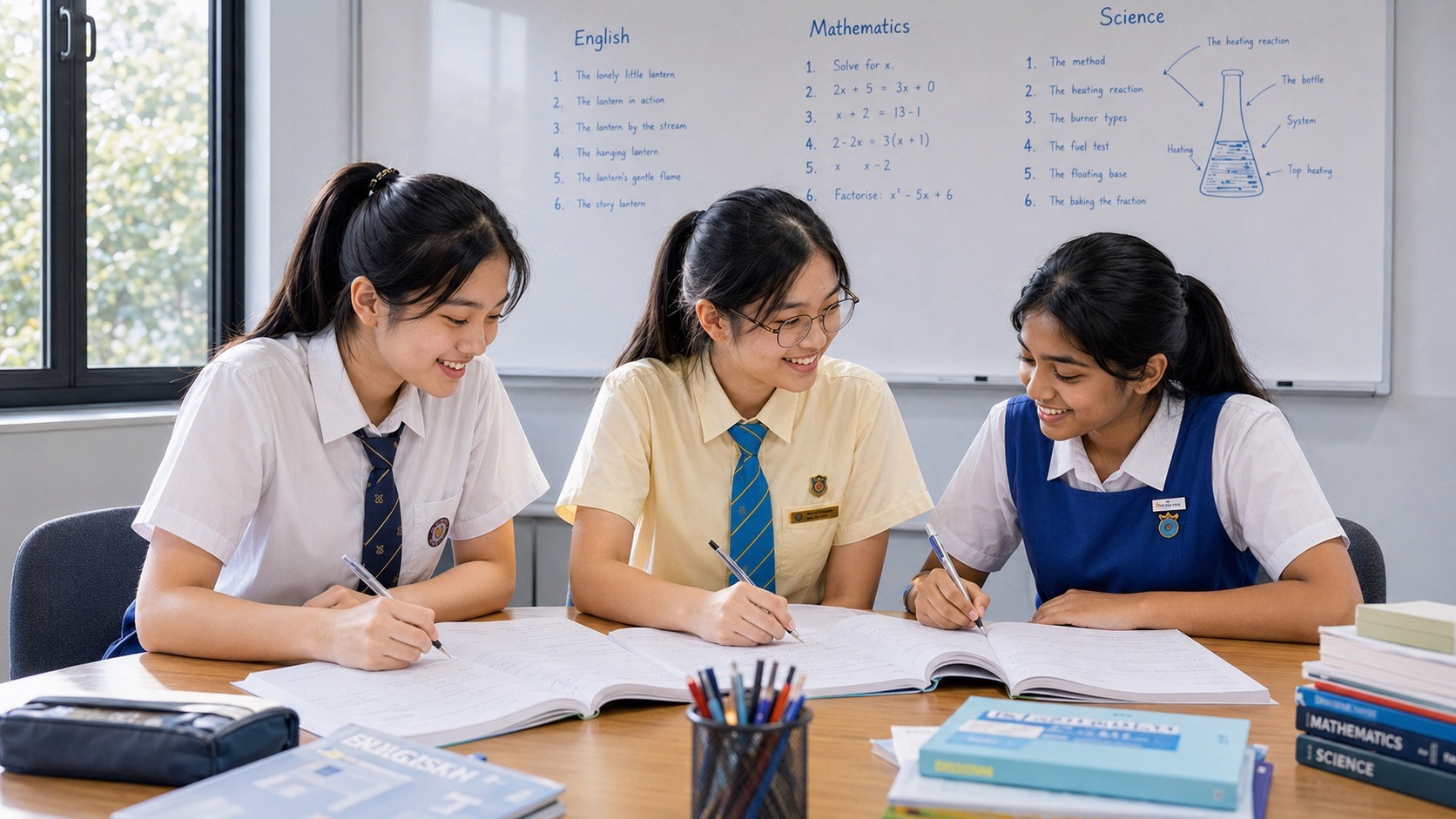
Junyuan Secondary School is at 11 Tampines Street 84, Singapore 528933, and the official historical 2026 Secondary 1 Posting Group 1 (PG1) admitted PSLE Score range was 25–28. The last posted pupil’s Score 28 describes the completed 2026 exercise for students who took PSLE in 2025; it does not guarantee entry for pupils starting Secondary 1 in 2027. A Punggol family should check the child’s actual Posting Group eligibility, use current MOE SchoolFinder information and test the journey to the Tampines Street 84 campus. The school’s own contact page lists Tampines MRT, Tampines West MRT and several buses, including 291, 46, 69 and 118. Junyuan has announced an open house for Saturday, 21 November 2026, from 8:30 am to noon.
Junyuan’s distinctive educational programmes link Food, Innovation, Science and Health—FISH—with Community Youth Leadership. Its July 2026 ALP explains how lower-secondary pupils investigate nutrition, food preparation, rice cultivation, sustainability and cultural food traditions through Food and Consumer Education, Geography, Malay Language and PE. Secondary 1 learning culminates in a mini-MasterChef experience, while Secondary 2 pupils work towards the JY MasterChef Cook-off. The Learning for Life Programme aims to make every pupil a Community Youth Leader, with Secondary 1 class service linked to Food Bank Singapore, Secondary 2 student-planned VIA and opportunities for selected older students. Under Full Subject-Based Banding, PG1 is an admission category and G1, G2 and G3 describe separate subject standards. This guide distinguishes genuine programmes from selected extensions, explains school fit and gives Punggol parents realistic next steps.
- School: Junyuan Secondary School, 11 Tampines Street 84, Singapore 528933
- Official 2026 PG1 historical admitted range: 25–28; last posted Score 28
- 2027 places depend on the actual school posting and are not guaranteed by old cut-offs
- School vision: Champions for the Community
- ALP FISH stands for Food, Innovation, Science and Health
- FISH connects Food and Consumer Education, Geography, Malay Language and PE
- Secondary 1 pupils explore food nutrients, preparation and a mini-MasterChef task
- Secondary 2 programme describes the JY MasterChef Cook-off
- LLP Community Youth Leadership teaches the Five Practices of Exemplary Leadership
- Secondary 1 school-wide Service Learning and Innovation workshops with Food Bank initiatives
- Secondary 2 pupils plan a class Values-in-Action project; selected older pupils may join overseas service
- Leadership training is broad while council, peer-support and CCA roles have separate selection
- GEAR-UP After-School Engagement offers supervised interest, sports and creative activities
- DSA talent areas in 2026: Community Youth Leadership, Basketball, Rugby and Volleyball
- Official open house: 21 November 2026, 8:30 am–12 pm; check the school’s latest notice
- Individual G1/G2/G3 subject levels and 2027 booklists need separate confirmation
Reviewed 1 November 2026. The 2026 historical PG1 range does not determine future admission; programme arrangements, vacancies, subject levels and joining procedures are governed by current official notices.

Contents: Junyuan PG1, FISH and Community Leadership
- 1. Definition Lock: PG1 Entry and G1 Subject Learning
- 2. Junyuan’s Historical 2026 PG1 Score Range
- 3. Score 25 and the Choice Between Posting Groups
- 4. Where Junyuan Is in Tampines
- 5. Champions for the Community
- 6. What FISH Means as an ALP
- 7. Food and Consumer Education as Science in Daily Life
- 8. Understanding Nutrients Without Diet Fads
- 9. Secondary 1 Mini-MasterChef
- 10. Why Food Preparation Requires Mathematics
- 11. Geography and the Journey of Rice
- 12. Food Security and Environmental Responsibility
- 13. Malay Language and the Cultural Meaning of Grains
- 14. Physical Education and Informed Food Choices
- 15. A Secondary 2 Orienteering Challenge
- 16. The JY MasterChef Cook-Off in Secondary 2
- 17. Why FISH Is Interdisciplinary
- 18. The Community Youth Leadership LLP
- 19. The Five Practices of Exemplary Leadership
- 20. Leadership Progression From Secondary 1 Onwards
- 21. Service Learning and Innovation for All Secondary 1 Pupils
- 22. Food Bank Singapore and Food Insecurity
- 23. How to Plan a Responsible Food Donation Drive
- 24. Secondary 2 Class VIA Projects
- 25. Peer Support Leaders and School Belonging
- 26. Student Council and Class Leadership
- 27. Overseas Values-in-Action and Cambodia
- 28. GEAR-UP After-School Engagement
- 29. Digital Learning and the Personal Learning Device
- 30. The Official 21 November 2026 Open House
- 31. DSA-Sec and the Leadership and Sports Areas
- 32. How the 2027 Subject Booklist Should Be Used
- 33. G1 English and Explaining Food Choices
- 34. G1 Mathematics and Food Measurements
- 35. Science, Nutrition and Evidence
- 36. Mother Tongue and Cultural Food Learning
- 37. The Role of CCA in a Balanced Week
- 38. A Fictional Punggol Pupil Learning Through FISH
- 39. A Fictional Class Plans a Food Donation Drive
- 40. Comparing Junyuan With Other Eligible Schools
- 41. Your Next Step: Use the Official School Information
Definition Lock: PG1 Entry and G1 Subject Learning
PG1 is a national Secondary 1 admissions category based on the pupil’s PSLE eligibility. G1 is an academic subject standard under Full Subject-Based Banding, alongside G2 and G3. A child can enter Junyuan through PG1 and later offer different individual subject levels where the official criteria permit. Shared form-class experiences and distinctive school programmes are not restricted to one universal academic profile.
Parents should keep the PSLE eligibility notice, formal school posting result and Junyuan’s individual subject allocation as separate documents. Each determines a different practical action. The child may enjoy cooking or serving others while still needing help reading instructions or applying numerical ratios. School support should address those specific needs without treating the admission group as a permanent verdict on ability.
Junyuan’s Historical 2026 PG1 Score Range
The official Student Portal school-detail page lists Junyuan’s PG1 admitted score range as 25–28 for the 2026 Secondary 1 intake. The figures concern pupils who sat PSLE in 2025. The final posted score of 28 describes what occurred in that completed allocation, based on the places available and the school preferences submitted.
It would be misleading to promise a 2027 school place to every child who scores 28. The next cohort may rank schools differently and face different vacancy numbers. Use the historical range as one comparison point, not a prediction. Families should prepare a realistic list of eligible schools they would genuinely attend and follow MOE’s current tie-break and posting rules.
Score 25 and the Choice Between Posting Groups
A pupil with PSLE Score 25 may be eligible for PG1 or PG2 under the current framework. This decision can affect the ordinary six-school application and the level of academic challenge when the pupil starts Secondary 1. A family should evaluate actual subject strengths, school options and how well the learner responds to the intended curriculum.
Junyuan’s historical PG1 range is not automatically the right reference for a pupil choosing PG2. Review the correct group data and the child’s official results notice. MOE’s submission process has specified rules for applying the chosen Posting Group across ordinary school preferences. Do not improvise a different group for each campus. A sensible decision prioritises learning fit over the social status adults attach to a label.
Where Junyuan Is in Tampines
Junyuan’s official contact page lists 11 Tampines Street 84, Singapore 528933. It identifies Tampines and Tampines West MRT stations, with bus services including 291, 46, 69 and 118. This is a distinct school from Tampines Secondary at Tampines Street 12 and East Spring Secondary at Tampines Street 34. Similar neighbourhood references are not interchangeable school addresses.
A family in Punggol should test the actual morning commute from its own home, including the last walk to Junyuan’s gate. Consider the later return after CCA or school events, which may involve more waiting or transfers. The route must be safe and sustainable for the student. No single travel time can responsibly be asserted for every Punggol block.
Champions for the Community
Junyuan’s vision is Champions for the Community, with a mission to nurture and empower every Junyuan Champ to learn, lead and excel. The aspiration combines academic development with a responsibility to make useful contributions to others. The school uses food, health and community service as practical settings in which pupils can develop these habits.
Parents can ask how the school helps an ordinary Secondary 1 pupil become more independent and how teachers respond when the learner makes a mistake. A champion need not be the winner of a sporting competition. A student who learns to explain a Science result accurately or supports a classmate can demonstrate growth. The motto becomes useful when translated into concrete actions and reliable school routines.
What FISH Means as an ALP
Junyuan’s Applied Learning Programme is organised around the theme Food, Innovation, Science and Health, abbreviated FISH. Its official July 2026 page explains that academic learning should be connected to real situations so that pupils understand its relevance. Food provides a familiar context involving culture, nutrients, preparation, sustainability and choices that affect personal and community wellbeing.
A PG1 pupil may be motivated by cooking or a food-related investigation even while finding written Science difficult. The programme can create a reason to use measurements or read a procedure carefully. The family should ask what the child understands from an activity rather than celebrate only the finished dish. Applied learning works best when experience and academic knowledge reinforce each other.
Food and Consumer Education as Science in Daily Life
The FISH programme connects Food and Consumer Education with understanding nutrients, food science and basic preparation techniques. Pupils learn that making food involves more than following instructions blindly. They need to consider ingredients, suitable methods, hygiene and the reasons for particular choices. A successful practical task can reveal how classroom concepts apply to an everyday need.
Parents may reinforce age-appropriate responsibility in a supervised home kitchen. Ask what the pupil measured and why hygiene mattered. Avoid dangerous equipment use or unsupervised cooking to imitate school procedures. The school’s actual teaching and safety arrangements govern formal practical tasks. The important learning is a child’s growing ability to plan and explain reliable steps.
Understanding Nutrients Without Diet Fads
FISH gives pupils opportunities to investigate nutritional concepts and healthier choices. A teenager should learn that different foods contribute to a balanced diet and that information about nutrients must be interpreted responsibly. The programme should not become a contest to identify the thinnest child or follow extreme online dietary advice.
Parents can discuss regular meals, appropriate variety and how to read suitable food information. Avoid using school projects as a reason to shame another person’s eating habits. If a pupil has a relevant medical condition or dietary restriction, the school and qualified professionals should guide individual needs. General health education supports informed choices rather than supplying personal medical prescriptions.
Secondary 1 Mini-MasterChef
Junyuan’s official ALP page says Secondary 1 Food and Consumer Education culminates in a mini-MasterChef experience. This provides a context for students to apply food preparation, science and teamwork in a practical challenge. The activity can encourage planning, accurate measurement and attention to hygiene while making learning memorable.
A family should ask what the child learned about the process, not only how the dish tasted or whether the team won. A pupil may make an error and then discover how to prevent it next time. The educational outcome is competence and reflection. The exact 2027 task and resources should be confirmed with Junyuan rather than copied from a previous class’s photographs.
Why Food Preparation Requires Mathematics
Recipes and food planning involve quantities, ratios, units and sometimes costs. A pupil studying G1 Mathematics can use those ideas in a situation where the effect of an error is easy to understand. Doubling one ingredient without adjusting the others may change the result. Accurate measurement is therefore part of practical competence.
Parents can ask the student to estimate a quantity and explain how they checked it. If fractions or percentages are difficult, practise the actual foundational concept instead of adding advanced worksheets for status. The ALP may motivate mathematical learning, but formal subject-level changes depend on school and MOE criteria, not whether a dish was judged successful.
Geography and the Journey of Rice
Junyuan’s FISH programme links Geography with rice cultivation and food sustainability. Pupils can investigate where food comes from and how the environment affects production, transport and availability. This helps students recognise that the food served at home depends on land, water, people, markets and conditions beyond a single supermarket.
Ask the child to explain one stage of a food supply chain and a possible challenge along the way. Avoid simplifying every issue to a single cause. Good Geography reasoning considers relationships and evidence. A practical topic such as rice can help pupils understand systems without requiring them to memorise a dramatic claim about global food security.
Food Security and Environmental Responsibility
Singapore depends on complex food systems, and FISH can introduce questions about resilience, efficient resource use and responsible consumption. A sustainable proposal should be examined for feasibility, not merely celebrated because it contains a green slogan. Changes in cultivation or distribution may have trade-offs involving energy, water and cost.
Parents can ask what evidence would support a proposal and whether the pupil considered another practical alternative. A classroom demonstration of food growing does not prove it can replace national supply chains. Such modest and accurate conclusions are part of genuine applied learning. The student learns to connect a local task with wider questions without pretending to solve everything.
Malay Language and the Cultural Meaning of Grains
The official FISH page links Malay Language learning to the cultural significance of grains and rice as staple foods. This is a distinct contribution from Science or Geography: food has cultural and linguistic meanings as well as nutritional properties. Pupils can discover how practices differ among communities while respecting the experiences of people around them.
Parents should encourage thoughtful questions rather than cultural stereotypes. A student may use language to describe a tradition, explain a process or compare foods accurately. The curriculum is not limited to pupils with one particular home language; the school determines the formal teaching arrangements. An interdisciplinary topic provides context for language, not a replacement for its syllabus.
Physical Education and Informed Food Choices
Junyuan’s ALP also connects PE with learning about healthier food options and making informed daily choices. This reflects the relationship between nutrition, activity and general wellbeing. A pupil who studies healthy living should understand that reliable habits are more useful than one dramatic change inspired by a social-media trend.
Parents can discuss how the pupil manages meals on a long school day, particularly before CCA. Avoid restrictive diets or unsafe exercise advice. The programme’s aim is knowledge and responsible decision-making. Where a teenager has specific health needs, the appropriate school and professional channels should be consulted.
A Secondary 2 Orienteering Challenge
The official ALP describes an Orienteering Challenge during the Secondary 2 Level Camp as one place to use knowledge about food choices and physical activity. Orienteering can involve route awareness, decision-making and teamwork, adding a practical context to personal wellbeing and outdoor learning.
A child starting Secondary 1 in 2027 would normally reach Secondary 2 in 2028, so the current description should not be treated as a confirmed personal itinerary. Outdoor activities require appropriate school supervision and safety procedures. Families can support ordinary route awareness through suitable supervised walks without attempting to recreate a school challenge independently.
The JY MasterChef Cook-Off in Secondary 2
Junyuan’s ALP describes the JY MasterChef Cook-off in Secondary 2 as a culmination of learning from different subjects. Pupils apply food preparation, scientific ideas, cultural understanding and teamwork in a coherent practical task. This illustrates why the ALP is more than a set of unrelated kitchen experiences.
Ask what academic idea the child used to make a decision. Did a measurement, ingredient choice or understanding of a cultural tradition affect the plan? The competition element can motivate pupils, but the learning does not disappear for a group that fails to win. The school’s actual event arrangement and criteria may change before the new cohort reaches Secondary 2.
Why FISH Is Interdisciplinary
An interdisciplinary programme becomes meaningful when a pupil connects different subject perspectives to solve a question. Food preparation may involve Mathematics, nutrition, cultural language and the geography of food production. The topics influence one another rather than standing as isolated worksheets. This gives pupils a chance to recognise knowledge outside the formal examination format.
Parents can ask which subject helped the team most and why. A good answer includes a concrete example, such as using a fraction to adjust quantities or a geographical idea to understand supply. The task should reveal genuine understanding. An attractive presentation is not sufficient if the student cannot explain the underlying concepts independently.
The Community Youth Leadership LLP
Junyuan’s Learning for Life Programme focuses on Community Youth Leadership. The school states that every student has the potential to become a leader and uses the vision Champions for the Community. Its framework draws on the Five Practices of Exemplary Leadership, developing pupils through class learning, selected leadership roles and service experiences.
A PG1 pupil can begin by preparing for group work, keeping promises and listening to others. Formal appointments require the school’s processes, but leadership habits are not restricted to prefects. Parents should recognise dependable action rather than pressure a teenager to collect titles. Genuine character development can occur alongside academic learning at an appropriate level.
The Five Practices of Exemplary Leadership
The LLP teaches Model the Way, Inspire a Shared Vision, Challenge the Process, Enable Others to Act and Encourage the Heart. These practices describe useful behaviours rather than slogans for a wall. A student can model an expectation by completing work honestly, help a group agree on a goal or encourage a classmate who has made a mistake.
Parents can ask for one example of a behaviour the child practised. Avoid treating the lesson as an examination requiring memorisation of all five phrases without understanding. Leadership becomes educationally meaningful when pupils make careful decisions and reflect on how their actions affect others.
Leadership Progression From Secondary 1 Onwards
Junyuan’s official LLP page describes cohort leadership training during CCE lessons, including modelling the way at Secondary 1, challenging the process at Secondary 2, and later shared vision and enabling others to act. Selected student leaders have additional training connected with their responsibilities. This progression recognises that a twelve-year-old is still learning how to work with others.
Ask the teenager what small responsibility they can handle now. A pupil may need to learn where assignments appear before taking on a major school event. That does not mean they lack leadership potential. Development should be appropriate to readiness and provide chances to grow through experience and feedback.
Service Learning and Innovation for All Secondary 1 Pupils
Junyuan’s LLP states that all Secondary 1 students take part in a Service Learning and Innovation workshop. The school teaches how to understand community needs and use an innovation protocol before taking action. This is important because service should begin with research and empathy, not simply with a large event proposed by adults.
Parents can ask what the class learned about the problem and whether its plan was realistic. The child should understand the intended beneficiaries and how the action might help. A modest, well-considered contribution is more valuable than an elaborate activity that cannot be sustained. The programme encourages students to move from awareness to responsible participation.

Food Bank Singapore and Food Insecurity
Junyuan’s official LLP gives examples of partnerships with Food Bank Singapore, with Secondary 1 classes raising awareness of food insecurity and organising donation drives. This connects naturally with the FISH ALP, since students can examine food from both a scientific and a social perspective. Knowing the nutrients in a meal is different from understanding why some households struggle to access it.
Parents can discuss the importance of respecting beneficiaries and following the actual donation requirements. Do not assume any food item is appropriate for donation without checking official instructions. A good contribution is useful, safe and made with dignity. The class should reflect on what it learned rather than simply count donated bags.
How to Plan a Responsible Food Donation Drive
A donation drive requires more than encouraging everyone to bring something. Students need to understand the organisation’s current needs, the quality and safety of accepted items, collection logistics and appropriate communication. A project that produces a large amount of unsuitable food can create extra work rather than meaningful help.
Ask the child what information the class gathered before collecting donations and how it would recognise a successful outcome. This can teach planning, quantities and civic responsibility. A responsible pupil should also avoid photographing recipients in ways that violate privacy. Genuine service is grounded in what beneficiaries need, not in publicity.
Secondary 2 Class VIA Projects
Junyuan’s LLP describes Secondary 2 students planning and implementing class Values-in-Action projects. By then, pupils are expected to take greater responsibility for choosing a suitable cause, organising tasks and reflecting on the results. The school can guide how students work with community partners and manage appropriate safety.
A student entering Secondary 1 in 2027 normally reaches this stage in 2028. The programme direction is useful to understand now, but specific partners and dates remain subject to school planning. Parents can encourage the child to ask whose voice influenced the choice and what the group learned. Those habits are valuable in everyday problem-solving.
Peer Support Leaders and School Belonging
Junyuan’s leadership framework includes Peer Support Leaders who develop empathetic listening and help promote positive relationships. School is a large social transition after Primary 6, and a student who knows whom to approach is better placed to ask for help when confused or excluded. Peer support can build a welcoming environment but does not replace professional counselling.
Parents can ask if the child has a trusted teacher and how they would raise a concern. If a serious safeguarding issue occurs, pupils should report it through suitable school channels. It is not the responsibility of a teenager to manage a crisis alone. A caring school community combines everyday kindness with appropriate adult support.
Student Council and Class Leadership
Junyuan’s LLP lists class leaders, Student Council, CCA leaders and other appointed roles. These can involve planning activities, facilitating discussion and representing student needs. Such responsibilities require reliability and training. The school distinguishes broad leadership learning from selected formal appointments.
A PG1 pupil can develop meaningful leadership habits without a title. Ask what they contributed to a class task and how others benefited. A young person who is quiet but dependable should not be dismissed because they do not yet want to speak at assembly. Formal roles may be valuable later when the pupil wishes to undertake their responsibilities.
Overseas Values-in-Action and Cambodia
Junyuan’s official LLP describes an opportunity for Secondary 3 volunteers to take part in overseas Values-in-Action activities in Cambodia. The school presents the programme as a chance for students to broaden their perspectives and contribute to community partners. Such trips require current arrangements, school approval and suitable planning.
Families should not assume every student will travel or that the destination will remain fixed years later. Overseas service needs ethical reflection and respect for the people involved. A teenager can learn community responsibility through local service as well. The value of the experience lies in meaningful engagement, not collecting a passport stamp for a portfolio.
GEAR-UP After-School Engagement
Junyuan’s programme listing includes GEAR-UP, an After-School Engagement initiative with sports, creative workshops and activities intended to build resilience, relationships and belonging. This can be relevant for a pupil who needs structured opportunities after lessons or wants to explore interests in a supportive setting. The school defines actual availability and participation arrangements.
Parents should ask which activities are appropriate and whether the child can manage the schedule alongside homework and travel to Punggol. Participation should support wellbeing rather than overload the week. An after-school programme is not automatically compulsory or a substitute for targeted academic help. The best choice depends on the pupil’s real needs.
Digital Learning and the Personal Learning Device
Junyuan’s National Digital Literacy Programme information explains how pupils are equipped to use approved devices and platforms for school learning. The school also provides Home-Based Learning and Student-Initiated Learning resources. A child may be familiar with social media yet still need help organising assignments, protecting passwords and recognising reliable sources.
Ask the student to demonstrate where a task appears and how they know it was submitted. If the family has difficulty with approved devices or access, contact the school through official channels. An expensive private subscription is not automatically necessary. Digital learning is valuable when it develops independent thinking and appropriate responsibility.
The Official 21 November 2026 Open House
Junyuan’s homepage announces an open house for Saturday, 21 November 2026, from 8:30 am to noon, with interest registration through the school’s published link. As of 1 November 2026, this is a forthcoming event. Parents can confirm the latest schedule before travelling to Tampines Street 84.
Use a visit to ask what every Secondary 1 pupil does in the FISH ALP and community leadership LLP. Ask which food activities require school supervision, how academic subjects are grouped under Full SBB and what CCA arrangements apply. Let the child ask a question about something they genuinely want to learn. An open house is a research opportunity, not an admission offer.
DSA-Sec and the Leadership and Sports Areas
Junyuan’s official 2026 DSA page lists Community Youth Leadership, Basketball, Rugby and Volleyball as talent areas for Secondary 1 entry in 2027. The ordinary application period was from 6 May to 2 June 2026, and shortlisted applicants follow the school’s assessment arrangements. DSA has separate rules and requires the pupil to satisfy the relevant academic Posting Group eligibility.
A student who participates in a Secondary 1 service workshop after posting has not retroactively obtained a DSA offer. Families with a final DSA allocation follow its school commitment rules; other eligible applicants use the national S1 posting process. By November, do not mistake the old application dates for a newly open window.
How the 2027 Subject Booklist Should Be Used
Junyuan’s school and student information provides materials for different academic subjects and levels. A family should wait for the actual 2027 joining and subject allocation before purchasing books. Under Full SBB, a child may have different G-level resources for particular subjects even when the overall admission was through PG1.
Do not buy every possible textbook merely because the family hopes for a more demanding class later. Ask the school which editions, device arrangements and uniform items apply. If expenses are difficult, consult the current school and MOE Financial Assistance Scheme rules. Practical preparation means having the correct materials without unnecessary spending.
G1 English and Explaining Food Choices
A child may enjoy the FISH programme and prepare a dish competently but struggle to read detailed instructions or organise a written explanation. G1 English develops foundational reading and communication at the appropriate standard. The practical activity gives a real context for vocabulary and writing, but formal subject teaching remains essential.
Ask the pupil to describe the preparation task, explain one choice and identify a safety consideration. If the answer is unclear, help repair the missing link rather than write the entire report on their behalf. Independent communication matters more than a perfectly polished adult-prepared presentation.
G1 Mathematics and Food Measurements
Food science involves quantities, ratios, units, costs and comparisons. These can make G1 Mathematics immediately relevant to a student’s everyday life. A wrong conversion from grams to kilograms or an incorrect fraction can change the result of a recipe or food plan.
Parents can practise age-appropriate numerical reasoning through ordinary examples and ask the child to explain the calculation. If a concept remains weak, address it directly before moving to advanced work. A practical task may motivate learning but does not automatically qualify the pupil for a G2 course. Subject-level changes require separate assessment and school criteria.
Science, Nutrition and Evidence
Food and health topics can involve observations, conditions and claims about how a process works. Students should learn to distinguish a demonstrated change from a broader conclusion that requires further evidence. A successful dish does not prove that every nutritional claim about it is correct. Good applied learning encourages curiosity paired with responsible interpretation.
Ask what was observed and whether another factor might explain the result. Avoid extreme dietary advice or unsupervised hazardous experiments as supposed school preparation. A thoughtful teenager should become more accurate in explaining what they know and when specialist advice is needed.
Mother Tongue and Cultural Food Learning
The FISH programme can provide authentic language contexts, including the cultural importance of rice and grains. A pupil may be stronger in Mother Tongue than English or Mathematics, or have another uneven academic profile. Full Subject-Based Banding allows individual subject-level arrangements where the current eligibility criteria apply.
Parents can support meaningful reading and home conversation, then ask teachers about formal writing or comprehension needs. Cultural food learning is an opportunity to listen respectfully to different experiences, not to assign stereotypes to classmates. A suitable curriculum should recognise both language capability and the child’s wider interests.
The Role of CCA in a Balanced Week
Junyuan offers CCAs across arts, sports, uniformed groups and other activities, with selection and training arrangements determined by the school. A teenager might enjoy food science but wish to pursue a music or sports CCA instead. The educational benefit of a group comes from consistent participation, relationships and feedback, not from collecting as many activities as possible.
A Punggol family should plan the return journey after training, school meals and enough time for homework. A student who is exhausted every evening may need a different routine. Joining a CCA is not an automatic promise of EAGLES or bonus points. The child should choose something they can sustain meaningfully.
A Fictional Punggol Pupil Learning Through FISH
Imagine a pupil eligible for PG1 who enjoys cooking but is unsure about fractions. The family investigates Junyuan’s FISH programme, checks its historical 2026 PG1 score range and tests the commute to Tampines Street 84. They do not assume that enthusiasm for food guarantees a place.
If the pupil attends, a supervised food preparation task might reveal why measuring ingredients accurately matters. The student begins to explain numerical steps rather than memorise an operation. This fictional scenario is not a claim about a real Junyuan child or a guaranteed 2027 project. It illustrates how practical interest can create motivation for academic learning.
A Fictional Class Plans a Food Donation Drive
Another imaginary class wants to support a community food organisation. At first the pupils intend to collect whatever food items are readily available. After learning the organisation’s actual requirements, they change the plan and prioritise appropriate, usable donations. They discover that helpful service depends on listening and organisation rather than simply collecting the largest number of bags.
The group reflects on how to improve communication and respect participants’ dignity. This invented example illustrates the school’s service-learning aim; it does not claim any actual class made this specific mistake. The transferable lesson is that responsible contribution requires accurate information and willingness to revise.
Comparing Junyuan With Other Eligible Schools
A Punggol family may compare Junyuan’s FISH and community leadership programmes with nearby schools emphasising robotics, creative arts, sustainability or entrepreneurship. None is universally best. The right choice depends on actual PG1 eligibility, the teenager’s genuine interests, school teaching and support, and the real daily journey.
Ask the same questions at every school. What do ordinary pupils experience? Which activities are selected? How are G1 Mathematics and English taught? What is the CCA timetable? Keep older score ranges labelled correctly and rank only schools the child would genuinely accept. A credible decision should not depend on an admission guarantee that no one has authority to make.
Your Next Step: Use the Official School Information
Start with the child’s actual Posting Group eligibility and Junyuan’s current MOE SchoolFinder profile. Understand that 25–28 was the 2026 historical admitted range, not a fixed 2027 outcome. Read the July 2026 FISH and LLP pages and consider attending the 21 November open house if appropriate after checking the latest details.
Test the route to 11 Tampines Street 84 and ask about academic support, programme participation and 2027 joining procedures. After a formal allocation, buy books only for the pupil’s approved subjects. PG1 was the school-entry route; the lasting educational goal is a student who becomes more capable, compassionate, independent and prepared for future choices.
Frequently Asked Questions
Where is Junyuan Secondary School?
11 Tampines Street 84, Singapore 528933, near Tampines and Tampines West MRT.
What was Junyuan’s 2026 PG1 admitted PSLE Score range?
25–28, as recorded on the official student portal for the 2026 Secondary 1 intake.
Does a PSLE Score of 28 guarantee Junyuan in 2027?
No. The next cohort’s allocation depends on current choices, vacancies and MOE rules.
What does FISH stand for?
Food, Innovation, Science and Health, Junyuan’s Applied Learning Programme theme.
Which subjects contribute to FISH?
Food and Consumer Education, Geography, Malay Language and PE are named in the school’s current programme.
What is the Secondary 1 mini-MasterChef?
A published FCE practical experience applying food preparation and scientific ideas.
What is the JY MasterChef Cook-off?
The school describes a Secondary 2 culmination connecting food science, culture, physical health and other learning.
Does Junyuan’s LLP include every pupil?
The school describes cohort community leadership and service-learning experiences for all pupils, plus selected formal roles.
What is the Secondary 1 community service focus?
Service Learning and Innovation, including school examples with Food Bank Singapore and appropriate donation projects.
Does every pupil join an overseas Cambodia trip?
No. The school describes a volunteer opportunity for eligible Secondary 3 students under actual arrangements.
What is GEAR-UP?
An After-School Engagement programme with appropriate sports, creative and developmental experiences.
When is Junyuan’s 2026 open house?
Saturday 21 November 2026, from 8:30 am to 12 pm, as announced on the school homepage.
What DSA talent areas are listed for 2027 entry?
Community Youth Leadership, Basketball, Rugby and Volleyball in the 2026 exercise.
Is PG1 the same as studying all academic subjects at G1?
No. Each subject’s level is determined individually under Full SBB eligibility and school arrangements.
Does the programme guarantee entry to food-related careers?
No. It develops foundations and explores fields; future course admission has separate criteria.
What should a Punggol family check first?
Official PG1 eligibility, school programmes, a sustainable daily journey and current joining details.
Official Sources and Your Next Step
- Junyuan Secondary – Official Location and Transport
- Junyuan – FISH Applied Learning Programme
- Junyuan – Community Youth Leadership LLP
- Junyuan – School Programmes and GEAR-UP
- Junyuan – Open House 21 November 2026 and DSA Announcements
- Official Student Portal – Junyuan 2026 PG1 Score Range
- MOE SchoolFinder
- MOE – Secondary 1 Posting
- Related: East Spring Secondary PG1 Health Science
- Related: Tampines Secondary PG1 Maker and Arts
Your next step: Use the current Junyuan and MOE school information, assess the FISH programme and community leadership in relation to the child’s interests, and test the journey before choosing where to rank the school.


