
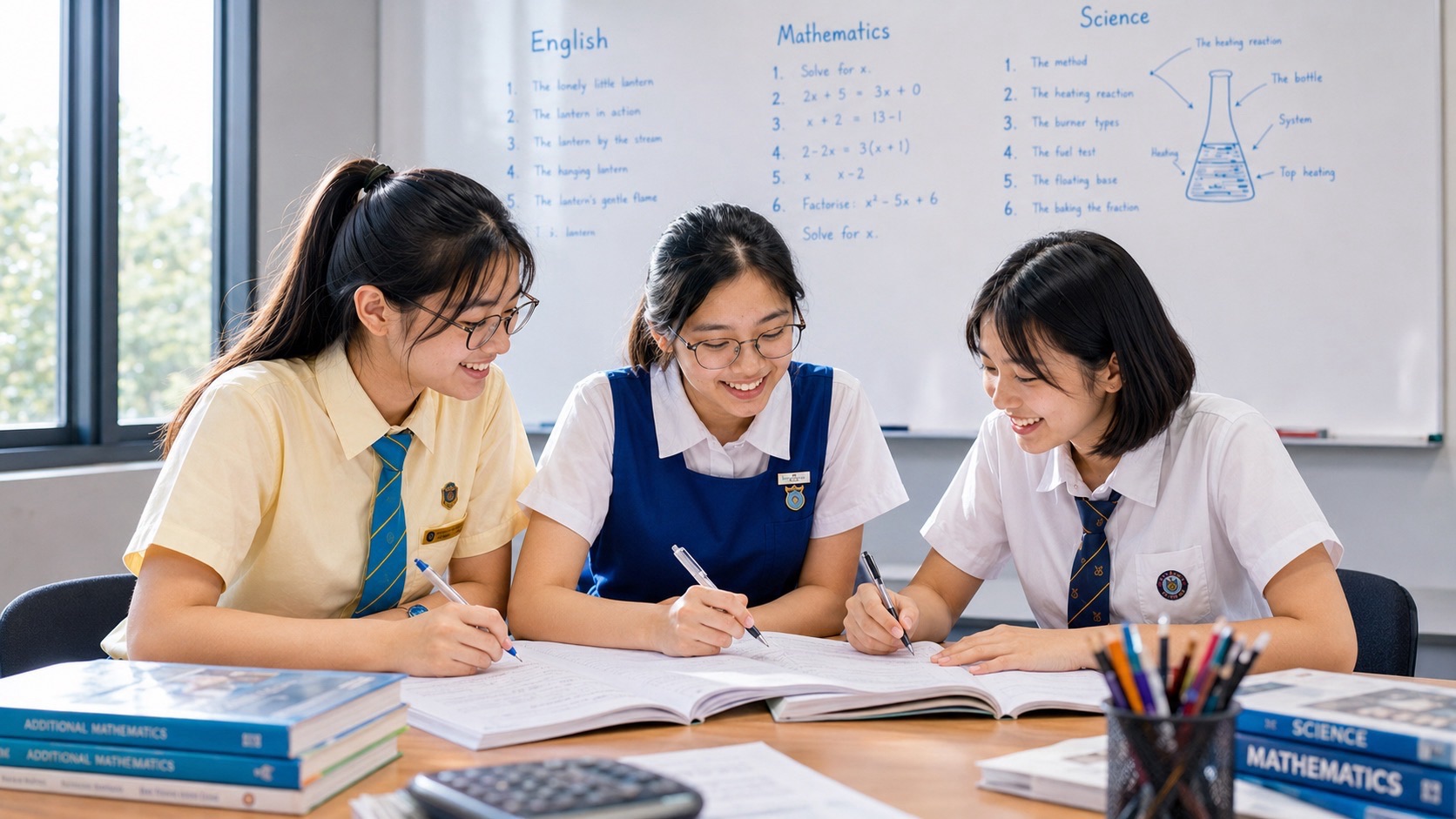
CHIJ St. Joseph’s Convent is a Catholic girls’ secondary school at 62 Sengkang East Way, Singapore 548595, with a Posting Group 1 (PG1) admissions route. Published historical records for the 2026 Secondary 1 intake show PG1 admitted PSLE Score ranges of 25–28 for both non-affiliated and affiliated applicants, with a last admitted score of 28 in each category. Those figures reflect pupils who sat PSLE in 2025; they are not a guaranteed 2027 cut-off. A Punggol family considering SJC should verify the daughter’s official Posting Group eligibility and any genuine primary-school affiliation, check MOE SchoolFinder, and test the actual journey to Sengkang East Way. The school’s official contact page lists Sengkang MRT and Rumbia or Bakau LRT as transport references.
SJC’s distinctive learning is the Art of Communication through Theatre and Debates, alongside the Learning for Life Programme Bringing L.I.G.H.T. to the Community. Its Applied Learning Programme is a school-wide progression integrating theatre, oracy, literature, speech, video blogs, debates and collaborative expression. The LLP uses its values of Love, Integrity, Gratitude, Humility and Tenacity to guide leadership and service, including Secondary 1 sustainability, Secondary 2 school-community work and upper-secondary projects with seniors. Under Full Subject-Based Banding, PG1 is a school-entry route while G1, G2 and G3 describe the actual levels of individual academic subjects. This article explains the school’s programmes, history, girls’ school setting, affiliation considerations, learning support and practical preparation without promising any child a school place or selected CCA role.
- School: CHIJ St. Joseph’s Convent, 62 Sengkang East Way, Singapore 548595
- Government-aided Catholic girls’ secondary school, not a co-educational campus
- 2026 historical PG1 ranges: 25–28 non-affiliated and 25–28 affiliated
- Both historical last admitted PG1 scores were 28; 2027 admission is not guaranteed
- Affiliation must be verified for the particular primary-school pupil and posting process
- ALP: Art of Communication through Theatre and Debates, developing oracy and empathy
- School-wide ALP experiences include drama, speech, literary response and multimedia expression
- LLP: Bringing L.I.G.H.T. to the Community
- L.I.G.H.T. = Love, Integrity, Gratitude, Humility, Tenacity
- LLP themes: Sec 1 sustainability, Sec 2 school community, upper secondary service with elderly
- DSA talent areas include performing arts, theatre/debate, leadership and sports, under separate rules
- PG1 is admission; actual G1/G2/G3 academic subject levels require separate school confirmation
- Verify 2027 booklists, school support, current programme activities and the Punggol commute
Information reviewed 1 November 2026. Historical admission scores, school programmes and access arrangements are not individual guarantees. Verify current instructions for the 2027 intake directly with MOE and the school.

Contents: SJC PG1 Admission, Learning and School Fit
- 1. Definition Lock: PG1, G1 and the SJC School Place
- 2. Where SJC Is and How to Reach It From Punggol
- 3. A Catholic Girls’ School and What Parents Should Ask
- 4. Understanding the 2026 PG1 Scores Correctly
- 5. Affiliation Is Not Based on a School Name Alone
- 6. Why the Score 25 PG1–PG2 Boundary Matters
- 7. SJC’s Art of Communication Applied Learning Programme
- 8. Theatre Is More Than Memorising Lines
- 9. Oracy and Clear Everyday Explanation
- 10. Debates Teach Evidence, Not Just Confidence
- 11. Literature and Understanding Another Perspective
- 12. Video Blogs, Speeches and Multimedia Tasks
- 13. Storyboarding as a Bridge Between Images and Writing
- 14. Theatre Visits and Cultural Appreciation
- 15. School-Wide Experiences Versus Selected Extensions
- 16. The LLP: Bringing L.I.G.H.T. to the Community
- 17. Love and Respect in a School Community
- 18. Integrity and Responsible Communication
- 19. Gratitude, Humility and Tenacity
- 20. Secondary 1 LLP: Sustainability
- 21. Secondary 2 LLP: School Community
- 22. Upper Secondary LLP: Work With Seniors
- 23. Passion Ignite and the VIA Showcase
- 24. SJC’s Four Groups of Student Leaders
- 25. Girls’ School Belonging and Peer Support
- 26. Student Safety and the Current Code of Conduct
- 27. School Counsellors and SEN Support
- 28. G1 English: Drama Can Support Written Clarity
- 29. G1 Mathematics: Different Strengths Still Matter
- 30. Science and Evidence in Persuasive Communication
- 31. Mother Tongue and Cultural Expression
- 32. CCA and DSA: Distinct From General ALP Lessons
- 33. 2026 Open House and School Visits
- 34. Books, Uniforms and Household Costs
- 35. A Fictional Punggol Girl Interested in Theatre
- 36. A Fictional Student Learns Empathy Through Service
- 37. What Parents Should Check Before Ranking SJC
- 38. Your Next Step: Verify Eligibility and Practical Fit
Definition Lock: PG1, G1 and the SJC School Place
Posting Group 1 is a national Secondary 1 entry category based on PSLE outcomes. G1 is a subject level in Full Subject-Based Banding, along with G2 and G3. A pupil may enter SJC through PG1 and attend mixed form-class experiences with students who offer other academic subject levels. Her spoken language, artistic ability, mathematical readiness and leadership habits need not all be equally strong. The admission group is not a permanent intellectual or social label.
Parents should keep the PSLE eligibility notice, school posting confirmation and SJC’s actual subject allocation as distinct documents. They answer different questions and guide different actions. The daughter who has a strong speaking ability may still need help producing written evidence, while a pupil who likes Mathematics might be uncomfortable performing before an audience. Suitable teaching recognises those differences without treating them as deficiencies in character.
Where SJC Is and How to Reach It From Punggol
The official school website gives the campus address as 62 Sengkang East Way, Singapore 548595. It identifies Sengkang MRT and the Rumbia and Bakau LRT stations as useful train connections and lists local bus services. For a family in Punggol, this is a neighbouring-estate option rather than a school located in Punggol itself. The relevant route depends on which part of the town the pupil travels from.
Test the morning journey at the time the student would actually report, including the final walking distance, road crossings and possible waiting. Check how the return trip works after CCA, performances or service activities. Do not invent a fixed travel duration for every Punggol family. A school with suitable programmes still needs to fit the child’s sleep, homework and safe independence routines.
A Catholic Girls’ School and What Parents Should Ask
SJC is part of the Convent of the Holy Infant Jesus tradition and describes its ethos through the school motto Simple in Virtue, Steadfast in Duty. It is a girls’ school and government-aided institution. Parents should understand that this identity is part of the school’s values and community culture while recognising that the school’s academic curriculum and Full SBB obligations also matter. The school setting may appeal to some pupils and be less attractive to others.
Ask how a new girl experiences form classes, support, CCAs and leadership opportunities. A family’s decision need not be based on religious or historical reputation alone. The child should be able to picture attending daily, asking questions, making friends and pursuing interests. An official school visit is useful for understanding everyday relationships rather than merely admiring an impressive hall or photograph.
Understanding the 2026 PG1 Scores Correctly
Published 2026 Secondary 1 admission data shows PG1 non-affiliated 25–28 and affiliated 25–28 for SJC. The last admitted score in each historical row was 28, based on the 2025 PSLE cohort. These ranges are noteworthy because the two PG1 rows were identical in that intake, while other Posting Group rows can differ with affiliation. None of this establishes what will happen in the 2027 exercise.
A pupil with a 2026 PSLE Score of 28 is not promised a place merely because the number matches a former last admitted score. Actual school choices, student results, capacities and tie-break arrangements determine the new outcome. Record the historical year beside every figure. An accurate school list contains several places the pupil would genuinely attend rather than treating one attractive school as already secured.
Affiliation Is Not Based on a School Name Alone
SJC has recognised primary-school affiliations that can affect the applicable admissions comparison under MOE’s rules. The CHIJ network includes schools such as CHIJ Our Lady of the Nativity and CHIJ Our Lady of Good Counsel, but the family must confirm which affiliations are formally recognised for the daughter’s actual situation and intake. Studying at any school with the CHIJ initials does not automatically establish that she qualifies for every affiliation benefit.
Parents should check the actual SchoolFinder affiliation information and MOE’s choice-order conditions, not a relative’s recollection. The 2026 PG1 affiliated and non-affiliated score ranges happened to be the same; that does not make affiliation rules meaningless or guarantee they will remain identical in 2027. Use the row that genuinely applies and rank schools according to the family’s real preference.
Why the Score 25 PG1–PG2 Boundary Matters
A pupil with PSLE Score 25 can have a choice of PG1 or PG2 under the present national framework, subject to the official individual notice. The decision affects which school admissions group is used and the initial subject-level expectations. The family should not choose a group purely because another parent regards it as a symbol of higher status. The child’s readiness and available options matter.
At SJC, historical PG1 and PG2 rows differ, so the parent must examine the group actually chosen. Do not apply the PG1 28 score to PG2 as if they were interchangeable. MOE’s S1 option submission has a defined method for selecting a group across ranked school choices. Ask the primary school for guidance if the pupil’s academic profile is uneven or the family does not understand the consequences.
SJC’s Art of Communication Applied Learning Programme
SJC’s ALP is named The Art of Communication through Theatre and Debates. The school describes a four-year progression intended to develop confident, empathetic and discerning communicators. It draws on oracy, theatre production and the language curricula rather than simply training pupils to win a speech contest. The emphasis includes perspective-taking, literary appreciation and collaboration.
For a PG1 pupil, communication can be developed at an appropriate pace through guided participation. A girl who can tell a story orally but struggles with a formal paragraph might learn how to organise ideas through performance work. Conversely, a strong reader may need confidence speaking to unfamiliar classmates. The ALP can create useful experiences, while academic English remains an explicit subject with its own syllabus and feedback.
Theatre Is More Than Memorising Lines
Theatre can teach pupils to understand characters, interpret choices and communicate meaning through voice, movement and expression. SJC’s ALP describes drama-based pedagogy and opportunities to consider different perspectives. A performance requires participants to listen and respond to others, not merely repeat words loudly. Students can also reflect on how an audience might interpret a scene differently from its creators.
Parents should ask what the daughter learned about the character or issue rather than focus solely on whether she was the lead performer. A pupil who plays a small supporting role can practise concentration, teamwork and responsibility. Drama learning is valuable when it strengthens understanding, expression and empathy. It should not become a competition for who appears most prominently in school photographs.
Oracy and Clear Everyday Explanation
Oracy refers to the ability to use spoken language effectively for different purposes. SJC’s programme aims to develop students who can speak clearly, confidently and convincingly. A student may need to explain an idea, ask for clarification, listen to a peer or present a reasoned argument. These are everyday school and life skills, not only examination tricks.
At home, ask the pupil to explain a short passage or event using her own words. If the point is unclear, ask what evidence supports it. Avoid replacing a young person’s voice with a fully scripted adult speech. The goal is genuine independent communication. A gradual increase in clarity and confidence matters more than an impressive accent or complicated vocabulary.
Debates Teach Evidence, Not Just Confidence
A debate involves forming a position, supporting it with reasons and responding fairly to another point of view. SJC connects debate and discussion with empathy and critical thinking. A child can speak forcefully without reasoning well, and another can think carefully yet need support expressing an argument. The educational task is to bring reasoning and communication together.
Parents can practise by asking for one supporting example and one reasonable objection to a claim. Encourage respect rather than turning every family conversation into a contest. A pupil should learn that admitting a weak point and revising an argument is intellectually responsible. Debate should promote careful judgment, not reward shouting or confident misinformation.
Literature and Understanding Another Perspective
The school’s ALP connects with English, Literature and Mother Tongue teaching. Reading a story or scene can help pupils consider motives and social context before interpreting a character’s actions. A pupil working at G1 English may need support with vocabulary or inferences, but can still contribute valuable observations during drama or discussion.
Ask what the character wanted, which detail supports the interpretation and what another reader might conclude. These are useful comprehension questions. If the pupil struggles to find evidence, teach that step explicitly instead of dismissing her contribution. Literary understanding grows through repeated reading and discussion, not merely through performing a scene memorised by someone else.
Video Blogs, Speeches and Multimedia Tasks
SJC’s official ALP page describes video blogs, speeches and other creative tasks as ways pupils can practise communication. A video blog can require selecting information, sequencing ideas, considering an audience and using images ethically. A polished video is not automatically an accurate or thoughtful one. The student must understand what she is claiming and why.
Parents can ask how the video was planned and whether sources were checked. If other pupils are visible, consent and privacy matter. The child should not copy a script from an AI service or social-media post without understanding it. Multimedia literacy is strongest when a pupil remains responsible for accuracy, respectful expression and genuine work.
Storyboarding as a Bridge Between Images and Writing
A storyboard divides a story or presentation into planned scenes. This can help students recognise the order in which an audience needs information and how visual choices influence meaning. SJC connects storyboarding with drama-based learning and literary tasks. Such preparation can also support school writing because each scene may correspond to a narrative point.
A parent might ask the daughter to describe the beginning, change and resolution of a short scene. Then invite her to write one clear sentence for each step. The child should make the creative decisions, while adults support structure and accuracy. A storyboard is a thinking tool, not a substitute for teaching formal writing techniques.
Theatre Visits and Cultural Appreciation
SJC describes opportunities to attend plays, workshops and related cultural experiences. Its ALP materials show students engaging with theatre production and discussing performance. These experiences can broaden how pupils interpret stories and understand language. They do not necessarily mean every cohort will attend the same play or that each student will be selected for an external competition.
Ask what the daughter noticed about staging, language and audience response. Which part of the performance altered her understanding? A thoughtful reflection can be meaningful without requiring specialist dramatic vocabulary. For 2027 entry, check the school’s actual programme notices rather than rely on a past trip photograph.
School-Wide Experiences Versus Selected Extensions
SJC describes its core communication ALP as school-wide, but external competitions, festivals, performances and advanced projects can have additional selection requirements. A school website may feature award-winning pupils, which does not mean every incoming Secondary 1 student immediately joins a competition team. Distinguishing ordinary learning from selective extension is important when choosing a school.
Parents should ask which activities a newcomer will encounter and how a pupil who develops an interest can explore further. A student can gain confidence through routine oracy lessons without becoming a debater. Equally, a motivated learner can seek appropriate challenges under school criteria. Both are worthwhile routes; selected participation is not the only evidence of educational value.
The LLP: Bringing L.I.G.H.T. to the Community
SJC’s LLP is named Bringing L.I.G.H.T. to the Community. The acronym represents Love, Integrity, Gratitude, Humility and Tenacity. The school uses Values-in-Action and student leadership learning to help girls contribute to their school and the wider community. The programme aims to build adaptive thinking, communication and responsibility over the secondary years.
For a parent, the useful question is what the child actually did to show a value. Did she listen carefully, act honestly or help a peer? A formal student leader can demonstrate these qualities, but a quiet classmate can do so as well. The admission group does not decide who has the potential to serve with empathy. Meaningful character learning happens through everyday choices.
Love and Respect in a School Community
The school’s values include love, expressed through care and respect for others. Pupils may encounter classmates with different academic levels, family circumstances and interests. SJC’s community programme can help young people recognise those differences without turning them into social ranks. A mixed form class should become a place where students learn from one another.
Parents can ask whether the daughter knows someone she can approach when uncertain and whether she has helped anyone else feel included. If a real bullying concern arises, use the school’s authorised reporting process. General values education does not replace the need for investigation and appropriate protection in a specific incident.
Integrity and Responsible Communication
Integrity means providing accurate information and acting consistently with responsibilities. That is especially relevant to an ALP involving speeches and digital media. A pupil should not fabricate examples to win a debate or submit a video blog whose claims are unverified. Being persuasive and being truthful are not opposing qualities when communication is taught well.
Parents can model checking a source before sharing it and acknowledging when something is uncertain. Encourage the child to correct an error rather than conceal it. Such habits support academic honesty, online safety and future workplace responsibility. Integrity is demonstrated in the process, not only when a project receives public praise.
Gratitude, Humility and Tenacity
Gratitude can involve recognising a peer’s contribution; humility can involve listening to feedback; tenacity can involve continuing to practise a difficult skill after a setback. These values are useful in theatre, sports, written assignments and relationships. A student who is shy about speaking may need patient practice rather than a demand to become instantly confident.
Parents can notice a specific improvement and explain why it matters. Did the daughter return to a difficult passage, thank someone for help or revise a presentation after criticism? A character programme becomes meaningful when the behaviours are understood. Merely reciting the five values without applying them is not the educational goal.

Secondary 1 LLP: Sustainability
SJC’s official LLP describes Secondary 1 projects around sustainability. These can provide opportunities for pupils to identify environmental concerns, discuss practical choices and reflect on responsible habits. The focus may align with school and community initiatives, but the precise partners and tasks can change across cohorts. A new pupil should not be promised a particular outing solely because an older photograph appears online.
Ask what problem the students investigated and how they decided whether an action was useful. A recycling activity may be a start, but the child should understand material use and environmental impact rather than count only the number of items collected. Thoughtful service combines evidence with responsibility and respect for the people sharing a space.
Secondary 2 LLP: School Community
The LLP’s Secondary 2 focus turns towards the school community. A class may look at a need involving students, teachers or shared facilities and plan an appropriate contribution. This can help young people move from simply participating in a task to understanding how group decisions affect others. Cooperation and communication become practical rather than abstract values.
Parents can ask whose perspective the class considered and what feedback changed its plan. A small improvement to everyday school life can be more useful than an elaborate project that cannot be maintained. The daughter entering Secondary 1 in 2027 would normally reach this programme stage later, so current material is a framework rather than a fixed future itinerary.
Upper Secondary LLP: Work With Seniors
SJC describes upper-secondary VIA work with elderly people and Senior Activity Centres, including community partnerships in the Sengkang and Punggol area. These activities can help pupils learn about ageing, communication and the importance of respectful service. It is not appropriate to promise that every girl will work with the same organisation or undertake identical tasks in a future year.
Encourage the student to listen to what participants actually want rather than assume all seniors need the same help. Privacy and consent matter. A successful service activity should be evaluated by its usefulness and the pupil’s reflection, not simply by how photogenic the event becomes. Empathy develops from genuine interaction and a willingness to revise assumptions.
Passion Ignite and the VIA Showcase
The school mentions a Passion Ignite and VIA showcase where selected groups can present their service projects and learning to peers. This offers an opportunity to communicate how a project developed and what students learned about the community. Being selected for a showcase is different from having participated in the basic LLP experience.
Parents should not assume the showcase is a mandatory prize for all PG1 entrants. Encourage the daughter to reflect on her contribution even without stage recognition. A project that improves a relationship or builds responsibility can be worthwhile without an award. Formal selection remains a school decision; intrinsic learning belongs to every student who participates meaningfully.
SJC’s Four Groups of Student Leaders
SJC identifies Student Council, Sports Leaders, Class Leaders and CCA Leaders as four main leadership groups. These students can coordinate peer support, school activities and community initiatives. The roles involve responsibilities and opportunities to practise communication. Selection and continuing performance follow school arrangements rather than the pupil’s original Posting Group alone.
Ask the child what sort of responsibility genuinely interests her. A student need not become a councillor in the first month to develop leadership. Helping classmates communicate, preparing a team and acting honestly under pressure are foundations. Parents can encourage suitable opportunities while respecting the school’s actual criteria and the child’s readiness.
Girls’ School Belonging and Peer Support
A pupil moving from a Punggol primary school to SJC may know few classmates. A girls’ school setting and mixed form classes will introduce new friendships, routines and subject groups. The daughter should learn whom to approach if she is confused about a timetable or concerned about an interaction. The school’s current peer-support structures and form teachers are the practical sources for guidance.
Parents can ask simple questions about who helped the student and what she enjoyed during orientation. Avoid making every conversation about PSLE scores or which classmates take G3 Mathematics. A sense of belonging often grows through regular shared experiences, not through instant popularity. If a problem persists, seek appropriate school support instead of treating it as proof that the chosen school was inherently wrong.
Student Safety and the Current Code of Conduct
SJC’s published 2026 Code of Conduct describes a zero-tolerance approach to hurtful behaviour and bullying, including ways to report concerns to staff, use a confidential online form or contact school leaders. It also outlines immediate safety measures, investigation, proportional responses and support for those involved. A parent should read the actual school’s rules rather than rely on a generic social-media statement.
If the child reports an incident, prioritise safety and document facts accurately. Do not circulate identifying material about minors publicly. Ask whom the daughter can contact if behaviour recurs and how school communication will proceed. A school-wide values programme is important, but it should coexist with practical reporting and appropriate response to real harm.
School Counsellors and SEN Support
SJC’s August 2026 staffing information lists school counsellors, Special Educational Needs Officers and a Student Welfare Officer among its support personnel. This indicates relevant roles exist, but it does not guarantee every child a particular number of individual sessions or automatic examination accommodations. Support should be discussed according to the pupil’s actual educational and welfare needs.
Parents can describe a concrete difficulty such as trouble following multi-step instructions or persistent anxiety about a class interaction. Ask which staff member coordinates support and how information should be shared securely. PG1 eligibility itself is not a diagnosis. Individual assessment and appropriate teacher observations are more useful than assumptions about what every pupil in a Posting Group requires.
G1 English: Drama Can Support Written Clarity
Drama and debate can motivate a pupil to practise English, but a confident performance does not automatically produce a clear comprehension response. A daughter taking G1 English may need explicit help with inference, vocabulary or paragraph structure. SJC’s ALP provides authentic content to discuss, while the subject teacher remains responsible for the formal English syllabus.
At home, ask the pupil to explain a character’s motive and cite one supporting detail. Then invite a short written response. If the evidence is missing, teach that step rather than simply adding adjectives. A more demanding English level should reflect sustained readiness and the school’s criteria, not participation in a theatre performance.
G1 Mathematics: Different Strengths Still Matter
A child who speaks confidently may still struggle with fractions, ratios or basic algebra. Mathematics needs independent reasoning and accurate working, irrespective of how strong the student’s oracy is. Under Full SBB, a pupil’s actual subject levels are determined individually according to eligibility and school arrangements. The admission group is not a reason to assume the child cannot grow.
Parents can ask the student to explain why a procedure works and check one unfamiliar example without a template. If an error repeats, repair the underlying concept instead of increasing the difficulty solely for prestige. Subject-level changes are meaningful when the pupil can manage the actual syllabus, not when a family is eager to remove a label.
Science and Evidence in Persuasive Communication
A debate or speech about a scientific issue must be grounded in reliable evidence. Students should learn to distinguish an observation from a conclusion and an anecdote from a broader claim. SJC’s emphasis on discerning communication can be useful in Science as well as the Humanities. A persuasive tone does not make a claim accurate.
Ask what data support a statement and whether alternative explanations exist. Encourage the pupil to say when evidence is insufficient. These habits are valuable across G levels and can help prevent misinformation in personal digital use. Students should not invent statistics or copy unsupported claims into speeches because they appear convincing.
Mother Tongue and Cultural Expression
SJC’s ALP connects with Mother Tongue Language curricula and cultural appreciation. A PG1 pupil might have stronger Mother Tongue skills than English or vice versa, and Full SBB can recognise subject-specific readiness under the relevant criteria. Participating in discussions or cultural activities can be a meaningful way to practise language without assuming every child has the same proficiency.
Parents can support meaningful home conversation and suitable reading while asking teachers about formal comprehension and writing needs. A challenging language level should be appropriate to actual readiness. Cultural appreciation is most valuable when pupils learn to understand different perspectives rather than memorise stereotypes.
CCA and DSA: Distinct From General ALP Lessons
SJC’s 2026 Direct School Admission listing includes talents in Choir, Concert Band, Debate and Theatre, Leadership, Netball, Table Tennis and Volleyball. DSA-Sec is a separate admissions route with school selection and national PSLE Posting Group requirements. A school-wide drama experience is not an automatic DSA place, and an external audition does not guarantee the pupil’s academic eligibility.
If the child has a valid DSA offer, read its official terms and programme commitment. Otherwise, follow the ordinary S1 posting instructions. After admission, CCA membership and auditions can have their own rules. Parents should not confuse attending an ALP lesson, joining a CCA and receiving a formal talent admissions allocation.
2026 Open House and School Visits
SJC’s official homepage advertises a 2026 Open House. The school is a good subject for a visit if a Punggol girl and her family are comparing the nearby CHIJ setting with co-educational choices. Open houses can provide insight into the campus, values, clubs and what students experience. Check the current schedule and registration information directly rather than inventing a date.
Let the daughter ask one question about a programme she genuinely finds interesting. Ask teachers what an ordinary Secondary 1 pupil does in the communication ALP and how G1 academic teaching is supported. A school visit can inform preference, but it does not establish admission or promise a role in a selected production.
Books, Uniforms and Household Costs
SJC’s October 2026 supplier page provides official information about uniforms, PE attire and books. Parents should wait for the school posting result and current 2027 subject list before purchasing materials. A PG1 student may have approved subject-level differences, so buying all possible G1, G2 and G3 books is wasteful and may be confusing.
If basic school costs are difficult, ask the school about appropriate MOE Financial Assistance or other applicable support. An affiliation or Posting Group does not automatically determine household eligibility. The most useful spending plan includes correct resources, meals, transport and any required device without speculative purchases based on another family’s booklist.
A Fictional Punggol Girl Interested in Theatre
Imagine a Punggol pupil eligible for PG1 who enjoys reading stories aloud but finds comprehension inference questions difficult. Her family researches SJC’s communication ALP, checks the historical 2026 PG1 range and tests the journey. They understand that enjoying drama does not guarantee admission or a selected DSA place.
If the pupil joins SJC, a classroom performance may help her consider a character’s motivation and practise a clear explanation. The family then connects that insight to short written responses. This fictional scenario is not a testimonial or a promise of a particular programme session. It illustrates how a genuine interest can support academic learning while other skills still need explicit teaching.
A Fictional Student Learns Empathy Through Service
Consider another girl who joins a supervised sustainability or community activity and initially assumes she knows what the participants need. After listening, she revises her plan and chooses a smaller, more suitable contribution. A teacher helps her reflect on gratitude and humility instead of merely documenting hours of service.
The educational growth lies in listening and changing behaviour. It is not a guarantee of an EAGLES award, leadership appointment or different G level. A PG1 pupil can develop important character and communication capabilities through ordinary participation. Parents should value the actual evidence of growth rather than demand a public title.
What Parents Should Check Before Ranking SJC
Record the child’s official eligible Posting Group, verified affiliation category, SJC’s historical 2026 admission ranges and the tested journey. Compare the school’s ethos, theatre and debate ALP, L.I.G.H.T. LLP, subject support and CCA options with other eligible schools in Sengkang and Punggol. Let the daughter speak about her preferences rather than treating family history as the sole deciding factor.
Keep unknown information marked for verification. Will a particular selected activity run in 2027? Which G-level textbooks will be required? What are the actual reporting arrangements? Answers belong to current official notices. A reliable choice is based on the child’s needs and likely daily experience, not an unsupported probability or a school’s name alone.
Your Next Step: Verify Eligibility and Practical Fit
Start with the official PSLE result and MOE SchoolFinder information for SJC. Verify any genuine affiliation and understand the different rules from DSA. Read the school’s current communication and community programme pages, then test the route to 62 Sengkang East Way. Build a list of schools the pupil would genuinely accept rather than relying on a previous cut-off.
After allocation, follow the actual 2027 booklist, joining instructions and subject-level timetable. Encourage the girl to join school life, form relationships and learn with growing independence. PG1 was the administrative entrance to secondary education. The lasting outcome will come from real learning, responsible communication and contributions made over the years.
Frequently Asked Questions
Where is CHIJ St. Joseph’s Convent?
62 Sengkang East Way, Singapore 548595, near Sengkang MRT and Rumbia and Bakau LRT.
Is SJC a girls’ school?
Yes. It is a Catholic government-aided girls’ secondary school.
What was SJC’s PG1 score range for 2026 entry?
Historical non-affiliated and affiliated PG1 ranges were both 25–28; the last admitted score was 28 in each.
Does Score 28 guarantee a 2027 place?
No. Past score ranges cannot guarantee the next cohort’s allocation.
Does primary school affiliation matter?
It can, where the individual child and school meet MOE’s recognised conditions. Verify the actual affiliated category rather than assuming it.
What is SJC’s ALP?
The Art of Communication through Theatre and Debates, using oracy, performance, language and perspective-taking.
What is L.I.G.H.T.?
Love, Integrity, Gratitude, Humility and Tenacity, the school values used in its community LLP.
What is the Secondary 1 LLP theme?
The school’s 2026 description identifies sustainability as the Secondary 1 area.
Does every girl join the debate team?
No. School-wide speaking and drama experiences are different from selected CCA and competition opportunities.
Does SJC have counselling and SEN staff?
Its official 2026 staffing pages list school counsellors, SEN Officers and student welfare support.
Is SJC’s code of conduct available?
Yes. It describes reporting, investigation and support routes for harmful behaviour.
Does a PG1 student always take every subject at G1?
Not necessarily. Individual subject-level options follow Full SBB eligibility and school arrangements.
Can a pupil enter through DSA?
SJC lists several performing arts, sports and leadership domains, subject to current application and PSLE eligibility rules.
What should Punggol parents check first?
Official PG1 and affiliation eligibility, school programmes, student support and the actual commute.
Official Sources and Related Reading
- SJC Official Address and Transport
- SJC Art of Communication ALP
- SJC Bringing LIGHT to the Community LLP
- SJC Student Safety and Code of Conduct
- SJC Counsellors and SEN Support
- SJC School Bookshop and Uniforms
- SJC Official Open House and DSA Notices
- MOE SchoolFinder – Current School and Affiliation Data
- MOE Secondary 1 Posting
- Historical PG1 2026 Affiliated and Non-affiliated Scores (verify with MOE)
- Related eduKatePunggol Compassvale Guide
Your next step: Verify the child’s actual posting and affiliation eligibility, check SJC’s current requirements and talk with the girl about its theatre, debate and community programmes. Test the route from Punggol and rank only schools she would genuinely attend.


