
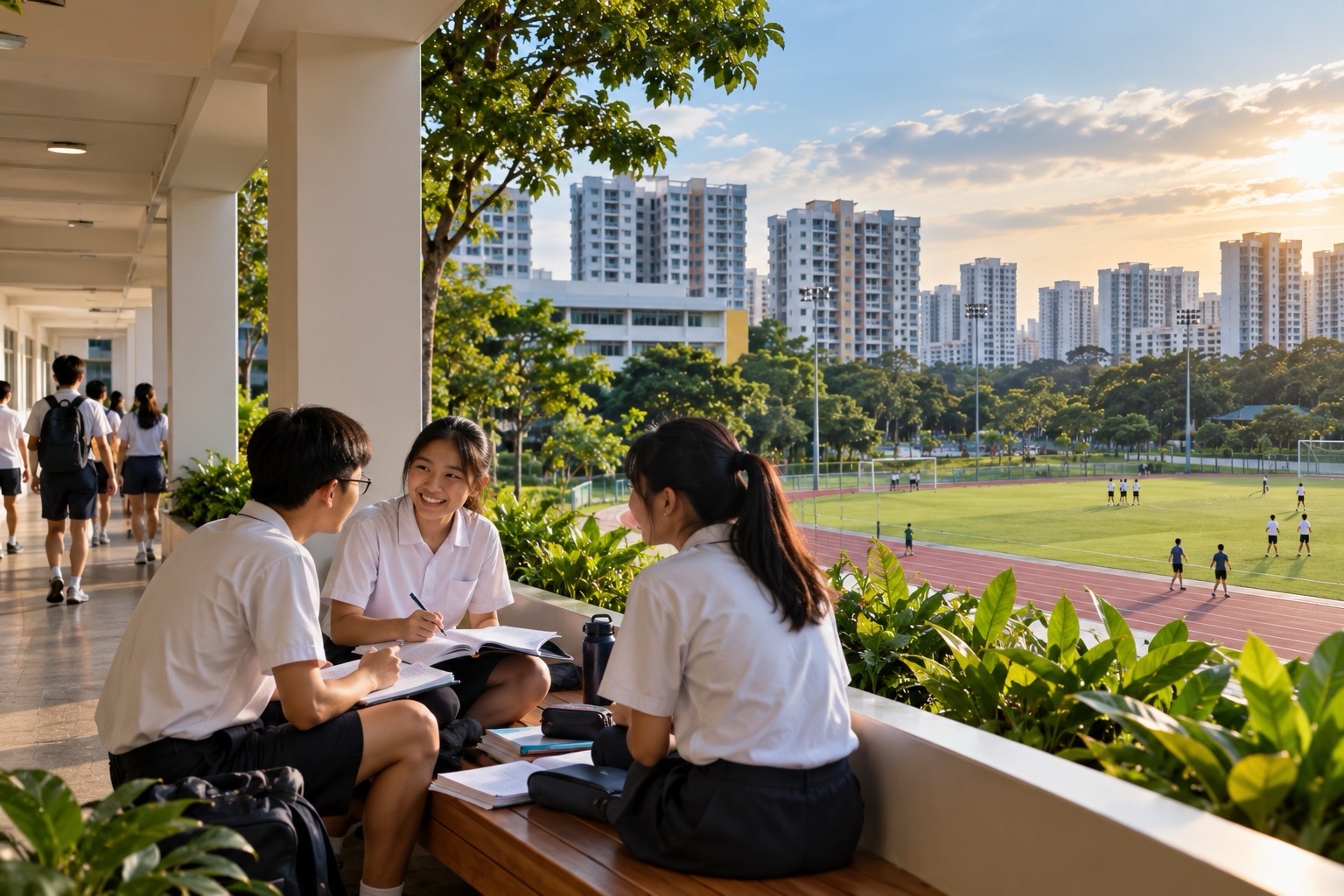
Bowen Secondary School is at 2 Lorong Napiri, Singapore 547529, in Hougang, and the published 2026 Secondary 1 Posting Group 1 (PG1) admitted PSLE Score range was 25–28. The last admitted score of 28 is historical information from pupils who took PSLE in 2025 and entered school in 2026. It cannot guarantee admission for the 2027 Secondary 1 intake. Punggol parents can consider Bowen as one of the schools for which their child may be eligible, but should check the actual Posting Group notice, current MOE SchoolFinder profile and daily route to Hougang. The school’s official contact page lists public transport approaches from Hougang, Serangoon and Ang Mo Kio; parents should test the specific journey rather than invent an estate-wide travel time.
Bowen’s distinctive educational experience includes its Bowen ChANgeMakers programme and AForte applied-learning modules designed to help pupils studying predominantly G1 and G2 subjects. ChANgeMakers combines business and entrepreneurship with community youth leadership: Secondary 1 students use design thinking to improve school life, Secondary 2 students work on service and prototypes with community partners, and upper-secondary pupils can advocate for social causes. AForte adds support for attitude, attendance, academic performance and aspirations, with sports discovery and elective modules in areas such as aeronautics, culinary work and mechatronics. Under Full Subject-Based Banding, PG1 is an entry route rather than a permanent academic stream. This guide explains which Bowen programmes are cohort-wide or selected, why practical learning matters and what Punggol families should verify before ranking the school.
- Bowen Secondary: 2 Lorong Napiri, Singapore 547529, Hougang
- 2026 Secondary 1 PG1 historical score range: 25–28; last admitted score 28
- 2027 cut-off and placement depend on the actual MOE posting exercise
- ALP Business and Entrepreneurship plus LLP Community and Youth Leadership
- Bowen ChANgeMakers integrates design thinking with service and social enterprise
- Secondary 1 projects focus on making school life better for real stakeholders
- Secondary 2 programme uses five-week community service and design-thinking experiences
- Upper secondary students can participate in Bowen Congress advocacy
- AForte supports pupils studying predominantly G1 and G2 subjects
- Four AForte areas: Attitude, Attendance, Academics and Aspirations
- Sports Discovery and ITE elective modules are additional applied-learning opportunities
- CARE-bean Corner and other wellbeing activities support social engagement
- Distinguish regular programmes from selected DSA, ALP Interest Group and competition activities
- Confirm the child’s subject levels, transport and current 2027 school notices
Verified against information available 1 November 2026. The score range refers to the 2026 intake, not an admission guarantee for 2027; programmes and selected activities may change.

Contents: Bowen PG1 Parent Guide
- 1. Definition Lock: PG1 Is Not the Same as G1
- 2. Bowen’s Historical 2026 PG1 Range of 25–28
- 3. Score 25 and Choosing a Posting Group
- 4. The Actual Location: 2 Lorong Napiri
- 5. Business and Entrepreneurship as Applied Learning
- 6. The ChANgeMakers Programme
- 7. Secondary 1: ChANgeMakers in the School
- 8. Design Thinking: Empathy Before Invention
- 9. Prototypes and the Value of a Failed Test
- 10. How the Secondary 1 Project Showcase Works
- 11. Secondary 2: ChANgeMakers in the Community
- 12. Service Learning Is Not Collecting Photographs
- 13. How Secondary 2 Students Connect Service With Design
- 14. Upper Secondary: Bowen ChANgeAdvocates
- 15. Bowen Congress and Explaining a Social Cause
- 16. The Selected ALP Interest Group
- 17. AForte: Applied Learning for Predominantly G1 and G2 Subjects
- 18. The Four AForte Areas
- 19. Building Self and the Scaffold Programme
- 20. Sports Discovery as an Opportunity to Explore
- 21. Experience ITE and Applied Career Exploration
- 22. Elective Modules in Practical Fields
- 23. CARE-bean Corner and Student Wellbeing
- 24. BowenExplore and Student-Initiated Learning
- 25. Bowen FIESTA and School Belonging
- 26. Bowen Horizons and Overseas Learning
- 27. DSA in Entrepreneurship, Leadership and Other Talents
- 28. English: Explaining a Community Problem
- 29. Mathematics: Measurement and Realistic Planning
- 30. Science and Responsible Testing
- 31. Mother Tongue and Uneven Strengths
- 32. A Fictional Bowen Student Improving School Life
- 33. A Fictional Student Exploring AForte
- 34. Choosing Bowen From Punggol
- 35. Your Next Step: A Practical Bowen Plan
Definition Lock: PG1 Is Not the Same as G1
PG1 is a category for national Secondary 1 school admission. G1 is a particular subject standard under Full Subject-Based Banding, while G2 and G3 describe other standards. Students can belong to mixed form classes and be taught in different academic groups according to individual eligibility. A student who entered through PG1 may enjoy practical entrepreneurship, music, sports or community projects alongside formal learning at their actual subject levels.
Parents should not call the child a PG1 learner as though the category describes every strength. Keep the school posting result separate from the academic subject allocation and CCA selection. Each has its own rules. A pupil who finds English challenging can still be a thoughtful contributor to a project, while a child strong in Mathematics may need help communicating with a team. Accurate distinctions support better teaching and less stigma.
Bowen’s Historical 2026 PG1 Range of 25–28
Bowen’s reported 2026 Secondary 1 PG1 admitted score range was 25–28, with the final posted pupil at Score 28. These numbers describe the previous exercise for students sitting PSLE in 2025. They reflect the preferences and available places of that cohort, not a school promise to accept a particular score in 2027.
A family should label the intake year beside every historical score. If the child receives Score 28 after PSLE in 2026, they are not automatically guaranteed a Bowen place. MOE’s posting and tie-break rules determine the result when limited vacancies are contested. The correct use of older cut-offs is to create a broad, realistic list of schools the pupil would genuinely attend.
Score 25 and Choosing a Posting Group
The current national framework can allow pupils with PSLE Score 25 to choose between Posting Groups 1 and 2. That choice affects the school selection process and the initial learning environment. It should not be made merely because an adult prefers a numerically higher label or feels embarrassed about the child’s overall score.
When evaluating Bowen, use the correct group’s previous admission figures and the pupil’s official eligibility notice. Do not copy the PG1 range into a PG2 application or assume a different group can be selected beside every school in a single list. Ask the primary school when subject readiness is uncertain. The purpose of the decision is appropriate academic challenge with realistic options.
The Actual Location: 2 Lorong Napiri
Bowen’s official contact information lists 2 Lorong Napiri, Singapore 547529, in Hougang. The school explains that visitors can use bus connections from Hougang, Ang Mo Kio and Serangoon MRT stations. The appropriate route from a home in Punggol will differ depending on the family’s neighbourhood and the child’s school reporting time.
Test the morning journey and the late-afternoon return after CCA. Include waiting for public transport and the final walk to the correct entrance. A map’s straight-line distance is not the whole commute. A nearby school can be convenient but unsuitable in other ways, while a longer route can be worthwhile for a pupil who strongly benefits from the teaching. Choose with the whole routine in mind.
Business and Entrepreneurship as Applied Learning
Bowen’s Applied Learning Programme includes Business and Entrepreneurship. The official school page defines applied learning as authentic, practice-oriented education, not simply a route for vocational students. Pupils are encouraged to connect knowledge from academic subjects with problems in industries and communities. Entrepreneurial thinking can involve recognising a need, testing an idea and communicating a useful response.
Parents should avoid reducing this to teaching children to sell snacks for a profit. A school challenge may ask how a service can become more welcoming, how a resource can be used carefully or how a team can improve a process. The real educational value is in thinking responsibly and using evidence. A PG1 student can develop those abilities while strengthening the English and Mathematics needed to explain them.
The ChANgeMakers Programme
Bowen ChANgeMakers integrates the school’s Applied Learning and Learning for Life approaches. It aims to nurture inventive, empathetic young people who use enterprise skills to contribute to others. The name reflects the idea of students becoming active agents of change rather than passive recipients of information. Its design-thinking projects provide authentic situations for collaboration and reflection.
Ask the pupil what the team observed and whether the problem belonged to actual people. A design that looks spectacular can be less useful than a small change to a routine that students and staff genuinely need. The programme is educational when pupils can explain why a decision was made and what evidence changed it. Formal competitions or selected extensions are separate opportunities.
Secondary 1: ChANgeMakers in the School
Bowen’s official ChANgeMakers page describes a Secondary 1 programme over two terms in which pupils investigate and improve their school environment. They consider the perspectives of students, cleaners, security officers, canteen stallholders and teachers. Possible questions include canteen queues, classroom cleanliness, learning difficulties or environmental problems. The project can conclude with presentations and feedback on student prototypes.
This structure is useful for a newcomer because the school itself becomes a place to observe thoughtfully. Parents can ask whose view the child sought and what the team learned. It is important not to assume that a problem has been solved simply because pupils produced a drawing. Good proposals are based on evidence and the willingness to listen to people affected.
Design Thinking: Empathy Before Invention
Design thinking begins with understanding a real user and defining a problem accurately. Students may be eager to build something before asking why it is needed. Bowen’s programme encourages them to consider different school stakeholders so that a solution responds to actual circumstances rather than an imagined user.
A parent can ask the child what the person said and how the team tested its interpretation. If the first assumption was wrong, revising the plan is progress. A PG1 pupil may be strong at noticing practical barriers while needing support with a formal written explanation. Both the observation and the writing deserve attention. Innovation grows when different strengths are used deliberately.
Prototypes and the Value of a Failed Test
A prototype is an early attempt to explore whether a proposed solution works. A cardboard model, a redesigned process or a simple digital presentation can reveal a problem before large resources are committed. Bowen’s ChANgeMakers expects pupils to develop and present solutions, which means they must learn to respond to questions and feedback.
Parents should encourage the child to describe what changed after testing. Did the group notice a measurement error, a safety issue or a user who did not understand the instructions? A failed first attempt is not a verdict on the student’s capability. The skill is learning how to improve a solution systematically and explain the reason.
How the Secondary 1 Project Showcase Works
Bowen’s school description includes a Secondary 1 showcase where groups present proposed improvements and respond to questions from teachers. Such presentations give pupils authentic practice organising ideas, speaking clearly and defending evidence. The existence of selected awards does not mean every pupil must win a category to benefit from the programme.
A parent can ask which question was most difficult and how the student answered. A truthful statement of limitations may show more learning than a rehearsed speech full of unsupported claims. Do not prepare the entire pitch in adult language and then demand that the pupil memorise it. The purpose is genuine communication and growing confidence.
Secondary 2: ChANgeMakers in the Community
Bowen describes a five-week Secondary 2 experience combining service and design thinking. Pupils work with community organisations and learn from real interactions before proposing solutions. Historical partners named on the school page include MINDS, AWWA and Bright Vision Hospital. These examples illustrate the type of community work, but the actual partners and opportunities may change from year to year.
Students should understand that service requires attention to the people involved. Parents can ask what the team observed, how it respected privacy and whether the planned action would be genuinely useful. A young person may need to revise a proposal after listening to someone whose circumstances differ from their own. That is a valuable education in empathy and responsible decision-making.
Service Learning Is Not Collecting Photographs
A community project can produce impressive images while accomplishing little. Bowen’s integrated programme emphasises reflection after service and deeper understanding of the needs of community partners. The learning objective is not simply to complete a visit but to understand what respectful, sustained contribution looks like.
Parents should avoid posting identifying photographs of people receiving support without suitable permission. Ask the pupil what was difficult about the interaction and what they would do differently. Ethical service puts the people involved before the publicity. A student’s personal development can be meaningful even when there is no formal award, media report or public praise.
How Secondary 2 Students Connect Service With Design
After interacting with a community, pupils may identify a practical barrier and use design thinking to address it. The first proposal might fail because it overlooked a person’s routine, physical ability or preferences. Bowen’s programme describes the process of refining ideas and presenting prototypes to teachers and community partners.
Ask the teenager whether the solution responds to the actual observation rather than a stereotype. If a design is too complicated to use, simplification may be the best improvement. These experiences can help students see that innovation involves more listening and testing than glamorous technology. Practical empathy is a transferable skill beyond the classroom.
Upper Secondary: Bowen ChANgeAdvocates
Bowen’s upper-secondary ChANgeAdvocates programme provides opportunities for students to champion social causes and use earlier service-learning experience more independently. Pupils may develop a proposal, select a community issue, implement an activity and communicate the outcome. The learning progression gives older pupils greater autonomy while expecting greater care in planning and evidence.
A pupil entering Secondary 1 in 2027 will reach these years later. Families should not assume every older project or partner will be repeated identically. The transferable objective is to research a cause, understand the affected people, choose proportionate action and report results honestly. Formal recognition is separate from the value of a well-considered contribution.
Bowen Congress and Explaining a Social Cause
The school describes Bowen Congress as a platform for upper-secondary students to raise awareness of their chosen causes and invite others to consider responsible action. Public communication requires pupils to distinguish facts, interpretation and proposals. A dramatic slogan without evidence can undermine an otherwise worthwhile cause.
Parents can ask how the student would respond to a respectful challenge from someone with another perspective. What evidence supports the claim? Which parts remain uncertain? Such questions build critical reading and communication. A young person can become a thoughtful advocate without being expected to adopt a fixed adult political position or solve an entire national problem.
The Selected ALP Interest Group
For a smaller group of pupils with strong interest in design thinking, Bowen’s school page describes additional experiences through an ALP Interest Group. The group may engage in relevant learning journeys, mentoring and deeper work on social enterprises or designs. Those opportunities are selective, not an automatic part of every PG1 student’s timetable.
Ask the school about current participation conditions if the child wishes to explore further. A student can still learn a great deal from ordinary ChANgeMakers without entering the extension. Parents should not use selected membership as the only definition of academic potential. Sustained learning is valuable whether or not it produces a special invitation.
AForte: Applied Learning for Predominantly G1 and G2 Subjects
Bowen’s AForte Applied Learning Module programme is explicitly designed to support pupils offering predominantly G1 and G2 subjects. Its aim is to increase engagement in class, help students discover strengths and connect learning with realistic aspirations. This is particularly relevant when a PG1 family wants to understand how the school responds to varied academic readiness.
The programme should not be misrepresented as a separate admission guarantee or a shortcut around the curriculum. It complements normal subject teaching through practical experiences and guidance. A pupil still needs literacy, numeracy and school attendance while exploring interests beyond written examinations. The value is seeing how school learning connects with future possibilities.
The Four AForte Areas
AForte organises development around Attitude, Attendance, Academic performance and Aspirations. These four areas reflect the reality that students need more than motivation alone. A teenager may understand a concept but miss lessons, or attend reliably but need targeted support with reading. Different barriers require different responses.
Parents can use the four areas as a diagnostic conversation rather than a moral checklist. Ask what happened during a difficult week, which school task was unclear and what the pupil hopes to learn next. Do not label a child lazy because a single assignment was unfinished. A useful plan identifies a specific barrier and a reasonable next action.

Building Self and the Scaffold Programme
Bowen describes multi-week programmes to help pupils manage emotions, build relationships and make responsible choices. Its lower-secondary Scaffold Programme focuses on strengthening supportive class relationships. These experiences address the social transition into secondary school, which can be difficult even for students who understand academic work.
A parent can ask whether the child knows a classmate they can approach and how they respond when confused or upset. This should be discussed calmly, without expecting immediate friendship with everyone. If bullying or significant distress occurs, use the school’s actual support procedures rather than relying only on a general character lesson. Relationships are part of learning access.
Sports Discovery as an Opportunity to Explore
AForte describes Sports Discovery opportunities that expose students to a range of activities. The published examples include bowling, kin-ball, fencing, golf and selected self-defence experiences, with actual school arrangements determining what happens in each cohort. These programmes can help teenagers encounter unfamiliar interests rather than commit to a single sport they have never tried.
Parents should ask whether the child enjoyed the practice and what they learned about teamwork or safety. A student who does not excel immediately may still develop confidence through responsible participation. Activities involving physical risk require trained supervision. Do not imitate specialist sports at home simply because the school brochure lists them.
Experience ITE and Applied Career Exploration
Bowen’s AForte programme includes an Experience ITE component, allowing pupils to learn about the variety of further-study options at the Institute of Technical Education. The purpose is to provide accurate information and reduce the tendency to treat every post-secondary course as a simple prestige ranking. Students can see the skills and training associated with different fields.
A parent can ask what the pupil found surprising and which basic English or Mathematics skills a course might require. Do not promise admission to a particular ITE programme based on a school visit. Actual entry depends on the relevant qualifications and current course rules. Career exploration should inform learning, not lock a twelve-year-old into one job.
Elective Modules in Practical Fields
Bowen’s AForte page describes Elective Modules in areas such as Aeronautics, E-Entrepreneurship, Food Science Culinary, Photography and Mechatronics. Some learning takes place at school and some through ITE. The school says pupils can experience up to three such modules between Secondary 2 and 4, subject to actual arrangements.
These exposures are valuable because a teenager may not know what a field involves until they try a task. Ask which process was interesting and which skill required repeated practice. A short module does not make the student a licensed professional or guarantee a course place. It is an informed step towards future decisions.
CARE-bean Corner and Student Wellbeing
Bowen describes a CARE-bean Corner that developed from a project with the Singapore Children’s Society. The space is intended to support positive social interaction and student engagement through recreational and learning resources such as board games and other supervised activities. It is part of the school’s broader care approach rather than a substitute for formal counselling or safeguarding.
Parents can ask how a new student seeks support when overwhelmed or unsure about school relationships. A welcoming social space may help, but serious concerns still require appropriate staff attention and qualified support where needed. A child benefits from knowing who can help, not simply from hearing that a special room exists.
BowenExplore and Student-Initiated Learning
Bowen’s BowenExplore programme gives pupils opportunities to direct learning according to their interests within structured Home-Based Learning time. It reflects the broader aim of developing curiosity and self-management. Choosing an interest does not remove the responsibility to plan, use reliable sources and complete work honestly.
Ask the student to explain what they wanted to learn and which steps they took. A pupil with little experience managing independent work may need a smaller starting task and clear feedback. Digital platforms can support exploration, but the child must remain accountable for the thinking. A self-directed project should strengthen independence, not become an excuse for an adult to complete a polished portfolio.
Bowen FIESTA and School Belonging
The school describes Bowen FIESTA as a structured series of activities supporting holistic development and school culture. Shared events can help students form connections across form classes and subject-level groups. A child who finds an academic lesson difficult may still feel connected through a school activity, performance or team task.
Parents can ask how the student participated and what they learned about others rather than simply whether the event was entertaining. School belonging matters to attendance and confidence. It should be developed alongside accurate academic teaching, not used to distract from a specific learning gap that needs attention.
Bowen Horizons and Overseas Learning
Bowen Horizons provides selected overseas learning opportunities for students in Secondary 2 and 3 to explore Asian cultures and develop wider competencies. An overseas trip can broaden perspective, but the school’s historical activities do not guarantee a place for every new pupil or a specific destination in later years.
Ask what the student would learn and how they would demonstrate respectful cultural understanding. Families should also consider cost, health and safety information when an actual school trip is offered. Global awareness can be developed through local community work and reading as well as travel. It should not become a status symbol or the sole measure of educational quality.
DSA in Entrepreneurship, Leadership and Other Talents
Bowen’s official DSA page describes talent areas in Entrepreneurship, Community Youth Leadership, Marching Band, Badminton and Football. This is a separate admissions route with school selection and PSLE Posting Group eligibility rules. A successful DSA allocation carries a commitment, unlike the ordinary six-school S1 posting exercise.
A PG1 family should not assume that participation in ChANgeMakers grants a DSA offer. The relevant year’s application and selection windows matter. In November 2026, earlier school selection activity for 2027 entry should not be described as a newly open application. Read actual offer letters and official MOE instructions rather than rely on an admissions rumour.
English: Explaining a Community Problem
A student taking G1 English may enjoy working with a community partner yet find it difficult to describe a problem clearly in writing. Bowen’s design and advocacy activities provide authentic contexts for reading instructions, selecting evidence and organising a response. These skills still require explicit teaching; project participation does not make English grammar or comprehension automatic.
Ask the pupil to identify the problem, one observation, a possible solution and the limitation of the proposed response. If the explanation misses a logical connection, help them repair that step. Do not write the entire report for the child. Real progress is visible when the student can communicate independently at the appropriate syllabus level.
Mathematics: Measurement and Realistic Planning
Entrepreneurial and design projects can involve budgeting, quantities, rates, measurement or comparison. G1 Mathematics develops the numerical foundations that help pupils make reliable decisions. A design team may have an exciting idea but make an error in units or proportional reasoning. The project reveals why a precise calculation matters.
Parents can ask the child to estimate first, calculate carefully and check the result against the practical situation. If a ratio or fraction is misunderstood, work on the underlying concept rather than assign unrelated advanced questions. The school’s academic subject-level review follows separate criteria and should not be confused with receiving praise for a practical project.
Science and Responsible Testing
A project concerning materials, food or the environment can encourage scientific observation. Pupils need to distinguish a claim from the evidence supporting it. A prototype that operates once does not establish that it will work safely in every circumstance. Teachers may help students compare conditions and evaluate whether a proposed change has the expected effect.
At home, ask what the pupil measured and what might have influenced the outcome. Encourage honest statements about uncertainty. Do not recreate hazardous school workshop or laboratory activities without appropriate supervision. Good applied learning develops the habit of testing and revising, which is useful in Science and future workplaces.
Mother Tongue and Uneven Strengths
A PG1 student may be stronger in Mother Tongue than English or Mathematics, or have the opposite profile. Full Subject-Based Banding allows schools to consider individual subject readiness under the relevant criteria. The admission group does not automatically determine every textbook level for four years.
Families can support language through meaningful conversation and suitable reading, then ask subject teachers about formal comprehension or writing needs. Do not purchase a higher-level text as a symbol of ambition when the school has not approved the course. Balanced growth preserves time for projects, CCA and friends while steadily strengthening academics.
A Fictional Bowen Student Improving School Life
Imagine a Punggol student who enters Bowen through PG1 and notices that the school canteen queue becomes confusing at a busy time. During a ChANgeMakers task, the pupil listens to other students and stallholders before proposing a clearer system. The first prototype fails because it does not consider how people move through the space.
The group revises the proposal and explains the change. This fictional case does not claim a particular 2027 project or real incident. It illustrates how careful observation, empathy and presentation can connect with English and Mathematics. The child is learning to solve a genuine problem instead of merely producing a model for praise.
A Fictional Student Exploring AForte
Consider a second pupil who enjoys photography but is uncertain about career options and struggles to organise homework. The family’s interest in Bowen grows after reading about AForte. Rather than assume the pupil must join every module, they investigate what is offered and how the school supports attendance and academic habits.
A suitable elective exposure may later help the child discover an interest, while teachers and family address the actual organisational gap. This scenario is not a promise of a photography place or post-secondary admission. It shows why a skills-based exploration should sit alongside everyday school readiness and realistic routines.
Choosing Bowen From Punggol
A good school comparison should include the child’s PG1 eligibility, Bowen’s historical admission range, the actual bus or train journey, academic support and distinctive programmes. Ask whether the child would enjoy design-thinking, service learning and possible AForte experiences. A school need not be the closest to be right, but the journey must be manageable.
Check current SchoolFinder data and the school’s latest notices. Keep older figures labelled by year and rank only schools the pupil would genuinely be willing to attend. A programme title, an old competition photograph or another family’s preference cannot guarantee a place.
Your Next Step: A Practical Bowen Plan
Before the 2027 intake, verify the actual PG1 eligibility and official school details, then ask Bowen what ordinary Secondary 1 pupils do through ChANgeMakers and which AForte experiences relate to students studying predominantly G1 or G2 subjects. Test the journey to Lorong Napiri and learn about the school’s first-term support.
Once formally posted, follow Bowen’s current registration, subject allocation, booklist and uniform instructions. Encourage the pupil to build relationships, ask questions and use feedback. PG1 was the route into secondary school; the meaningful educational outcome is a teenager who develops competence, character and the ability to contribute to others.
Frequently Asked Questions
Where is Bowen Secondary School?
2 Lorong Napiri, Singapore 547529, in Hougang.
What was Bowen’s 2026 PG1 cut-off?
The final admitted PSLE Score was 28, within the historic 2026 PG1 range 25–28.
Does Score 28 guarantee entry in 2027?
No. A prior-year cut-off describes the earlier allocation only.
What is Bowen ChANgeMakers?
A school programme integrating business and entrepreneurship with community youth leadership and design thinking.
What do Secondary 1 students do in ChANgeMakers?
The school describes projects to improve school life by understanding different stakeholders and pitching prototypes.
What happens in Secondary 2?
The school’s page describes five-week service and design-thinking work with community partners.
What is Bowen Congress?
An upper-secondary advocacy platform for students to communicate and support social causes.
Who is AForte designed for?
The school describes it as a programme for pupils studying predominantly G1 and G2 subjects.
What are AForte’s four areas?
Attitude, Attendance, Academics and Aspirations.
Does AForte include ITE experiences?
Yes. The school describes Experience ITE and elective modules in practical fields.
Is CARE-bean a formal examination programme?
No. The school describes it as a student engagement and wellbeing space.
Does ChANgeMakers automatically grant DSA admission?
No. DSA selection, academic eligibility and commitment are governed by a separate process.
Can a pupil participate at G1?
PG1 and G1 do not create a blanket exclusion from school-wide programmes; selected activities have their own requirements.
What is the first step for Punggol families?
Confirm actual PG1 eligibility, SchoolFinder information, programme fit and the daily journey.
Official Sources and Related Guides
- Bowen — Address and Public Transport
- Bowen — ChANgeMakers
- Bowen — Applied Learning and Learning for Life
- Bowen — AForte Applied Learning Modules
- Bowen — Signature Programmes
- Bowen — DSA Talent and Commitment
- MOE SchoolFinder
- MOE Secondary 1 Posting
- Bowen Historical 2026 PG1 Scores, Unofficial; Verify With MOE
Your next step: Verify the actual 2027 posting eligibility, compare Bowen’s ChANgeMakers and AForte opportunities with the child’s interests, and test the daily route to Lorong Napiri before ranking schools.


