
Schools and education at Punggol increasingly require students to search, check and explain digital information responsibly. Digital information literacy is the ability to locate suitable sources, evaluate claims, recognise uncertainty and use information safely. In 2026, Singapore’s Ministry of Education announced stronger AI literacy and Cyber Wellness coverage of AI-generated information and deepfakes. A child researching a school, library or public programme should learn to verify dates and details through the responsible institution instead of trusting the first search snippet or a polished AI answer.
This guide shows Punggol families how to form effective searches, evaluate sources, interpret photographs and statistics, verify claims independently, and respond thoughtfully to AI-generated content. Examples use local places as familiar research subjects without pretending to report a particular school’s technology programme. The purpose is to create careful readers and responsible authors rather than teach children that everything online is false. Where school accounts, learning tools and assignments are involved, the child’s current school policies and age-appropriate supervision take priority.
- Main skill: find information, think critically, use tools responsibly and communicate evidence.
- Official 2026 context: MOE is strengthening AI literacy and Cyber Wellness learning.
- Begin with a clearly worded question and identify the institution likely to know the answer.
- Open the complete source: snippets, headlines and forwarded screenshots are not conclusive.
- Check author or organisation, publication date, purpose and the exact claim.
- Distinguish factual reporting, opinion, advertising, forecasts and hypothetical examples.
- Images and graphs represent selected information and need context.
- AI-generated text and images require verification; visual glitches are not a dependable deepfake detector.
- Protect private school messages, student records, passwords and personal images.
- Independent test: research a new question, show a source trail and state what remains uncertain.
Definition lock: information literacy, verification and AI literacy
Digital information literacy refers to knowledge, skills and habits for locating, interpreting, evaluating, managing and communicating digital information. Verification is the process of checking a particular claim against suitable evidence rather than relying only on its confident presentation. AI literacy includes understanding capabilities, limitations, safety responsibilities and appropriate use of AI systems. These terms should not be collapsed into one instruction to ‘use the internet safely’; each describes a distinct decision the learner can practise.
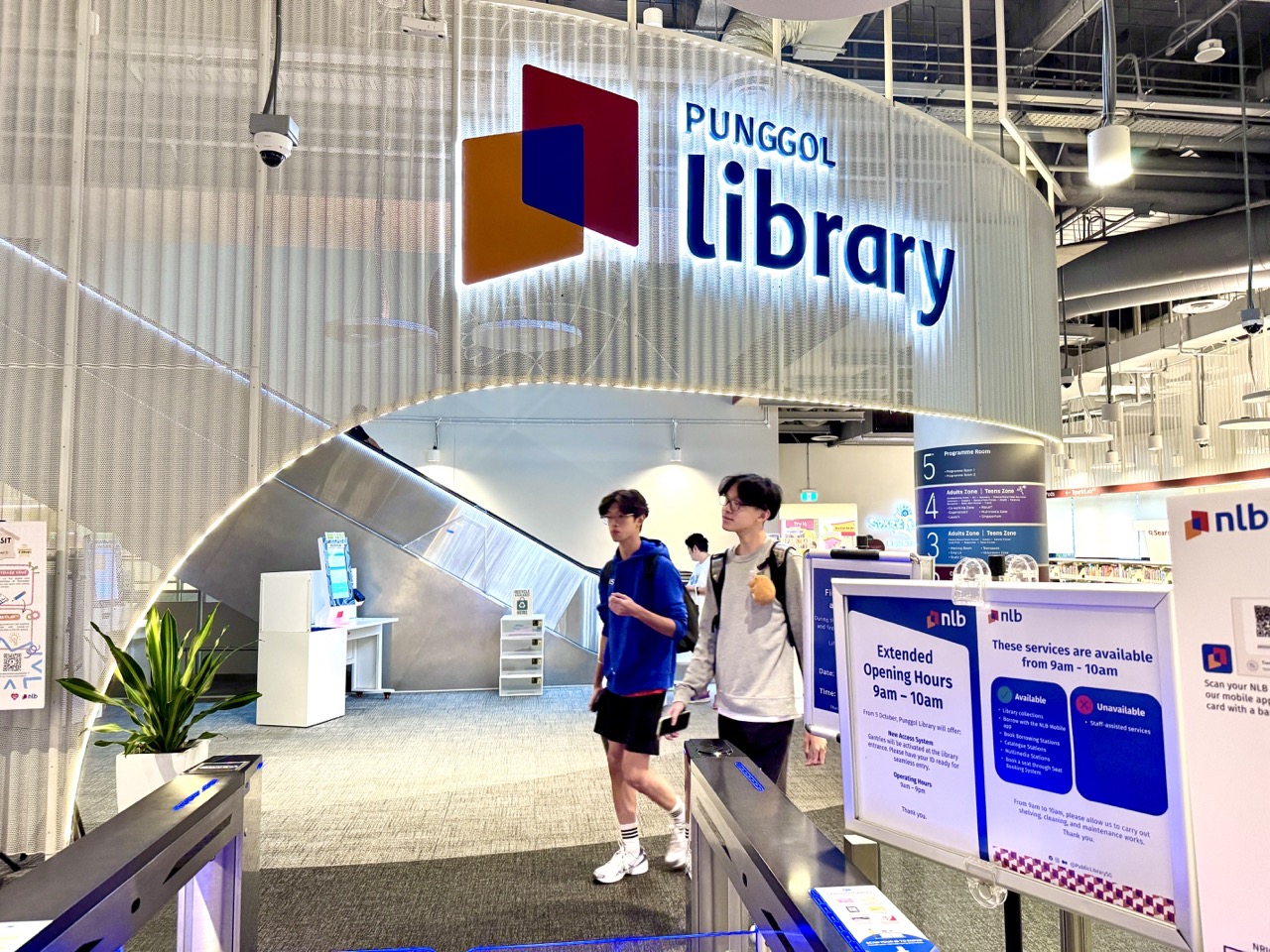
The lesson examples below are independent, original exercises for home and classroom discussion, not an assertion that a named Punggol school uses the same technology, assignments or assessment criteria. MOE’s national direction and individual school implementations should be checked separately. A photograph of a local institution illustrates context and does not establish what happens inside its classrooms.
A seven-step verification routine
- State the claim precisely, without adding assumptions.
- Ask which organisation or person could know that information directly.
- Open the relevant original document, not only the search preview.
- Check the date, conditions and whether the information is still current.
- Compare another meaningful source when the consequence of error warrants it.
- Record what was established and what remains uncertain.
- Use or share the information only within suitable safety and privacy boundaries.

1. Search for the question, not the answer you hope to find
Digital research often begins with a search box, but the most important step happens before the search: deciding what is being asked. A pupil who enters ‘Punggol school best’ may receive rankings, advertisements and opinions without a clear definition of best. A more useful question asks for a specific publicly verifiable detail, such as a school’s current subject offerings or the correct source for an admissions procedure. The quality of the question shapes which evidence can answer it.
Search terms should name the subject, type of information, location and time when those dimensions matter. For example, ‘MOE SchoolFinder primary school Punggol’ targets an official discovery service more precisely than ‘school near me’. When the task concerns a specific school, use its current official website and compare its information with MOE where appropriate. A search engine result is a route toward evidence; it is not the evidence by itself.
Teach the decision, not a memorised warning
Ask the child to write a question on paper, then list which institution is likely to hold the answer. For national curriculum rules, that institution may be MOE. For public library programmes, it may be the National Library Board. For an individual CCA timetable, it is likely the school itself. This approach prevents the pupil from treating every search result as equally informative and develops a healthy instinct for where responsibility lies.
A common mistake is searching only for words that confirm the student’s first opinion. A learner might type ‘why all homework is bad’ and then collect arguments that fit the phrase. Ask them to reformulate the query neutrally: ‘What are possible benefits and limits of age-appropriate homework?’ Then examine the scope and quality of the sources. Research should be able to reveal inconvenient evidence without being judged a failure.
An independent changed-context check
Children should learn the difference between an official site, a summary written by another publisher and a person’s individual experience. A school review can describe an experience, but cannot certify the school’s current admission rules. Likewise, a page with an impressive headline may be outdated or rely on a secondhand summary. The next move is to open the underlying source and check the relevant claim there.
For transfer, give an unfamiliar question about borrowing a book at Punggol Regional Library. Do not supply the search terms. Ask the pupil to identify the likely authority, propose a query, open the official NLB page and write what can be confirmed. The point is purposeful information gathering, not merely a quick list of links.
2. Read a result page without mistaking the snippet for proof
A search results page has titles, short excerpts, dates, advertisements and links. It is designed to help a user choose what to open. The snippets can omit qualifications or combine information from different parts of a page. A child who cites the result preview without reading the linked source may accidentally repeat a claim out of context. Teach the distinction between finding a candidate source and establishing a fact.
A fictional search result might say ‘New Punggol programme opens next year’, while the linked page explains that the date remains subject to confirmation. If the pupil copies only the preview, a tentative plan turns into a guaranteed opening. The reader needs the full statement, its date, the organisation responsible and any conditions attached. This matters especially for future 2027 and 2028 claims that could change before a family acts.
Teach the decision, not a memorised warning
Show two short search previews and ask what each actually establishes. The answer may be ‘Nothing beyond the fact that this page appears to discuss the topic.’ Then open the source and locate the exact relevant sentence. A reliable citation needs to support the claim made in the child’s work, not merely share several keywords with it. The habit slows the pupil down in a productive way.
Some results are paid placements or promotional content. Promotional text is not automatically false, but its purpose may differ from an official explanation of rules. Ask who benefits from the reader’s action and which factual details are independently confirmed. A tuition provider’s page may be useful for explaining its own classes, yet it is not the authority for national examination regulations.
An independent changed-context check
Another problem is copied articles that appear on multiple domains. A student may believe they have three independent sources because the same paragraph appears on three websites. Ask which page originated the information and whether the other pages merely repeat it. Independent corroboration requires separate evidence or a meaningful additional source, not a larger count of identical headlines.
Use a changed-topic exercise: search for a public venue’s current access instructions, then compare the preview with the venue’s own page. Can the child identify a detail that must be checked in the full source? This is a basic form of digital literacy that transfers from school research to everyday decisions.
3. Check the author, organisation, date and purpose
A document is easier to evaluate when the reader can identify who issued it, why it exists and when it was last updated. A government policy page, a school newsletter, a newspaper report and a personal blog can each be useful for different questions. The task is not to label one entire category good and another bad. It is to ask whether the source is positioned to know the particular fact being claimed.
Consider a claim about which year a Primary Science syllabus applies to. MOE’s own syllabus is stronger evidence than a generic article with no date or reference, because MOE issues the national curriculum. In contrast, if the question concerns a family’s experience of a particular activity, a first-person account can provide that perspective, though it still should not be mistaken for a school-wide outcome.
Teach the decision, not a memorised warning
Teach a four-field source note: organisation or author, document title, date, and relevant sentence or section. Add the URL when the source is online. The pupil can then return to the evidence without searching again. If the page has no visible update date, record that limitation rather than inventing one. A credible research note is transparent about what can and cannot be verified.
Publication date and event date are different. An article written in 2026 may describe a development that opened in 2025, or a proposal intended for 2027. Students should label which date applies to the claim. A source can be recent yet discuss an old event, and an older official document may remain authoritative until formally replaced. Freshness must be judged relative to the question.
An independent changed-context check
One easy mistake is assuming that a professional-looking website is official. Domain spelling, design and copied logos can mislead. When a child needs school or government rules, start from a known government or school domain rather than following an unfamiliar message link. For sensitive transactions, an adult should verify the real service independently and avoid entering details after a suspicious redirect.
Change the task from a school policy to a public transport notice. Ask which authority manages the relevant service and what date the notice describes. Can the pupil distinguish an official operational update from an old news article or a commuter’s anecdote? That is source evaluation in a genuinely new context.
4. Separate fact, interpretation, advertising and personal opinion
A factual statement can in principle be supported by evidence, while an opinion expresses a judgement or preference. Many everyday messages mix them. ‘This is the most enjoyable school’ is an opinion unless the writer defines a legitimate measure and evidence. ‘This school offers a named programme this year’ is a factual claim that must be checked. Children should learn to unpack mixed statements rather than declare the entire paragraph true or false.
Imagine a brochure says, ‘Our fun activities make every child confident.’ The existence of the activities may be checkable, but the claim about every child’s confidence is broad and potentially promotional. Ask what specific observation could support it and whether the statement overgeneralises. A family’s positive experience can be sincere without representing all students. Discernment means respecting the experience while recognising its limits.
Teach the decision, not a memorised warning
Give the child three coloured pencils to mark a short fictional advertisement: one for factual details, one for claims that require evidence, and one for value judgements. This exercise turns a vague warning about online bias into a concrete reading skill. The child should explain why a sentence was marked, not merely guess the category from a word like amazing or guaranteed.
Be alert to hedging words that express uncertainty: may, planned, expected, subject to approval and estimated. These are not meaningless disclaimers. They change what the reader can safely conclude. A site that says a facility is expected to open in a given year has not supplied the same information as one reporting that the facility is already operating.
An independent changed-context check
A common error is using a single person’s review to generalise about every teacher or parent in a school. Ask the student to rewrite the claim with the right scope: ‘One reviewer reports…’ rather than ‘All families experience…’ Even when a statement comes from an identifiable source, the number of observations and how they were gathered matter.
For transfer, give a short paragraph about a hypothetical new sports centre with a verified location, a proposed future programme and an enthusiastic review. Can the pupil classify each statement and write a careful, accurate summary without promising that the proposed programme has begun?
5. Verify a claim by seeking independent evidence
Finding a second webpage is not necessarily verifying a claim. If both pages copied the same announcement, the evidence may have a single origin. For important factual questions, identify the primary source and, where useful, an independent source that provides a different kind of confirmation. The objective is not to accumulate twenty links. It is to make a clear chain from claim to trustworthy information.
Suppose a forwarded message says a Punggol school has changed its reporting time for tomorrow. A parent should not act on the forwarded screenshot alone. The safer check is the school’s official notice or approved communication channel. A family can teach this principle with a made-up example, without sharing actual private teacher messages or demanding that children investigate operational emergencies.
Teach the decision, not a memorised warning
Use a claim-evidence grid: claim in the first column, evidence source in the second, exact relevant fact in the third, and remaining uncertainty in the fourth. A child may discover that a source confirms the school’s name but not the claimed event date. That is valuable progress. Research succeeds when it narrows uncertainty honestly, even if the original claim remains unresolved.
Where a topic concerns scientific findings, different articles may summarise one study. Ask what that study actually tested, how large the claims are and whether other independent evidence supports the broader conclusion. At primary age, learners need not master formal research methodology, but they can begin recognising that repeating a claim does not transform it into new evidence.
An independent changed-context check
Another challenge is conflicting updates. A current official page may supersede an older schedule, but a downloaded PDF might still circulate. Record the publication dates and check whether the information is specifically for the year in question. Do not treat a future-dated plan as though it is already in force. This is particularly important when writing guides that mention 2027 and later.
The independent transfer check is to provide two conflicting fictional event notices for a school holiday workshop. Ask the child what would verify the current time, who is authorised to confirm it and what information should not be shared while checking. A sound answer identifies a safe process rather than choosing whichever notice looks nicer.
6. Treat images, captions and video clips as claims with boundaries
An image shows a selected view at a particular moment, not the complete story. A photograph of an empty school entrance cannot establish that no students attend the school; the image might have been taken after dismissal. A dramatic crop may remove context. Digital literacy asks pupils to describe what is visible, identify the source and date where possible, and avoid filling missing information with confident invention.
Compare two photographs of the same public structure taken from different angles. One may emphasise open space while the other includes a busy crossing. The images can both be accurate. Their differences teach framing and selection. Ask what claim each picture supports directly and what cannot be established from the frame. This prepares children to interpret online images without treating every photo as a complete record.
Teach the decision, not a memorised warning
AI-generated and manipulated images make this discipline even more important. Visual clues may sometimes raise suspicion, but they are not a reliable universal test of whether an image is authentic. A convincing image can be fabricated, and a genuine image may look unusual because of lighting or compression. Teach children to check provenance, original publication and corroborating evidence rather than rely on a checklist of strange fingers or shadows.
Deepfake video or audio can falsely attribute words and actions to people. If a clip makes an unusual or serious claim, the appropriate response is not to share it instantly while speculating. Pause, identify the original source and seek reliable confirmation through the relevant institution. Children should understand that forwarding a sensational claim can cause harm even when the sender says they were only asking a question.
An independent changed-context check
Respect for privacy matters when practising photo research. A classmate’s face or private home address should not become an example posted online without permission. Use images of objects, publicly displayed information or materials cleared for educational reuse. Permission to view a photograph is not necessarily permission to republish it in another article or presentation.
For transfer, show a hypothetical crop of a Punggol path that removes an adjacent shelter. Ask the child to identify the visible claim and propose what additional view would be needed to assess whether the whole route is sheltered. This teaches careful inquiry rather than guessing at people’s intentions or identities.
7. Do not let numbers and graphs become misleading proof
Digital posts often include impressive figures without explaining what was counted. A claim about a ‘50% increase’ needs a baseline, a time period and a clearly defined measure. A child can learn to ask what the numerator and denominator represent even before handling advanced statistics. A number is evidence only when the reader can understand where it came from and what comparison it supports.
Consider a fictional school club that grows from ten members to fifteen. The increase is five members, which is 50% of the original ten. But the statement ‘half the school joined’ would be unsupported because the total school enrolment is unknown. The same percentage can describe a change in a small group without indicating the scale of the entire institution.
Teach the decision, not a memorised warning
Graphs can mislead through axis choices, missing units or truncated scales. A pair of bars at 98 and 100 may appear dramatically different if the vertical axis begins at 97. Teach the pupil to read the labels and inspect the numerical values before accepting a visual impression. A graph is a representation of data, not a replacement for understanding the data.
Sometimes the issue is comparing groups of different sizes. If one school activity has more participants than another, the raw total may reflect enrolment rather than greater participation proportion. Without denominators, a strong conclusion is premature. Children should be encouraged to state which extra quantity is needed rather than making a guess to satisfy the prompt.
An independent changed-context check
Do not permit children to invent percentages for a persuasive speech and present them as local statistics. If an exercise uses fabricated numbers, mark them as hypothetical. For actual demographic, school or transport data, locate the responsible official source and the correct year. A fake statistic can spread quickly when reproduced in a chart with polished colours.
Give the learner a novel table showing a rise from 20 to 25 and ask for the absolute and percentage increase. Then show a second category rising from 200 to 205. Both increase by five, but their percentage changes are different. Can the pupil explain that distinction and avoid an exaggerated headline?
8. Question AI-generated answers without fearing every technology
In March 2026, MOE announced measures to strengthen AI literacy, including updates to Code for Fun and Cyber Wellness coverage of AI-generated information and deepfakes. This direction does not mean every primary pupil should use every commercial chatbot freely. Age, developmental readiness, school policies, privacy and teacher supervision remain central. The educational aim is to develop judgement about tools, not to outsource the responsibility to think.
An AI assistant may provide a fluent answer about a Punggol facility that includes an invented opening hour, an out-of-date programme or a plausible nonexistent reference. Its sentence style is not evidence. A child should ask which statements can be checked against an official source and which are only suggestions. For factual school claims, the current institution’s site matters more than a confident paragraph generated without sources.
Teach the decision, not a memorised warning
AI tools can sometimes help brainstorm safe practice questions or provide alternative explanations when permitted by school guidance. The pupil should still make the learning decisions, complete assessed work independently as required, verify the content and acknowledge any assistance according to policy. A seemingly efficient shortcut can reduce skill development if the child merely copies a ready-made answer.
Never upload a classmate’s identification details, private teacher messages, student marks, medical information or family passwords to a public tool as part of an experiment. If a tool requests information that is not necessary for the learning goal, an adult should stop and check. Digital safety is a condition of useful education, not an optional lesson saved for after a mistake.
An independent changed-context check
A common misconception is that an AI tool either always tells the truth or always lies. Neither assumption is useful. Outputs vary by task and evidence. Teach the learner to separate requests that need creative suggestions from requests that require current verified facts. The checking standard must be appropriate to the consequence of being wrong.
Try this exercise: present a fictional AI answer claiming that Punggol Regional Library closes at a particular hour today. Ask the pupil what authoritative live source would confirm the current hours and why relying on the generated sentence would be unsafe. No actual opening time needs to be guessed for the lesson to succeed.
9. Build a clear source trail and protect the people behind the data
A finished school explanation should allow a reader to trace important factual claims back to their source. At primary level, a simple source note may be enough: organisation, page title, date and link. As students advance, their teachers may require fuller citation conventions. The point is not to decorate a page with links. It is to make the origin and scope of each important claim transparent.
Paraphrasing means understanding the source and explaining it accurately in the student’s own structure, not swapping individual words while keeping a copied paragraph. Students should practise reading a short passage, closing it, summarising the core idea and then checking their summary for accuracy. If exact words are necessary, use quotation responsibly and comply with the assignment’s instructions.
Teach the decision, not a memorised warning
Privacy and accuracy are linked. Even a true personal fact can be inappropriate to publish. A source trail should not expose a child’s personal account, a private teacher email or a classmate’s records. Use publicly available sources where possible and keep private communication within approved school channels. If the task requires sensitive information, seek adult guidance rather than assuming that a citation makes disclosure acceptable.
An important online safety move is recognising when research has turned into a request for credentials or payment. School communication should go through known official channels. Children should not be asked to enter Singpass details, banking information or passwords to prove that a web page is trustworthy. A request for secrets is not an evidence-checking exercise; it is a reason to stop and verify independently.
An independent changed-context check
Review a draft using four questions: Which statements are directly observed? Which come from an authoritative source? Which are interpretations? Which have not been checked? Mark unresolved claims before sharing the work. If the answer depends on information that might have changed, note the date of verification. This prevents a once-accurate guide from becoming misleading by silence.
For the final transfer task, give the pupil an unfamiliar question about an educational programme. Let them find an official source, record its title and date, write a short explanation with one bounded claim, and state one uncertainty. A child who can do that independently has developed a useful and durable research habit.
Four-week research-and-verification routine for a Punggol family
Week one: ask the pupil to research a publicly available MOE curriculum fact and record the responsible institution, document title and date. Week two: give a fictional forwarded notice and ask what official channel would confirm it. Week three: examine a cropped public-place photograph and a misleading bar chart, naming what each representation does and does not prove. Week four: present an invented AI answer with one unsupported Punggol service claim and ask the child to draft a careful correction with a source trail. The plan is illustrative, not a school mandate or an invitation to use unapproved platforms.
Worked claim-check: A programme is ‘opening next year’
A fictional online article says, ‘A new Punggol student programme is opening next year.’ Before passing it on, ask five questions. What is the reference year of the article? Is the programme planned, formally confirmed or already operating? Who is responsible for the programme? Does the current official source show eligibility or registration conditions? Does the article use the word expected or subject to change? A responsible answer might say, ‘I found a proposal, but I could not confirm an opening date or application procedure from the responsible institution.’ The refusal to invent a missing date is a success.
The pupil can then revise the search strategy rather than rewrite the uncertain statement as a guarantee. They might look for a current government or institutional announcement, compare it with the earlier article and record the date checked. Even if the answer remains uncertain, the child has practised separating an observed webpage, its claim and the supporting evidence. This is the kind of literacy that protects future school, finance, travel and family decisions.
What parents can ask before approving a new digital learning tool
- What specific learning objective does this tool serve?
- Is it approved or recommended by the child’s school and appropriate for their age?
- Does it collect personal information, photographs, contact details or assessment records?
- Can the child recognise which output requires source verification?
- Does the tool help thinking or merely supply completed assessed work?
- What permission, disclosure or acknowledgement does the assignment require?
- How can the pupil complete a comparable task without the tool?
- What would we do if the tool gives a plausible but incorrect response?
Frequently asked questions
What is digital information literacy?
It is the ability to find, evaluate, organise and responsibly use digital information. It includes judging source relevance and accuracy, understanding limits, and communicating findings without exposing private information.
Does a search-engine preview prove the claim it shows?
No. Open the underlying page, inspect its context and date, and check the specific statement. Preview excerpts are navigation aids rather than complete evidence.
How should a child check current school information?
Start with MOE’s official information and the named school’s current website or approved communication channel. Be especially careful with dates, application conditions and forwarded screenshots.
Can photographs prove a story about a school?
They may show a limited visible scene, but do not independently establish unseen events, motivations or school-wide conditions. Verify the origin, date and context.
Are deepfakes always easy to spot?
No. Visual glitches can raise questions but are not a reliable test. Check who originally published the clip and whether trusted independent sources support the claim.
What did MOE announce about AI literacy in 2026?
MOE announced strengthened AI literacy across education, Code for Fun updates for 2027 and Cyber Wellness lessons addressing AI-generated information and deepfakes. Check the official 2026 Committee of Supply announcements for exact wording and implementation details.
Should students copy AI answers for schoolwork?
No. Follow school rules on permitted assistance, verification and acknowledgement. The child remains responsible for independent work and should never share sensitive information with unapproved tools.
How many sources are enough for a claim?
There is no universal number. Use an authoritative primary source when available and meaningful independent corroboration where the question warrants it. Multiple copied summaries are not independent evidence.
Your Next Step
Give your child one ordinary public-information question about Punggol. Ask them to name the responsible institution, find a current authoritative page, copy only the relevant factual detail and explain its limits. If a search preview or AI response offers a different answer, treat the disagreement as a reason to verify rather than a contest over who sounds more confident. Finish with one sentence beginning ‘I could confirm…’ and another beginning ‘I could not yet confirm…’.
Official sources and related Punggol reading
- MOE Committee of Supply 2026 announcements: AI literacy and cyber wellness
- MOE EdTech Masterplan 2030
- MOE SchoolFinder
- NLB Punggol Regional Library
- Schools and Education at Punggol | Social Studies, Neighbourhood Inquiry and Civic Thinking
- Schools and Education at Punggol | Writing Clear Explanations Across Subjects
- Schools and Education at Punggol | Understanding School Feedback, Progress Reports and Learning Gaps
Editorial reference date: 1 November 2026. The fictional notices, figures and AI examples are practice materials, not real Punggol announcements. Please verify current programmes, opening hours and school communication with the responsible institution.


