
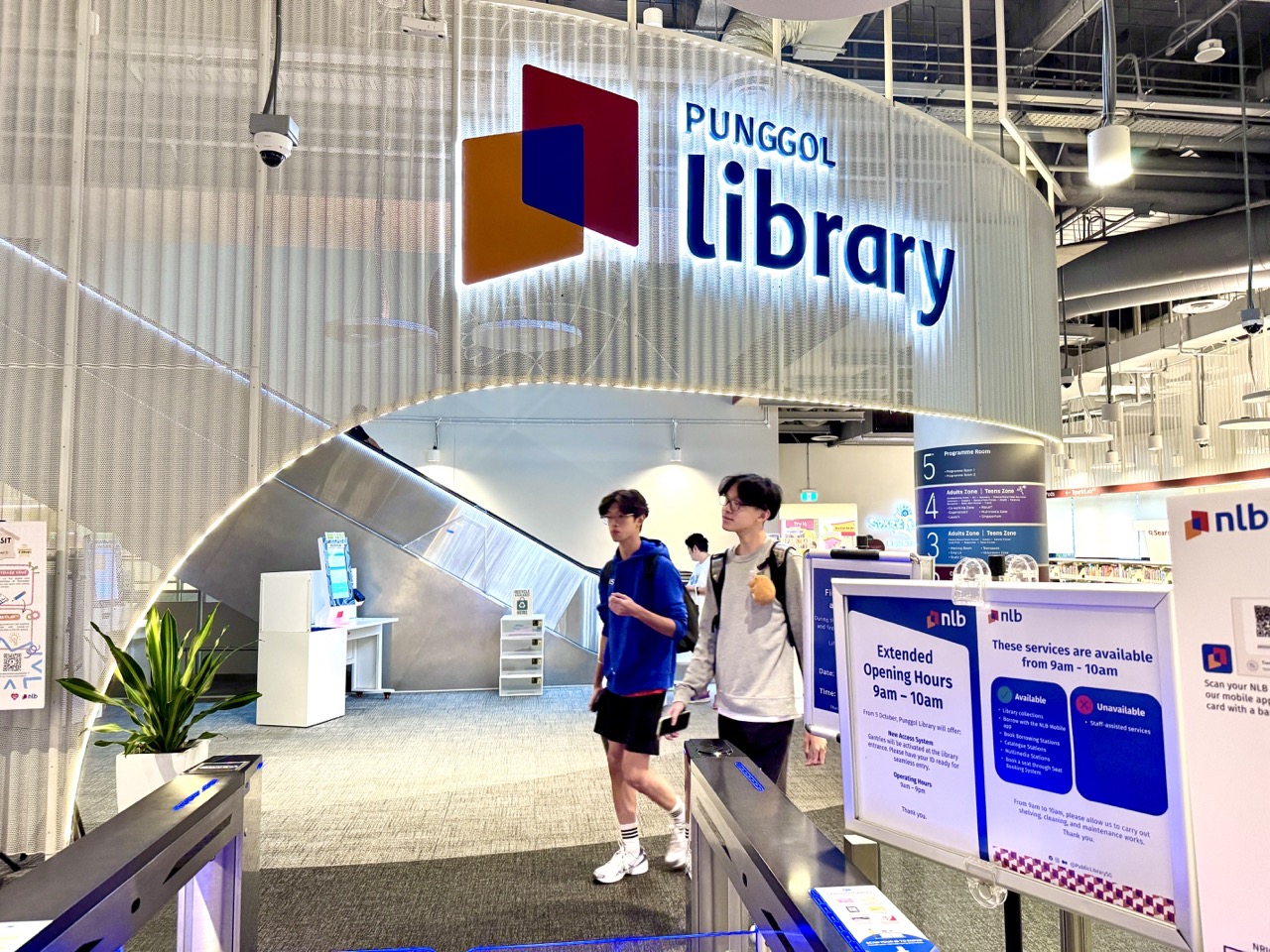
Students admitted to a Punggol secondary school through Posting Group 2 (PG2) can use Punggol Regional Library at One Punggol to strengthen English reading, subject vocabulary, research and independent study. PG2 is an admission group under Full Subject-Based Banding, not a reading-age label or a permanent limit on which books a teenager can understand. The most useful library routine begins with a real school question, an appropriate source, a few accurate notes and a short explanation written in the student’s own words.
Punggol Regional Library is located at One Punggol, 1 Punggol Drive, #01-12, Singapore 828629. It has a dedicated Teenspace and Study Zone on Level 3, alongside physical collections and National Library Board digital resources. For a student from Edgefield, Greendale, Punggol Secondary or Yusof Ishak Secondary, the practical choice is whether a particular visit helps reading or homework more effectively than studying at home. Parents should check the current NLB opening hours, seat-booking rules and borrowing conditions before going, rather than treating the library as an unlimited, always-available classroom.
- PG2 versus G2: PG2 describes Secondary 1 entry; English and other subject levels are confirmed individually.
- Location: Punggol Regional Library, One Punggol, 1 Punggol Drive, Singapore 828629.
- Teen resources: Level 3 Teenspace and Study Zone, with current access and booking requirements to be checked with NLB.
- Reading: choose an achievable book that still introduces new ideas and vocabulary.
- Research: define a narrow question and separate verified source facts from interpretation.
- Notes: record title, publisher, date, page or URL, relevant evidence and a paraphrase.
- Writing: explain the evidence in original sentences rather than copying a passage.
- Digital resources: NLB Mobile, Libby and relevant eResources when membership and access permit.
- Next action: one library visit, one research question and one independently written paragraph.
Why the library is useful even when grades seem fine
A student who receives acceptable English marks can still benefit from encountering unfamiliar genres, sources and ways of thinking. Class tests cover selected skills at selected times; a library offers sustained exposure to language beyond one worksheet. A novel demands attention across chapters, a biography requires the reader to follow causes and decisions, and a well-written science book connects explanations with examples. These experiences develop patience and comprehension that can eventually support school work without turning every reading session into an examination exercise.
For a PG2 entrant, the first year may involve a new school, more teachers and unfamiliar expectations. The library can give the learner a quiet setting in which progress is self-directed. Choosing a book, finding an answer, asking for help appropriately and returning materials responsibly are small exercises in independence. The parent should value these habits alongside test performance. A child who reads willingly and can discuss a source accurately is learning something important even when no teacher has assigned a mark.

Definition lock: PG2 does not prescribe a library shelf
Posting Group 2 is part of Singapore’s secondary-school posting framework. G2 describes the level of a particular subject, such as English Language, under Full Subject-Based Banding. Neither term tells a librarian which novel a child must choose or whether the teenager can enjoy a challenging history book. Readers differ in vocabulary, interests, background knowledge and confidence. A pupil who finds a scientific text difficult may still enjoy sophisticated stories, while another who reads fiction quickly may need support with factual argumentation.
Parents can replace labels with concrete observations. Ask whether the book makes sense, whether the child can explain its main idea and where difficulty begins. One learner may need a shorter text before tackling a long article; another may need more difficult material that rewards sustained attention. The aim is to find an appropriate challenge for that reading task, not to force all reading into one academic category. This respects Full SBB’s broader recognition of varied strengths.
Know which part of One Punggol you are using
One Punggol is an integrated community hub, not a single-purpose school building. The National Library Board operates Punggol Regional Library within it. The library provides different spaces for different audiences; published NLB materials identify the Level 3 Teenspace and the Study Zone. Those functions matter to a secondary-school student. A teen browsing fiction needs a different environment from one who wants a sustained quiet session to revise notes or complete written work.
Before travelling, identify the purpose of the visit. If the child wants a book, check its catalogue status and the appropriate borrowing arrangements. If the goal is focused study, check current seat reservation procedures, access hours and etiquette. If the child hopes to join a workshop, inspect its age guidance and registration requirements. The family will get more value from a purposeful hour than from walking through every floor and hoping to become inspired by the building alone.
Use the established library guide for venue details
Detailed venue logistics are important but can change: opening hours, public-holiday access, study-seat release times and individual programmes may be updated. The existing Punggol Regional Library Guide covers those facilities and floor-by-floor visitor questions. This article intentionally owns a different topic: how a PG2-entry teenager learns from the library. Keeping those subjects separate avoids reproducing a full location guide whenever a parent asks about English reading.
A good routine is to open the NLB information page or check the library’s official notice on the day of the visit. A published schedule is not a promise that seats remain free or every learning facility is open for a walk-in. For school-age students travelling independently, parents should also agree on transport, meeting points, contact arrangements and an appropriate return time. Good educational planning includes both the task and the practical conditions that make it possible.
Begin with a question your child genuinely wants answered
One of the easiest ways to produce shallow research is to ask a teenager to ‘find something about the environment’. That task is so broad that almost any website or book looks relevant. Narrow it. What might explain why some park paths feel hotter than others? How did Punggol change from a settlement with farms and fishing-related activities to a modern residential town? What does a writer gain by choosing a first-person narrator? Each question points towards different sources and evidence.
Ask the child to write the question before searching. Then identify which words are important and what kind of answer would count. A historical question needs dated records and reliable accounts. A science question may need explanation and observations. A literary question requires evidence from the text itself. This one-minute step prevents the learner from collecting impressive information that does not answer the assignment. It is a transferable habit across English, History, Science and project work.
An effective catalogue search is not a sentence copied from homework
Students sometimes type the whole homework prompt into a search field and accept the first apparent match. A more useful method identifies two or three topic terms and tries alternative wording. For a question about Punggol’s history, search terms might include ‘Punggol’, ‘settlement’, ‘farming’, ‘fishing’ and ‘Singapore urban development’. For a question about inference in literature, terms might include ‘narrative voice’, ‘character motivation’ and ‘reading comprehension’. These combinations can lead to more relevant sources than one overlong query.
Teach the learner to read the catalogue record or source description before borrowing. Is the book suitable for the task’s year level and scope? Is it fiction, reference, a primary source or a popular overview? A child should also learn to interpret absence: a missing search result does not necessarily mean the information does not exist. Try a synonym, a broader subject or guidance from authorised library staff. Search is an iterative reasoning process, not a test of typing speed.
Choose a manageable book with one stretch goal
An appropriate book should be interesting enough to sustain reading and challenging enough to introduce something new. One practical test is to let the child read a few paragraphs and explain what happened or what the author is arguing. If every sentence is opaque, the book may require more background knowledge. If it is effortless and repetitive, the child may be ready for greater depth. Avoid demanding a rigid reading age from a teenager based only on the original PG2 posting result.
One useful combination is a comfortable book for regular reading plus a harder source consulted for a specific question. The comfortable book builds continuity and pleasure; the challenging source creates an opportunity for guided vocabulary and reasoning. These functions can coexist. Parents who insist every book must be difficult may inadvertently make reading feel like punishment. Parents who never introduce challenging texts may leave the learner without practice handling complex ideas. Balance is more helpful than a prestige label.
Reading a page is not the same as understanding it
A teenager may reach the last page of a chapter while remembering almost nothing. This happens when attention wanders, vocabulary is unfamiliar or the reader has not built a mental picture of the main argument. Rather than instructing the child to read faster, pause at natural intervals. Ask who or what the paragraph concerns, what changed and why the detail matters. A short verbal summary can expose a misunderstanding before it spreads across the chapter.
For non-fiction, ask what the author claims, what evidence is offered and which key term needs a definition. For fiction, ask what a character wanted and which textual detail supports that interpretation. The child should refer back to the book when uncertain. This is not a contest to guess the parent’s preferred answer. It is practice in using written evidence. The reading becomes active when the learner can support an interpretation and revise it if new information appears.
Build a vocabulary record without filling a notebook with lists
Secondary English benefits from vocabulary, but a long copied list of impressive words often gives the appearance of knowledge without the ability to use it. During reading, select just a few words that matter to the sentence’s meaning. Record each word in its original context, explain the meaning in ordinary language and create a new sentence with the same sense. If the word has a particular emotional tone or technical meaning, note that distinction.
Revisit the word later in a different passage. A student who remembers ‘reluctant’ in one story but cannot recognise it in a report has only partial command. Ask whether it means unwilling, uncertain, slow or forced, and what the context actually supports. The aim is precision. A learner who gains a modest number of genuinely usable words can improve both reading and writing more than one who memorises hundreds of definitions with no transfer.
Use a source log to protect accuracy
When researching a topic, write down the author or responsible organisation, title, publication date if available, URL or book details, and the specific fact or argument the student wishes to use. If the material is in a physical book, record an accurate page reference. For online material, include the date accessed when the information can change. A child should be able to find the evidence again without relying on memory or a random screenshot.
Separate the source’s statement from the learner’s interpretation. For example, a government page may state a park’s four themed zones. The claim that one zone is ‘the most educational’ is the student’s judgement and needs a different kind of support. Labelling the difference avoids accidental overclaiming. This habit will later support Humanities source work and more advanced research. It also makes project writing easier because the evidence is organised before the first paragraph is drafted.
Fiction, non-fiction and reference have different jobs
A novel can help a student practise sustained attention, character inference, imagery and narrative structure. A non-fiction book can introduce explanations, arguments and organised factual knowledge. A reference work can clarify a definition or provide a starting overview. These sources are not rivals. They address different reading purposes, and a student should learn to choose among them. The library’s wide collection can support all three without requiring the parent to prescribe a single genre.
For instance, a student investigating climate and cities might read a narrative about urban life to develop empathy, a popular science account for concepts and an official source for current local policy. The sources do not become interchangeable. A fictional scene cannot prove a scientific trend, and a government fact sheet cannot tell the reader what a novel’s narrator secretly intends. The educational skill is choosing evidence appropriate to the question.
Teach the difference between a claim and a citation
Copying a website’s URL underneath a paragraph does not automatically make the paragraph trustworthy. The source must actually support the specific claim. A student might write that a public facility is ‘always crowded’ and cite a page that merely lists its opening hours. The URL is real, but the reasoning is defective. Encourage the learner to point to the sentence or data that supports the factual statement and explain why it is relevant.
A good practice is to mark the evidence in notes and paraphrase it accurately. If a source says ‘may’, the learner should not rewrite it as ‘will’. If a statistic refers to a year, keep the year attached. If the article concerns one country, do not generalise its findings to the whole world without evidence. Intellectual honesty makes a report more credible even when the conclusion is modest. This is a central research habit that can be practised with ordinary library materials.
Paraphrase means preserving meaning, not swapping synonyms
A student may copy a source sentence and replace every third word, believing this makes it original. That is neither good writing nor good understanding. Ask the child to put the source aside briefly, explain the idea aloud and then write the explanation in their own sentence structure. Compare the new sentence with the original to ensure no important condition or qualification was lost. The source should still be acknowledged where the school requires citation.
If the idea remains impossible to explain without copying, return to the source and identify what is unclear. Perhaps the writer assumes technical knowledge the student does not have. A dictionary, simpler overview or teacher explanation can help. Good paraphrasing follows comprehension. It does not precede it. This distinction is useful for English assignments, Science explanations and Humanities projects, and it protects against accidental plagiarism.
Turn the research into a short argument
After gathering sources, ask the child to answer the original question in one sentence. Then select two pieces of evidence that directly support the answer. Each piece should be followed by an explanation of why it matters. The paragraph can close by acknowledging a limitation or what remains uncertain. This is a simple argument structure, not a formula meant to flatten every writing task. It teaches the student to connect knowledge and reasoning.
Imagine a hypothetical question about why a library has different spaces for teenagers and younger children. Evidence might concern their differing needs for study, reading and participation. The student should explain the function of each cited feature rather than merely list floors. A conclusion such as ‘one design is best for everyone’ would require evidence that the project probably does not have. A measured conclusion is often a stronger conclusion because it is actually supported.
Use the NLB digital collection thoughtfully
Physical library visits are not the only way to read. National Library Board eResources include digital reading and reference material, subject to membership and individual resource conditions. NLB describes NLB Mobile and Libby as ways to borrow and access eBooks or audiobooks, while some online reference sources can be accessed using NLB’s eResources service. Availability, loan limits and formats differ by item, so users should follow the current official instructions.
Digital convenience can help a teenager continue reading during a journey or when visiting the building is impractical. But digital access still requires choices. Encourage the child to download or open one relevant book, set a modest reading goal and record important notes. A phone full of borrowed titles is not the same as reading them. The aim is sustained engagement with text, whether on paper or screen.
Teenspace supports interests beyond examination revision
NLB’s published description of the library identifies a Teenspace intended for young people, offering an environment for browsing and reading. The existence of a teen area matters because adolescents are developing interests that extend beyond the compulsory syllabus. A student may encounter graphic novels, biographies, contemporary fiction or books about technology and social questions. Some texts will support school skills directly; others will keep reading enjoyable and self-directed.
Parents should avoid judging every choice by how many examination marks it might produce. A teenager who enjoys comics may practise visual sequencing, dialogue, inference and sustained reading. Such reading does not replace learning to write formal arguments, but it can form a useful bridge toward other texts. The key is variety over time. Ask what the child liked, whether a new concept appeared and what book they might try next. Curiosity is a good starting point for independent literacy.
The Study Zone is not an entitlement to unlimited seating
Punggol Regional Library’s Level 3 Study Zone is a distinct facility, and published NLB information describes reservable seats and different access arrangements from the main library. A family should verify the current seat-booking system and any time limits rather than assume an empty table can be occupied indefinitely. Spaces are shared with students and other readers who may need quiet working conditions. A student who learns to respect booking and noise rules is also practising community responsibility.
Before travelling for a study session, set a specific task and check whether a seat can be booked as required. Bring the necessary book, notebook, writing tools and suitable device. Avoid carrying an entire schoolbag of optional worksheets. If the space is busy or no reservation is available, have a backup plan, such as borrowing the needed book and studying at home. Educational success should not depend on access to one particular chair.
Plan a forty-minute focused research session
A short, well-designed session can outperform several distracted hours. Begin with five minutes to restate the question and inspect the material. Spend fifteen minutes reading a relevant section carefully. Use ten minutes to select and record two supporting details. Then spend ten minutes writing a paragraph in the student’s own words and checking whether it answers the question. These timings are only an example, not a requirement imposed by NLB or the school.
A child who needs a break can divide the work into shorter intervals. The important thing is that every interval has a purpose. If the student cannot find relevant evidence, do not fill the remaining time with decorating notes. Reconsider the question or the source. A focused session ends with a specific product—an accurate answer, a better question or a clear account of what remains unknown. That gives parents something meaningful to discuss afterward.
When a child says there is nothing interesting to read
The usual response is to assign a classic book and demand completion. That may be appropriate for a school task but rarely solves a broader problem of motivation. Instead, ask which subjects, stories or practical concerns the child already finds engaging. A teenager interested in sports might enjoy athlete biographies, physiology or the history of a sport. One interested in transport might read engineering explanations, maps or accounts of urban planning. These entry points can lead towards more complex reading.
Allow the child to abandon a freely chosen leisure book occasionally, while distinguishing that choice from abandoning assigned schoolwork. Ask what was unappealing: difficulty, slow pacing, unfamiliar background or simply a mismatch of interest. Use the answer to select another title. Reading identity develops through repeated successful encounters with text, not solely through endurance of unsuitable books. A library offers many possible second attempts.
Cross-language reading can enrich understanding
Punggol families may use English alongside Chinese, Malay, Tamil or other home languages. A teenager can sometimes understand a scientific or historical idea more clearly by discussing it in one language before expressing it accurately in another. That is a useful learning strategy when done thoughtfully, but the school assignment still requires the prescribed response language and subject-specific vocabulary. Parents should not assume that every source in one language can be translated word for word into an exact equivalent.
Ask the learner to explain the concept first, then identify which technical terms must be preserved precisely. In an English assignment, ensure the final paragraph is clear and genuinely written by the student. The library’s multilingual collections and resources can support broader interests; current availability should be checked through NLB’s catalogue. Language flexibility can strengthen thought without becoming an excuse to copy a ready-made translation that the student does not understand.
Accessible reading formats matter for different needs
NLB describes Punggol Regional Library as a venue developed with accessibility in mind, offering inclusive spaces and resources. Some readers benefit from larger text, audio or other accessible formats; the appropriate option depends on availability and individual preference. A child who uses an audiobook is not automatically less serious about reading. Listening can support vocabulary, comprehension and engagement, although specific school tasks may require close inspection of written text.
Parents should ask what format helps the student participate and whether it meets the educational task. Do not diagnose a condition from a child’s preferred reading medium or demand disclosure of another patron’s needs. Check the library’s official accessibility information or ask staff about available resources. The principle is simple: provide a useful way into knowledge while preserving the learning objective. Different formats can support different readers without changing what it means to reason accurately.
Keep personal information private during research
A young student may be tempted to create accounts on unfamiliar websites, upload schoolwork containing classmates’ names or photograph other library users for a project. None of those steps is necessary for most ordinary research assignments. Teach the child to use authorised school and NLB resources and to protect personal information. If a website asks for excessive details, ask an adult or teacher before proceeding. If research involves interviews or photographs, follow school-approved consent and safety procedures.
Digital literacy also includes resisting fabricated sources. A page that looks polished may contain invented statistics or misleading quotations. Verify consequential claims through authoritative documents, and avoid presenting generative AI output as independent evidence. The student should know which ideas came from a source and which were their own interpretation. Responsible research protects people as well as accuracy.
A four-week reading and research routine
Week one can establish the library and catalogue habit: choose one book and identify where it came from. Week two concentrates on summarising one chapter accurately, including a key detail. Week three introduces a factual research question, a second reliable source and a short source log. Week four asks the student to write a supported paragraph and identify one remaining uncertainty. This is an optional family routine, not a compulsory NLB programme.
Keep the plan flexible around school tasks and CCAs. Some weeks the student may read more; others may spend time understanding a difficult paragraph. Judge progress by whether the learner can explain a text, find relevant evidence and write independently rather than by the number of books checked out. A parent can encourage without becoming a daily examiner. One thoughtful conversation about an idea may create more curiosity than ten rushed reading logs.
An example: a student investigates Punggol’s changing landscape
Imagine a fictional Secondary 1 student, Aina, who wonders how Punggol changed over time. She begins with a broad online search and finds material about housing, transport and older community memories. Her parent asks her to narrow the question to one period or development. She then checks NLB or other reliable historical sources, records publication dates and distinguishes a first-person memory from an official historical record. She avoids treating an attractive old photograph as proof of every claim in its caption.
Aina writes a paragraph explaining one documented change and explicitly identifies what her evidence cannot establish. She cites the source and keeps a note of the next question. This example is invented; it does not report a specific student’s research or assert an unsupported historical fact. Its purpose is to show how one visit can teach scope, source evaluation, careful language and independent writing. The library becomes useful because the student thinks better, not because the building itself earns marks.
A second example: a learner repairs one English weakness
Imagine another fictional student, Wei, who has difficulty explaining why a character behaves in a particular way. He chooses a short story that interests him and reads a manageable section. Rather than summarising the entire plot, he identifies one action and asks what it suggests about the character. He then selects the line of text that most strongly supports the inference and writes a short explanation. His first answer simply repeats the action; the second connects the detail to the motive.
When he tries a different story, the parent checks whether he can repeat the reasoning without prompts. If not, the learner revisits the distinction between evidence and interpretation. The library provides the text, but the learning happens through explanation, feedback and independent transfer. This kind of focused task supports G2 English work without pretending a library session can guarantee examination results or a change in subject level.
Sources and the next useful step
The People’s Association’s One Punggol hub information confirms the regional library as part of the integrated hub. NLB’s public libraries site and eResources catalogue provide current library and digital access information. For a practical overview of the local venue, consult eduKatePunggol’s Punggol Regional Library Guide.
For school-level context, see the PG2 weekly learning guide. Your next step is to choose one question your child cares about, find a suitable source through the library or NLB’s digital collection, and ask the child to explain the evidence in an original paragraph. Reading becomes a lasting skill when curiosity, accuracy and independent thought grow together.
Frequently asked questions about PG2 reading and Punggol Regional Library
Is the library only for G3 students?
No. Punggol Regional Library serves different age groups and reading interests. PG2 is a school admission category, not a library access restriction.
Where is Punggol Regional Library?
At One Punggol, 1 Punggol Drive, #01-12, Singapore 828629. Check NLB for current opening and access arrangements.
Does the library have a space for teenagers?
Yes. Published NLB information identifies a Teenspace on Level 3. Current use conditions should be checked.
Can my child reserve a study seat?
The Level 3 Study Zone has reservable seats; consult NLB’s current booking procedures, hours and availability.
Should a G2 English student read only easy books?
No. Choose readable material that interests the child, with some appropriate challenge and opportunities to discuss unfamiliar ideas.
Can NLB eBooks replace a physical visit?
For many reading tasks, digital books can be useful. Access and loan conditions differ by item; NLB Mobile, Libby and eResources provide supported routes.
How do I know whether research notes are accurate?
Check that each claim is supported by the actual cited source, with relevant date, page or URL. Separate evidence from opinion.
Should my child copy impressive paragraphs to improve writing?
No. Encourage understanding, accurate paraphrasing, original explanation and attribution according to school requirements.
How long should a library research session last?
Use a realistic duration suited to the child and task. A short focused session producing a clear answer may outperform an unfocused afternoon.
What is the most useful follow-up at home?
Ask the child to explain one idea they learned, identify its source and show how the evidence supports the conclusion.
Editorial note, 1 November 2026: Programme arrangements, access hours, digital resources and study-seat rules can change. Confirm live NLB information before a visit. All student scenarios are fictional teaching examples, not testimonials.


