
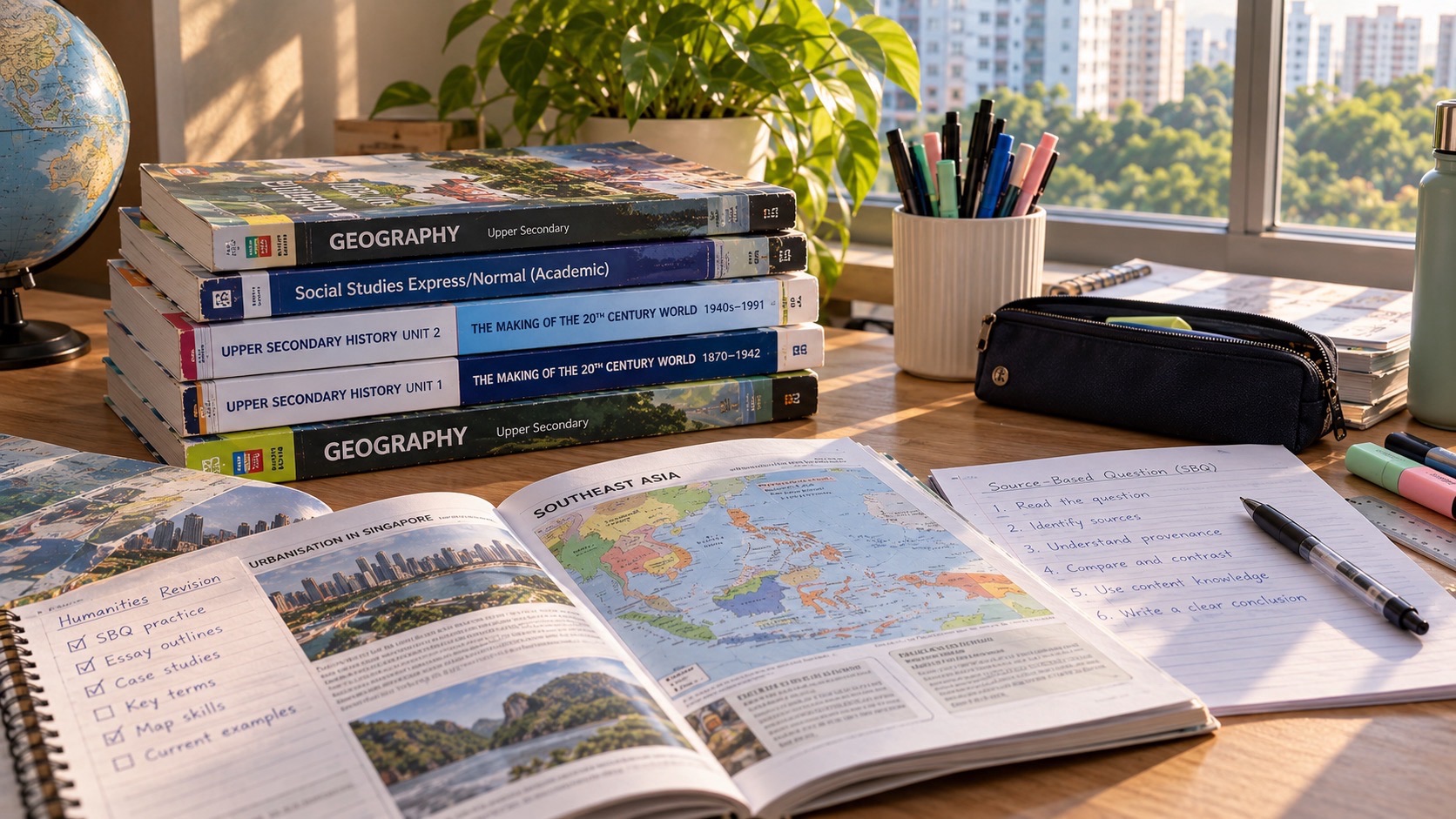
A Punggol secondary-school student admitted through Posting Group 2 (PG2) can improve Humanities work by learning to read a source carefully, identify the question, make a supported inference, compare evidence and explain what the source cannot establish. PG2 concerns Secondary 1 admission; G2 refers to an individual subject level under Full Subject-Based Banding. This article is particularly useful when the child studies History, Geography or a Humanities subject at G2, although the school’s actual curriculum, assessment instructions and subject combination remain authoritative.
MOE’s lower-secondary G2/G3 History syllabus includes source interpretation, inference, comparing viewpoints, distinguishing fact from opinion and using evidence in historical inquiry. For a Punggol family, local histories such as Kampong Wak Sumang and the development of Punggol offer an engaging way to practise these skills, but a local story is not automatically part of every school’s tested syllabus. Here we show how to interrogate photographs, maps, oral histories, websites and written claims without inventing sources or confusing an eyewitness memory with independently established fact.
- Posting and learning: PG2 is admission; the student’s G2 or G3 Humanities level must be confirmed separately.
- Start with the question: inference, comparison, reliability, usefulness and explanation require different answers.
- Source basics: establish who produced it, when, for whom and why.
- Observation: say what the text or image actually shows before interpreting.
- Inference: explain a claim using precise evidence from the source.
- Corroboration: compare independent sources without forcing them to agree.
- Provenance: a primary source may be valuable but still partial or mistaken.
- Punggol context: use verified NLB and National Archives material about past communities, not invented legends.
- Next action: work through one sourced example and write a short justified answer independently.
Definition lock: Humanities reasoning is not determined by posting group
Under Full Subject-Based Banding, Posting Groups serve the admission process, whereas G1, G2 and G3 indicate the level of an individual subject. A child may be admitted through PG2 and have a different subject profile from a friend who entered through the same group. In History or Geography, what matters now is the level actually taught and the kinds of thinking required in the school’s assignments. A generic ‘PG2 Humanities worksheet’ may be unsuitable if it ignores the precise question format and curriculum.
The more useful parent question is, ‘What has my child been asked to infer, compare or explain, and what is missing from the answer?’ A student might have memorised facts but fail to interpret an unseen source. Another might notice subtle details yet lack background knowledge. Both need targeted support. A posting label does not diagnose either difficulty. Start with an actual assessed question and the student’s reasoning rather than an assumption about academic ability.

The question tells you what evidence to seek
Source-based work often goes wrong before the first sentence of the answer. A pupil may recognise an interesting photograph and begin describing it without considering what the examiner asks. The words ‘infer’, ‘compare’, ‘explain’, ‘how useful’ and ‘how reliable’ signal different reasoning tasks. Read the question, underline the command and identify whether the answer concerns a viewpoint, a relationship, a factual detail or the limits of evidence.
For a hypothetical question asking what a photograph suggests about a community’s work, the pupil should not write a general essay about Singapore development. They should select visible details, make a cautious inference and explain the connection. If asked to compare two photographs, one account alone is insufficient. The student needs to examine both. These habits can be taught before memorising any response template. Accurate reading of the task saves effort and improves relevance.
Read the source caption before making assumptions
A photograph may show people, buildings and objects, but its caption can supply the date, location and context that determine how it should be interpreted. A picture of a kampong said to be from one decade cannot be treated as an image of Punggol in every decade. A map produced for surveying may highlight boundaries differently from a tourist map. Always inspect the source title, date, author or collection when available, and any limitations mentioned by its publisher.
Captions themselves can be wrong, outdated or incomplete, so treat them as evidence to consider rather than unquestionable truth. If the image is from a curated National Library Board collection, record the credited archive or photographer. If a social-media account provides no provenance, do not build a confident historical argument upon it. Accurate source identification is an essential step in Humanities, not a decorative citation added after the answer is written.
Observation comes before inference
An observation is something the source directly provides. A photograph may show wooden structures, a road and several people carrying goods. An inference might be that trade or transport was taking place, depending on the objects and surrounding context. The learner needs to connect the interpretation to visible details rather than claim to know the people’s exact beliefs or identities. The more dramatic the inference, the more evidence it needs.
A useful home exercise is to ask the child to make two columns: ‘what I can see’ and ‘what that may suggest’. If an idea cannot be placed in the first column, it may belong to background knowledge or speculation. Then ask whether the source permits more than one reasonable interpretation. This method teaches the student to reason with care rather than simply invent a colourful historical story. Evidence limits are a strength, not a failure of imagination.
Make an inference and explain the link
Suppose a fictional historical source describes residents travelling a long distance to obtain fresh water. A possible inference is that water access was inconvenient for those residents. But a complete answer also explains how the detail supports that conclusion. ‘They walked far for water, which suggests a nearby reliable supply was not easily available’ makes the connection explicit. The learner should not add claims about disease, poverty or household income unless the source or relevant contextual evidence supports them.
The example is invented for teaching; it is not a factual quotation about Kampong Wak Sumang. To practise, select a genuine paragraph from an authorised textbook or a clearly attributed historical source. Ask the student to write one inference, identify the supporting words and explain why those words matter. Then use a new passage to test whether the method transfers beyond the first example.
A useful inference need not be dramatic
Many students believe an inference must uncover a secret motive or a surprising conclusion. In practice, a modest statement well supported by evidence can be stronger than a dramatic claim. A source showing a small communal gathering may support the idea that people met for a shared activity. It cannot, by itself, prove that the entire village was harmonious or that there were no disputes. The task is to draw warranted conclusions, not produce the most emotional story.
Parents can model restraint by asking, ‘How far does this piece of evidence really take us?’ If the child answers with ‘everyone’, ‘always’ or ‘never’, ask whether the source covers all people and all times. This is a valuable habit well beyond examinations. Public claims about politics, science, neighbourhood developments and social issues often suffer from the same over-generalisation. Humanities can help a teenager recognise it.
Compare sources by criteria, not by copying quotations
A comparison question requires a relationship between at least two sources. First identify a common topic: perhaps the difficulty of transport, the value of a public space or a community’s response to change. Then examine whether the sources agree on that aspect, disagree or emphasise different parts. A source about work and another about leisure might not be contradictory at all; they may simply answer different questions. The comparison must name the relevant issue clearly.
A useful sentence might explain that both accounts portray a location as busy, but one emphasises commerce while the other emphasises recreation. The student then gives a supporting detail from each source and explains the similarity or difference. This is a generic method; exact marks and response structures follow the school’s task. A comparison that only summarises Source A and then Source B without connecting them is usually less convincing than a focused, evidence-supported relationship.
Different perspectives do not automatically mean one source is false
Two witnesses can describe the same development differently because they experienced different consequences. A trader may remember increased customers, while a resident may remember noise or inconvenience. Their accounts may both be genuine within their perspectives. The student should investigate context and specific claims before declaring one source biased or dishonest. Bias can influence emphasis and selection, but the mere existence of a viewpoint does not make evidence useless.
Ask whose experience is represented and whose is missing. What was the author trying to communicate? What information might they reasonably know? The answer should avoid mind-reading. A memoir may convey how an event felt without proving every numerical claim. An administrative record may document a policy while revealing little about individual emotions. Together, different kinds of sources can provide a richer and more careful account.
Provenance changes how a source can be used
Provenance refers to where a source came from: its creator, date, audience, purpose and circumstances. A newspaper report from a period may document contemporary reactions; a retrospective interview may give an eyewitness’s later memories; an official map may record geographical boundaries for a particular administrative purpose. Each can be useful, but for different questions. Students should examine provenance when it materially affects what the source can tell them.
Do not teach a blanket rule that official sources are always unbiased or personal accounts are always unreliable. Evaluate the actual claim, context and evidence. A government document can accurately state a policy but not capture every person’s experience. A witness may provide valuable everyday detail while misremembering a date. The student should explain those strengths and limitations instead of ranking source types mechanically.
Reliability requires a reason linked to the claim
When asked whether evidence is reliable, some students write ‘It is reliable because it is from the internet’ or ‘It is unreliable because the author is biased’. Neither is sufficient. The answer should assess whether the source is likely to give accurate information about the specific matter in the question. Consider the creator’s access to information, possible incentives, date, consistency and external confirmation. A source might be reliable for what its author believed but less reliable for an exact population figure.
Practise with a fictional example of a resident remembering that a neighbourhood used to be quiet. The account may be useful evidence of personal experience, but it cannot establish exact daily traffic counts without supporting records. A thoughtful answer distinguishes what can be trusted from what needs corroboration. That is more sophisticated than treating reliability as a single yes-or-no label applied to an entire document.
Usefulness depends on the enquiry
A source can be limited and still useful. An old photograph might not reveal why a development happened, but it can show the appearance of a place at a specific moment. A personal interview might not give precise economic statistics, but it can describe how a change affected one household. If the question asks about living conditions, such detail may be especially relevant. Usefulness therefore depends on the purpose of the investigation and the kinds of conclusions the source can support.
Ask the child, ‘Useful for what?’ before allowing a generic answer. Then identify one contribution and one limitation, with reasons. If a source is missing context or covers only one person’s experience, say so precisely. Avoid calling it worthless simply because it does not answer every question. Historical inquiry often builds understanding by combining imperfect but complementary evidence.
Corroboration means checking independent evidence
Corroboration involves comparing a claim with other relevant evidence. If a memory describes a major local change in a particular year, look for a dated map, report or archival document that can confirm the timing or provide context. A second website repeating the first without attribution may not be independent confirmation. The student should ask whether the sources have different origins and whether they are truly talking about the same event.
When sources agree, the confidence of a narrow claim may increase. When they conflict, investigate the dates, definitions and perspectives before deciding what the difference means. Do not force agreement. For a Punggol history exercise, curated material from the National Library Board and National Archives can provide valuable starting points. The purpose is not to gather the greatest number of links; it is to understand what each source adds to the answer.
A Punggol example: Kampong Wak Sumang
The National Library Board’s BiblioAsia article on Kampong Wak Sumang explains how books, oral history interviews, maps, newspaper reports and artefacts can help reconstruct a Punggol community that no longer remains physically intact. This is a rich illustration of historical inquiry because no single source captures the complete experience of the kampong. Published material also discusses how residents relocated during the twentieth century as the area changed.
A student can examine the article’s stated evidence and ask which claims come from official records, which from remembered accounts and which from a later historian’s synthesis. For example, a story about a well believed to have healing qualities reveals something about community beliefs, but it should not be repeated as scientific proof that the water cured disease. Distinguishing historical belief from verified medical effect is a powerful lesson in careful reading.
The 1844 and 1985 maps ask different questions
The BiblioAsia account references an 1844 geographical map showing Tanjong Pongol and a 1985 survey map connected to Kampong Wak Sumang. The maps were produced in different periods and for different purposes. They should not be compared as though every road and coastline were measured with identical methods, scales and conventions. A historian could ask what geographical names appear or how different records depict the area, while also acknowledging uncertainty.
A student should check the captions and archival credits before making a statement about reclamation, the exact location of old structures or the age of a modern road. Some historical locations cannot be fixed precisely from the published sources. Good work states that uncertainty instead of drawing an exact invented boundary on a current map. Historical maps are evidence, not interactive directions promising a visitor can walk to an old landmark today.
A location name is a clue, not complete proof
Punggol contains place names that may remind residents of earlier communities, but a similar name is not sufficient evidence that a modern building occupies precisely the same historical site. For example, Sumang Walk and Sumang Link prompt questions about the name’s history. The NLB article provides researched context, while exact historical boundaries require careful archival interpretation. A child’s modern observation of a street sign cannot settle the full historical story on its own.
This is useful for teaching the difference between a research question and a conclusion. The sign may inspire curiosity. The learner then consults sources, checks dates and considers what is known. A strong paragraph might explain the connection reported by an identified curator and state what the material does not establish. Avoid inventing a romanticised tale of a village simply because the name sounds old.
Geography uses evidence too, but asks different questions
History often asks how we know what happened in the past. Geography examines spatial patterns, environmental processes and human relationships with places. A Geography task might ask students to interpret a map, compare data across locations or explain an observed pattern. Those activities also require source awareness: when was the data collected, what area does it cover, what units are used and what limitations exist? A map’s attractive design cannot compensate for missing context.
Parents can help students switch lenses deliberately. A historic map may be a source for changing representations of Punggol. A current land-use plan may explain designated uses and planning intentions, not guarantee that every proposed building has been completed. A weather table may show conditions during the recorded period, not prove the climate of all Singapore. Evidence-based Geography begins by naming the spatial or environmental question accurately.
Read the legend, scale and date of a map
A map is a selective representation. Its colours, symbols and labels mean something only when interpreted through the legend and date. Students should identify orientation, scale where provided and the boundary of the area shown. If a planning map uses coloured zones, those categories need to be read from the official key rather than guessed from familiar colours. A scale can help estimate distance, but it does not necessarily indicate the walking path or travel time between places.
Use a public map only for the question it can support. Ask whether a feature is current, proposed or historical. If the date is missing, acknowledge the limitation. A student who checks map metadata is learning more than how to read coordinates. They are learning that an apparently objective image can still reflect choices about what information to include and omit.
Photographs can show appearance but not invisible causes
A photograph of a canal, housing block or park can document visual features at one moment. It may not explain who authorised a design, what the land was used for decades earlier or how every resident feels about it. To answer those questions, other sources are needed: planning documents, historical records, interviews or measured surveys. Young learners often infer too much from a dramatic image because it appears immediately convincing.
Teach the child to state what a photograph actually supports. If people appear walking in a park, it demonstrates that some people were there at that moment, not that the park is always crowded or universally popular. If a building looks new, appearance alone cannot establish the completion date. A careful Humanities response combines a measured observation with properly attributed context. The best conclusion may be narrower than the student’s first impression.
An oral-history source gives a perspective, not a complete census
Oral histories are valuable because they preserve people’s experiences, language, memories and interpretations. A person recalling life in a former kampong may describe social relationships, work or everyday routines that official statistical records barely mention. But memory can be selective and shaped by the passage of time. A child’s analysis should respect the interviewee while asking which details can be independently supported and whether another person might have experienced the period differently.
The objective is not to accuse older witnesses of dishonesty. It is to understand what kind of evidence a remembered account provides. Ask who was speaking, how long after the events the interview occurred and what the original question asked. The National Archives of Singapore and NLB provide useful examples of how recorded recollections can be preserved and contextualised. A respectful student does not turn uncertainty into ridicule.
When a source contains a legend or miracle claim
Historical records sometimes describe beliefs in healing objects, unusual events or supernatural explanations. Such accounts can be important evidence of what people believed or how a community told its stories. They do not automatically establish that the reported physical effect occurred. For example, the BiblioAsia discussion of a well associated with Kampong Wak Sumang treats healing claims as part of remembered community belief. A responsible student must preserve that distinction.
A weak answer repeats ‘the water cured illness’ as established fact. A stronger answer says that some residents believed the well had healing qualities, attributing the belief to the source and avoiding a medical claim. The student can then ask what that belief might suggest about local culture without implying that every resident shared it. Humanities teaches the ability to understand the past on its own terms while respecting the limits of evidence.
How to distinguish fact from opinion
A factual statement can, in principle, be checked against evidence: a publication date, a named location, a recorded action. An opinion expresses a judgement, such as whether a development was beautiful or a policy wise. Many passages mix the two. Students should learn to separate a verifiable component from an evaluation. ‘A park opened in a particular year’ and ‘it was the best improvement’ are different claims requiring different support.
Ask the learner to underline words that signal evaluation: best, terrible, unfair, impressive or disappointing. These do not automatically make a sentence wrong, but they show a viewpoint. Then examine any supporting evidence. Opinions can be reasoned and important; they simply should not be mistaken for neutral measurements. This distinction helps students in History, Geography, English and responsible online discussion.
Background knowledge should illuminate, not replace, the source
Students sometimes memorise a topic well and then answer every source question with an essay on that topic. Background knowledge is valuable for interpreting context and identifying what a source may omit. But when the question asks about evidence from a particular document, the learner must still engage with that document. A rehearsed account of Singapore’s development cannot substitute for comparing two given statements about a specific event.
Use the sequence: read the source, identify the task, make the point, cite relevant detail, explain and add accurate contextual knowledge only where it advances the answer. If the contextual claim comes from another source, it must be correct and appropriate. Do not paste unrelated facts to make an answer look more sophisticated. Disciplined selection usually produces a stronger response than sheer volume.
A worked hypothetical inference paragraph
Imagine a fictional source describing a small community organising a shared meal after a difficult day of work. The question asks what the account suggests about relationships. A concise response might infer that neighbours sometimes cooperated socially, then cite the described meal and explain how the shared activity supports that inference. It should not conclude that the whole community never argued, because the source provides no evidence for such an absolute claim.
The exercise is fictional and should not be quoted as an archival account of Punggol. Its value lies in the reasoning structure. Ask the child to separate inference, evidence and explanation and then rewrite the answer using a different hypothetical source. If the student repeats the same conclusion regardless of the text, the method has not transferred. A successful response changes when the evidence changes.
A worked hypothetical comparison paragraph
Suppose Source A describes a route as convenient for a trader, while Source B describes the same route as difficult for a parent with a young child. A student should first identify the question: are the sources inconsistent about a fact, or do they reflect different needs? They may both be plausible. The comparison can say that the accounts differ in their evaluation of convenience, then explain each perspective using specific details.
Avoid inventing a numerical average or declaring that one author must be lying. This is a fictional source pair created to demonstrate comparison, not evidence about any current Punggol transport service. The student learns that perspectives can vary without making factual corroboration irrelevant. When writing the answer, include clear linking words and explain the basis of the difference. Accurate comparison requires both sources to appear in the reasoning.
Use a claim-evidence-reasoning grid
Create a three-column grid with the claim in the first column, the supporting source detail in the second and the explanation in the third. A fourth column can record a limitation or context if needed. The format is simple enough for a lower-secondary learner to use with a historical paragraph, map or photograph. It makes missing reasoning visible: if the evidence column is blank, the claim may be unsupported; if the explanation is blank, the relationship has not been shown.
Parents should not fill the grid for the child. Ask questions that reveal thinking, then let the student write in their own language. After one guided example, provide another source and ask for an independent attempt. The goal is not to create a lifelong dependency on one template. It is to teach a mental habit of connecting what is claimed with why it is justified.
How to avoid fabricated citations
A student researching a topic may encounter confident online summaries or AI-generated paragraphs that attach plausible but nonexistent references. Before citing anything, open the original source, check that it exists and confirm that it supports the specific claim. Do not assume a quote is authentic simply because a search result displays it. If an exact quotation is important, inspect the page or original document and reproduce only what school rules permit.
Record author, publisher, date and a page or accessible URL. If the source has no verifiable author or date, consider whether it is suitable for the task. NLB and National Archives collections can provide transparent provenance for local history material, but even those items require careful interpretation. The learner should be able to show where each claim came from. Research integrity is part of historical reasoning, not an administrative chore.
A local research visit can be useful without collecting personal data
Punggol Regional Library’s Punggol Stories exhibitions and curated material offer an opportunity for students to explore local history. A visit can prompt questions about old maps, community memories and changes in land use. It does not authorise the learner to record strangers, reproduce copyrighted material without permission or gather private family histories from other visitors. School research must follow exhibition rules and any teacher instructions.
Ask the child to note one exhibited fact, one attributed source and one question they still have. A short, accurate record can support a meaningful paragraph at home. If photography is restricted, respect the rule and use written notes or an officially provided catalogue. The purpose is to engage with evidence responsibly, not to collect the greatest possible number of images. A careful visitor can learn considerably while preserving other people’s privacy and the collection’s integrity.
A seven-day source-analysis routine
Day one: identify the question type. Day two: extract two relevant details from a clearly sourced passage. Day three: make a cautious inference. Day four: compare another source on the same topic. Day five: check provenance and distinguish perspective from factual error. Day six: write a short independent answer with a limitation. Day seven: review the answer against the actual task and ask what evidence is missing. This is a home-learning illustration, not a school’s mandated sequence.
Each session can be short and adapted to the child’s current Humanities material. If the student confuses observation and inference, do not rush ahead to reliability essays. Repair that distinction first. When the learner can explain a new source without prompts, increase complexity. A tutor or teacher may provide more suitable sources from the current syllabus. Practice succeeds when it creates independent thinking, not when it produces a notebook full of memorised phrases.
How to review mistakes without memorising model answers
When a source-based answer receives a weak mark, ask which element failed. Did the child misunderstand the question? Was the inference unsupported? Was the comparison limited to one source? Did the explanation overlook provenance? Those errors require different repairs. Copying a full model answer may show what a finished response looks like, but it does not establish why the student’s reasoning was incomplete.
Use a correction routine: identify the first failed step, explain the principle, retry the same kind of question with different material and revisit it later. Keep one carefully explained example of improvement. Do not promise that learning a fixed set of sentence starters will guarantee a particular grade. The actual assessment criteria belong to the school and, for national examinations, the relevant SEAB syllabus. Reliable reasoning is the foundation for adapting to different tasks.
Local context should support, not distort, school learning
Punggol is a compelling place to practise historical and geographical enquiry because it has visible new developments and documented older communities. But a student’s school may be studying a different period, country or topic entirely. A local example is useful for practising the transferable method; it does not replace the required content. Parents should match support to the actual curriculum and ask the teacher when unsure whether an external resource is appropriate.
This is particularly important under Full SBB, where subject levels and learning sequences vary. A teenager who can analyse a Punggol heritage source may still need to know the specific historical actors, time period and concepts assigned in class. The home exercise should make a skill clearer, then transfer it back to the school material. Curiosity and examination readiness can complement each other without being confused.
Official sources and the next step
MOE’s Lower Secondary G2/G3 History syllabus describes historical inquiry and source-based skills. For national examination planning, SEAB’s 2027 G2 syllabus list identifies Humanities combinations, while the assigned school’s actual subject levels and tasks govern lower-secondary learning. For documented Punggol history, read NLB’s Kampong Wak Sumang research and Punggol Stories.
For broader PG2 learning, see the project and evidence guide, which concentrates on collaborative work rather than source-based Humanities responses. Your next step is to open one real source, identify its creator and date, and ask the child for one inference supported by an exact detail. Then have them explain what the source cannot establish.
Frequently asked questions about PG2 Humanities source work
Does PG2 mean every Humanities subject is taken at G2?
No. Confirm the student’s individual subject levels and actual school offerings under Full SBB.
How should a source-based answer begin?
Read the question type, state a relevant inference or comparison and cite evidence that supports it.
What is the difference between observation and inference?
Observation reports what the source directly supplies; inference interprets what those details may suggest.
Are old photographs always reliable?
They can be valuable for visible features at a documented time, but context, caption accuracy and what is outside the frame matter.
Is a biased source automatically useless?
No. A viewpoint may make a source especially useful for understanding a person’s perspective, even when factual claims need checking.
What is corroboration?
Comparing a claim with genuinely independent, relevant evidence, without pretending differences automatically invalidate either source.
Can an oral-history interview be used as evidence?
Yes, especially for remembered experiences. Interpret its timing, perspective and limitations and corroborate factual details when needed.
Can students use Punggol Stories for a school task?
It can support learning where relevant, subject to the teacher’s actual brief and exhibition permissions. Local material is not necessarily the tested syllabus.
Should children memorise a full model answer?
Understanding the reasoning structure and practising unfamiliar sources is more transferable than copying complete answers.
What is the most useful home exercise?
Choose one attributed source, identify a specific detail, write one supported inference and explain one limitation.
Editorial note, 1 November 2026: Real Punggol historical references are attributed to NLB; hypothetical passages and example pupils are invented for instruction and should not be cited as archival sources. The school’s actual task and current MOE/SEAB syllabus take priority.


