
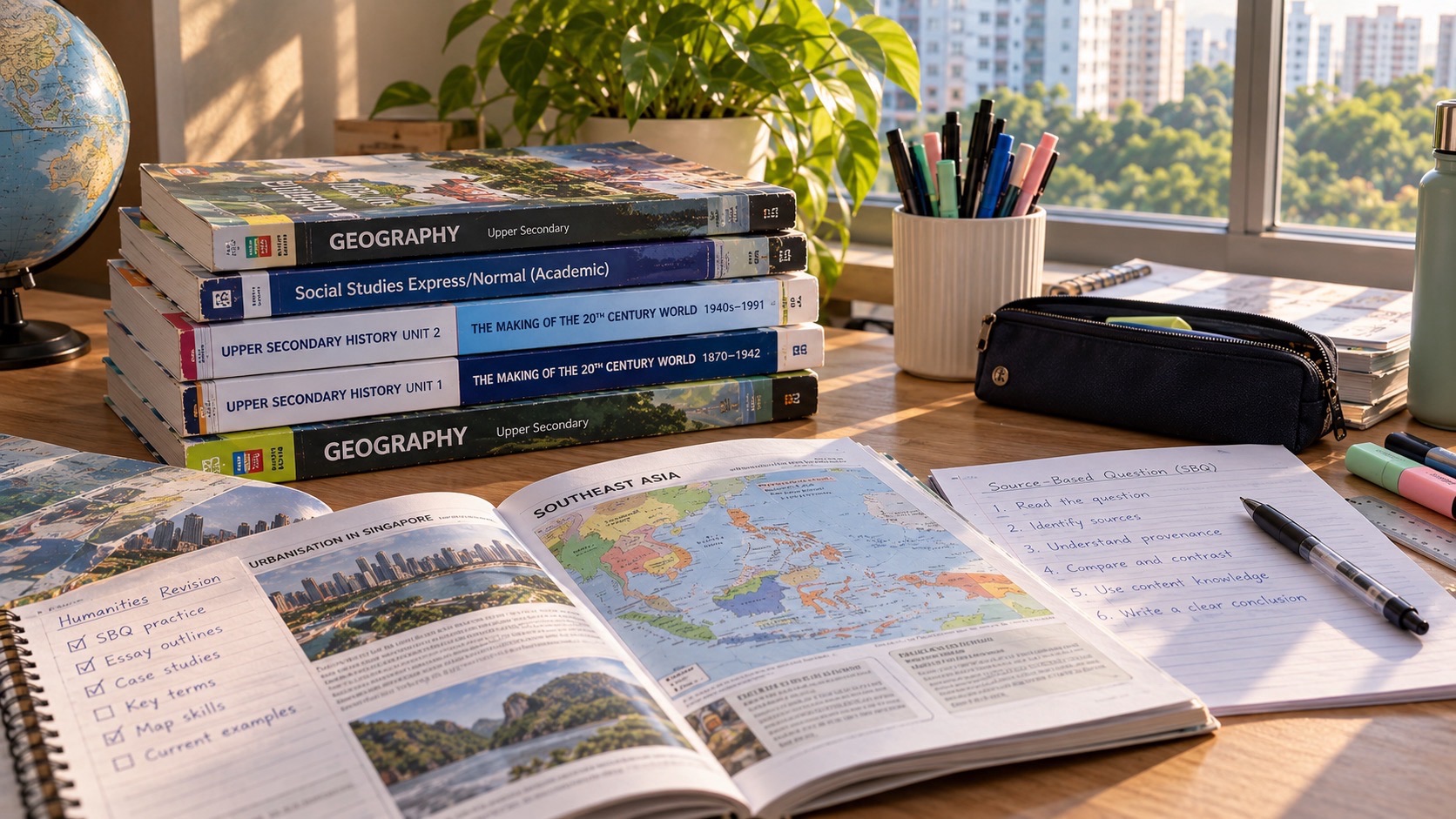
A Punggol student admitted to secondary school through Posting Group 2 (PG2) can learn G2 History by tracing how Singapore participated in regional trading networks before 1819, why a British trading post was established, how the port developed and how different migrant communities contributed to its growth. PG2 is a Secondary 1 admission group; G2 describes the level of an individual subject under Full Subject-Based Banding, and the actual History offering must be confirmed. A reliable answer should distinguish historical evidence from legend, explain multiple causes and recognise that Singapore had a history of trade and settlement long before the arrival of the British.
MOE’s 2021 lower-secondary History syllabus, updated in May 2024, identifies Unit 1, ‘From Temasek to Singapore (1299–Early 1800s)’, and Unit 2, ‘Singapore’s Development as a Port City Under the British (1819–1942)’. National Library Board research discusses fourteenth-century trade, archaeological evidence and early written accounts, while National Heritage Board sources explain the 1819 treaty, the free-port policy, port activity and migrant communities. Families at Edgefield, Greendale, Punggol Secondary and Yusof Ishak Secondary should follow the current school chapter and use the period-specific sources. This guide teaches a sourced chronology, causal explanations, comparison of communities and fair consideration of colonial power rather than memorising a simplified ‘Singapore began in 1819’ story.
- PG2 versus G2: school entry and individual subject level are distinct.
- Before 1819: Temasek was part of regional maritime trade networks, with fourteenth-century written and archaeological evidence.
- Historical sources: distinguish inscriptions, maps, objects, chronicles and later interpretations.
- Regional change: the decline of Srivijaya, rise of Melaka and Johor connections belong to the syllabus context.
- 1819: British East India Company representatives negotiated a treaty with local Malay rulers to establish a trading post.
- Free port: trade policies and location contributed to maritime activity, alongside labour and wider regional conditions.
- Migrant communities: people arrived from different places and filled varied roles; avoid stereotypes and simplistic hero stories.
- Continuity and change: the British period transformed port governance without creating the island’s entire history from nothing.
- Next step: place five sourced developments on a timeline and explain one causal connection with evidence.
Definition lock: PG2, G2 and historical understanding are not the same
Posting Group 2 facilitates admission to a secondary school. Under Full Subject-Based Banding, a child may study individual subjects at different levels when the relevant criteria are met. History is a humanities discipline, and its lower-secondary syllabus describes particular periods and questions. The original PG2 label does not determine which chapter a school currently teaches, nor does it establish the student’s talent for understanding human decisions or evidence.
A responsible family therefore starts with the current History textbook or teacher’s source pack. Is the task to identify a chronology, explain geographical advantages, assess a historical source or compare different migrant communities? These are distinct reasoning goals. An answer full of dates may still fail a cause question, while a rich historical anecdote may be irrelevant to a specific source-analysis task. Good learning follows the actual question.

Singapore’s history did not start in 1819
The island and surrounding waters had communities, trade relationships and political significance before the British East India Company established a trading post in 1819. National Library Board material describes documentary references to Temasek and archaeological finds dating to the fourteenth century. The lesson for students is not that the British period was unimportant, but that the historical story has earlier layers that must be acknowledged.
Ask the child what kinds of evidence support a precolonial trading presence. Written accounts, ceramics and other archaeological objects provide different kinds of information. They may reveal material exchange without telling historians every detail about residents’ daily life or political authority. An accurate account recognises what can be established and what remains uncertain. It avoids both erasing early history and pretending the evidence answers every question.
What Temasek means in the syllabus
Temasek or Temasik is a historical name associated with Singapore’s early past. MOE’s lower-secondary unit frames early Singapore within trading networks across Southeast Asia from the late thirteenth century onwards. Students should not assume that every document uses the same spelling or that one name proves a fixed political boundary identical to modern Singapore. Names can reflect languages, contexts and later transcription practices.
When reading a source, record which term its author uses and the approximate date of the record. If the text refers to Singapura, Temasek or another place name, check whether they are being used for the same settlement, region or historical tradition. Accurate vocabulary helps prevent anachronisms. A place can have a long history under changing names and authorities.
Written accounts have a creator and purpose
The fourteenth-century trader Wang Dayuan described places in Southeast Asia in Daoyi Zhilue, providing an important external account of early Singapore. Later Malay court chronicles such as the Sejarah Melayu also preserve narratives about rulers and origins. These sources differ in creation date, audience and purpose; historians do not use them as interchangeable eyewitness reports.
Ask who wrote the text, when it was produced and what the writer may have wished to record or legitimise. A trader may be interested in ports and commerce, while a court chronicle may support political lineage and collective memory. Neither can be dismissed simply because its perspective differs, but neither should be taken without critical context. The quality of a History answer depends on the question and the appropriate evidence.
Archaeological finds contribute independent evidence
Archaeological materials recovered near Fort Canning and the Singapore River provide evidence of settlement and connections with trading networks in the fourteenth century. National Library Board and heritage institutions describe finds including ceramics and other artefacts. Objects can suggest exchange, use or status, but their interpretation depends on archaeological context, dating and comparison with other evidence.
A pupil should not claim that a single imported pot proves the exact number of merchants or that all residents were wealthy. Artefacts establish some activities and relationships more strongly than others. Ask what the object is, where it was found and which inference is justified. Good historical reasoning moves from observed evidence to cautious interpretation rather than filling gaps with invented biography.
Legends and history are related but different
Stories associated with Sang Nila Utama and the naming of Singapura are important to historical memory and political narratives. They are not identical in evidential status to archaeological finds dated through research. National Library Board explicitly discusses how some chronicles were composed to support claims of rulership and lineage. A student should attribute legendary accounts accurately rather than present every episode as an independently verified event.
This does not mean that literary or legendary material has no historical value. Such works can reveal ideas about legitimacy, identity and the stories communities told about their past. The question matters: what happened in a precisely documented year is different from what an account suggests about a later court’s political worldview. Distinguishing these enquiries is a sign of mature History understanding.
Geography helped create port opportunities
Singapore’s position near maritime routes linking the Indian Ocean and South China Sea made its surrounding waters important to shipping and exchange. The exact significance varied across periods and regional trading systems. A student should explain how location relates to navigation, exchange and access to markets rather than write only that Singapore is ‘in a good place’. The mechanism connects geography with commerce.
Ask what traders needed from a port of call, such as access to routes, exchange opportunities and suitable maritime conditions. Geography creates possibilities but does not guarantee that a port prospers forever. Political decisions, competition and external developments can change those opportunities. A strong historical explanation includes both location and wider circumstances.
Ports depend on networks, not only coastlines
A port is more than land beside the sea. Trading activity depends on ships, merchants, goods, information, institutions and connections with other places. A coastline can be geographically convenient yet have limited trade if the relevant networks change. Students should therefore examine how Singapore was linked to regional and international commerce rather than attribute every development to one natural harbour feature.
A conceptual map can show several ports exchanging goods across the region. Ask why the routes matter and what could change them. A network explanation is stronger than a slogan about ‘strategic location’ without evidence. The same principle helps students understand the later British free-port policy and growth of a colonial entrepôt.
Srivijaya and changing regional power
The lower-secondary syllabus includes the fall of Srivijaya among the external circumstances relevant to early Singapore’s rise as a port of call. This is not a claim that one kingdom’s decline instantly created Singapore. Changing regional political and trade arrangements could shift opportunities among ports, including those participating in trade with China and other regions.
Ask the learner to distinguish a background condition from a directly documented local event. A regional change may help explain why a trading location became more significant, while maritime geography and merchant networks also mattered. Avoid an explanation that reduces a complex process to one dramatic date. Good History describes interactions and uses source-backed chronology.
Melaka altered regional trading patterns
The rise of Melaka in the fifteenth century changed the regional importance of ports and trading networks. MOE identifies Melaka’s founding and growth among reasons for the decline in early Singapore’s relative prominence. A student should not assume that this meant the island became completely empty or ceased to have any connections. Relative prominence is different from total abandonment.
Ask which trade or political functions shifted and what evidence supports the comparison. A careful answer can explain competition and changing regional centres without claiming a sharp end to all human activity. Historical development is often uneven, with continuity alongside change. This is a richer account than memorising that one port simply replaced another overnight.
Portuguese, Dutch and Johor influence matters
The lower-secondary History syllabus connects early Singapore’s changing significance with the continued importance of Melaka under Portuguese and Dutch control and with the Johor Sultanate. These regional powers and networks shaped the political and commercial context before the British trading post. The student should avoid describing the pre-1819 region as if it contained only one European power and no Malay political institutions.
Ask who controlled particular ports at particular times and how this affected trade relationships. The child’s school materials determine the expected depth, and some details may be beyond the immediate G2 scope. The key is to recognise shifting political contexts rather than impose modern borders and institutions on past events without explanation.
1819 involved existing local rulers
National Heritage Board material records that Stamford Raffles and William Farquhar arrived in early 1819 on behalf of the British East India Company and negotiated with local Malay authorities, including Temenggong Abdul Rahman and Sultan Hussein Shah. A treaty was signed on 6 February 1819. This was an important new colonial trading arrangement, but it did not mean the island was uninhabited or politically ownerless beforehand.
Ask the student to identify the actual parties and distinguish their interests. The British East India Company was a powerful commercial and political organisation, and the negotiation occurred in an unequal imperial context. The treaty’s existence is a historical fact; assessing its power relationships is part of responsible explanation. A good answer does not erase local agency or portray colonial expansion as a purely benevolent business transaction.
Raffles and Farquhar had different roles
Historical accounts of early colonial Singapore involve more than one administrator. Raffles played a leading role in the trading-post policy and treaty arrangements, while Farquhar served as the early Resident and contributed to the settlement’s practical administration. Different sources may emphasise their contributions differently. A student should not attribute every decision to one famous name merely because a monument or textbook heading features that person.
Ask which event or policy the question concerns and who was actually involved. If an assertion about one person’s action requires a source, use the assigned material or reputable museum research. Historical agency is distributed among leaders, officials, merchants, workers and local rulers. Naming that diversity makes causal explanations more credible.
The free-port policy encouraged trade
National Museum research describes Singapore’s early British trading port as open to vessels from different nations, with a policy of free trade that attracted merchants and ships. The policy reduced important barriers and helped position the settlement within regional networks. But it would be inaccurate to say that no regulations, taxes or controls of any kind ever existed throughout the colonial period.
Ask what a free-port policy changes for traders and why that might affect destination choices. A lower barrier can make a port more attractive when combined with location, security and market links. A strong answer names the mechanism instead of repeating that ‘free port was very good’. The policy had real consequences and existed within a wider colonial economic and political system.
An entrepôt connects trade flows
An entrepôt is a place where goods may be imported, stored, traded or re-exported, rather than being produced entirely within the port itself. Singapore’s port development involved networks linking producers, merchants, workers and markets across different regions. Students sometimes assume every cargo passing through a port was manufactured in the settlement. That confuses trade function with local production.
A simple fictional map can show spices or textiles moving from one origin through a trading hub to another destination. The pupil should identify which stages involve production, exchange and transport. Such a model helps explain economic roles without inventing an actual shipment. The historical task is understanding how port-city networks operate and why particular policies might support them.
Port growth was not automatic
Even with a strategic location and a free-port policy, ships, warehouses, labour, trust and infrastructure were needed for trade to expand. Regional competition and global conditions also shaped outcomes. A student should not claim that one treaty automatically generated a modern port with factories and cranes in 1819. Development took time and involved decisions and work by many groups.
Ask which elements had to develop after the initial agreement. Settlement growth, harbour activity, administrative arrangements and transport capacity are potential parts of the explanation when supported by the assigned sources. A timeline can separate the beginning of a trading-post policy from later port-city expansion. Historical causation is rarely a single-step formula.
Migrant communities shaped the port
Singapore attracted people from the Malay Archipelago, China, South Asia and elsewhere during the nineteenth century. Some arrived for trade, employment or other opportunities, while many also faced coercive, insecure or difficult conditions. Their experiences varied substantially. National Museum and heritage sources document merchants, labourers, officials, artisans, sailors and other roles that supported the port and town.
A responsible answer does not reduce one ethnic community to a single occupation. Individuals and families had diverse circumstances, and records may privilege certain voices over others. Ask whose labour or expertise is visible in the source and whose perspective might be missing. Port growth was built through human work, not only famous colonial administrators.
Bugis traders contributed to maritime networks
National Heritage Board’s Kampong Glam heritage material describes Bugis maritime traders from South Sulawesi and their links with Riau and early nineteenth-century Singapore. Their movement and trading networks help explain how the settlement drew on regional commerce that existed beyond British control. Students should avoid treating all Bugis people as identical in occupation or experience.
Ask how a merchant community’s established connections could contribute to the port’s growth. Existing relationships, ships, knowledge and exchange practices matter. The example shows that migrant communities were active participants in commerce, not merely passive passengers in a colonial story. Historical explanation should recognise contributions while remaining accurate about the particular group and period.
Indian communities took many different roles
Heritage sources describe Indian migrants involved in military service, administration, trade, finance, construction and other work during the colonial period. Some workers arrived under exploitative or coercive systems, while others developed businesses and institutions. A pupil who writes that every Indian migrant held one profession misses the complexity and risks turning History into stereotype.
A strong response identifies the role relevant to the question and supports it with a specific source or example. It can also ask how colonial power and labour arrangements shaped opportunities and constraints. Historical respect does not require romanticising hardship or ignoring exploitation. The aim is to understand individual and collective contributions within their actual context.
Chinese communities also had varied experiences
Chinese migrants included merchants, labourers, artisans and people working across different trades and social conditions. Some successful merchants influenced commercial networks, while others faced difficult or insecure work. A source that describes one prominent businessperson does not establish the lives of every member of a wider community. Students should avoid generalising from a few famous individuals.
Ask what evidence the assigned chapter supplies about trade, labour, institutions and daily life. A careful explanation may distinguish economic contribution from social circumstances and identify both opportunity and constraint. Complex port-city development is better understood through several perspectives than through one heroic founder narrative.
Labour is part of the port’s infrastructure
Goods cannot move through a port without people handling cargo, maintaining facilities, providing services and building connections. Ports also require buildings, roads and administrative systems. Colonial Singapore’s development drew on workers whose contributions were not always fully recognised in older public narratives. The national History curriculum explicitly asks students to consider the social and economic roles of communities.
A pupil can explain how labour supported expansion without inventing exact worker counts. Ask which activity a particular source documents and what that activity enabled. A port’s success involves commercial policy, but also physical work and social systems. Recognising that connection improves causal depth and keeps History from becoming only a timeline of famous men.
Migration can involve push and pull factors
People may leave a place because of limited opportunity, insecurity or other pressures, while another place offers employment or trading possibilities. Historians often discuss such push and pull factors, but individual decisions can involve more complex constraints and relationships. Students should not treat every migrant as voluntarily pursuing wealth or assume that all arrivals experienced the same treatment.
A useful exercise asks the child to identify factors documented for a particular group and period. Do not invent personal motivations for an unnamed historical individual. The strongest response separates what the source explicitly states from a broader possible explanation. Understanding migration requires evidence and empathy, not stereotypes.
Colonial trade policies had unequal effects
Growth in trade could create commercial opportunities while colonial structures also produced inequalities, restrictions and coercive labour arrangements. A simple claim that British rule benefited everyone equally is not supported by the complexity of the historical record. Nor is it enough to describe all historical actors as having identical interests. National Museum sources allow students to examine both economic development and the exercise of colonial power.
Ask who benefited from a particular policy, who bore its costs and what the source shows. A mature response can recognise increased trade without dismissing the experiences of labourers or local political actors. History explains developments through evidence, not partisan slogans or compulsory praise. Evaluating competing consequences helps students reason carefully about power.
1826 and the Straits Settlements
Singapore, Penang and Melaka were grouped in the Straits Settlements from 1826. This administrative reorganisation is relevant to the history of governance and trade, but students should not confuse the date with the founding of Singapore itself or its later conversion into a Crown Colony. Administrative categories changed over time, and each date refers to a different institutional development.
A timeline can mark 1819 as a trading-post treaty, 1826 as the Straits Settlements grouping and 1867 as the Crown Colony transition. The child should explain what changed in governance at each stage instead of memorising three dates without meaning. Historical chronology becomes useful when attached to institutions and consequences.
1867 marked a change in colonial governance
In 1867 the Straits Settlements became a Crown Colony administered more directly under British imperial arrangements. The change did not suddenly create Singapore’s commercial networks, which had grown over preceding decades. It concerned governance and imperial administration, and the effects need to be interpreted through suitable historical sources.
Ask what differed between earlier East India Company-linked arrangements and later Crown Colony administration. The student should not claim that every feature of daily life changed on the same day. One historical event can be significant in a particular domain while other developments continue gradually. That distinction reinforces change and continuity.
The Suez Canal affected trading routes
The opening of the Suez Canal in 1869 changed important maritime routes between Europe and Asia, creating further opportunities within regional and global trade. MOE includes the canal among developments relevant to Singapore’s growth as a port city. A student should not write that the canal itself was built in Singapore or that every ship immediately used the new route under identical conditions.
Ask how shortening or changing routes could influence port activity when combined with steamships and global commerce. The answer should identify the trade-network mechanism and appropriate historical period. The canal is one factor among several. Explaining it in isolation would miss the interplay between infrastructure, technology and market demand.
Port-city development brought social change
As the port grew, Singapore’s settlement patterns, services, employment and institutions changed. The population became more diverse through migration, and the city developed commercial and administrative areas. Students should avoid claiming that new infrastructure appeared everywhere simultaneously or that the same benefits reached all residents.
A historical map or museum account may show changes in roads or land use. Ask what the source establishes and what additional evidence would be needed to describe people’s lived experience. Economic activity and social conditions are connected, but the details matter. Good History recognises transformation without reducing it to a simple picture of progress.
The Jackson Plan shows planning and its limits
The early nineteenth-century town plan commonly associated with Philip Jackson attempted to organise different parts of Singapore, including areas associated with different migrant communities. National Heritage Board material notes that the resulting ethnic zones were not strictly segregated, and actual cultural and religious activity crossed boundaries. The plan is useful evidence of colonial administrative intentions, not a perfect map of how every person lived.
Ask the child to distinguish a planning document from the reality it was meant to influence. An official map can show a proposed allocation, while other sources may reveal how people used the area differently. This is a powerful lesson about interpretation: a historical source can tell us what authorities planned without proving that everyone obeyed exactly.
Kampong Glam provides a specific community example
National Heritage Board’s Kampong Glam trail identifies the area’s historical connection to maritime traders and Sultan Hussein’s community. It describes activity along coastal parts of the settlement before later land reclamation and redevelopment changed the shoreline. Students should not assume that present-day buildings, roads and sea edges match their nineteenth-century positions exactly.
A family can use the official heritage trail as a source for historical questions, distinguishing its description of past geography from current maps. The exercise shows how migration, trade and land-use change intersect. The location is outside Punggol, but the historical chapter concerns Singapore-wide history; families should not force every example to be inside their home estate.
A merchant’s success does not describe every migrant
Some historical sources focus on wealthy merchants, famous buildings or influential individuals. These can be important, but they are not representative surveys of all people who arrived in the colony. Labourers, women, children and people without preserved personal records may be less visible in archival narratives. A student should be aware that the surviving evidence may give an uneven picture.
Ask whose voice is missing from the record. Is a merchant’s account evidence of trade opportunities, or proof that all migrants prospered? The first may be reasonable while the second is not. Historical empathy and evidence analysis work together. A reliable explanation preserves the individual’s actual experience without generalising it into a universal story.
Trade goods reveal networks but not complete biographies
Archaeological finds and port records can identify materials moving between regions, such as ceramics or textiles. The presence of an imported object suggests connections but does not establish the detailed route or identity of every person who handled it. Students should distinguish a material fact from a reconstructed story that requires further evidence.
Give a hypothetical object label and ask what it directly proves, what it suggests and what remains unknown. The ability to make cautious inferences is useful in the precolonial and colonial chapters. History is not guessing a complete life from one pot. It is building explanations through many forms of evidence and recognising the limits of each.
Change and continuity across seven centuries
Singapore’s trading relationships altered as regional powers, technologies and institutions changed, yet maritime connectivity remained an important recurring feature. National Library Board research on the port over hundreds of years explores both continuity and transformation. Students should not interpret continuity as identical conditions across centuries; the scale, ships, political control and commercial practices changed substantially.
Ask which feature persisted: geographic position, exchange relationships or the port’s broad role. Then ask what changed: governance, infrastructure, trading partners or the nature of work. A carefully paired answer is more informative than saying Singapore was always exactly the same trading centre. The concept helps connect early Temasek with later colonial port development without collapsing the periods together.
Punggol heritage is a related but different local history
Punggol has its own historical communities and settlement history, including Kampong Wak Sumang described in National Library Board research. That does not mean early Singapore’s principal fourteenth-century trading settlement was located at Punggol or that the Singapore River’s history can be transferred directly to Punggol Waterway. The local estate and the national port-city narrative are connected through broader Singapore history but require separate place-specific evidence.
If a child wishes to explore local heritage, use an appropriate Punggol source and label its dates accurately. The earlier PG2 chronology guide addresses Kampong Wak Sumang in more depth. This article’s particular focus is the national trading networks and migrant communities specified by the lower-secondary History syllabus.
A fictional timeline exercise
Imagine a worksheet containing the dates 1300s, 1819, 1826, 1867 and 1869. The pupil is asked to match them with early Temasek maritime trade, the treaty for a British trading post, the Straits Settlements grouping, the Crown Colony change and the opening of the Suez Canal. These labels correspond to established historical developments, but the worksheet itself is an invented practice activity rather than an official school paper.
The student should then explain one connection rather than stop at the matching exercise. For example, how could the Suez Canal’s route changes influence trade through a growing port? A timeline is useful when it supports causal reasoning. Remembering which event came first is necessary but not sufficient for explaining why it mattered.
A fictional cause comparison
Consider an invented classroom question asking why Singapore’s nineteenth-century port expanded. One student says only that it was geographically well located. Another discusses geography, the free-port policy, maritime trade networks and the contribution of migrants and labour. The second explanation is stronger when each factor is accurately linked to an outcome rather than simply listed.
The exercise should not pretend that every factor had equal importance or that a single cause can explain every decade of development. Ask which evidence supports each claim and how it relates to the growth being studied. A thoughtful comparison can consider both long-term geographic advantages and specific political or economic decisions.
A fictional source-evaluation exercise
Imagine two original classroom statements: one claims Singapore was an empty island before the British arrived, while the other cites fourteenth-century written and archaeological evidence of settlement and trade. Students should identify why the first claim is contradicted by established evidence, while still asking what exactly the second source can prove. They should not merely declare that all historical statements are equally valid opinions.
The educational goal is fair evaluation. A source-supported account deserves appropriate weight, while an unsupported assertion should not be repeated for rhetorical balance. The child can remain open to new evidence without treating all interpretations as interchangeable. This is historical literacy applied to a public narrative with important implications for how people understand Singapore.
Avoid making every colonial actor a hero or villain by default
Historical study examines decisions, interests, power and consequences. Some policies encouraged trade and infrastructure, while colonial arrangements also involved coercion, inequality and conflicts over authority. A student should neither glorify every colonial administrator nor assume that naming harms removes the need to explain economic development. The most credible account is evidence-based and sensitive to distinct people and periods.
Ask what a particular source shows, which perspective it reflects and whose experience may be omitted. A balanced answer does not mean giving equal weight to unsupported claims. It means considering relevant evidence fairly, including consequences that differed among groups. Students learn to separate historical explanation from slogans.
Writing a strong port-city paragraph
A useful History paragraph can name a factor, explain how it affected the port and give appropriate evidence or an example. Instead of ‘The port grew because the location was good’, the writer can explain that Singapore’s location near established regional maritime routes allowed traders to connect exchanges across seas, while trade policies and local labour contributed to the settlement’s growth. The explanation connects conditions with outcomes.
The paragraph should fit the question. If asked about migrants, discuss their roles rather than repeat only the island’s location. If asked about sources before 1819, draw on archaeological finds and written accounts rather than twentieth-century port statistics. Relevance and causal reasoning matter more than length or ornate vocabulary.
A ten-day historical learning sequence
Begin with the broad chronology of Temasek, Melaka, the Johor Sultanate and the early British trading post. Next, read one short official account of early maritime trade and identify what it documents. Then explore the 1819 treaty and free-port policy, followed by the different roles of migrant communities. End with a comparison of precolonial and colonial trade and one new explanation about causes or consequences.
This is an optional study plan, not a teacher-issued timeline. Some History outcomes are marked optional or non-examinable for the older Normal (Academic) syllabus context, so families must follow the current school’s scope. If the learner cannot distinguish documented evidence from legend, repair that first. Understanding dates alone will not support a robust written answer.
How parents should interpret History feedback
A teacher may note that the pupil mixed up 1819 and 1867, ignored the role of migrants, described a free port without explaining its significance or used an unverified legend as fact. These are different mistakes. An effective tutor identifies the first invalid claim and teaches the correct relationship before assigning another essay. The child should then attempt a changed question independently.
Ask the learner what the source can establish and which evidence supports the explanation. A neat paragraph copied from a model answer is not proof of understanding. The goal is the ability to handle unfamiliar historical material with accurate chronology, fair perspective and reasoned conclusions. This is a transferable capability beyond one school chapter.
Museum and library resources can support independent learning
National Library Board’s Curiocity digital stories and BiblioAsia articles provide accessible research about early trade and port development. National Heritage Board and the National Museum publish material about colonial Singapore, historic artefacts, migrant communities and changing districts. Parents should use the official resources most relevant to the assigned chapter and avoid copying lengthy copyrighted passages into school submissions or website articles.
A Punggol family can explore the material through Punggol Regional Library or reputable online collections, subject to current access and catalogue arrangements. Ask the student to record one source title, date, factual claim and remaining question. That small research habit teaches provenance and caution. Historical curiosity grows when learners can locate evidence rather than rely on impressive-sounding stories.
What the 2027 SEC label does and does not mean
SEAB lists G2 History as K227 and Humanities (Social Studies, History) as K230 for the 2027 graduating Secondary Education Certificate. These are different upper-secondary subject arrangements, not automatic consequences of being admitted through PG2. Lower-secondary History’s course and assessment may differ from the national graduating papers and subject combinations offered later at particular schools.
Parents should verify the pupil’s actual current History class and, when the time comes, the school’s specific Secondary 3 option booklet. A keen History student can develop skills through reading and enquiry without assuming future eligibility or an identical assessment format. The sensible goal is accurate subject knowledge and historical reasoning now.
Official sources and Your Next Step
MOE’s Lower Secondary History syllabus defines the Temasek and colonial port-city units. NLB’s Singapore Maritime Gateway documents pre-1819 trade and archaeology, while the National Museum’s Singapore History Gallery provides the colonial and migration context. NHB’s Jackson Plan account provides evidence about town planning and its practical limits. For graduation-year subject codes see SEAB’s 2027 G2 index.
For historical reasoning about causes, significance and continuity, use the earlier PG2 History chronology guide. For the different local history of Kampong Wak Sumang, consult its NLB references there. Your next step is to ask the child to explain one cause of early Singapore’s rise as a port and one consequence of the nineteenth-century free-port policy, citing the actual source used rather than reproducing a memorised slogan.
Frequently asked questions about PG2 G2 History Singapore trade and migration
Does PG2 guarantee the pupil studies G2 History?
No. PG2 is the admission group; individual History or Humanities offers are determined through the relevant school arrangements.
Did Singapore begin in 1819?
No. Documentary and archaeological evidence shows earlier settlement and maritime trade, including in the fourteenth century.
Which historical name is associated with early Singapore?
Temasek or Temasik, among other historically used names, in the appropriate source context.
Why was early Singapore significant for maritime trade?
Its geographic location and position within changing regional networks created trading opportunities.
What happened in February 1819?
A treaty involving British East India Company representatives and local Malay rulers enabled establishment of a British trading post.
What did a free-port policy contribute?
It helped attract traders by offering favourable trade conditions in combination with location and networks.
Why are migrant communities important to port history?
Merchants, workers, officials, artisans and others contributed labour, trade and institutions under diverse circumstances.
What changed in 1826 and 1867?
Singapore joined the Straits Settlements grouping in 1826; the Straits Settlements became a Crown Colony in 1867.
Is the Malay Annals an identical type of evidence to excavated ceramics?
No. They differ in authorship, purpose, date and the kinds of claims they can support.
What is one useful History task?
Construct a sourced timeline, explain a causal mechanism and distinguish what records directly establish from interpretation.
Editorial note: Prepared 1 November 2026. Historical assertions are linked to MOE, NLB and NHB resources; invented student and exercise scenarios are clearly fictional. The pre-1819 narrative distinguishes archaeological evidence from later court traditions. The 2027 SEC codes refer to that graduating cohort, not every new Secondary 1 pupil.


