
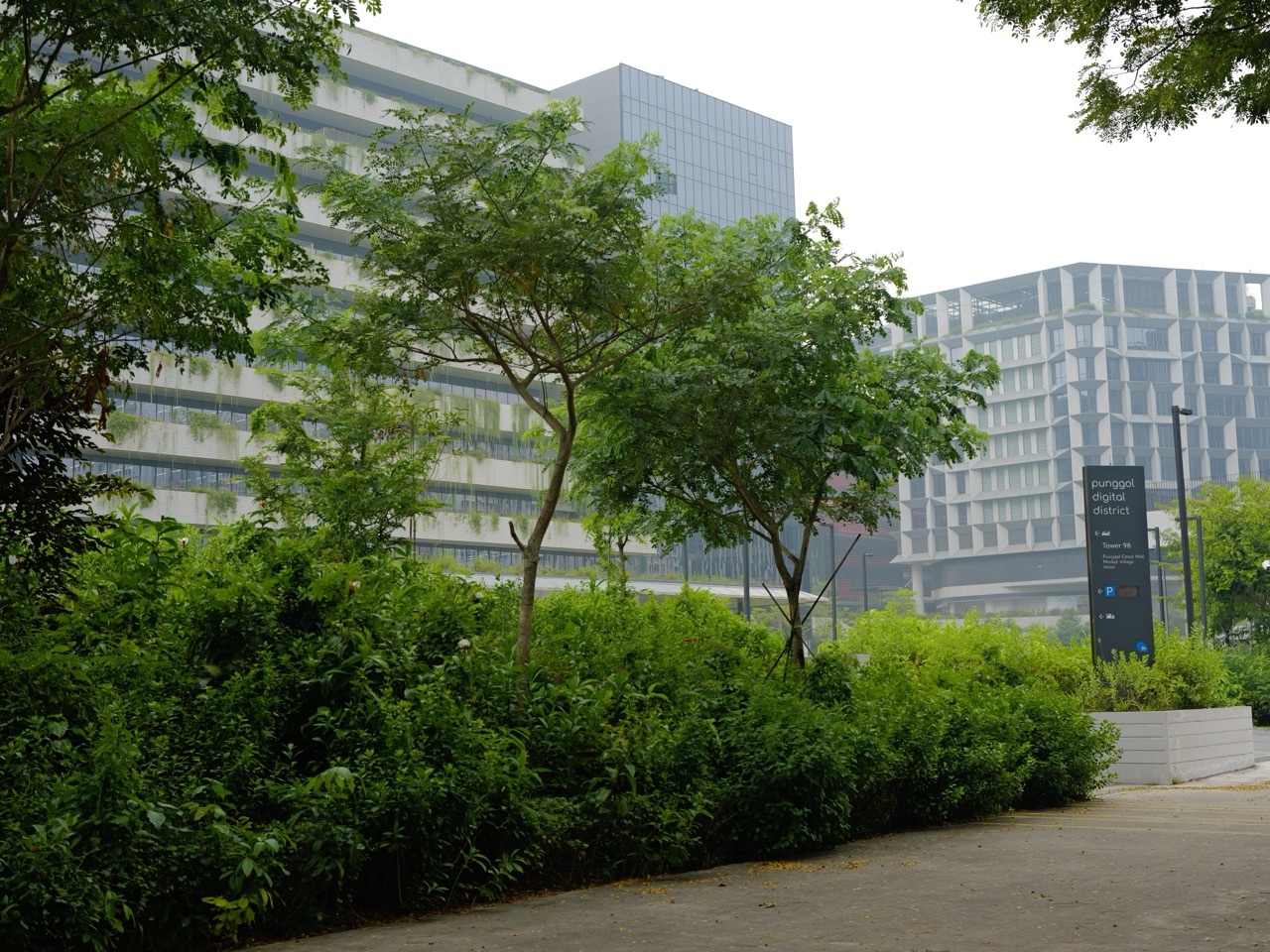
Punggol Digital District has a confirmed Singapore initiative for testing physical artificial intelligence and autonomous robots in a mixed-use urban environment. JTC announced on 20 May 2026 that a multi-operator robotics testbed would be established in the district with IMDA, SIT and other public and industry partners. For a business in Punggol, Sengkang, Pasir Ris or Seletar planning 2027–2037, the opportunity is to supply an authorised and measurable service: robot fleet coordination, safe site mapping, lift-and-gantry integration, equipment support, data reporting or carefully scoped repetitive-task automation. The presence of robots in a press release does not mean any startup may put an unapproved machine on a public footpath or that automation is automatically profitable.
The May 2026 JTC announcement named knowledge partners FieldAI and Thoughtworks and robotics companies Slamtec, Unitree and QuikBot in its physical AI collaboration, and described a precinct-level exemption framework facilitated with LTA for suitable autonomous mobile robots on selected public paths subject to safeguards. Separate JTC publications describe a Sharpa memorandum of understanding announced in April 2026 and dConstruct Robotics exploring delivery workflows involving lifts and access gantries. These are genuine industry developments, but an MOU, a demonstration and a fully operating commercial contract are not equivalent. This guide examines the suppliers, safety responsibilities, business economics and realistic ten-year scenarios rather than treating every pilot as guaranteed deployment.
- Industry: Physical AI, embodied intelligence, autonomous mobile robots, robotics-as-a-service, maintenance and approved building-system integration.
- Local anchor: The announced Punggol Digital District multi-operator robotics testbed and its connection with SIT.
- Potential buyers: Approved testbed participants, commercial landlords, building operators, technology firms and legitimate service businesses.
- Supplier opportunities: Robot fleet scheduling, navigation maps, controlled access integration, remote supervision support, preventive maintenance and data-quality services.
- Regulatory boundary: Public-path operations and building access need appropriate authorisation; the precinct-level arrangement is not unrestricted public permission.
- Commercial measures: Tasks completed, safety, human intervention, utilisation, service availability, full equipment costs and client satisfaction.
- 2027–2037: Near-term validation, medium-term service development and long-term support and upgrades, with no guaranteed fleet numbers.
- First action: Identify one repetitive physical task and who has authority to commission its safe automation.

What physical AI means in the business world
Physical AI refers to systems that use sensing and computing to act in a physical environment. A computer program may produce an answer on a screen, but a robot moves among people, doors, lifts and objects. It can encounter a blocked passage or a person who does not move as expected. This changes the nature of risk. A business deploying machines must manage physical safety, equipment maintenance, user communication and operational accountability alongside software.
The commercial product is therefore not simply an intelligent machine. It is a dependable way to complete a useful task. A buyer might want internal mail moved between approved floors, selected items delivered through an office building or routine cleaning supported by a machine. Each application needs a safe workflow and a way to deal with exceptions. The value is the work completed, not the novelty of watching a robot move.
What JTC actually announced on 20 May 2026
JTC described a multi-operator robotics testbed at Punggol Digital District intended to support several operators in a real mixed-use public environment. IMDA, JTC, SIT, the National Robotics Programme and other partners were involved in developing the collaboration. The announced goal was to help robotics systems and infrastructure operate safely among ordinary users rather than remain isolated in laboratory demonstrations.
The release explicitly stated that robots would need to meet safety standards and defined operating parameters. It also said further details on specific trials and use cases would be provided later. A supplier should verify those details through current official channels. The announcement does not itself establish that every proposed machine is commercially active or that a new entrant can join without permission.
Why named companies matter but do not guarantee business
JTC named FieldAI and Thoughtworks as knowledge partners and Slamtec, Unitree and QuikBot as robotics companies connected with the project. Its April 2026 Sharpa announcement described a memorandum to explore deployment of North robots and an innovation laboratory. Its LaunchPad material referred to dConstruct Robotics and potential delivery robots using lifts and access gantries. Panasonic has also described robotics development work in Punggol Digital District.
These names prove that industry participants have engaged with the district. They do not prove that a particular entrepreneur has been appointed as a subcontractor or that every robot is ready for widespread commercial use. A company should seek the relevant procurement or partnership route, understand actual conditions and describe its affiliations truthfully. A founder gains little by claiming a government endorsement that does not exist.
The industry includes manufacturers, operators and integrators
A robot manufacturer builds the machine and may supply related software or technical support. A fleet operator uses robots to provide services to customers. An integrator connects suitable machines to approved building systems. A maintenance provider may handle authorised servicing, while an analytics vendor organises operational reports. One company can provide several roles, but it should not assume it has all the necessary capabilities.
The business model changes with the role. Hardware production can require expensive engineering, testing and supply-chain management. Fleet operations need regular staffing and support. Integration services may involve intense project work followed by maintenance. A startup should choose the role that matches its strengths and the buyer’s needs instead of announcing an end-to-end robotics empire before its first contract.
Punggol’s role is testing and integration, not a promised robot factory
The district is designed as a business park connected to SIT and smart infrastructure. That makes it a relevant place to test physical AI and explore real urban workflows. It does not automatically mean that mass manufacturing of every robot type will occur within Punggol or that local factories will receive preferential orders.
A business based in the North-East can potentially work with technology suppliers elsewhere in Singapore or overseas, subject to actual agreements. It may produce software in Punggol while buying hardware from another manufacturer. The commercial advantage lies in solving a real integration problem, not in forcing every supply-chain activity into one geographic area. Honest local reporting separates the test location from where components are made.
One robot is not the same as a reliable fleet
A single robot moving down an empty corridor can be visually impressive. A commercial fleet needs to handle multiple tasks, changing routes, charging, maintenance, staff handovers and failures. Two robots may arrive at one lift simultaneously. One may be unavailable because its battery needs attention. A network outage might affect several machines at once. The operator must plan for these situations.
Fleet management includes task assignment, priority, equipment health, access rights and human escalation. A supplier may provide a platform that improves coordination, but its value needs to be measured against the old process. More machines do not necessarily create higher productivity. A smaller, well-managed fleet might complete more useful tasks than a larger system frequently waiting for assistance.
Taking a lift creates a real integration challenge
JTC’s LaunchPad announcement discussed potential delivery robots that can pass gantries and take lifts in Punggol Digital District. This creates commercial opportunities for permitted integration because lifts are shared public infrastructure, not private robot equipment. The system must consider passenger use, building safety, access policies and how the machine responds to interruptions.
An integrator should work with the relevant building owner and authorised technical parties. It should not attach devices or issue commands to lifts without permission. The customer’s engineers may need to review interfaces and failure behaviour. A successful demonstration proves only the tested circumstances, while the operating contract must address ordinary daily exceptions and emergencies.
Access gantries require legitimate credentials
A secured gantry exists to control access. A robot may require a managed identity or another approved method to pass certain points, but that permission should be limited to its legitimate task. A developer should not copy employee access credentials or bypass a barrier simply to make the demonstration work.
A supplier offering access integration can help maintain clear permissions, expiry, event logs and revocation. The owner needs to know which machine may enter each space and when. These details are commercially important because the buyer has security and privacy responsibilities. An access system that is convenient but uncontrolled may create risks greater than the labour it saves.
Robots sharing a public path need a safety case
Public paths can contain children, cyclists, people with mobility aids, sudden obstacles and groups moving unpredictably. The machine must operate within its approved conditions and have suitable stopping behaviour. A system that works in an empty warehouse cannot be assumed to operate safely in a crowded mixed-use precinct.
The provider should identify relevant hazards and establish procedures for handling them. Qualified parties must determine applicable safety standards and assessments. The operator must be able to stop a deployment when conditions are unsafe. A commercial contract should never reward a supplier for completing more trips by disabling safeguards. Reliable coexistence with people is fundamental to the product.
What the precinct-level framework does not mean
JTC described an LTA-facilitated precinct-level exemption approach under the Active Mobility Act for suitable autonomous mobile robot operations in PDD. This was intended to help approved trials proceed under defined safeguards. It is not permission for every person to place a self-driving device on every Singapore pavement.
A new company should confirm whether its robot, site, use case and operating conditions are covered by an actual authorisation. Trial permissions may not transfer when the machine changes, the route moves or the service becomes commercial. Work should begin only after the appropriate arrangements are in place. The supplier’s marketing should not make a narrow exemption sound like an unlimited licence.
Building maps require maintenance
A mobile robot may rely on a map or other model of the environment. Public buildings change as furniture moves, construction work starts and temporary barriers appear. A route that worked yesterday may be blocked today. This creates a potential service market for properly authorised mapping, update management and monitoring.
A mapping provider should explain how its information is validated, versioned and delivered to the operating system. The robot must remain capable of responding safely when the information is incomplete. A founder should not promise that a digital map makes the world predictable. Good mapping reduces uncertainty; it does not eliminate the need for reliable sensing and safe operating limits.
Site access is different from data access
An operator may permit a robot to use an approved route without giving the software developer unrestricted access to building sensors or private office systems. Similarly, a university researcher might be allowed to analyse selected information without controlling operational equipment. A startup needs to distinguish these permissions carefully.
A useful contract defines which systems are accessed and for what purpose. The supplier should avoid collecting more data than necessary and document how credentials are handled. The district’s Open Digital Platform may support authorised integration and simulation, but public descriptions do not mean all interfaces are open. Technical curiosity cannot replace permission.
Customer tasks should be defined before buying hardware
A business may want robots because competitors are talking about automation. That is not a sufficient purchasing reason. Identify the actual task, its frequency, cost and operating constraints. A delivery robot may save walking time but still require staff to load and unload it. A cleaning robot may operate at certain hours but need supervision and manual work in inaccessible areas.
The supplier should calculate the entire process before and after deployment. Which activities are removed, which remain and which are added? How are delays handled? A buyer may choose not to automate a task when the total system is more expensive or less convenient. A responsible integrator is willing to reach that conclusion.
Human handovers can dominate the economics
Imagine an authorised robot carrying internal mail between two floors. It may travel automatically, but a worker must load the correct envelope, confirm the destination and ensure a recipient accepts it. If the worker spends almost as long preparing the task as they would walking it personally, the return on investment may be weak.
The business should measure human intervention per completed delivery. Include routine loading, recipient delays, failed access and technical faults. An effective design might consolidate several deliveries into one trip or schedule activity during a suitable period. But every improvement must preserve privacy and safety. Counting robot journeys alone can conceal operational inefficiency.
Utilisation is not a simple uptime percentage
A robot may be powered on but unavailable for work because it is charging, waiting for access or undergoing maintenance. It may complete a journey without delivering the intended item. A marketing metric such as 99% uptime should therefore be examined carefully. What exactly was available, and did the customer receive the useful service?
A fleet contract can define completed tasks, response time, equipment availability and human intervention separately. A supplier should record failed missions rather than silently delete them. A buyer will often value honest reports about why tasks failed. Improvement becomes possible only when the underlying causes are visible.
Charging is an operating constraint
Mobile robots require suitable charging arrangements and may need a designated area, approval from the building owner and appropriate electrical safety. Their charging time affects the hours available for service. A fleet that can work only during part of a shift may not deliver the benefit assumed in the business case.
A provider should plan charging around the authorised workload, follow manufacturer instructions and budget for battery maintenance and replacement. It should also prepare for a charger outage. A public corridor is not automatically a permitted charging area. Commercial operation requires suitable facilities and procedures, not merely a machine that can connect to a plug.
Maintenance creates recurring costs and possible supplier revenue
Robots have motors, sensors, wheels, battery systems, software and mechanical components that can fail or deteriorate. A manufacturer may provide warranty support, while an approved service contractor may perform defined maintenance. The exact arrangement depends on the model and agreement. Unauthorised modifications could affect safety or warranty status.
A specialist maintenance business should know which parts and procedures it can legitimately handle. It needs records of service, faults and return-to-operation checks. If a task is outside its competence, the company should refer it to an appropriate specialist. The commercial value comes from reducing disruption responsibly, not claiming that any electronics technician can repair every autonomous robot.
A fleet operator needs human supervision
Autonomous operation does not eliminate every human task. People may manage schedules, investigate incidents, communicate with users and recover machines when they cannot complete a route. Workers must understand the operating limits and have a way to stop an unsafe activity. These responsibilities should be included in staffing and training plans.
A startup promising completely labour-free service should explain who handles exceptions and how. JTC’s May announcement discussed new roles in supervision and operations as physical AI develops. A realistic business model treats these functions as part of operating quality. Cutting them out of the forecast to inflate savings is misleading.
Robotics-as-a-Service shifts capital risk
Under a Robotics-as-a-Service model, the customer may pay a recurring amount for access to equipment and support instead of buying the hardware. This can make a trial more attractive to the buyer, but the provider still owns or finances valuable equipment. It must recover costs over the contract while funding maintenance, software and staff.
A new vendor should examine contract length, likely task volume, redeployment options and obsolescence risk. If a customer cancels early, can the machine serve another business? If the hardware needs expensive upgrades, who pays? A monthly fee is not automatically profitable simply because it recurs. The supplier needs conservative financial scenarios rather than assuming full utilisation forever.
Hypothetical robot-fleet economics
Suppose a fictional company operates four appropriately approved robots for a client and charges S$2,200 per unit monthly, for S$8,800 revenue. Hardware financing and depreciation cost S$3,000, support staff S$1,700, connectivity and software S$900, maintenance S$800 and insurance and logistics S$600. Direct and allocated costs total S$7,000, leaving S$1,800 before additional overhead and unexpected incidents.
These numbers are teaching examples, not actual JTC supplier rates. If an extra engineer is needed regularly or a major component fails, the margin can disappear. A founder should therefore price real support obligations and keep a financial reserve. The cheapest robot subscription is not necessarily the best deal for a client who depends on reliable work.
Cost per completed task is the better measure
A delivery robot may make many movements while performing relatively few valuable deliveries. The buyer should compare the total cost of the automated service with the cost and quality of the previous workflow. Include the machine, charging, supervision, maintenance, connectivity and staff time for handovers.
A simple example: if monthly fleet cost is S$8,000 and the system completes 4,000 useful tasks, the cost is S$2 per completed task before other business overhead. If only 2,000 tasks are completed, the cost doubles to S$4. Those are illustrative figures. A good operator measures the reality and adjusts the deployment rather than celebrate the number of robots it owns.
Multi-vendor integration is a separate market
PDD’s proposed testbed involves multiple robotics providers. Their machines may use different fleet systems, maps and interfaces. A customer may want consistent building access or reporting across several platforms. Systems integrators can potentially help, subject to legitimate permission and agreements.
Interoperability is difficult because software updates, equipment models and security controls can change. A startup should specify the versions and interfaces it actually supports. It cannot guarantee that any robot from any manufacturer will immediately work with every lift. A narrow, tested integration can be more valuable than a broad promise that fails under ordinary operating conditions.
The Open Digital Platform can help test approved concepts
JTC describes PDD’s Open Digital Platform as a common district operating system that can support visualisation, simulation and authorised deployment of technology. That could help approved robotics partners evaluate interactions with infrastructure before live testing. A simulated journey might reveal scheduling conflicts or equipment access problems.
But a simulation is not proof of live safety. Robots interact with people and changing physical conditions. The authorised operator must confirm how the real-world trial will be conducted. A startup should disclose which results come from software and which come from actual field operation. The distinction matters when presenting savings, performance or reliability claims to customers.
Cybersecurity affects robots and buildings together
A connected robot may use network access, remote support, operational maps and building-system interfaces. If credentials are compromised or software changes without authorisation, the consequences can affect physical operations. Suppliers need appropriate access control, secure updates and incident reporting arrangements. Privacy matters when sensors capture images or operational information about people.
A vendor should collect only the information needed for the approved task and protect it. It should not upload footage of employees or residents to unrelated public systems without permission. The building owner may set stricter conditions than the startup expected. The contract should explain who can change the robot’s behaviour and how access is revoked when the relationship ends.
Public acceptance is an economic variable
People sharing space with robots may feel curious, comfortable or concerned depending on the machine’s behaviour and the environment. A fleet that technically works but regularly blocks walkways or confuses pedestrians may create complaints and operational restrictions. Customer acceptance therefore belongs in the performance evaluation.
An operator can monitor incidents, understandable feedback and appropriate user experience data. It should not assume that a favourable demonstration guarantees long-term acceptance. Clear instructions and predictable behaviour can reduce confusion. The goal is a useful service that fits within everyday life, not a constant exhibition that demands everyone’s attention.
Accessibility must be considered before deployment
Shared paths are used by people with mobility aids, prams and different sensory needs. A robot’s route, stopping position and audible or visual signals may affect their ability to move comfortably. A business should include these needs in the approved risk assessment and user testing where appropriate.
The operator should not treat an unexpected interaction as the user’s mistake. The machine must function within its permitted environment and respect public access. A robot that makes ordinary movement more difficult can undermine the service’s social benefit. Inclusive design may improve both safety and customer confidence.
What a legitimate pilot should measure
A pilot needs a narrow purpose, defined operating conditions and an agreed decision rule. For example, a building manager may test internal item delivery between two authorised points. The evaluation can measure the average time from request to acceptance, number of human interventions, customer complaints and cost. The operator should also record all safety-relevant incidents.
The pilot should have a stopping rule and a way to remove the technology without disrupting essential operations. If the trial shows little benefit, the right outcome may be not to proceed. A founder should not present every trial as successful simply because the robot completed a filmed journey. Credible evidence improves future product design.
Demonstration sponsorship is not procurement
An industry exhibition may feature an attractive robot, and a public agency may support a demonstration programme. These activities can create visibility but do not automatically become commercial sales. A company should distinguish a paid service contract, research grant, memorandum of understanding and non-binding expression of interest.
The financial forecast should include only actual committed revenue in the appropriate category. A promising conversation may lead nowhere, while pilot costs can continue to rise. A startup should protect working capital by limiting the number of speculative deployments. It can seek customers with a defined operational problem instead of relying entirely on publicity from PDD.
A fictional indoor delivery startup
Imagine an engineering startup that wants to deliver documents between offices in one approved building. The company identifies the responsible site manager and receives permission for a bounded test. It studies lift and access requirements, maps the allowed route and calculates the existing staff time. It builds a safe workflow including loading, delivery confirmation and human fallback.
During the trial, the team records delays and support needs. If the robot saves meaningful time without creating new risks, the operator may consider a contract. If human assistance makes it uneconomical, the team can redesign its service. This is a credible commercial process because the customer controls the site and success is measured.
A fictional fleet-analytics company
A software firm notices that robot operators struggle to understand why tasks fail. It designs a dashboard using fictional task logs and highlights recurring interruptions such as access delays, charging downtime and incomplete handovers. It does not control the robots or change building systems. Its product helps authorised supervisors investigate.
A customer may later supply approved data under a contract. The company measures whether the tool saves reporting time and helps reduce repeated incidents. It must protect sensitive information and support data export at contract end. A narrow software business can be useful without purchasing any robot or claiming access to the entire district.
A fictional robotics maintenance supplier
An established equipment service firm wants to support a permitted robot fleet. It obtains proper manufacturer procedures, training and contract authority for defined maintenance tasks. It prepares a plan for routine checks, spare parts and escalation when a fault exceeds its competence. The firm does not alter safety systems in order to make repairs faster.
The customer may pay for predictable uptime and clear records. The service company should price response hours and parts realistically. A small reliable maintenance contract could be more sustainable than an ambitious attempt to operate all machines independently. Trust grows when every repair is documented and the operator knows which tasks were actually completed.
2027–2029: validate real workflows and operating permissions
The early period follows the 2026 testbed announcements. Specific robots, partners and route permissions may evolve, so businesses should use current official information. A supplier can focus on one authorised use case and learn whether it delivers value under normal conditions. It should avoid buying a large fleet before an operator commits to suitable work.
A sound plan includes staff training, technical testing and enough capital for delays. If a pilot fails, the business should identify the cause before proposing expansion. The objective is a safely repeatable operation rather than a large number of demonstrations. A startup that can explain limitations may be more credible than one claiming perfect autonomy.
2030–2033: expand the capability, not just machine numbers
If customers value the service, a supplier may support additional buildings or workflows. Each new environment can have different access systems, user behaviour and safety conditions. Expansion should follow appropriate approval and testing rather than assuming an earlier exemption applies everywhere. A company should document integration methods and keep staff competent as platforms change.
The business may specialise in fleet scheduling, approved access integration or one robot category. Broad diversification is not automatically better. Reliable delivery and repeatable support are more valuable than a catalogue of untested capabilities. These dates are internal planning checkpoints, not official promises of how many robots Punggol will use.
2034–2037: manage obsolescence and continuity
Physical AI hardware can change quickly. A supplier may need to replace sensors, batteries, processors or software platforms during a ten-year period. Contracts should address support life, spare parts, data ownership and transition. A provider that depends on one machine model risks disruption when the manufacturer changes its strategy.
Long-term value can come from understanding customers’ workflows, preserving safe integration knowledge and maintaining trustworthy operational records. No one can guarantee a 2026 robot model will be standard in 2037. A resilient firm can adapt technology while continuing to deliver a useful service responsibly.
Practical checklist for new physical AI suppliers
- What precise task does the robot perform and who is the paying customer?
- Who owns the site, the machine and the connected building systems?
- What permissions and current operating conditions apply?
- What safety assessment and qualified oversight are required?
- How does the equipment interact with people, lifts and secure access points?
- What happens when a route is blocked or a network connection fails?
- Who supervises, loads, unloads and recovers a machine?
- Which records and personal information are collected?
- How is task completion distinguished from a mere robot movement?
- Are battery, maintenance, staff and support costs included in the price?
- What happens if the customer cancels or a model becomes obsolete?
- Is any claimed JTC, SIT or IMDA affiliation formally confirmed?
- Can the company produce accurate reports of failed as well as successful tasks?
- Does the proposal work financially when volume is lower than expected?
These questions reveal the real market. A robot is an asset; a dependable service is a business. A supplier should only promise operations for which it has permission, competence and enough financial capacity to maintain quality.
Frequently asked questions
Did JTC announce a robotics testbed in Punggol Digital District in 2026?
Yes. Its 20 May 2026 announcement described the multi-operator physical AI testbed and named several industry participants. The actual status of each trial should be verified separately.
Can any startup put an autonomous robot on public paths at PDD?
No. The announced precinct-level arrangement relates to approved operators under safeguards and conditions, not a general public exemption.
Can delivery robots use building lifts and security gantries?
That is among the use cases JTC has described, but actual integration requires permissions, compatible equipment and proper safety and security controls.
Is robotics-as-a-service automatically more profitable than selling robots?
No. The provider may retain capital, maintenance and support costs. Profit depends on contract terms, equipment lifetime, utilisation and service quality.
Does every robot need to be manufactured in Punggol?
No. The district’s confirmed role includes testing, integration and research. Manufacturing locations and supply contracts must be separately verified.
Are all service jobs expected to disappear by 2037?
No such prediction is warranted. Robotics may change work and introduce supervision or maintenance tasks, but adoption, safety and economics remain uncertain.
Your Next Step: one authorised task and a complete cost model
Start with a building or business that has a repetitive physical task worth improving. Find the actual decision maker and verify the route, equipment and operating permissions. Develop a small prototype or approved trial with human fallback and clear safety criteria. Measure cost per completed task after accounting for maintenance, staffing and equipment financing. Only expand when a real customer can explain the benefit. The most successful Punggol robotics suppliers may be those that make technology dependable rather than those promising the most dramatic demonstration.
Official reading: JTC and IMDA’s 20 May 2026 physical AI testbed announcement, JTC’s April 2026 Sharpa robotics collaboration, JTC’s LaunchPad announcement on dConstruct Robotics and testbedding, Panasonic’s PDD robotics innovation hub, and JTC’s Punggol Digital District business ecosystem. Verify current robot operating approvals, site conditions and procurement arrangements before offering commercial services.


