
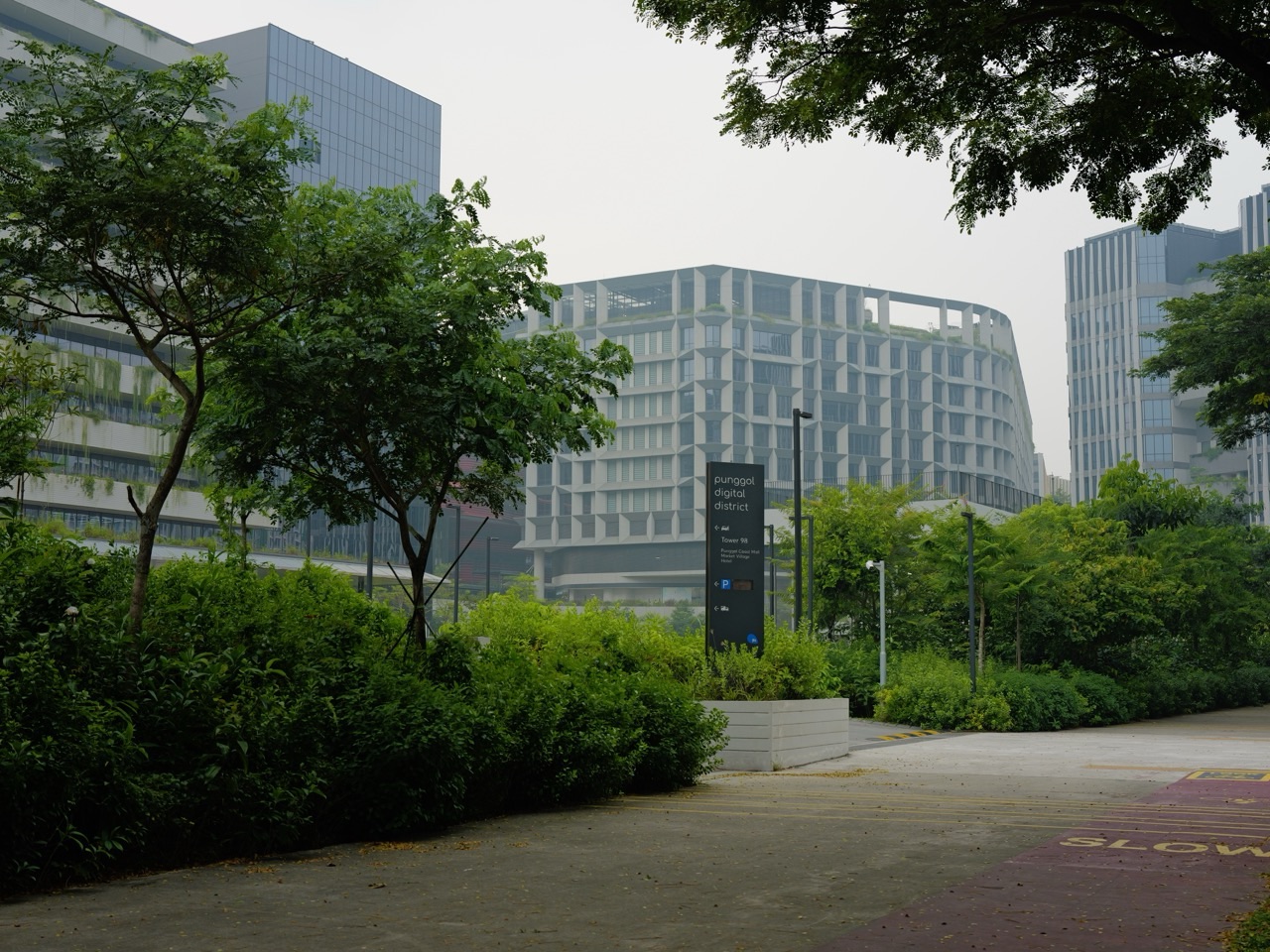
Punggol Digital District offers technology businesses a more practical proposition than simply renting an office in a fashionable address: it combines JTC’s business park, the Singapore Institute of Technology, an Open Digital Platform, corporate partners and real-world situations in which a product can be tested. For a founder thinking about 2027–2037, the relevant question is not “Will Punggol become a technology hub?” but “Which problem can my business solve, who will pay, and what evidence would make a pilot commercially credible?” This guide explains that business journey, from identifying a buyer to operating safely, measuring results and deciding whether to scale.
As of 1 November 2026, Punggol Digital District is an operating, developing precinct rather than a ten-year promise that has already been fulfilled. JTC describes a 50-hectare district focused on areas including AI, cybersecurity, fintech, robotics and smart city solutions. Its often-quoted 28,000 jobs is a district-scale expectation, not proof of 28,000 filled positions or a guaranteed market for every startup. LaunchPad @ PDD is planned to open in phases from late 2026; exact admission, tenancy and programme arrangements need direct confirmation. Over the next decade, commercial discipline will matter more than the excitement of an announcement.
- Location and industry: Punggol Digital District, Punggol Coast, and the wider North-East Singapore business network.
- Main opportunity: Prove an actual customer problem through a carefully authorised test or pilot.
- Relevant capabilities: Cybersecurity, reliable software integration, AI evaluation, sensors, robotics, fintech and digital operations.
- Important distinction: A publicly announced testbed is not an automatic right for any startup to deploy equipment.
- Evidence to collect: Baseline costs, measurable service outcomes, reliability, safety, user acceptance and willingness to pay.
- 2027–2037 outlook: A sequence of possibilities, not a confirmed ten-year schedule or return forecast.
- Who this helps: Founders, small and medium-sized firms, suppliers, parents explaining industries to teenagers and adults considering enterprise.
- First action: Identify one paying customer and one measurable problem before committing to expensive premises or technology.

What makes Punggol Digital District an unusual business environment?
A technology park usually gives a company an address, neighbours and possibly access to shared facilities. Punggol Digital District is designed to connect more layers. Companies can be close to an applied university; the buildings and physical infrastructure create operating problems; data platforms can support some authorised experiments; and users arrive for work, education, shopping or ordinary life. That combination matters because the distance between laboratory performance and daily reliability is often where promising products fail. A robot that moves well through a controlled room may struggle with people, doors, unpredictable deliveries and safety obligations. A scheduling algorithm may impress in a demonstration yet collapse when a building manager changes a shift or a lift is unavailable.
The district should be understood as an ecosystem, not an entitlement. A tenant, a student, a company invited into a trial and a visitor walking along Campus Boulevard have different rights. Being physically close to a sensor does not mean access to its data. Being near SIT does not mean a university research partnership automatically exists. The productive business opportunity lies in obtaining legitimate access, solving an operational problem and creating evidence other customers trust. For background on the wider geography, see our earlier Punggol Digital District explainer; this article concentrates on the commercial method.
Start with a buyer, not with an invention
Imagine two companies. The first begins with the announcement that artificial intelligence is transforming everything. Its founder hires developers and produces a sophisticated dashboard with no committed users. The second speaks with ten facilities managers about repeated maintenance callouts, identifies a recurring source of lost working time, and builds a small workflow that might remove it. The second company has not necessarily invented more impressive technology. But it has a clearer route to someone spending a budget. That distinction can determine whether a startup survives its first year.
Before any proposal to JTC, SIT, a corporate partner or another organisation, write down the identity of the economic buyer. Is the buyer the property owner, operator, service contractor, university department, retailer or another party? Who benefits from the improvement, and is that the same party that pays? A cleaning contractor may benefit from better scheduling while the building owner controls procurement. A delivery robot may reduce some repetitive movement but create new maintenance and supervision obligations. Interviewing only enthusiasts and users is not enough. The founder must understand the people who authorise procurement, shoulder liability and manage the budget.
Map the value chain around a proposed pilot
A buyer is only one part of a commercial system. Consider a hypothetical indoor delivery service. It involves an end customer ordering goods, a merchant accepting the order, a robot provider, possibly a logistics partner, an access-control operator, a building manager, security personnel, a network provider, a maintenance team and people who share the paths. Each participant has a different definition of success. The merchant wants predictable completion. The buyer wants affordable service. Security needs controlled access. Pedestrians need safety. Building managers need normal operations to continue.
The founder should draw this sequence on one page, beginning with the customer’s action and ending with support after delivery. At each step, mark who owns the equipment, the data and the decision. Then ask what happens when something fails. Does the robot wait, call for help, return or require human recovery? Who tells the customer? A commercial design is incomplete until failure paths are described. Punggol’s mixed-use environment makes those questions especially visible, but the same method applies to healthcare, retail technology, finance and industrial software.
The Open Digital Platform is not a free public data feed
JTC’s Open Digital Platform, developed with GovTech, is an important part of the district’s operating concept. In a July 2026 announcement, JTC said Panasonic would work on smart facilities solutions using the platform, which aggregates information from more than 20,000 sensors and various systems, and supports digital-twin simulations. These details describe a real industrial collaboration. They do not establish that every dataset can be downloaded by any business, or that all infrastructure interfaces are open to arbitrary developers.
A sensible product team separates technical feasibility from permission. It first identifies the minimum data needed for the experiment. Next it asks the data owner about legitimate access, retention conditions, cybersecurity controls, confidentiality and approved purposes. Only then does it design a prototype around the data actually available. Sometimes a realistic, anonymised or synthetic dataset is enough for early validation. Sometimes live integration is necessary and requires a longer approval process. A responsible founder treats privacy engineering and access management as part of the product, not paperwork to be completed after a launch announcement.
What does a real testbed prove?
A testbed is not simply a backdrop for a video. It is an opportunity to confront reality under agreed conditions. Good tests compare a defined baseline with a measurable intervention. If the product claims to save energy, what consumption would have occurred without the change? If it claims to improve delivery, what existing completion time and error rate are being replaced? If it claims to protect against cyber threats, can independent reviewers show the improvement without introducing new vulnerabilities?
The test plan needs a beginning and an end. Record the test environment, eligible users, operating hours, measurement method, incident response, stopping rules and owner of each decision. A small pilot that reveals five important problems can be more valuable than a large demonstration that collects no reliable evidence. During 2027–2037, successful businesses are likely to use real-world validation repeatedly as products evolve. That is an analytical expectation, not an official prediction about the district’s admission rules or performance.
Robotics: where an appealing demonstration meets the public realm
In May 2026, IMDA, JTC and SIT announced a plan to test multi-operator robots in a mixed-use public area, involving industry partners and use cases such as delivery, security and cleaning. This is commercially interesting because a public area is shared by people with different purposes. A robot that looks efficient in a warehouse must negotiate the social and physical variability of ordinary urban life. The announcement described an intended launch later in 2026; operators should verify current status and authorised conditions rather than assume all trials are active or unrestricted.
For a robotics supplier, the winning metric is rarely maximum speed. It might be safe tasks completed per staff hour, predictable service outside peak periods, reduced physical strain or lower total cost after supervision and maintenance. The measurement must include interruptions, equipment downtime and human assistance. A business that only reports successful trips will misunderstand its own economics. A transparent incident log, conservative deployment boundaries and courteous interaction with pedestrians may be as commercially important as the navigation system itself.
Artificial intelligence should be evaluated as a service, not a slogan
An AI company may describe its model as intelligent, automated or agentic. Those words are not outcomes. A more useful sentence is: “This system will classify incoming maintenance requests and suggest the correct specialist, while a human retains authority to approve urgent action.” Now it is possible to measure wrong classifications, time saved, the rate of human intervention and the consequences of a mistake. The product becomes understandable to a buyer.
The challenge is that AI output can change, especially when a model or surrounding system is updated. An enterprise customer therefore needs evaluation cases, version control, logging and a rollback plan. There must be clear responsibility when the system is uncertain. A startup selling to financial or critical-service organisations will also encounter stronger information-security and contractual expectations. Businesses near PDD could benefit from an ecosystem that understands technology, but they still need to earn the right to handle a customer’s information.
Cybersecurity creates opportunity only when trust is demonstrated
A cybersecurity firm may find potential customers among technology companies and organisations with interconnected buildings, devices and business systems. However, security is not a product that can be promised through marketing alone. Buyers will ask which threats are covered, which are outside scope, whether access is authorised, how evidence is protected and how the service will respond to an incident. A penetration test, for example, needs express permission and a defined scope; proximity to a smart district is not permission to probe systems.
The strongest small suppliers often specialise. They may support secure configuration, supplier risk assessment, identity management, developer training or incident readiness. A focused service with documented methods can be easier to buy than an enormous claim to solve every threat. During the next decade, new sensors and automation may create additional protection needs, but no forecast can guarantee the size of each buyer’s budget. The sensible starting point is to identify a specific, legally authorised service with demonstrable outcomes.
Fintech is not just about creating another payment app
JTC lists fintech among the district’s relevant sectors, and financial institutions are among its business participants. That does not imply that every fintech opportunity involves a consumer wallet or speculative digital asset. A company might instead improve business reconciliation, invoice matching, authorised fraud detection, risk reporting or the accessibility of financial administration. Sometimes the most valuable software solves an unglamorous task performed thousands of times.
Founders must distinguish technology development from regulated activity. Product design, software provision and handling customer funds can involve quite different regulatory obligations. A company should investigate the relevant Monetary Authority of Singapore requirements and obtain appropriate professional advice before it offers a regulated service. Product demos should not resemble financial guarantees. A prudent founder first asks which institution is the customer, what compliance checks will arise, and what documents a procurement officer will need before a pilot even begins.
The university connection must produce reciprocal value
SIT is not merely a place from which employers can recruit graduates. An applied university can contribute domain knowledge, research methods, structured projects and the discipline to test a solution rather than admire it. In September 2025, SIT officially opened its Punggol campus and described its innovation and industry-collaboration ambitions. An industry relationship, however, cannot be reduced to obtaining inexpensive student labour. Both sides require clear learning and research value, supervision and legitimate agreements.
A firm seeking a university partnership should prepare a precise brief. Explain the problem, the existing method, known constraints, data that could legally be shared, desired technical contribution and intellectual-property questions requiring discussion. Think about how a student project differs from a commercial deliverable. A useful collaboration might create a tested prototype or report, not a complete product ready for a paying client. Respecting that boundary improves the quality of the relationship and prevents disappointed expectations.
LaunchPad @ PDD: what founders should and should not assume
JTC announced that LaunchPad @ PDD would open in phases from late 2026, bringing startup spaces into the district. Its purpose is to support an ecosystem rather than to give every startup guaranteed access. As at this article’s publication date, a founder should check which spaces and programmes are actually available, who qualifies and how an application is assessed. Do not commit to an expenditure because a press release used the phrase “coming soon.”
There is also a difference between a workspace, a business programme and a testbed. Renting or obtaining a desk does not grant privileged access to data, customers or experimentation sites. Likewise, attending a networking session is not proof that a company has been selected for an industry pilot. A commercially sensible founder can make progress without any of these benefits: interview customers, produce a working mock-up, document security measures and obtain a letter expressing interest. Those foundations strengthen an application when a suitable opportunity appears.
A financial model that prevents an expensive pilot from becoming a trap
A pilot can look attractive because it produces publicity. Yet it may consume months of work and leave no recurring revenue. Build a basic model with five numbers: setup expense, monthly running expense, cost of support, expected customer payment and expected duration before a decision. Then calculate what happens if the pilot lasts twice as long or produces half the expected revenue. Companies rarely fail because a spreadsheet lacks decimal precision. They fail because a major cost was not recognised.
Take an illustrative, invented example. A team spends S$18,000 on integration and testing, then S$3,000 monthly to operate the service. A three-month pilot therefore consumes S$27,000 before management time and contingency. If a buyer offers only S$6,000 for the entire pilot, the company needs another source of funding or a reason to regard the shortfall as an investment in evidence. It should not confuse the S$6,000 contract with profitability. These figures are a teaching example, not actual PDD rents, partner fees or typical market prices.
Procurement is part of product design
A startup may believe the buyer will make a quick purchase if the technology is impressive. In practice, a company procurement team may ask about insurance, vendor registration, financial stability, data protection, business continuity, technical maintenance and the ability to support the service over several years. A promising prototype that cannot meet these requirements may never progress to production. This is not necessarily bureaucratic hostility; the customer may have real operational risks that it cannot transfer to a new vendor without evidence.
Prepare a small supplier pack before meeting a buyer. Include a one-page product explanation, explicit exclusions, a support contact, relevant security documentation, business registration information, references that are genuine and a clear method for escalating incidents. Do not invent certificates or imply that a pilot constitutes government endorsement. Good procurement readiness lets the customer assess the company without needing ten follow-up meetings. It also forces the founder to discover gaps while they are still manageable.
How a supplier can participate without being a technology startup
Not everyone in the district economy will develop artificial intelligence. Technology firms purchase installation services, repairs, equipment, logistics, cleaning, design, accounting, legal support, specialist recruitment and training. Such suppliers can benefit from the concentration of businesses, but their opportunities come through legitimate tendering and commercial relationships, not by assuming the district must award work locally. A Punggol resident who owns a dependable maintenance company may understand workplace needs as well as a venture-funded software firm does.
The supplier still needs differentiation. If it sells only on cheapness, it may be replaceable and financially fragile. It could instead specialise in rapid response, careful documentation, after-hours reliability, bilingual customer support or the handling of particular equipment. The strongest pitch is specific: “We record every inspection, send a verified report by the next business day and provide a named person when a problem needs escalation.” Such claims should be realistic and measured. Local proximity can help fulfil a service promise, but it is not a substitute for competence.
Punggol, Sengkang, Seletar and Pasir Ris form a wider business catchment
The district should not be treated as an island detached from neighbouring towns. A firm in Punggol may employ people who live in Sengkang, work with aerospace suppliers near Seletar or use precision-engineering and semiconductor services around Pasir Ris and Tampines. These relationships need travel planning, access arrangements and sometimes entirely different safety expectations. The industry boundaries are more useful than an assumption that every business in north-east Singapore belongs to the same cluster.
For example, a sensor developer could test a software workflow in an office environment, then consider whether a manufacturing customer has genuinely similar needs. A factory may demand different standards for calibration, uptime, environmental control and documentation. The commercial value of regional proximity lies in learning across customers while respecting each industry’s requirements. Our companion pieces in this series examine the Seletar Aerospace Park and wafer-fab industry parks as distinct supplier environments.
2027–2029: a sensible near-term business scenario
For the first part of the 2027–2037 horizon, a prudent startup would concentrate on understanding what district facilities and collaboration programmes actually operate, establishing buyer relationships and developing proof of usefulness. Some technologies may produce practical demonstrations more quickly than others. Software that organises routine reports might require less physical approval than a robot using shared public pathways. Companies should schedule work around these differences rather than assume an announced public programme will become fully accessible on an exact date.
The external environment can also change quickly. Interest rates, customer budgets, global technology competition, public regulation and supplier costs may alter what buyers can justify. A good near-term plan therefore has a low-cost route to basic evidence, a defined maximum exposure and the ability to stop if the problem proves unimportant. The first three years need not deliver spectacular growth to be valuable. They should identify the products customers actually want and the operations necessary to serve them dependably.
2030–2033: what scaling could look like
If a small pilot works, the next question is whether it transfers to another building, customer or sector without heroic manual effort. A service that saves time only because the founder personally attends every failure is not yet scalable. Product teams should standardise onboarding, security review, customer reporting, technical support and the process of updating their systems. As customers accumulate, the unit economics become clearer. Some products will deserve continued investment. Others may remain niche services.
By 2030–2033, a disciplined Punggol company could have moved from proof of concept to a repeatable commercial service. But this is a possible development path, not an official PDD milestone. A company might also find better customers elsewhere and retain only an engineering presence in Singapore. Successful growth should be judged by actual service quality, profit, retention and responsible employment, rather than by whether the founders still sit in the same office. The district is useful if it improves the business; the business does not exist to justify a district narrative.
2034–2037: the decade-end question is resilience
A decade is long enough for products, technologies and competitors to change substantially. The AI tool that attracted a customer in 2027 may be commonplace by 2037. A valuable company must therefore own more than a fashionable label. It might own trusted processes, specialised knowledge, customer relationships, reliable integration skills or a long record of safety and support. Those advantages require continued learning and are not guaranteed by access to one launch event.
A mature business should stress-test its concentration risk. What happens if its largest customer moves? If an important software platform changes its pricing? If a regulation makes a use case impractical? If staff with critical knowledge leave? The right end-of-decade investment may be a second supplier, stronger documentation or a new service model rather than another impressive prototype. Local employers and families benefit when businesses become durable and responsible. The longer time horizon therefore argues for caution as much as ambition.
Three realistic founder pathways
Pathway one: a resident with a service-business background
Consider a founder who already understands building maintenance. They might first document an avoidable scheduling problem, interview three operators and test a simple reporting workflow without investing in advanced machine learning. If the system reduces repeated visits, the founder can seek an initial paid arrangement. A later, more sophisticated version may integrate sensors or predictive analytics if the customer needs them. The order is important: customer knowledge first, software second.
This founder can also keep a conventional service business running while testing the new product. That reduces the pressure to exaggerate early results. It does require clear separation of client data and permission for reuse. A customer’s maintenance records must not quietly become a public training dataset. Trust may be the strongest advantage a small local company has.
Pathway two: an engineering graduate developing a specialist product
An engineering graduate may know how to design the technology but not how to sell it. The first step is to understand who already solves the problem, what buyers dislike about current methods and which safety standards apply. Rather than building a complete autonomous system, the graduate might supply one reliable component or software module to an established operator. Smaller scope makes testing easier and creates a realistic way to learn procurement.
A university connection can help identify mentors and applied research opportunities, but professional boundaries still matter. No graduate should market an informal classroom demonstration as an independently certified commercial result. The credibility of evidence grows when the testing method and limitations are disclosed.
Pathway three: an existing SME adding a digital service
An established SME may have customers, revenue and a practical understanding of workflows. Its innovation problem is often less about invention and more about upgrading without disrupting what already works. A facilities company could introduce digital job records and later provide analytics. A training company could develop better assessment tools. A logistics supplier could improve exception handling before experimenting with robotics.
The SME should pilot change in stages. Staff need a voice in workflow design. Customers should know which decisions remain human-controlled. If the upgrade increases administrative work rather than reducing it, the manager should reconsider it. Technology adoption is successful when it improves the organisation, not when the company can announce that it uses a fashionable system.
A twelve-question checklist for a commercially serious PDD proposal
- What exact problem is being solved and what happens if nobody solves it?
- Who experiences the problem, and who pays for the solution?
- What reliable baseline proves that the current method is inadequate?
- What is the smallest experiment that could disprove the product idea?
- Which premises, devices, paths or datasets would the pilot require?
- Who can authorise that access, and what agreements must be signed?
- What safety, privacy and cybersecurity consequences are foreseeable?
- Who responds when the prototype fails outside office hours?
- How will success, inconvenience and unintended harm be measured?
- What is the total pilot cost, including staff time and maintenance?
- What must happen before the customer makes a production purchase?
- If the pilot fails, what can the team learn without harming users or compromising data?
Answer these in plain language. A proposal that cannot explain its purpose to a busy operations manager is not ready simply because the underlying code is complicated. Being clear also makes it easier for independent experts to spot an error. That is a strength, not a weakness.
Frequently asked questions
Is Punggol Digital District mainly for new startups?
No. JTC describes an ecosystem that includes companies, academic partners, government agencies and industry associations. Some opportunities suit startups; others suit established firms or specialised suppliers. The right route depends on what the organisation can deliver. A startup space and a corporate tenancy are not interchangeable, and participation conditions should be checked directly.
Can any member of the public test a robot there?
No general permission should be inferred from the word “testbed”. Testing equipment in shared spaces requires appropriate authorisation and compliance with safety and operational conditions. Announced exemptions or special frameworks apply to defined participants and uses; they do not remove ordinary obligations from unrelated companies or individuals.
Does the 28,000-jobs figure predict startup customers?
No. JTC uses that figure as a district-scale jobs expectation. Employment capacity is not the same as an immediately addressable customer market. A startup must identify buyers, budgets, purchasing authority and a credible reason why its specific product will be chosen.
Is the Open Digital Platform available to any developer?
Do not assume so. The platform supports approved industrial use cases and collaborations. Data permissions, access rules and security obligations must be confirmed with the appropriate owners. Synthetic data can often help with early design before a live integration is authorised.
Will PDD definitely make AI and robotics firms profitable by 2037?
No location can guarantee a company’s profitability. District infrastructure can reduce some barriers, but commercial results depend on product fit, competition, customer budgets, regulatory compliance, operations and execution. Treat 2027–2037 as a planning horizon, not an official revenue forecast.
Should a founder rent office space before speaking to customers?
Usually the lowest-risk sequence is to validate a real buyer problem before making a long-term premises commitment. Some activities require specialist space from the beginning, but that should be justified by operational necessity. Confirm current tenancy and programme terms directly with JTC.
Your next step: one problem, one buyer, one measurable trial
If you live or operate near Punggol and want to build a business around the digital economy, avoid beginning with ten speculative trends. Choose one problem that you understand well. Name the organisation that currently pays for that problem. Record how the work is done today. Ask what a successful improvement would look like after six weeks, and what costs or risks might make a buyer reject it. Then build the smallest legal and safe demonstration that can answer the question.
For updated official information, consult JTC’s Punggol Digital District overview, the business ecosystem and LaunchPad information, the JTC robotics testbed announcement of 20 May 2026, the Open Digital Platform partnership announcement of 9 July 2026 and SIT’s campus and applied-learning announcement. Policy, access and commercial terms may change after publication.
The durable Punggol business advantage is not that every idea will succeed. It is that ambitious ideas can be brought into contact with real operations, tested responsibly and improved using evidence. That is how a technology story becomes a business.


