
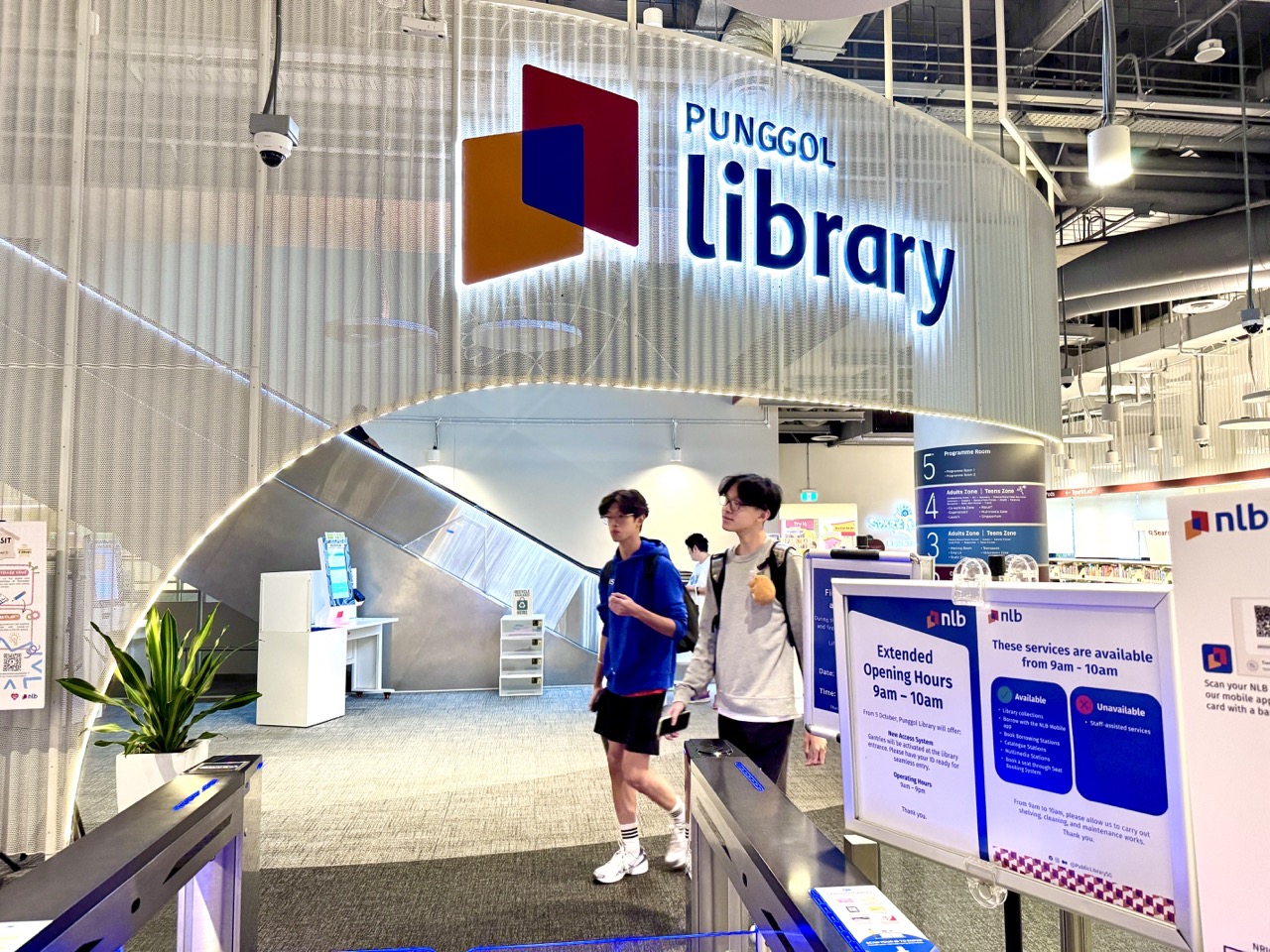
Why would a public library place children’s story spaces, a makerspace, quiet study areas, accessible reading resources and business information in different parts of one building? If a library is simply a room containing books, the answer is not obvious. Surely more shelves would be enough.
Punggol Regional Library reveals a different idea. The five-storey library at One Punggol was opened in stages in 2023 and fully opened on 5 April that year. Its design includes early-literacy and children’s spaces, a teen and study area, adult and non-fiction collections, making and business-related facilities, and accessibility features intended to help people who cannot use a conventional library in the same way as everybody else.
The National Library Board has described the library as a major example of its ambition to make learning accessible and meaningful to different groups. The purpose is not merely to divide users by age. It is to recognise that reading, discovering, creating, studying and seeking assistance require different environments.
This guide explains why Punggol Regional Library has different learning zones, how the layout can support a child’s changing interests, why accessible borrowing and calm spaces are genuine service design, and what families can learn from the relationship between a book collection and a functioning public learning system. It is not a live programme timetable or a promise that every room can be entered without booking.
The answer in 50 seconds
Punggol Regional Library is a five-storey public library in One Punggol. NLB’s official accounts identify age- and interest-appropriate collections and spaces, including children’s storytelling and tinkering, study areas, resources for teens and adults, making facilities and accessible services.
The reason for different zones is that the needs of users vary. An infant first encountering picture books needs a different environment from a teenager preparing for examinations. A person testing an engineering idea may benefit from a supervised tinkering space, while somebody conducting quiet research needs a different setting. A visitor with a sensory disability may require calmer conditions or particular assistive tools.
The core principle is matching space and support to the task, while allowing people to move between activities as their interests and abilities grow. A regional library is a learning network housed within one building, not a single room where every visitor must behave or learn identically.
Why the phrase ‘public library’ hides many different jobs
A public library provides access to reading materials, but that is only the beginning. It also helps people find information, discover unfamiliar subjects, use certain digital resources and participate in suitable learning activities.
Consider five visitors. One is a preschooler hearing a story. Another is a Primary 4 child solving a simple design challenge. A third is a Secondary 3 student working quietly. A fourth is an adult researching a business idea. The fifth needs assistive technology to use a digital collection. All are library users, but their goals are not the same.
A design that treats them as interchangeable may fail. A large active children’s area can create noise that makes sustained study difficult. A conventional borrowing kiosk may be uncomfortable for a wheelchair user. A room full of books may be insufficient for somebody who needs guidance using a specialist database.
The library’s job is to create sensible pathways through these needs rather than force them into one space.
Why the first two levels were opened for children first
Punggol Regional Library opened its first two floors on 30 January 2023, with a focus on children’s learning experiences. It then fully opened on 5 April 2023, bringing the remaining areas into operation.
The staged opening matters when interpreting older articles. A news report from January 2023 may correctly describe the other floors as not yet open. That does not reflect the library’s later full opening.
At a conceptual level, placing early-learning activities together helps families find appropriate resources. It also creates a visible entry point for young readers who are not yet ready for quiet independent research.
A child can visit the library for a story, a book or an age-appropriate activity without needing to understand every service offered to adults. The library becomes approachable before it becomes complex.
Why early-literacy space is different from a normal bookshelf
A young child may not yet read sentences independently. Their first experience of books involves pictures, listening, pointing, turning pages, recognising sounds and sharing attention with an adult.
A conventional library shelf is excellent for storing and organising material. But it does not automatically create a suitable environment for early literacy. Seating, book height, appropriate collection choices and the opportunity to explore at a child’s pace can matter.
Punggol Regional Library includes an Early Literacy Zone and children’s spaces designed around the needs of young users. The design recognises that becoming a reader is a process, not a requirement to arrive already reading fluently.
For parents, the lesson is not to turn every library visit into a spelling test. Shared reading, choice and curiosity can help build a durable relationship with books.
Why a toy library belongs beside books
Punggol Regional Library’s children’s facilities include a Toy Library and TinkerTots features. At first glance, toys may seem out of place in an institution devoted to reading.
But imaginative play, stories and early learning overlap. A child who uses puppets or props can invent a narrative, name characters, describe events and practise communicating with other people. Those activities connect with the language and reasoning used in reading.
This does not mean every toy automatically teaches a specific academic skill. The usefulness depends on age-appropriateness, supervision, accessibility and the way children engage with the activity.
The broader principle is that young children may approach stories through movement and play before they can follow a long printed text independently. A library can welcome that developmental stage without abandoning its literary purpose.
Why Storyteller Cove asks children to create
A book tells a story somebody else has written. Storyteller Cove and other narrative spaces at the library invite children to engage more actively with stories, including imagining characters or producing their own ideas.
That changes the role of the child from only receiving information to also generating meaning. They might ask what a character could do next or why an event happened. They may invent a different ending or connect the story with their own experiences.
A good library activity does not require children to produce a perfect composition in a few minutes. It gives them a reason to be curious about language and storytelling.
For a Primary English learner, that experience can support the habit of asking about cause, character, setting and sequence—ideas that later become important in reading comprehension and writing.
Why Spark!Lab is an engineering space inside a library
NLB established Spark!Lab at Punggol Regional Library in partnership with the Smithsonian Institution. It offers hands-on activities for children aged approximately seven to twelve, using challenges that invite them to test and improve ideas.
One example described at opening was creating an object that would fly through a wind tunnel. Another involved constructing an arrangement that balances on a surface. These are design problems rather than book-borrowing tasks.
Why would the library support them? Because information becomes more powerful when learners can use it to ask questions, build models and test outcomes. The library’s mission includes discovery, not just storage.
But a tinkering zone is not an unsupervised engineering workshop. Visitors must observe the current age, access, safety and programme rules. The purpose is thoughtful experimentation within a managed learning environment.
Why the first idea is not always the best idea
Imagine a child trying to make a paper object fly. Their first design does not work. In an ordinary examination question, this might be viewed as a wrong answer. In a well-run tinkering activity, it can be the beginning of learning.
The child observes what happened, identifies what to change and tests again. They may discover that weight, shape or balance affects the outcome. The exact scientific explanation should be based on the activity and appropriate evidence, not invented after a single attempt.
That loop of trying, observing, revising and checking is a foundation of engineering thinking.
The library’s value is in giving children a manageable encounter with uncertainty. They can learn that a useful answer may emerge through careful iteration rather than immediate memorisation.
Why a teen space has a different atmosphere
A teenager’s needs differ from those of a preschool child. Teenagers may be developing independent study habits, reading more complex fiction, exploring interests or working on group projects.
Punggol Regional Library includes a teen-oriented area, with adult and teen fiction and study facilities described in its resource information. Different spaces allow young people to take more responsibility for their own learning choices.
A teen who wants quiet reading may not prefer the same sound level as a lively children’s storytelling session. Another may need a suitable collaborative setting for a project rather than complete silence.
The solution is not to declare one behaviour superior. It is to provide and manage spaces with different purposes and clear rules so users can select an appropriate environment.
Why study zones must be predictable
A study area supports tasks that require concentration: reading a difficult chapter, revising notes, solving Mathematics questions or evaluating information from several sources.
Predictability matters. If the rules, seating and expected activity level are unclear, users may struggle to decide whether the space suits their needs. Some study spaces use reservation systems or have particular access conditions.
NLB identifies study zones within Punggol Regional Library, but current seat booking, availability and operating arrangements should be checked on its official platforms. A library name alone does not guarantee an empty desk at the desired time.
A student can improve their study routine by knowing the task first. Choose a suitable space, bring the necessary materials and plan a manageable period of focused work rather than treating the library building itself as a magical source of concentration.
Why fiction and non-fiction can serve different kinds of learning
Fiction can develop imaginative engagement, exposure to language, characters and different perspectives. Non-fiction can provide explanations, evidence, concepts and factual context. The distinction is useful, though real books may combine elements of both.
Punggol’s age- and interest-based collections help readers browse material more deliberately. A child looking for a story and an adult researching a technical issue may need different shelves and discovery tools.
Library organisation can reduce the cost of finding information. It is easier to explore when related materials are grouped in a comprehensible way.
But shelf placement does not guarantee that a book is accurate or suitable for every purpose. Readers still need to consider author, date, evidence and relevance, particularly for fast-changing or high-stakes topics.
Why a public library needs accessible collections
A person may want to read but be unable to use ordinary printed material comfortably. Some readers need large print, tactile formats, audiobooks, assistive devices or other accommodations.
NLB has described Punggol Regional Library’s Accessible Collection and equipment intended to support visitors with disabilities. The facility includes tools such as magnifiers, accessible keyboards and technology supporting access to digital resources.
The principle is not to create a separate, inferior version of learning. It is to reduce barriers so more people can participate meaningfully in the same public institution.
Accessibility should be evaluated by what a visitor can actually accomplish. An impressive-looking machine is of limited value if someone cannot reach it, understand it or obtain the assistance needed.
Why Borrow-n-Go changes a small but important task
A conventional borrowing station may require a person to lift books, position them at a particular reader, use a screen and confirm the loan. Those steps can be difficult for some people.
NLB’s Borrow-n-Go feature at Punggol Regional Library is designed to simplify borrowing. NLB describes a portal with an accessible-height screen, intended to make the process more convenient for certain visitors, including wheelchair users.
The design shows how inclusion can be hidden in a routine task. Borrowing a book may seem trivial to someone who has never faced a barrier, but it is central to the library’s usefulness.
The broader lesson is that good technology removes unnecessary steps without making people’s needs invisible. It should be assessed through usability, not merely novelty.
Why a Calm Pod exists in a busy public library
Libraries serve many people. Even a well-managed environment can contain noise, movement, lighting and unexpected activity. Some visitors may become distressed or overwhelmed by those conditions.
Punggol Regional Library includes Calm Pods and other sensory-support features. NLB describes these as part of a wider approach to making its spaces accessible to visitors with different needs.
A Calm Pod should not be treated as an entertainment booth or a room to occupy because it happens to be empty. Its priority, time limits and access conditions should follow current NLB guidance.
The design’s significance is that inclusion goes beyond physical ramps. Sensory comfort and the ability to regulate one’s experience can affect whether someone can use a public learning environment.
Why accessibility also needs planning information
For a visitor unfamiliar with the library, knowing what will happen can be as important as the physical layout. NLB offers a social story and visual schedule material describing Punggol Regional Library and its spaces.
Visual schedules can help some visitors understand the sequence of a visit, prepare for transitions and communicate their preferences. They are tools, not requirements imposed on every family.
A caregiver might use such resources to choose a short route, explain what to expect and make the visit more predictable. But actual needs vary, and a person should not be defined only by a diagnosis or disability category.
The underlying principle is that access includes information, preparation and choice—not just a doorway wide enough to enter.
Why a library needs more than disability labels
It is easy to assume that one feature serves everyone with the same broad disability. In reality, people have individual preferences and different combinations of needs.
A wheelchair user may value clear turning space, while a person with visual impairment may use screen-reading tools or tactile information. Someone with sensory sensitivities may need a quieter environment. These needs can overlap without becoming identical.
NLB’s approach at Punggol therefore includes a range of accessible services rather than relying on one symbolic feature.
For students, this is an important civic lesson: inclusion is practical. It asks what is preventing a particular person from participating and what suitable changes can reduce that barrier.
Why a makerspace belongs beside the adult collection
Punggol Regional Library includes MakeIT, a making-oriented facility, alongside other resources for adults and teens. It connects information with opportunities to create or experiment using appropriate tools and programmes.
A public makerspace can help people explore a skill without immediately purchasing specialist equipment. It also creates a community setting in which learners can encounter new techniques.
But makerspace access may require age conditions, induction, booking or supervised sessions. A library membership does not automatically permit unrestricted use of all machines.
The educational logic is to support a progression: learn about an idea, test a relevant tool, reflect on the result and continue developing the skill responsibly.
Why creating something can deepen understanding
Consider a student learning about scale and measurement. They can read a definition, solve classroom questions and then examine how dimensions matter in a real object.
A suitable supervised making activity provides an additional form of feedback. The designed piece may not fit, prompting the learner to review the measurements and assumptions. The mistake reveals what needs to be understood better.
This does not imply that hands-on making is superior for every topic or learner. Some questions are better answered through reading, discussion or simulation.
The library’s variety is valuable because it gives people multiple routes into knowledge rather than insisting on one universal teaching method.
Why a business-information corner is not a commercial sales pitch
NLB’s Launch service includes resources for people exploring business ideas, with access to selected information tools and specialist consultation under published conditions. At Punggol Regional Library, this can serve adult learners and aspiring entrepreneurs.
A person may need to understand market research, industry publications or how to evaluate sources before committing to a business decision. The library can help them find relevant information.
However, NLB does not promise to write a personalised business plan or make commercial decisions for the visitor. Its specialist support has a defined scope, and access arrangements should be confirmed.
The larger lesson is that public education is lifelong. Libraries do not stop being useful when a person graduates from school.
Why adults need learning spaces too
A town’s adults may want to change careers, learn digital skills, research a practical question or develop a hobby. Their learning often takes place between work and family responsibilities.
A public library offers resources without requiring every visitor to enrol in a long course or buy all the material personally. That can reduce some barriers to exploration.
NLB’s broader strategy includes digital collections and learning nodes outside traditional libraries. The physical regional library complements those services by offering spaces, equipment and human guidance where appropriate.
For Punggol families, it is useful for children to see adults learning. A parent who researches a question and admits uncertainty demonstrates that learning does not end after school examinations.
Why local history belongs in a regional library
Punggol Regional Library includes Punggol Stories at Singaporium, a space drawing on local history, memories and heritage resources. NLB has documented its work on Kampong Wak Sumang and other aspects of Punggol’s past.
Why include local history when digital search engines already exist? A curated collection can bring together credible sources, context and community perspectives. It also gives residents a reason to connect the town they know with earlier settlements and changing land uses.
Historical interpretation must remain careful. A museum-style display is not proof that every popular story is literally true. Readers should compare records and recognise uncertainty where evidence differs.
The library’s broader role is to help residents see their neighbourhood as part of an ongoing story rather than a collection of recent buildings.
Why a curated collection is different from the internet
An online search may produce thousands of results, including advertising, outdated pages and material of uncertain reliability. A library collection is selected, organised and supported by cataloguing and professional information services.
This does not mean every item in a library is unquestionably correct. Books can become outdated, and scholars can disagree. The value lies in discovery tools, access to varied sources and opportunities to receive guidance.
A student researching Punggol’s history might use NLB’s digital archives, books and exhibition material rather than rely only on a social-media post.
The educational habit is to match the source to the question, check its date and explain how its evidence supports the conclusion.
Why moving between zones can mark growing independence
A child may begin with picture books and shared storytelling. Years later, the same person may use the children’s non-fiction collection, a teen space or a quiet study area. As an adult, they may return to explore career resources or local history.
A library that serves multiple stages of life can remain familiar while offering new capabilities. The visitor does not need to abandon the institution as their interests change.
This is one reason a regional library’s scale matters. It can support a wider range of learning than a single small specialised room.
The progression is not a rigid ladder. Adults can still enjoy fiction and storytelling; children can be curious about engineering; teenagers may enjoy imaginative activities. The zones provide options rather than fixed identities.
Why not everyone should use the loudest activity area
A child attending a tinkering session may speak excitedly and collaborate with others. Another visitor may need sustained quiet reading. Neither activity is inherently wrong, but putting both into one undifferentiated space can create tension.
Different zones help make behavioural expectations clearer. The task is to respect the purpose of the place and the people using it.
Parents should explain that a library is not necessarily silent everywhere, but that noise and movement must fit the designated area. A suitable interactive zone is not permission to disrupt a study room.
This is a useful civic lesson about shared institutions: different legitimate needs can coexist when space and behaviour are organised thoughtfully.
Why opening hours and booking rules still matter
Punggol Regional Library is part of a larger community hub, but it has its own operating arrangements. Different facilities within the library may have separate booking conditions, timed entry or capacity restrictions.
A historic guide may describe the soft-opening schedule in 2023. That is not a reliable source for today’s hours or availability. Use NLB’s current site and programme system before planning a time-sensitive visit.
The same caution applies to Spark!Lab, MakeIT, study seats and programme rooms. Seeing a facility named in a brochure does not guarantee walk-in access on demand.
The right approach is to distinguish the permanent purpose of a space from its current availability.
Why an accessible zone cannot solve an inaccessible journey
A library may offer excellent services, but a visitor must still reach the building, enter it and navigate between levels. Transport, ramps, lifts, signs and surrounding routes affect the complete experience.
For someone using a mobility aid, a blocked approach or unavailable lift can matter as much as the borrowing station inside. A family should therefore plan the full journey, not simply note that the destination advertises an accessible facility.
This is a general principle of public design. A good component only helps when the surrounding system connects to it.
Punggol Regional Library’s accessible services are meaningful, but actual trip suitability should still be checked for the person travelling.
Why the library is not a replacement for school
Schools provide a structured curriculum, educators, assessment and developmental support. Libraries offer complementary resources and opportunities for self-directed discovery.
A library may help a student find explanations, read widely or practise skills. It does not automatically diagnose learning gaps or guarantee examination improvements.
Parents can make the most of visits by helping children choose questions they genuinely want to explore. The aim should be developing independent learning habits, not assuming that more time inside a library automatically produces higher marks.
This distinction protects the value of both institutions. The school guides a formal learning programme; the library can open additional routes to knowledge.
Why reading choices matter more than impressive book counts
A large collection gives people options, but a child who has no interest in the selected book may not read it. A smaller choice that fits the reader can be more meaningful than a stack chosen only to look ambitious.
Parents can invite a child to select one suitable book independently, discuss why it appeals and return to explore another topic later. Library staff and catalogues can help when the child is uncertain.
Reading should also include appropriate challenge. A book that is always too easy may offer limited growth, while one far beyond the reader’s current comprehension may be discouraging. A balance of enjoyment and development is useful.
The library’s different collections support that process by making relevant material easier to find.
Why access to knowledge is also a social-equity question
Not every household has the same capacity to buy books, digital devices or specialist learning resources. A public library can reduce some barriers by making collections and selected facilities available to the community.
NLB’s inclusive approach at Punggol further recognises that physical and sensory barriers can restrict access even when materials are theoretically public.
A book that is available but cannot be used comfortably by a person with a disability is not equally accessible in practice. Similarly, a learning activity may be unsuitable if its entry conditions or location are unclear.
The policy purpose is to provide more meaningful opportunities, while acknowledging that not every barrier can be removed by a single building.
Why library design can influence learning behaviour
The environment sends signals about what activities are expected. A quiet table invites concentration. A playful storytelling corner encourages imagination. A making area suggests experimentation. An accessible interface communicates that different users have been considered.
These cues can make it easier for people to choose a suitable task. They do not cause learning automatically. Visitors still need curiosity, effort and guidance where appropriate.
The strength of a well-designed library is that its layout can reduce some friction. A person is less likely to feel lost when spaces are labelled clearly and organised around recognisable purposes.
This is why architecture is part of education even when no teacher is standing at the entrance.
Three worked examples for Punggol families
Example one: a Primary 3 child wants to build something
The child arrives hoping to explore an engineering activity. The parent checks Spark!Lab’s current age, availability and supervision rules. If the area is open and suitable, the child undertakes an approved challenge.
The parent resists telling the child the answer immediately. Instead, they ask what happened, which change the child wants to try and what evidence would show an improvement.
If the programme is unavailable, the family chooses an appropriate reading or observation activity rather than assuming the room must open for them.
The lesson is that learning through trial and revision can complement reading.
Example two: a teenager needs a quiet hour
A Secondary student has one chapter to revise. Instead of wandering between every library attraction, they identify a suitable study area and check whether the relevant seats require booking.
They plan a clear task: read the material, explain the main idea in their own words and test their understanding. The library provides a setting, while the student remains responsible for the learning.
The lesson is that choosing a space should follow the task, not the other way around.
Example three: an adult needs accessible borrowing
A library visitor has difficulty using a conventional kiosk. They consult current information about accessible borrowing, including Borrow-n-Go, and seek staff guidance if needed.
The objective is to obtain the same basic service with fewer unnecessary barriers. It is not a demonstration for other visitors to watch or photograph without consent.
The lesson is that inclusive technology has value when it makes an ordinary public service meaningfully usable.
How to use Punggol Regional Library for a family question
Begin with a specific question. A child might ask how bridges work, why Punggol has a waterway or where to find books about Singapore’s history.
Next, choose the suitable resource. It could be a children’s non-fiction book, an official digital reference, a staff enquiry or a local-history exhibition. Do not assume the most complicated tool is always best.
Then ask the learner to explain the answer and identify the evidence. If the explanation includes uncertainty, note what additional source would help.
The entire process can fit into a short visit. A family does not need to use every floor to make meaningful progress.
Why a makerspace does not guarantee that every idea is practical
A student may create a prototype or try a digital fabrication tool under an approved programme. That is valuable experience, but a successful demonstration does not automatically mean the object is safe, reliable or ready for commercial production.
Real engineering involves materials, testing, standards, maintenance and intended users. A prototype is evidence about a possibility under particular conditions.
This distinction matters if children become enthusiastic about technology. Encourage their curiosity while teaching that demonstrations and deployment are different stages.
The library can provide an introduction, but professional decisions require additional expertise and verification.
Why group work and quiet work need different rules
Two students might need to discuss a project. A third wants to read independently. If they sit together in a quiet-only zone, the project discussion may disturb the reader. If the quiet reader sits beside an active workshop, concentration may become difficult.
The solution is to respect the purposes and rules of different zones rather than ask everyone to adapt to the loudest activity.
A public library operates as a shared resource. Users cannot permanently claim spaces simply because their work feels important. Booking, permitted use and consideration for others allow different activities to coexist.
Children can transfer this habit to school: an art room, science laboratory and examination hall all support learning but have different behavioural requirements.
Why the library needs continuing feedback
NLB describes Punggol Regional Library as an important learning and experimentation site under its LAB25 strategy. That implies an institution that can learn from how people use new services.
A design feature can appear promising during planning but require adjustment in practice. Users may find a screen awkward, a sign confusing or a room difficult to navigate. Constructive feedback helps identify issues that are not visible in an architectural rendering.
Visitors should be specific and respectful. Describe the task attempted and the barrier encountered rather than declare the whole institution a failure because one feature was inconvenient.
This is also an educational principle: a good system improves through observation and revision, not through claims of perfection at opening.
Common misunderstandings
One mistake is thinking every floor has the same purpose. Another is treating children’s play and tinkering as activities unrelated to literacy or discovery.
A third is assuming a study zone always has free seats. A fourth is thinking a library membership grants unrestricted use of every makerspace machine or programme room. A fifth is treating a calm space as an ordinary lounge for everybody regardless of priority rules.
Another mistake is confusing accessibility with only physical ramps. Digital tools, sensory support and information can matter. Finally, do not claim that the library guarantees improved grades or professional success simply because it offers resources.
The useful approach is to identify a real learning goal and use the appropriate space responsibly.
Frequently asked questions
Where is Punggol Regional Library?
It is located within the One Punggol community hub on Punggol Drive. Check NLB’s official site for current access information.
When did it fully open?
NLB records its full opening on 5 April 2023, after the first two children’s floors opened in January 2023.
Why does it have different floors?
The arrangement supports different age groups, learning activities and support needs, from early literacy and storytelling to study, making and adult learning.
What is Spark!Lab?
A hands-on tinkering space developed with the Smithsonian Institution, offering age-appropriate design challenges under current access rules.
What is Borrow-n-Go?
A borrowing feature intended to reduce barriers for some users, including people with mobility needs.
What is a Calm Pod?
A support space designed for visitors who may need a quieter environment or help with sensory regulation, subject to current use rules.
Can children use every facility?
No. Age requirements, supervision, availability and programme conditions differ.
Are study seats always available?
No guarantee follows from their presence. Check the current booking arrangements and access conditions.
Does MakeIT mean anybody can use tools immediately?
No. Equipment and workshops may require eligibility, booking, induction or supervision.
Can adults still use the library for career learning?
Yes. NLB provides collections and services relevant to adult learning, including business-research support under defined conditions.
A useful family library checklist
- Choose one specific purpose before visiting.
- Identify the floor or facility that best supports the task.
- Confirm current opening hours, age rules and bookings.
- Respect different expectations for quiet and interactive spaces.
- Support children in choosing their own reading material.
- Do not take photographs of other visitors without appropriate consent.
- Check accessible facilities and complete journey arrangements when needed.
- Use staff and official digital resources when a source is difficult to locate.
- Distinguish a prototype activity from professional technical advice.
- Leave time for curiosity without trying to use all five floors at once.
Teaching Guide: design a library for different learners
Learning goal. The student should explain why a large public library needs different spaces for reading, creating, quiet work and accessibility, and should connect each feature to a real user need.
Activity one: five visitors. Draw five fictional people: a preschool child, a Primary 4 inventor, a Secondary student, an adult researcher and a person requiring assistive technology. Ask what each wants to accomplish.
Activity two: allocate zones. Give the learner five imaginary rooms. They must decide how to arrange active activities and quiet study without unnecessary conflict, explaining the trade-offs.
Activity three: remove a barrier. Present a borrowing screen that is too high for a seated wheelchair user. Ask how the design might be improved and what else must be checked to make the service usable.
Activity four: introduce sensory choice. One visitor needs a calm place after being overwhelmed. Ask why a dedicated support environment may matter and why its use needs appropriate priority rules.
Activity five: make a prototype. A child builds a fictional flying object that does not work. Ask whether the next step is to abandon the question or inspect and revise the design.
Activity six: research responsibly. Give an old online article and a current official source about a library programme. Ask which better answers today’s opening-hour question and why.
Transfer test. Apply the same design reasoning to a school with a library, science lab, art room and quiet examination area. The child should explain why different activities require different spaces.
Parent checkpoint. The strongest answer is: “A library is a place for several kinds of learning. Different rooms and accessible tools help different people use it, and we choose the right space for what we need to do.”
How this article connects with existing eduKatePunggol guides
The Punggol Regional Library programmes and collection guide explains the current local resources and related learning opportunities. What to Do in Punggol | Answer One Local Question at the Regional Library is a practical activity guide. Why Punggol | One Punggol Puts Different Services Under One Roof explains the hub’s wider civic design.
This article answers a different question: why are distinct learning zones and accessibility features built into one regional library? It explains the relationship between user needs, activities, design and public knowledge rather than duplicating a timetable or list of programmes.
Official sources and further reading
- National Library Board: Libraries and locations
- NLB BiblioAsia: Inclusive libraries and Punggol Regional Library
- NLB: Business Kickstarter and Launch Services
- Ministry of Digital Development and Information: Opening speech on Punggol Regional Library
- NLB: Punggol Regional Library Social Story
- eduKatePunggol: Regional Library programmes and reading
The one idea to remember
Punggol Regional Library is not a pile of books divided across five floors. It is an attempt to make a public learning system useful to people with different ages, interests and access needs. The spaces matter because they let visitors read, discover, create and seek support in ways suited to the task they are trying to accomplish.


