
Did you know? A Primary 4 Malay pupil can correctly read the sentence “Walaupun hujan, mereka tetap datang” yet answer a question as though the rain prevented everybody from arriving. The problem is not that the child cannot pronounce the words. It is that walaupun signals a contrast: the people still came despite the rain. Good Malay comprehension teaching pays attention to the relationship between ideas, not only the size of a pupil’s word list.
For Punggol Primary 4 Malay Language tuition in 2027, curriculum alignment matters. MOE’s Malay Language Teaching and Learning Syllabus for Primary School 2024 applies through a phased rollout beginning with the 2024 P1 cohort. A child who entered P1 in 2024 ordinarily reaches P4 in 2027, making this the first P4 cohort in that rollout. Families should still confirm the actual school textbook and current classroom sequence.
This guide explains how a P4 child can develop evidence-based reading, precise vocabulary, short original compositions and meaningful oral interaction. The same child would ordinarily move to P5 in 2028 and P6 and PSLE in 2029; 2027 itself is not the national PSLE year for the P4 cohort. The purpose of strong tuition is to prepare the mind and language for later demands without replacing current learning with unsuitable P6 examination pressure.
What the 2024 Malay curriculum is designed to build
The official 2024 syllabus approaches Bahasa Melayu as communication, not simply a weekly spelling exercise. Listening, speaking, reading, writing and spoken or written interaction reinforce one another.
At Primary 4, the syllabus’s published developmental descriptions refer to communicating about self, family, school, community and appropriate everyday situations, using understandable vocabulary and sentence structures. Tasks can involve responding to a stimulus, interpreting short connected texts and explaining an idea with guidance where appropriate.
A school may organise topics by theme, reading selection or textbook unit. That sequence should guide the tutor’s weekly work. A tuition programme that never asks which chapter the child is currently studying may be adding workload without supporting the real learning needs.
In practical terms, look for the ability to understand language in new contexts, not just remember a model answer immediately after it is shown.
Four possible reasons a child loses comprehension marks
- Recognition: the word itself is unfamiliar in print.
- Meaning: the child recognises the word but does not understand its contextual sense.
- Relationship: the child overlooks who acted, what happened first or which clause explains a result.
- Evidence: the child guesses a plausible answer that is not supported by the passage.
These problems look similar on a marked script but require different corrections.
A good diagnostic asks the learner to read a short unfamiliar passage, identify one literal detail, explain a simple inference and show the supporting phrase. Only after that should the tutor decide whether vocabulary, reading fluency or reasoning is the first priority.
Worked example 1: read the actual evidence
Original fictional Malay passage, written for this article:
“Selepas tamat kelas, Farah pergi ke perpustakaan untuk memulangkan sebuah buku. Di pintu masuk, dia ternampak seorang murid yang lebih muda sedang mencari kad perpustakaannya. Farah berhenti sebentar dan membantu murid itu bertanya kepada petugas.”
Direct question: Mengapakah Farah pergi ke perpustakaan?
She went there to return a book. The evidence is the phrase untuk memulangkan sebuah buku.
Inference question: Apakah tindakan Farah yang menunjukkan dia suka membantu orang lain?
She stopped and helped the younger pupil ask the staff. That action supports the inference that she was willing to help.
Unsupported answer: Farah found the missing library card and paid a replacement fee. The passage says neither of those things.
The tutor should teach a simple sequence: cari bukti → fahami maksud → jawab soalan. Find the clue, understand the meaning and answer the precise question.
Worked example 2: contrast is not a cause
Compare these original sentences:
“Farah membawa payung kerana hujan turun.”
“Walaupun hujan turun, Farah tetap pergi ke sekolah.”
The first explains a reason: rain caused her to bring an umbrella. The second establishes an unexpected outcome: she went to school despite the rain.
A student who uses kerana in every two-clause sentence may know the word’s English translation but not the logic of the story.
Ask whether the second action is a consequence of the first or occurs contrary to an expectation. Then change the topic: an activity that continued despite difficulty, or a choice that happened because of a stated reason.
Correct comprehension should transfer even when the subject, setting and names change.
Worked example 3: the pronoun must refer to somebody
Consider:
“Amir memberikan buku itu kepada adiknya. Dia mengucapkan terima kasih.”
Depending on the wider context, the referent of dia should be established by how the story is written. Here, readers may infer that Amir’s younger sibling thanked him, but the sentence alone might benefit from clarification if the intended person matters.
A pupil should not force every pronoun to mean the last character named without considering the action and context.
A clearer version of the second sentence is “Adiknya mengucapkan terima kasih kepada Amir.” This identifies the speaker and recipient unambiguously.
The tutor can ask which version is easier to understand and why. The lesson combines reading interpretation with better sentence construction.
Worked example 4: vocabulary has shades of meaning
Consider gembira, lega and bangga.
- Gembira: a general positive feeling of happiness.
- Lega: relief after a burden, worry or difficult situation eases.
- Bangga: pride in an achievement, identity or another meaningful cause.
In a fictional story, a child who thought a school project was lost may feel lega when it is found safely. A child whose team has completed a difficult task successfully may feel bangga.
Replacing either expression with gembira may still convey happiness, but can lose the more precise reason for it.
Ask learners to explain the emotional situation and write one original sentence for each word. Meaning comes before sophistication.
Worked example 5: what a good picture story needs
Original three-picture composition prompt:
- A pupil brings a stack of posters to a classroom presentation.
- A sudden wind scatters several pages in a school corridor.
- Two classmates help gather the pages before the presentation begins.
A weak response names what is in the pictures but gives no connection among the events.
A stronger plan follows:
- Latar: Saya membawa poster ke bilik darjah untuk pembentangan.
- Masalah: Angin yang kuat menyebabkan beberapa helai kertas bertaburan.
- Tindakan: Saya mula mengutip kertas, dan rakan-rakan datang membantu.
- Hasil: Kami berjaya menyusun semula poster sebelum pembentangan bermula.
- Pengajaran: Saya belajar bahawa kerjasama dan ketenangan membantu ketika menghadapi kesulitan.
The child should not reproduce this outline word for word in an actual school assessment. It is a demonstration of setting → problem → action → outcome, which can be used to plan a genuinely different story.
Why more idioms cannot fix a missing plot
A paragraph can contain impressive peribahasa but still leave the reader unable to understand what occurred.
Consider a story in which the main character loses an object, but the next paragraph says everyone is celebrating, with no explanation of how the object was found. The event sequence contains a missing causal step.
Before editing vocabulary, ask: What decision did the character make? What changed because of it? Why is the ending credible?
A useful tutor returns to the pupil’s own idea and asks for a clearer sentence. Only after the structure makes sense should unusual expressions be considered.
An accurately written ordinary sentence is preferable to a sophisticated expression that does not fit the context.
Worked example 6: an original connected paragraph
Compare this simple draft:
“Perpustakaan itu besar. Perpustakaan itu cantik. Perpustakaan itu menarik.”
The descriptions are understandable, but the paragraph gives little information about what happened.
A more connected original response is:
“Pada petang Sabtu, saya pergi ke perpustakaan bersama ibu. Kami memilih buku tentang haiwan dan duduk membaca di sudut yang tenang. Saya berasa gembira kerana dapat belajar sesuatu yang baharu.”
This gives time, people, actions and a reason. The child can then change the location to a park, school event or home activity and produce a fresh paragraph.
The goal of writing practice is to make language serve a clear purpose, not to expand every sentence merely to reach an arbitrary length.
Oral communication: a reason and a changed question
Original practice conversation:
Tutor: “Mengapakah kamu suka membaca?”
Pupil: “Saya suka membaca kerana saya ingin belajar tentang haiwan.”
Tutor: “Bagaimana jika buku itu sudah dipinjam oleh orang lain?”
The second question introduces a change. A thoughtful response might be: “Saya akan memilih buku lain atau meminta cadangan daripada pustakawan.”
The learner has responded to a new condition rather than repeated a memorised speech about books.
A tutor can initially scaffold with “Saya akan … kerana …”, but should remove prompts gradually. The test of progress is whether the child can express a relevant idea without the model.
Listening: the final instruction matters
Imagine a fictional spoken announcement:
“Aktiviti membaca pada mulanya dirancang di bilik darjah. Oleh sebab bilik itu digunakan untuk acara lain, aktiviti akan diadakan di perpustakaan.”
The final venue is the library, even though the classroom is mentioned first.
A student may understand every location word but still answer the original location, because they missed the correction signalled by akan diadakan and the new arrangement.
Use short spoken announcements with changes in place, time or requirements. Ask the learner what the speaker ultimately wants people to do.
The exercise teaches meaningful listening rather than the fastest transcription of isolated words.
Appropriate digital writing practice
The official 2024 Malay syllabus discusses written interaction, including written and typed communication using appropriate digital devices at relevant stages.
A Primary 4 child can practise entering a short Malay message using a school-approved device, checking spelling and reading the result for meaning. This is a language-learning activity, not a claim that a national P4 computer-based Malay examination exists.
A tutor should not collect or publish classmates’ private contact details for a writing exercise. Use invented names and school-safe scenarios.
Handwriting, oral expression, reading and suitable digital communication can reinforce one another without replacing each other.
The transition to upper primary
P4 is a useful time to diagnose weaknesses before P5 and P6, when reading passages and writing demands may become more complex.
Parents can review whether the student can:
- Recognise familiar words in a new passage.
- Understand sentence connectives and pronouns.
- Answer a direct comprehension question with the correct detail.
- Explain a modest inference from textual evidence.
- Plan a story with a clear problem and meaningful resolution.
- Give an opinion with one relevant reason.
- Respond to a changed oral question without memorised lines.
This is not a national marking rubric or a promise of future PSLE outcomes. It is a practical view of language readiness based on useful transferable skills.
A four-week learning plan for a Punggol family
Week 1: comprehend before copying
Read one school-aligned passage. Ask two literal questions and one simple inference. Have the pupil locate evidence for each answer.
Week 2: connect vocabulary with reasoning
Choose words about friendship, school or reading. Compare their meanings and apply them to new situations, including a cause and a contrast.
Week 3: plan and write an original story
Use a picture sequence. Discuss the event orally, then write a clear paragraph with setting, problem, action and result. Revise the sequence before correcting surface details.
Week 4: test independent transfer
Give a different passage and oral prompt. Review whether previously taught connectives, inference skills and word meanings work without hints.
Keep home practice manageable, with time for schoolwork, family interaction, rest and other interests.
What a genuine three-student tutorial can add
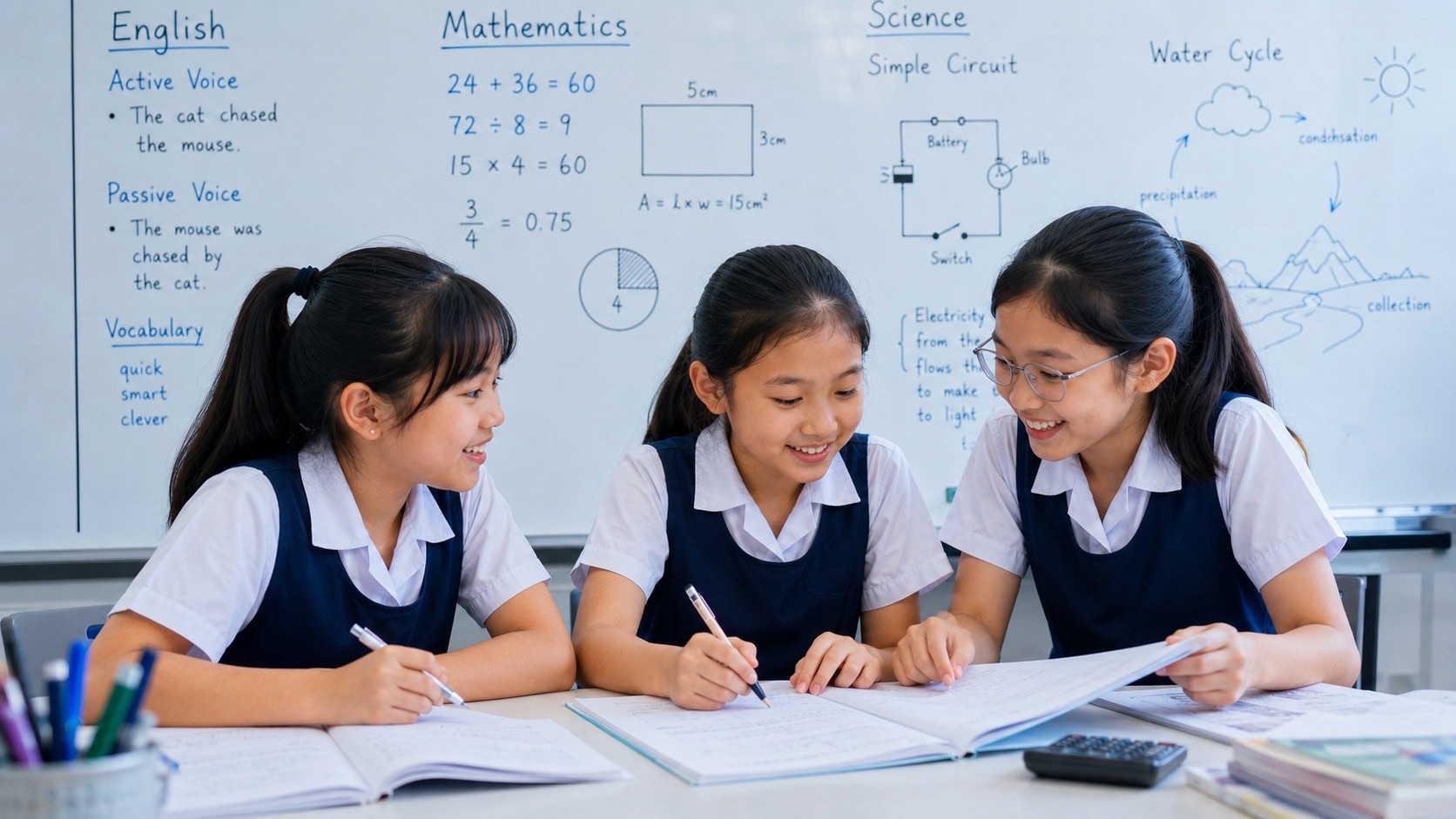
In a small group of three, one pupil might identify the explicit clue, another explain the inference and a third notice a claim that is not actually supported. The tutor can then require each student to answer a changed question independently.
For composition, pupils can discuss how a problem leads to an action but write their own distinct narratives. Detailed feedback is valuable when it identifies the first wrong relationship rather than simply producing a prettier model answer.
eduKate’s maximum-three-student, 1.5-hour tuition philosophy emphasises first principles, targeted feedback, spaced retrieval and independent transfer. Families should confirm whether a qualified Primary 4 Malay specialist and appropriate class are currently available; the article is not proof of a particular opening.
For further reading, see Punggol Primary 3 Malay comprehension and story writing, the Primary 2 Malay foundation, recommended Nabil and Nabilah Malay readers and why eduKate limits classes to three.
Questions parents should ask a Malay tutor
- Does the teaching follow the child’s 2024-syllabus cohort and actual school textbook?
- Can the tutor distinguish recognition, vocabulary, inference and writing organisation?
- Will the child provide textual evidence instead of guessing plausible answers?
- Is original narrative planning taught before stylistic embellishment?
- Are meaningful oral follow-ups part of the weekly lesson?
- Will a changed independent task demonstrate that feedback has transferred?
- Is the workload appropriate for a Primary 4 pupil progressing to P5 and the 2029 PSLE?
Frequently asked questions
Is 2027 the first Primary 4 year for the 2024 Malay syllabus cohort?
Under normal progression, yes. Pupils who entered P1 in 2024 ordinarily reach P4 in 2027. Verify the school’s actual curriculum arrangements.
Does the child take PSLE in P4?
No. A P4 pupil in 2027 would ordinarily take PSLE in 2029, after P6.
Should every Malay composition use many peribahasa?
No. An expression should be accurate and suitable for the situation. A coherent story using clear ordinary language is stronger than a disconnected collection of idioms.
What if a child speaks Malay but struggles with school comprehension?
Spoken language and printed-text literacy overlap but are distinct. Review vocabulary in context, sentence relationships and evidence-based inference rather than assuming more oral conversation alone will solve every reading problem.
Is tuition automatically needed when the new syllabus reaches P4?
No. School feedback and the child’s actual needs come first. Additional support is useful where it repairs a persistent, identifiable gap or provides suitable enrichment.
The Punggol family takeaway
P4 Malay is the year to make words work as meaningful sentences, sentences work as evidence, and evidence work as a clear written or spoken explanation. Check the correct curriculum cohort, protect original expression and insist on progress that appears in unfamiliar tasks.
Official references: MOE Primary Malay Language Syllabus 2024 and MOE Primary curriculum directory. Reviewed 30 October 2026. Later MOE and school instructions take precedence.


