
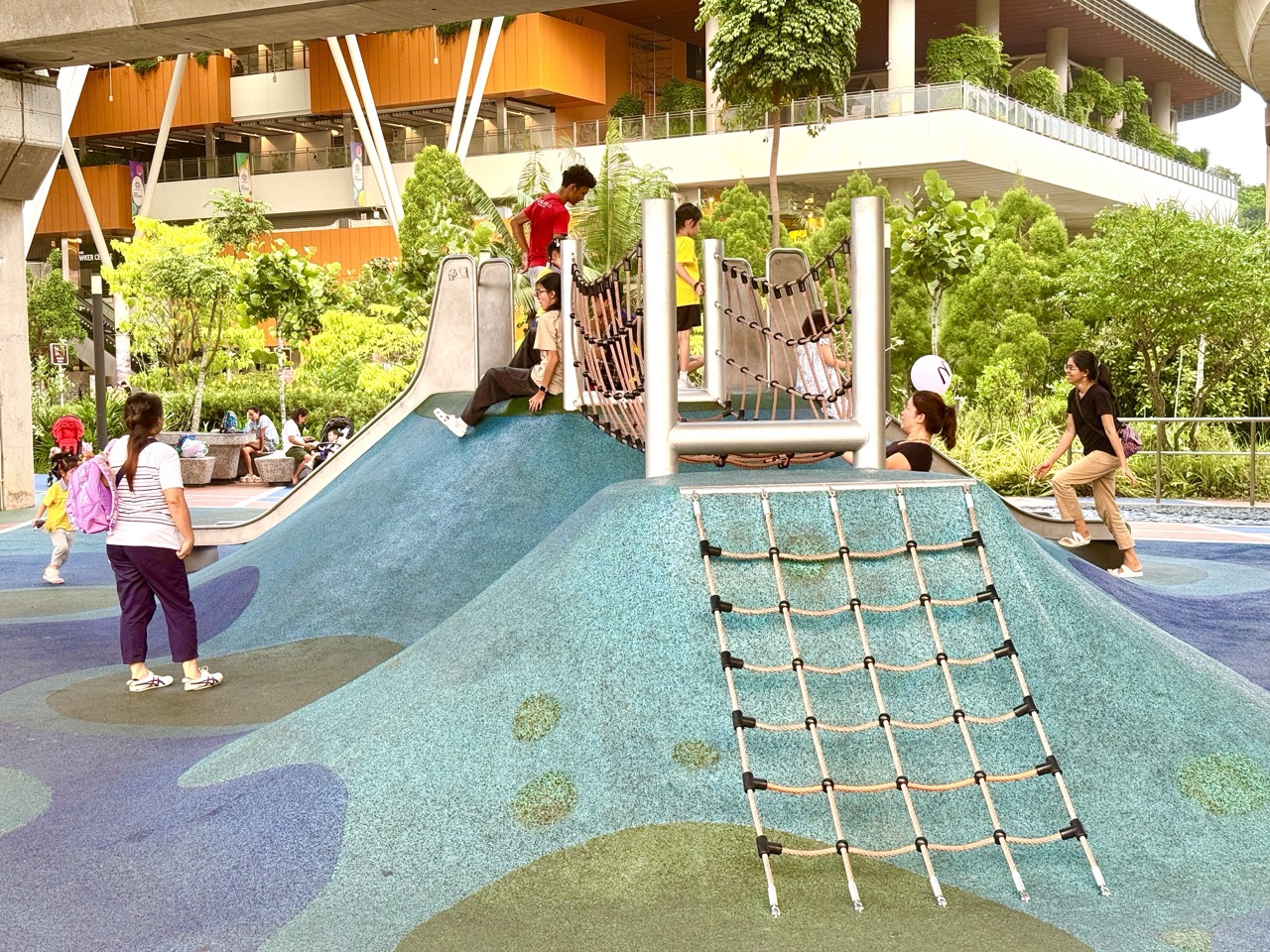
Did you know that two playgrounds can be equally colourful but teach children very different things? One may be full of climbing frames and slides. Another may give more opportunities for imaginative stories, cooperative games or experimenting with balance. They are both playgrounds, yet the experiences they offer are not interchangeable.
In Punggol, families can see play spaces in HDB estates, near walking routes and at recreational destinations. Some are compact, built around the needs of nearby blocks. Others are larger and attract visitors from different parts of the town. The useful question is not simply which playground looks most impressive in a photograph. It is what children actually get to practise when they play there.
Singapore’s Housing & Development Board has made that question explicit. From January 2026, HDB introduced a Play Values Framework to guide playground design in newly tendered BTO developments and new HDB parks, emphasising physical, social and creative play. The framework also considers age-appropriateness, safety and available space.
This article explains why Punggol families should care about those three kinds of play, how to recognise them, what changes for younger and older children and how parents can choose a suitable play environment. It is not a list of playground addresses or a claim that every existing Punggol playground has already been redesigned.
The answer in 50 seconds
HDB’s Play Values Framework groups children’s play into three broad aspects: physical, social and creative. Physical play involves movement such as climbing, balancing, sliding or swinging. Social play includes interaction, communication and cooperation. Creative play allows children to imagine, invent and explore different possibilities.
The reason for combining them is that children develop through more than one kind of experience. A playground made only for climbing may offer valuable movement challenges but fewer opportunities for certain kinds of pretend play. A space devoted exclusively to imaginative structures may not suit a child seeking active physical movement.
HDB’s 2025 announcement says the framework applies to newly tendered BTO projects and new HDB parks beginning in January 2026, with principles also extended to Town Councils for future upgrades. It does not mean all existing playgrounds were automatically rebuilt in 2026.
The practical message for parents is simple: choose play spaces for the child, the activity and the conditions—not only for the equipment count.
Why playing is not merely passing time
An adult watching a playground might see children running around without a clear purpose. But play can involve repeated decisions, movement planning, social negotiation, experimentation and imagination.
A child approaching a climbing structure must judge where to place hands and feet. A group inventing a game must agree on rules, adjust them and respond to one another. A child pretending a small platform is a spaceship is practising symbolic and creative thinking. None of these activities has to be turned into a formal lesson to have meaning.
This does not imply that every minute at a playground produces a measurable developmental gain or that a parent should rate each visit. Children’s interests and needs vary, and enjoyment matters.
The important idea is that different kinds of play can offer different opportunities. A thoughtful playground tries to make several of those opportunities available without treating childhood as a single narrow activity.
Physical play: what a child learns by moving
Physical play can involve climbing, sliding, swinging, balancing, crawling, bouncing and other movement. HDB’s framework identifies these as examples of physical play values. Such activities give children chances to explore movement patterns and respond to their environment.
Consider a child stepping from one low safe platform to another. They need to coordinate their body and plan a movement. A slide offers a different experience from a climbing wall; the child encounters direction, speed and balance in different ways.
This does not mean the highest or most difficult equipment is automatically the best. Challenges need to fit the child’s age, ability and the site’s safety conditions. An activity that is appropriate for an older child may be unsuitable for a toddler.
Parents can support physical play by observing what the child can manage and reading posted age guidance, rather than encouraging risky attempts for the sake of achievement.
Social play: why other children change the experience
A playground is one of the ordinary public places where children may meet peers outside the classroom. That creates opportunities to communicate, negotiate and cooperate. Sometimes it also creates disagreement.
A child may want to take turns on a swing. Another may invent rules for a chasing game. A third may need to explain that they do not wish to join. These interactions require understanding that other people have preferences and boundaries.
Good social play is not the same as forcing children to be outgoing. Some children prefer solitary play, parallel play or quieter interactions. They may need time, support or a different setting before joining a group.
The relevant developmental opportunity is to learn that play happens in a shared world. Respecting other children, making room and resolving simple disputes are as important as using the equipment correctly.
Creative play: why an empty-looking space can matter
Creative play is sometimes less visually dramatic than a large climbing frame. A child can turn a shaped mound into an imaginary mountain or use an open-ended structure as a shop, ship or fort.
HDB’s framework recognises creative and imaginative play, particularly for younger children. The design may include themed shapes, patterns and features that do not dictate one single action.
The child supplies part of the experience through imagination. This can be valuable because the play is not limited to a fixed sequence of moves. One group might invent a story, while another uses the same feature in a different way.
Adults should be careful not to insist on the “correct” imaginary meaning of every object. The child’s ability to create a harmless story or rule is part of what makes creative play different from following instructions.
Why the same playground cannot serve every age in the same way
Children develop at different rates. HDB’s new framework distinguishes broad design priorities for children aged 2 to 5 and those aged 5 to 12. For younger children, creative and imaginative play receives particular emphasis. For older children, physical challenges and group play become more prominent.
These are design categories, not a claim that a child’s abilities change suddenly on a birthday. A five-year-old may fall within overlapping considerations and still need adult judgement about specific equipment.
The purpose is to avoid treating a toddler and an older primary-school child as if they have identical height, coordination, judgement and social experience. The same physical structure may be engaging for one child and unsuitable for another.
Parents should always follow the site’s posted guidance and supervise according to the child’s actual abilities. Age labels help, but they are not substitutes for individual assessment.
Why a small playground can still be good
A playground in a residential precinct may have limited space. It might not contain the largest slides or most elaborate climbing structures. That does not automatically make it inferior.
A smaller local play area can be close to home, convenient for short visits and familiar to the children who use it. Its practical value may come from access and suitability rather than spectacle.
A thoughtful design can still offer more than one kind of play, even with limited equipment. A safe open area for imaginative games, a suitable balance feature and room for interaction may complement one another.
HDB’s framework explicitly balances play values with space availability. The correct question is what the site can offer appropriately, not whether it competes with a destination playground covering a much larger area.
Why neighbourhood access matters
The usefulness of a playground depends partly on how easily families can reach it. A beautiful facility far away may be an occasional outing. A modest playground close to a HDB block can be used during a short break after school.
For a caregiver with several children, a nearby space can reduce travel and simplify supervision. For a child with particular mobility needs, the route, entrance and play surfaces may be more important than the number of structures.
This is why play design belongs to the wider conversation about town planning. Equipment alone does not create access. Walkways, crossings, surrounding seating and the conditions of the site affect whether families can use it comfortably.
A Punggol parent choosing between two playgrounds should consider the complete trip, not just the images of the equipment.
Why inclusivity requires more than one accessible ramp
HDB describes the use of Universal Design principles in its estates, including barrier-free connections, ramps and facilities that help people of different ages and abilities use shared spaces. Such principles matter to playgrounds and their surroundings.
An accessible route to the entrance is valuable, but it is only one part of inclusion. A family may also need clear navigation, seating, a suitable play surface or an activity that a child with a particular ability can use.
Not every playground supports every type of play for every child. That is why a responsible guide should not claim a place is completely inclusive based on one photograph or an isolated feature.
Parents may need to contact the responsible operator or visit beforehand to assess suitability. Inclusion is measured by what a person can genuinely do, not only by the presence of a design label.
Why three-generation spaces are different from children’s-only spaces
HDB also describes three-generation fitness and play facilities in residential estates. These provide opportunities for children and adults to use a shared public space, sometimes for different activities.
A grandparent may watch from a seat, a parent may participate in safe activities, and a child may play nearby. The benefit is not that everyone must use the same equipment. It is that the family can share time in a space that recognises different ages.
Design still needs boundaries. Adult fitness equipment may not be appropriate for a young child, and play structures may have age or weight restrictions. Proximity does not make equipment interchangeable.
For a Punggol household, the important question is whether the outing works for the people coming together. A three-generation trip should not force the youngest or least mobile member into an unsuitable activity.
What safety means in a good playground
Safety does not mean eliminating all movement, challenge or learning. Children need appropriate opportunities to explore. But a playground should not encourage hazards outside its intended use, and adults should follow age guidance and safety instructions.
A child learning to balance may encounter a manageable challenge. That differs from climbing an external structure not designed for play, entering a restricted area or using equipment meant for older children.
A parent can help by distinguishing safe exploration from reckless behaviour. “Try this low balance element with me nearby” is different from “climb higher than everyone else to prove you are brave.”
The correct response depends on the actual equipment, child’s ability, supervision and environmental conditions. A blog article cannot certify a specific playground’s current condition.
Why a little difficulty can be valuable
A playground designed with no challenge at all may become uninteresting to a child whose skills have developed. A thoughtful environment offers varied levels of engagement so children can practise abilities without being pushed into unsuitable risks.
For example, a child who is learning balance may start with an easier element before trying a more demanding one designed for their age group. Another child may prefer an imaginative game rather than a physical challenge.
The key is voluntary, age-appropriate exploration. It should not become a competitive test in which an adult pressures a child to perform beyond their comfort or ability.
HDB’s framework emphasises balancing adventure with safety. That is a more useful way to talk about playground design than assuming the most difficult equipment produces the most development.
Why playgrounds are shared social infrastructure
A playground is not only a product for a single child. It is a shared resource used by different families. That means its function depends on the behaviour of users as well as the structures themselves.
Children need space to take turns, and adults need to supervise without blocking other users. Noise and activity must be considered alongside nearby homes. Play areas require maintenance and reporting of damaged equipment.
Community life is practised in small moments: leaving space for someone else, helping a younger child find an appropriate activity and responding respectfully when there is disagreement.
The broader lesson is that public spaces work best when people see themselves as part of a shared environment rather than treating equipment as personally owned.
Why play does not need to become a formal tutorial
Parents understandably want children to learn. A playground can support movement, communication and imagination, but that does not mean every visit should be managed like a school assessment.
If adults constantly tell children which skill to practise, the child may lose the freedom to explore interests and invent games. Adults can support learning through a few well-chosen questions and safe supervision, without controlling every movement.
A helpful question might be, “How could you and your friend both use this safely?” or “What does your imaginary shop sell?” The conversation can be short and natural.
The aim is not to attach an educational label to every laugh. It is to recognise that children can practise valuable abilities through ordinary play.
How the 2026 HDB framework changes planning
HDB announced the Play Values Framework on 2 December 2025 and said it would guide playgrounds for newly tendered BTO developments and new HDB parks from January 2026. It also planned to extend the framework to Town Councils, which maintain and undertake cyclical upgrades of existing estate playgrounds.
This timeline matters. It would be inaccurate to claim that every playground in Punggol was redesigned on 1 January 2026. The framework guides relevant new projects and can influence future upgrade cycles.
Residents evaluating a particular site should distinguish its current equipment from the design principles applicable to future works. A newly released framework does not automatically describe the present condition of an older playground.
This is a useful public-policy lesson: announcing a standard, applying it in new tenders and completing physical construction are different events.
Why Punggol families may notice several playground styles
Punggol has developed in stages, so its play spaces may reflect different planning periods, layouts, equipment and residential needs. Some playgrounds are part of older precincts. Others are associated with newer housing or recreational developments.
Variation is therefore unsurprising. It would be wrong to infer the exact design standard of a specific playground without checking its development date, renovation history and actual equipment.
Parents should compare spaces based on observable characteristics and child suitability. A modern-looking theme does not guarantee more suitable activities for every child. An older small playground may still serve a family’s daily routine well if it is properly maintained and appropriate.
The diversity itself can teach children that towns evolve over time rather than being built all at once.
Why play spaces need maintenance
A playground is exposed to weather and repeated use. Parts can wear, surfaces can become damaged and surrounding conditions can change. Maintenance is part of keeping the facility safe and functional.
Adults should look for visible hazards and follow posted instructions. If equipment appears damaged, stop using it and report the concern through an appropriate town council or operator channel. Do not attempt unqualified repairs or allow a child to continue because the equipment was safe on a previous visit.
A facility’s design intention is not proof of its current condition. That is a distinction between the specification of a product and its actual operation.
Students can learn from this principle. A successful engineered system needs regular care, not just an attractive launch photograph.
Why weather changes which playground is suitable
Singapore’s sun, humidity and thunderstorms influence outdoor activities. A playground that is pleasant in the early morning may be uncomfortable under direct afternoon sun. Wet surfaces may require additional caution, and lightning makes outdoor play unsafe.
Parents should check conditions rather than treating a shaded corner as protection from every heat or storm risk. Water-play facilities have their own rules, hygiene considerations and supervision requirements. One playground may be a good choice at one time but unsuitable later.
An indoor activity or a shorter visit can be a reasonable alternative when weather conditions are poor. The goal is a safe, enjoyable experience, not completing a fixed itinerary regardless of conditions.
This connects play design with Punggol’s wider walking and climate realities. The route to the playground matters as much as the play space itself.
Why parents should not compare children only by what they can climb
At a playground, one child may confidently climb while another prefers to watch, imagine or play with a friend. These differences do not provide a simple ranking of intelligence, courage or developmental success.
Children may vary in interests, experience, confidence and physical capabilities. Some need accommodations or different activities. A responsible adult should avoid turning public play into a contest or making judgements from one observation.
The Play Values Framework’s three categories provide a broader way to appreciate what children are doing. Physical achievement is only one dimension of play.
It can be useful to notice a child’s curiosity, cooperation or creativity, even when the child has not attempted the tallest structure.
Why independent choice matters
Within appropriate safety boundaries, children can benefit from making choices: which activity to try, whether to join a game and when to take a break. Choice gives them an opportunity to listen to their own preferences and respond to others.
A child who decides not to climb a particular structure has not necessarily failed. They may be making a reasonable judgement about comfort or readiness. Adults can encourage exploration without removing the child’s agency.
Likewise, a child who wants to play alone for a while is not automatically missing a social lesson. Social play can be invited gently rather than imposed.
The public-space goal is to offer appropriate opportunities, not prescribe a single pattern of play for all users.
Three Punggol-style family scenarios
Scenario one: a toddler and a Primary 5 sibling
A family has two children with very different abilities. A play space designed for older children may not provide suitable activities for the toddler. A smaller age-appropriate play area may be enjoyable for the younger child but less challenging for the older one.
The adult plans a visit that respects both children. They may choose a location with different appropriate play zones, set a manageable time and supervise each according to their needs.
The lesson is that a playground can be excellent without being suitable for every child at every developmental stage.
Scenario two: a child who wants to invent stories
A child repeatedly uses a small play structure as an imaginary train station. An adult thinks the child should instead climb more because climbing “looks more educational.”
A better response is to recognise that creative play has value too. The adult may ask what passengers need or how the station works, then let the child lead the story. If the child later chooses a physical activity, that choice can be supported.
The lesson is that imagination and movement contribute differently to play.
Scenario three: a disagreement over turns
Several children want to use the same swing. They disagree about whose turn comes next. The adult provides appropriate support and helps them develop a simple fair rule, while keeping everyone safe.
The children practise communication, patience and understanding another person’s needs. The educational value lies partly in resolving the social challenge, not only in moving on the swing.
The lesson is that shared equipment is also an opportunity to learn shared responsibility.
A simple way to observe the three play values
Choose a safe, appropriate playground that the family already uses. During a normal visit, notice examples of physical, social and creative activity without labelling every action or monitoring children as if they were research subjects.
Physical: is a child climbing, balancing or moving in a new way? Social: are children taking turns, negotiating a game or cooperating? Creative: are they inventing a story, using an open-ended feature or imagining a role?
One activity may involve more than one value. A pretend pirate ship game can include climbing, storytelling and group negotiation. The categories overlap in real life.
The exercise is intended to broaden the parent’s understanding, not calculate a score. A family should not record or share identifiable images of other children without appropriate consent.
What makes a playground inclusive for families
A family-friendly playground should consider not just the equipment but the approach, supervision, seating and available activity types. Some visitors may need quieter play, step-free routes or a place to rest. Others may require additional assistance to use particular features.
There is no universal checklist that can guarantee suitability for every child. Parents may need to inspect the current site and consult the operator about specific accessibility details.
The important principle from Universal Design is to plan for a range of human needs rather than assuming one standard user. The child who cannot use a particular structure should still be considered in the wider design of the play environment.
Inclusion does not require every piece of equipment to suit everyone. It requires thoughtful opportunities, appropriate information and efforts to reduce unnecessary barriers.
Why a playground should not be judged by social media alone
A photo often emphasises the most dramatic slide or colourful structure. It may not show age restrictions, accessibility, safety surfaces, shade, toilets or whether the space is crowded.
A short video may capture a child’s exciting moment but not the everyday experience of families with different needs. The most photogenic play area is not necessarily the most useful for a local household’s regular routine.
For a meaningful choice, consider current conditions and the child rather than relying only on attractive images. A modest play space close to home can be more practical than a distant themed destination.
This is a useful example of digital literacy: visual appeal is evidence of appearance, not a complete evaluation of suitability.
What residents can do when a playground needs improvement
Residents may notice missing opportunities for age groups, damaged equipment, limited shade or difficult accessibility. Constructive feedback should describe the exact problem and who is affected.
A request such as “our block’s playground has equipment that my four-year-old cannot use safely” is more actionable than “make the playground better.” The responsible authority can then assess what is possible within space, safety, budget and maintenance constraints.
Residents should not modify public play structures themselves. Public playground equipment requires professional design and maintenance.
The HDB framework provides useful vocabulary for feedback. People can discuss physical, social and creative opportunities rather than asking only for more equipment.
Common misunderstandings
The first mistake is believing that the newest playground must be best for every family. Another is equating child development only with climbing height or physical daring.
A third is assuming that a good playground needs expensive themed equipment. A fourth is treating any accessible entrance as proof that every activity suits every user. A fifth is assuming that a single age label replaces adult judgement.
Another error is claiming that the 2026 Play Values Framework instantly changed every existing Punggol playground. It is a design framework introduced for specified new projects and future upgrades, not an overnight reconstruction programme.
Finally, do not turn every outing into a formal lesson. Appropriate play includes enjoyment, choice and rest.
Frequently asked questions
What are the three kinds of play in HDB’s new framework?
Physical, social and creative play. They describe different but overlapping opportunities children can experience.
When did the framework begin?
HDB announced it on 2 December 2025 and said it would guide relevant new playgrounds from January 2026.
Does the framework cover every existing Punggol playground immediately?
No. It applies to new tenders and parks as stated by HDB and is extended to Town Councils for future upgrade planning.
Why are there different priorities for younger and older children?
Children’s abilities and interests change over time. HDB places particular emphasis on creative play for ages 2 to 5 and more physical and group play for ages 5 to 12.
Is creative play less important than climbing?
No. They are different aspects of a broad play experience. The design aim is to offer suitable opportunities across categories.
Can an older child use all toddler equipment?
Not necessarily. Follow age and equipment guidance. Suitability depends on the individual structure and current conditions.
Is a bigger playground always better?
No. Location, access, age suitability, maintenance and the kinds of play available matter more than size alone.
What if a child prefers solitary play?
That preference does not automatically indicate a problem. Offer suitable opportunities without forcing participation; seek professional advice if there are specific developmental concerns.
Are all playgrounds fully accessible?
Do not assume so. Check the actual route, equipment and support needed for the particular visitor.
Can a family use a playground for learning without worksheets?
Yes. Natural conversations about sharing, movement and imagination can be useful without turning the outing into a classroom exercise.
A parent’s practical playground checklist
- Choose the facility for the child’s current age, ability and preferences.
- Read posted rules and supervise appropriately.
- Look for opportunities for movement, cooperation and imagination.
- Check whether the route and facilities suit family accessibility needs.
- Consider heat, rain, surfaces and safe places to rest.
- Respect other children and keep shared space available to everyone.
- Do not pressure a child to attempt unsuitable equipment.
- Report damaged public equipment rather than trying to repair it.
- Respect privacy when taking photographs or videos.
- Let children enjoy play without constant scoring or comparison.
Teaching Guide: recognise three different play values
Learning goal. Students should explain that playgrounds can support physical, social and creative activity, and that different designs suit different people and age groups.
Activity one: identify. Draw three fictional playground features: a balance beam, a shared game area and an open-ended pretend-play structure. Ask which kinds of play each might support. More than one category can apply.
Activity two: redesign. Give a small imaginary playground only one climbing frame. Ask what could be added or changed to introduce social and creative opportunities while respecting space and safety.
Activity three: age considerations. Compare the needs of a three-year-old and a ten-year-old without treating every child of the same age as identical. Ask what an adult would need to verify before recommending equipment.
Activity four: inclusion. Imagine a visitor with limited mobility. Ask the learner to think beyond the entrance: which route, seating and activity choices would make the visit more workable?
Activity five: community. Invent a disagreement over turns on a swing and ask students to propose a fair rule. Explain that the quality of a shared play space also depends on respectful behaviour.
Transfer test. Present a play space in a different town. Ask the learner to identify which opportunities it offers and which might be missing, based only on visible evidence and posted information.
Parent checkpoint. A strong answer is: “A playground can help children move, play with others and imagine different things. The right one is suitable for the children who use it, not simply the biggest one.” That demonstrates the underlying concept.
How this guide differs from local playground directories
The existing Punggol family outing guide helps households plan a three-generation day. The Waterway Point, Happy Park and family amenities guide focuses on particular facilities and access.
This article explains why playgrounds are designed for different kinds of play. Its purpose is to help families evaluate what a play environment offers, not to rank playground addresses or promise that a named site has already been rebuilt under a newer standard.
Official sources and further reading
- HDB: New playgrounds and the Play Values Framework, 2 December 2025
- HDB: Universal Design in public housing estates
- HDB: Living in my community
- NParks: Parks and recreation information
- eduKatePunggol: Three-generation outing planning
The one idea to remember
A good playground is not a collection of brightly coloured objects. It is an environment that gives children suitable opportunities to move, connect and imagine. Punggol families can use those three ideas to choose play spaces more thoughtfully—and to understand why the design of a small neighbourhood playground matters to a child’s ordinary life.


