
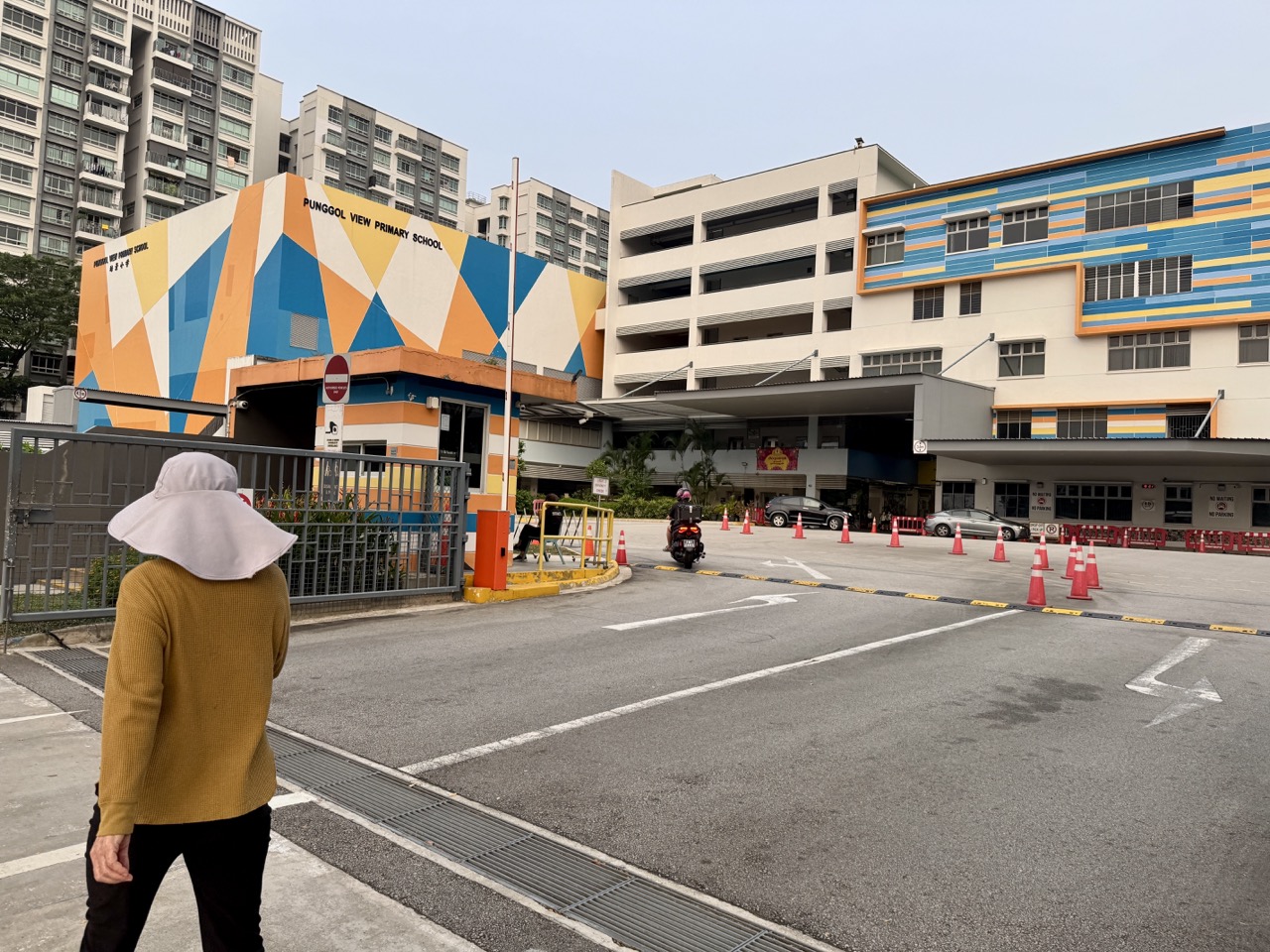
What should Punggol families expect from Punggol View Primary School in 2027? This established school at 9 Punggol Place uses E²C, its Effective and Empathetic Communicator programme, and Outdoor Experiential Learning to build thinking, communication and character. It also introduced WITs and Media Club CCAs in 2026, while MOE Kindergarten @ Punggol View offers separate K1, K2 and KCare arrangements.
For parents, the practical 2027 picture begins with Punggol MRT Exit B, verified bus stops and current school-day times. Children cannot be guaranteed admission or a particular CCA simply because the school is close to an HDB home.

Punggol View Primary 2027: verified facts
| 2027 planning point | What is verified in 2026 |
|---|---|
| Existing school | 9 Punggol Place, Singapore 828845; not a newly opening 2027 campus. |
| Public transport | Punggol MRT Exit B; stops 65351/65359; buses 50, 117/117M, 382W/382G. |
| 2026 operating hours | Report by 7.25am; ordinary school day 7.30am–1.45pm; selected CCAs after lessons. |
| ALP | E²C — Effective and Empathetic Communicator; journalism, oracy, storytelling and Star Studio. |
| LLP | Outdoor Experiential Learning with school-wide journeys and upper-primary camps. |
| New CCAs from 2026 | WITs board-game strategic thinking and Media Club digital storytelling. |
| Kindergarten | MK@Punggol View AM 8am–noon or PM 1pm–5pm; Raffles KCare 7am–7pm. |
| Not promised | Automatic P1 admission, unrestricted media studio access, identical 2027 CCA allocation or gate hours. |
Research position: 29 October 2026. The school’s official 2026 material explains its current arrangements; individual class and care requirements must be checked with the school for 2027.
Punggol View is already an operating school beside the town centre
Did you know that Punggol View Primary School combines a communication-focused Applied Learning Programme with outdoor experiential education—and also introduced two CCAs in 2026? That gives families practical educational information for 2027 instead of a generic claim that Punggol will gain a new school.
The established campus is at 9 Punggol Place, Singapore 828845, within walking reach of the Punggol town-centre network. Its programme aims to nurture confident learners and active citizens. It is not a newly announced campus opening in 2027, and proximity to the school does not guarantee a Primary 1 place.
For new residents, the relevant questions are how to arrive safely, what the curriculum actually emphasises, which parent resources are available and how younger children can transition through MOE Kindergarten or appropriate care. Every answer should distinguish an existing 2026 service from an admission or timetable that requires confirmation for 2027.
The correct transport point is Punggol MRT Exit B
The school’s official contact information names Punggol MRT NE17 Exit B as the rail approach. Bus stops 65351 outside and 65359 opposite the school serve routes 50, 117/117M and the 382W/382G variants, subject to the direction of travel. These details can prevent a new family from approaching the wrong side of the estate.
An adult arriving from Sumang should not assume the route is identical to a person coming from Punggol Central. The same bus may use different stops in the two directions. Verify the current service and the actual school-designated gate before the first day.
A good morning plan starts with the home lift lobby, safe crossing, public transport or walking path, and the legal entrance. A map may show a short straight line that overlooks busy vehicle access, construction or a covered walkway. Test the route at the real school hour.
Parents who use the town centre for work or shopping should also agree on a pickup fallback if transport changes. The correct school address and an authorised collector matter more than familiarity with a general Punggol landmark.
The 2026 school day ends at 1.45pm, but CCAs run later
Punggol View’s official operating-hours page last updated 8 September 2026 lists a reporting time of 7.25am, school start at 7.30am and normal school end at 1.45pm on Mondays through Fridays. This is a dated schedule and should not be copied as a guaranteed 2027 timetable for every special school day.
Tuesday is designated for most CCAs, generally 2.15pm–4.15pm. Selected school-team or CCA sessions on Thursday and Friday are listed from 3pm–5pm. Learning support and remedial activities can also occur after the ordinary curriculum ends.
The timing difference matters for parents working shifts or collecting siblings from different campuses. A family may need a separate plan for a Tuesday CCA and a standard Wednesday dismissal. Neither the administrative office closing at 5.30pm nor the Punggol bus schedule determines where a pupil may wait after class.
Parents should obtain the actual 2027 school circular, teacher guidance and approved collection arrangements instead of asking a child to remain outside the school unsupervised.
E²C is about effectiveness and empathy together
The official Applied Learning Programme is E²C @ PGVP, Effective and Empathetic Communicator. It focuses on listening and speaking, communication and collaboration, with information skills and perspective-taking. The school’s message is that confidence without respect for the other person is incomplete communication.
In Primary 1 and 2, pupils practise interaction and oral strategies through engaging lessons. Primary 3 pupils develop storytelling. In Primary 4, 5 and 6, children gain elementary journalism experience, with opportunities to act as reporters, emcees and contributors to media-related activities.
This sequence connects directly to English development. A child can learn to give a clear account, recognise whose perspective is missing, ask a good follow-up question and support a statement with an observation. The useful skill is not merely speaking loudly or using difficult vocabulary.
Parents can reinforce E²C by listening to a child’s explanation and asking what an unfamiliar listener needs to know. A class project is only one setting for communication; children apply the same skill when resolving a misunderstanding at home or asking a teacher for help.
Star Studio makes media production a learning process
Punggol View says its Star Studio @ PGVP includes recording and broadcasting equipment used for school videos and journalism-related learning. The studio supports the communication aims of E²C, but it is a school-managed teaching space rather than a general commercial recording studio that residents can book.
Video production can teach an older pupil to plan a script, check facts, consider the audience, organise visual evidence, work in a group and revise after feedback. Pressing record is not by itself evidence of a correct report or responsible storytelling.
Families should be careful with student privacy. A media assignment does not automatically authorise a pupil to publish identifiable images of classmates, teachers or members of the public on an open platform. School consent, safe digital behaviour and current rules govern any public-facing material.
The studio being present does not guarantee every Primary 4 or Primary 6 child will operate the same equipment on a fixed 2027 date. The school decides how projects are introduced by level and class.
WITs and Media Club were added in 2026
One of the most useful recent changes is the school’s August 2026 announcement of two new CCAs. Winning in Thinking Strategies, or WITs, develops strategic and adaptive thinking through board games such as chess and Scrabble. Media Club focuses on digital storytelling, content creation, creativity and collaborative project work.
These are concrete new opportunities, not a broad claim that every school in Punggol offers the same programme. They complement traditional activities by giving children space to compare decisions, anticipate another person’s move and explain why one strategy may be stronger.
A game-based thinking task can develop mathematical pattern recognition and language choices. Media Club can develop the ability to plan, create and evaluate work for an audience. Both are valuable only when pupils also learn fair play, ethical use of information and respect for others.
An announcement that a CCA was introduced in 2026 is not a guaranteed 2027 allocation. Parents should ask about level eligibility, selection, capacity and the actual current CCA timetable before enrolling the child in competing external lessons.
Outdoor Experiential Learning is the school’s Learning for Life Programme
The official Learning for Life Programme focuses on Building of Character through Outdoor Experiential Learning, often abbreviated OEL. A whole-school OEL Week provides learning journeys for younger pupils and camp-related experiences for the upper primary years, integrating activities with character and curriculum learning.
The programme description includes 2D1N and 3D2N camp formats and a one-day motivational camp within the progression. It does not promise identical excursions or outdoor challenges for every level in every 2027 term. Age, health, safety, weather and school planning influence the actual activity.
The educational principle is to learn from experience. Students practise cooperation, planning, coping with uncertainty and recovering from mistakes, followed by debriefing and reflection. A child who describes what went wrong and how the team adapted has learned more than a child who simply reports that a high element felt exciting.
Parents should use school-issued packing lists, consent and health instructions. An outdoor learning programme does not mean children should recreate supervised camp obstacles on public playgrounds or enter nearby reservoirs without permission.
The ABC²D curriculum model rewards thinking and inclusive learning
Punggol View’s 2026 curriculum framework uses the ABC²D model. It brings together Assessment Literacy, Blended Learning, Critical and Inventive Thinking, Effective and Empathetic Communication and Differentiation, intended to support learning for children with different needs.
This has practical consequences for how a parent interprets academic work. Assessment can provide information about a misconception rather than simply rank a child. Blended learning should support thoughtful practice, not replace teacher explanation. Differentiation means that the form or level of support may need to vary.
An excellent question for a family to ask is not only ‘What mark did my child get?’ but ‘Which concept does the child understand, and at which step did reasoning become unstable?’ That leads to targeted correction rather than more indiscriminate worksheets.
No broad curriculum model guarantees a particular grade. Pupil progress also depends on classroom experience, readiness, attendance, time, health, home support and effective feedback.
Punggol View promotes critical and inventive thinking
The school’s CIT programme describes critical reasoning, adaptive thinking and inventive thinking. Pupils are encouraged to check facts, examine perspectives, compare possible approaches and improve an idea using sound criteria.
School examples include discussions about values and environmental responsibility. For a Punggol family, the concepts can be practised when deciding how to share a common corridor or choosing a safe route through a busy interchange. A reason should connect to evidence rather than simply a personal preference.
Inventive thinking does not always require an expensive robot or a new app. A child may suggest changing a household routine and test whether it reduces forgotten belongings. Being able to reflect honestly when the idea fails is a useful outcome.
Parents should allow space for questions without presenting a child’s first suggestion as automatically correct. Critical thinking includes recognising uncertainty and changing a position when better evidence appears.
School rules and technology are not the same as a device free-for-all
The school’s June 2026 rules say pupils should report punctually and not leave campus during school hours without proper arrangements. The same document restricts personal mobile phones and electronic devices such as iPads and smartwatches, with a specified permitted exception for POSB Smart Buddy watches.
This is important because the school also provides ICT and media learning. An educational technology programme run under school supervision does not give pupils unrestricted permission to bring private devices into class.
Parents should verify any later changes to the device policy before buying a new electronic product for school use. If a child needs to contact an adult in an unexpected situation, the school’s approved communication method should be used.
Digital responsibility includes respecting privacy, asking permission before recording people and being careful about what personal information is shared.
MK@Punggol View has two distinct kindergarten sessions
The MOE Kindergarten within Punggol View Primary publishes an AM session from 8am to noon and a PM session from 1pm to 5pm for K1 and K2. It also lists KCare services from 7am to 7pm for eligible children who need a longer care day.
The school’s August 2026 useful-information page names Raffles Student Care as the KCare provider, with a separate contact line. Parents should distinguish kindergarten teaching, before- and after-session care and the primary school’s own student care.
The kindergarten curriculum includes the HI-Light and Starlight programmes, values education, early language and play. It follows a separate admission process from Primary 1. A family enrolled in MK should not assume that all admission and care decisions for the next stage are already settled.
Check the child’s session, confirmed place, fees or subsidies, pickup permissions and holiday arrangements with the appropriate provider before changing household work schedules.
Raffles student care and the primary-school after-class plan
Punggol View also lists Raffles Student Care under its primary-school service providers. That after-school programme is separate from Kindergarten Care even though the named operator belongs to the same wider organisation.
A parent should ask about the exact age group, care hours, holiday arrangements, vacancy, fees and the approved way a pupil moves from classroom dismissal to the care setting. A centre existing on or near campus is not evidence of guaranteed capacity.
Some pupils may stay for remedial lessons or CCAs on particular days. Families should coordinate these commitments with the student’s actual care or collection schedule.
An ordinary school-day plan should have a named adult and a backup when a parent is late. A long workday and a convenient school address are not sufficient plans by themselves.
Punggol Place and public weekend sport are separate amenities
The school’s Punggol Place location gives families access to the town centre, One Punggol’s library and community services, and established public transport. These offer valuable opportunities outside school but have their own operators and schedules.
Sport Singapore separately lists Punggol View Primary School Field for free-to-play public weekend use under the Dual-Use Scheme, usually Saturday afternoon and Sunday. That public sports booking is not permission to enter school classrooms or disturb pupil activities.
A family might combine an authorised public field booking with an outing to the regional library, but it should check booking status, local weather, safe routes and the needs of each participant.
Neighbourhood amenities help learning when families use them with purpose and realistic time management, not when every available activity becomes a compulsory extension of the school day.
Primary 1 admission and the 2027 school-year transition
MOE Primary 1 Registration is a formal process with phases, eligible home addresses, vacancies and possible balloting. For the 2027 Primary 1 cohort, the main registration exercise takes place in 2026. Living across from the school does not guarantee a place.
School applicants should use MOE’s official home-school distance and registration information rather than a real-estate travel-time estimate. Those who have a confirmed school posting can prepare the child’s independence, simple organisation and confidence in asking for help.
The school has 2026 briefing notes for different levels, including a recent parent briefing page updated in October 2026. Such material is useful context but must not be mistaken for automatically applicable 2027 dates or examination requirements.
Parents can help the child begin a new year with a predictable routine, adequate rest and time to read, play and talk. Understanding the school’s approach matters more when it becomes part of family life rather than another set of expectations to memorise.
2027 parent checklist
- Use the 9 Punggol Place school address and Punggol MRT Exit B for planning.
- Test legal crossings and actual school gate access during the school morning.
- Understand the distinction between the normal school day and Tuesday or selected CCA sessions.
- Read E²C, OEL, WITs and Media Club descriptions as learning opportunities, not guaranteed individual roles.
- Check MOE P1 registration criteria and vacancies; proximity alone is insufficient.
- Confirm MK session, KCare or primary student-care places and provider terms separately.
- Follow current school rules on personal devices and authorised collection.
Frequently asked questions
Where is Punggol View Primary School?
9 Punggol Place, Singapore 828845.
Which MRT exit does the school recommend?
Punggol MRT NE17 Exit B.
Which bus stops serve the school?
65351 outside and 65359 opposite, with services including 50, 117/117M and 382 variants.
When does the 2026 normal school day end?
The current official schedule lists 1.45pm, with later selected CCA sessions.
What is the E²C Applied Learning Programme?
Effective and Empathetic Communicator, with oral communication, perspective taking, journalism and storytelling.
What is Star Studio?
A school-managed recording and media-learning facility supporting the ALP.
Which two CCAs were new in 2026?
WITs, Winning in Thinking Strategies, and Media Club.
What is Outdoor Experiential Learning?
The school’s Learning for Life Programme, incorporating learning journeys and supervised camps.
Can pupils bring personal iPads because the school teaches media?
The current school rules restrict personal electronic devices; follow the school’s updated instructions.
What are MK@Punggol View session hours?
Morning 8am–12pm and afternoon 1pm–5pm, with separate KCare arrangements.
Who provides KCare?
The current school directory names Raffles Student Care; individual admission and vacancies need confirmation.
Does living near Punggol Place guarantee Primary 1 admission?
No. MOE registration phases, verified distance and vacancies apply.
Official school and MOE references
- Punggol View Primary: address, MRT Exit B and bus stops
- Punggol View Primary: E²C Applied Learning Programme and Star Studio
- Punggol View Primary: Outdoor Experiential Learning LLP
- Punggol View Primary: WITs and Media Club introduced in 2026
- Punggol View Primary: 2026 school operating hours and CCAs
- Punggol View Primary: ABC²D curriculum and CIT thinking
- Punggol View Primary: personal device and school rules
- MK@Punggol View: AM/PM kindergarten and KCare hours
- MK@Punggol View: Raffles student care contact and KCare
- MOE Primary 1 Registration phases and criteria
Related Punggol resident guides
- Punggol View Primary original gate and bus-stop photo guide
- Punggol Place, Punggol View and everyday services in 2027
- Punggol 2027: free weekend school fields and ActiveSG
- Punggol Town Square and Discovery Cube in 2027
Editorial note: 29 October 2026. Programme facts and timings are based on official dated school sources. No school admission, future event date, pupil-level placement or clinical result is promised.


