
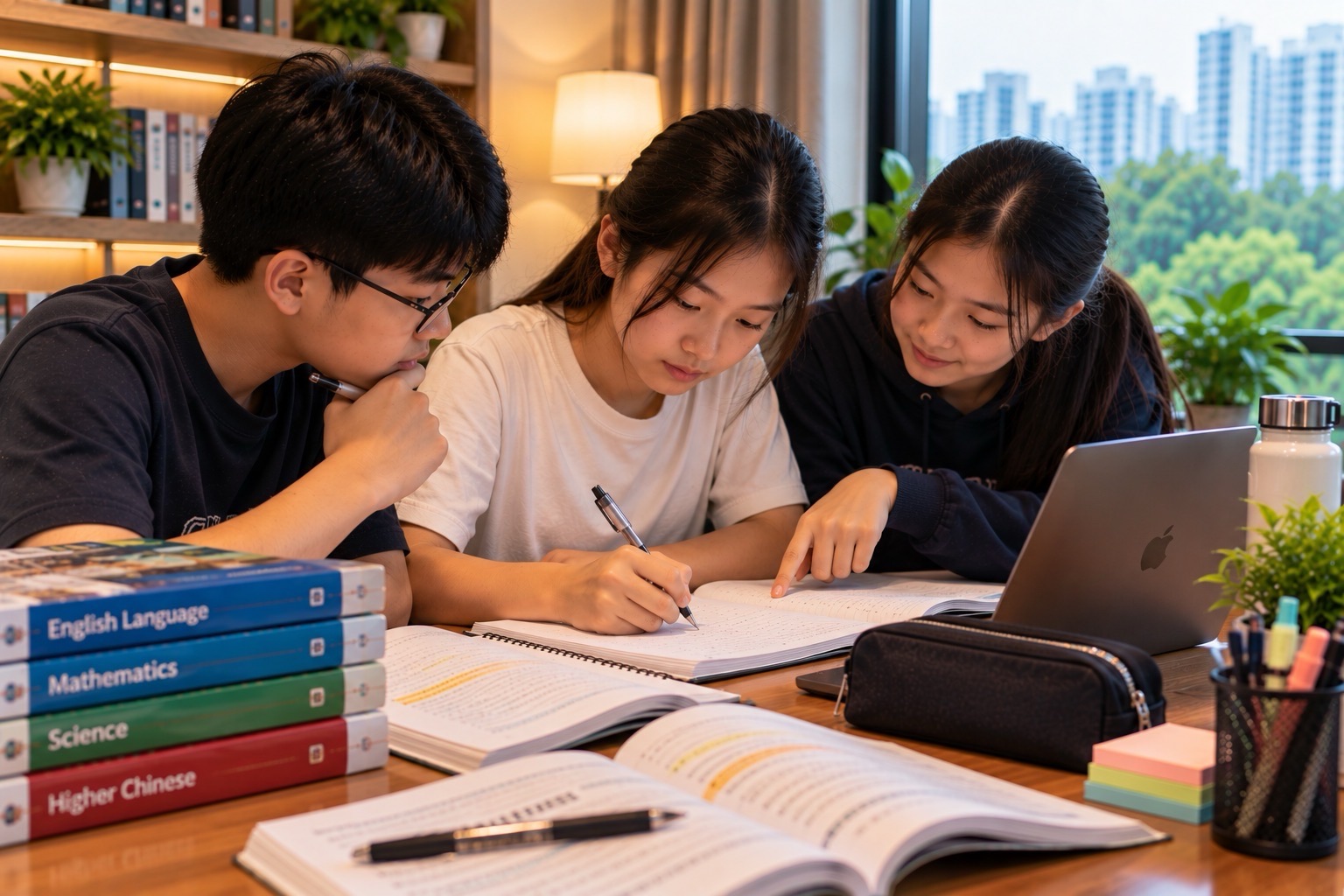
Did you know? For the 2027 Singapore-Cambridge Secondary Education Certificate (SEC), G2 Humanities (Social Studies, History) K230 has two papers that are equally weighted but have different tasks and durations. The Social Studies paper takes 1 hour 45 minutes and requires a typed digital answer booklet. The History paper takes 1 hour 50 minutes and includes two ten-mark essays selected from three questions.
Another distinction matters: the G2 History syllabus includes the Vietnam War as a Cold War case study. Parents should not assume that a generic G3 Humanities revision set, with its particular case-study emphasis, is a complete replacement for the G2 K230 course.
This article translates the official 2027 K230 syllabus into a practical study plan for Punggol parents and Secondary 4 pupils. It teaches source evaluation, chronology, historical causation and responsible written argument with original fictional source exercises. None of the invented quotations below is attributed to a real historical witness.
Identify the correct G2 Humanities combination
SEAB’s 2027 G2 school-candidate list names Humanities (Social Studies, History) K230, with previous reference 2126.
The official K230 G2 Humanities syllabus for 2027 provides exact assessment structures and the topics prescribed for examination. It is not interchangeable with K229 (Social Studies, Geography), K231 (Social Studies, Literature in English) or K336 (G3 Social Studies, History).
A student may take Humanities at one G-level and Mathematics at another under the Full Subject-Based Banding framework. The pupil’s actual school registration and course instructions determine what to practise, not an inference from a broad Posting Group label.
The two K230 papers and their weighting
Both components are compulsory and contribute 50% of the K230 subject result:
- Paper 1 — Social Studies: 1 hour 45 minutes, 50 marks, 50%. Section A Source-Based Case Study carries 35 marks. Section B has two compulsory structured-response questions worth 15 marks altogether.
- Paper 2 — History: 1 hour 50 minutes, 50 marks, 50%. Section A Source-Based Case Study carries 30 marks. Section B requires two out of three ten-mark essays, worth 20 marks altogether.
- Social Studies delivery: candidates receive a hardcopy paper and type answers into a digital answer booklet under the published examination arrangement.
- History source study: up to five sources; the first four questions test specified sources, and the fifth requires using evidence from multiple sources.
- History essay choice: candidates must answer two questions, not all three and not only one.
The two papers therefore need distinct revision routines. Practising Social Studies source handling without History’s contextual content cannot fully prepare the candidate.
What does K230 Social Studies cover?
Its three broad issues are:
- Exploring Citizenship and Governance: rights, responsibilities, roles of citizens and government, and trade-offs in decisions about society.
- Living in a Diverse Society: identity, diversity, shared experiences and responses to differences.
- Being Part of a Globalised World: interconnected economies, opportunities, vulnerabilities and practical responses.
The subject does not ask students to repeat one fixed opinion about governance or diversity. It asks them to interpret sources, distinguish factual claims from perspectives and construct useful recommendations relevant to a given issue.
An unfamiliar set of sources might concern a local service, community practice or global development. The exact context may be new, but the skills—reading evidence and judging fairly—should transfer.
Worked example 1: Social Studies evidence and inference
Original invented source for teaching, not an actual Punggol resident survey: “A student says, ‘The neighbourhood library’s study spaces help me focus. Sometimes the seats are full after school, so my friends and I use another quiet place until the crowd becomes smaller.’”
Literal claim: The student values the library for studying and sometimes finds the seats occupied.
Supported inference: Demand for that study space may be greater at the time the student usually visits. That inference is grounded in the description of seats being full after school.
Unsupported conclusion: Every Punggol library is overcrowded throughout the day. The fictional statement covers a single described experience and gives no all-day or town-wide sample.
A strong response identifies what the text says, explains what it reasonably suggests and recognises the limit of the evidence. A tutor should not reward an elaborate invented statistic simply because it makes the response sound authoritative.
Worked example 2: is a personal account reliable?
A personal account is useful evidence of an individual’s experience. It does not necessarily represent every person in the same community. The writer’s purpose, timing, relationship to the issue and actual observations all matter.
Imagine an administrative report showing that average room use rose during a particular month. That might be useful for evaluating operational demand, but the average can conceal daily peaks or accessibility issues for particular users.
It would be weak to say, “The student is biased so the source is worthless.” A personal perspective may be precisely what is useful when the research question asks how students experience a service.
The key question is always reliable or useful for which claim? The same source can be strong for one enquiry and limited for another. That precision helps in Social Studies and History alike.
Worked example 3: the Social Studies tenth-mark question
Paper 1 Section A includes five source questions. The first four carry 25 marks in total; the fifth carries 10 marks, requiring evidence across multiple sources.
Fictional source set: Source A praises improved access to online community services. Source B describes residents needing assistance with unfamiliar forms. Source C proposes staffed assistance but reports no measured results.
A reasonable judgement might be that online access offers convenience but should be accompanied by suitable support measures for people who need them. The student’s answer must also state that Source C is a proposal, not proof that such a programme has already worked.
A weak attempt simply paraphrases A, B and C in sequence and ends. The examiner is asking for synthesis and judgement, not three unrelated summaries.
The two structured Social Studies responses
Paper 1 Section B has two compulsory questions: a seven-mark task asking for a reasoned recommendation or argument in a Singapore context, and an eight-mark task asking for an explanation involving two factors or perspectives.
Original illustration: How could a neighbourhood study facility improve access for people with different needs?
An answer that says “Be more inclusive” gives a value but no specific method. A stronger answer might propose clearer information on available quiet and discussion spaces, explain who it helps and consider costs and space constraints.
For the two-factor response, a student could compare accessibility needs and capacity limitations and explain why both matter to the decision. It is not necessary to assert that two perspectives are exactly equal if evidence gives one greater importance.
The ability to reason from a specific case is more useful than memorising a long generic paragraph.
The 2027 G2 History content: a twentieth-century map
The K230 History section is titled The Making of the 20th Century Modern World, 1910s–1991. It includes:
- After World War I: the Paris Peace Conference, its effects in Europe and attempts at collective security.
- Rise of authoritarian regimes: the case study of Nazi Germany, including the Weimar setting, the rise and consolidation of Nazi power.
- War in Europe and the Asia-Pacific: developments leading to World War II and the war’s end within the prescribed level of detail.
- The Cold War: origins and development of superpower rivalry in Europe.
- Vietnam War, 1954–1975: a G2 case study of the extension of Cold War confrontation beyond Europe.
- End of the Cold War: the decline of the USSR and the end of the superpower rivalry.
The syllabus marks Nazi Germany, developments leading to World War II in Europe and origins of the Cold War in Europe as topics eligible for source-based case studies. Other examinable topics may feature in essays according to the syllabus rules.
A student who confuses the source-study list with the complete examinable syllabus may accidentally abandon relevant essay content.
Worked example 4: chronology is necessary but not enough
A student can memorise that the Treaty of Versailles was signed in 1919 and still fail to explain why it affected political and economic debates in interwar Germany. A date identifies when an event happened; an essay needs an account of the consequences and their mechanisms.
For a syllabus-specific response about the interwar period, the learner can distinguish the terms of the treaty, how different groups perceived them and how economic and political conditions changed over time. A strong answer should not claim that every later event was caused exclusively by one treaty.
Similarly, knowing that World War II began in Europe in 1939 does not automatically explain the failure of diplomacy, expansionist policies or the international conditions that preceded it. The essay asks for the links among events, not merely their order.
A useful tutor asks: What was the cause? How did it operate? Whom did it affect? What evidence supports that relationship?
Worked example 5: a fictional historical-source comparison
The following are original, fictional teaching excerpts. They are not real quotations about Nazi Germany, the Cold War or the Vietnam War.
Fictional Source A, an imagined 1947 letter: “Our neighbours are hopeful that the new arrangements will make daily life more stable, but nobody can agree about what the future holds.”
Fictional Source B, an imagined later textbook commentary: “The post-war arrangements produced new political tensions even while some communities sought stability.”
Similarity: Both sources suggest that uncertainty surrounded the arrangements after the war.
Difference: Source A emphasises an imagined contemporary local experience; Source B provides a retrospective interpretation of broader political tensions.
Neither source specifies which policy, country or organisation was involved. A student must not identify a real treaty or leader without supporting evidence. The exercise teaches a defensible comparison, not fabricated history.
Worked example 6: purpose and usefulness are different concepts
Imagine a historical propaganda poster urging a population to support the government’s policy. The poster is likely intended to persuade. Its purpose does not prove that the policy was widely supported or that the people who saw it acted as instructed.
Yet the poster may be very useful evidence of the message the authorities wished to communicate, the imagery they used and the audience they wanted to influence.
A pupil who writes “Propaganda is biased and therefore useless” has missed the question of purpose. A useful analysis says which enquiry the source can illuminate and what other evidence would be needed to answer a different question.
This principle applies to political cartoons, newspaper reports, memoirs and official statements across the prescribed historical periods.
Worked example 7: choose two History essays with knowledge
K230 History Section B presents three ten-mark essay questions. Candidates answer two, together worth 20 marks. The essays can cover examined topics except for the issue used for the source-based case study in the same paper.
Suppose a student sees a question about the aims of post-war international agreements and one about Cold War rivalries. They should choose based on accurate contextual knowledge and an ability to explain causation, not simply on which question contains familiar names.
An effective plan identifies the main claim, two or more relevant factors as appropriate to the wording, accurate period-specific evidence and an explanation of how each factor affected the outcome.
A weak essay lists “economy, politics and social issues” as three words. A strong response explains which economic or political development mattered, how it mattered and why it answers the question.
The choice rule makes time management important: writing three rushed essays instead of the required two may reduce depth without earning extra credit.
Why K230 History is not K336 G3 History
Both subjects involve twentieth-century topics and source-based historical reasoning. Their registration codes, level-specific syllabus content and assessment rules differ, however.
For G2 K230, the published content specifically includes a Vietnam War Cold War case study. A generic G3 resource emphasising a different Cold War case study cannot by itself replace the child’s G2 syllabus.
Parents should not use “History” as a generic resource label. Ask the tutor to open the correct K230 document and identify which lessons and practice questions match its stated learning outcomes.
Similarly, do not transfer e-examination arrangements from standalone K330 History automatically to the K230 History component. The digital typed-answer requirement is explicit for K230 Social Studies; candidates should follow the school’s actual instructions for each component.
Digital Social Studies preparation
The official Social Studies paper uses a printed question paper and a digital answer booklet. That creates a specific workflow: read the paper source, plan a response and type it accurately under the school’s authorised examination system.
A pupil should practise concise paragraph organisation and references to the source without relying on personal internet access, copied notes or unconfirmed word-processor features.
The tutor can use short typed exercises and school-approved familiarisation. Technical fluency helps preserve time for thinking, but it does not replace understanding what a source supports.
Students who write well by hand should still become accustomed to switching attention between paper evidence and a digital response.
Common K230 mistakes worth repairing
- Confusing G2 K230 with G3 K336, or selecting the wrong Humanities elective.
- Neglecting either Social Studies or History despite their equal weighting.
- Calling an account unreliable merely because it has a perspective.
- Making an inference without evidence from the specific source.
- Comparing two accounts without identifying a common question or claim.
- Summarising five sources without drawing a multi-source judgement.
- Reciting Treaty of Versailles facts without explaining a causal consequence.
- Treating historical chronology as proof of causation.
- Confusing G2 Vietnam War content with G3 case-study emphasis.
- Answering only one History essay when two are compulsory.
- Ignoring the Social Studies typed-answer requirement.
Each error suggests a different remedy. The tutor should identify the first incorrect step, explain the principle and test the skill on a fresh source later.
A realistic Punggol SEC 2027 study calendar
January–March: map the subject accurately
Verify K230 on the school registration. Collect one Social Studies source-based script, one History source comparison and an essay. Diagnose knowledge gaps, inference problems and written structure separately.
April–June: strengthen contextual reasoning
Practise Social Studies sources and two-factor recommendations. For History, build accurate timelines linked to causal explanations and source-study topics. Revisit earlier material through spaced retrieval rather than memorising an entire chapter only once.
July–August: add full-paper integration
Use 1 hour 45 minutes for Social Studies and 1 hour 50 minutes for History when the student is ready for timed simulation. Practise the five-source-question structure and choosing two out of three History essays. Use school-authorised typed-answer preparation for Social Studies.
Final SEC period: focus on accuracy and calm
Follow the official SEAB SEC examination page and the school’s 2027 timetable. Review the most frequent errors, reduce speculative last-minute predicted questions and protect rest.
What a three-student Humanities lesson should do
In a three-pupil class, one learner can identify the main statement in a source, another evaluate the author’s purpose and a third challenge an overconfident inference. After discussion, every student needs an individual new source to demonstrate mastery.
For History essays, pupils can compare whether their plans explain causal mechanisms or merely list dates. A good tutor checks the specific K230 content and coaches each learner towards a coherent supported argument.
eduKate’s maximum-three-student, 1.5-hour tutorial philosophy is valuable when it produces careful feedback, teaching from first principles and independent transfer. Parents should verify that a suitably qualified G2 Humanities specialist and matching class actually exist before booking a consultation.
Related Punggol reading: Social Studies and History combined Humanities guidance, source-based historical writing practice, the G3 K336 comparison guide and why eduKate uses three-student lessons.
Questions parents should ask before arranging tuition
- Is the registered subject G2 K230 and not a G3 History combination?
- Can the tutor distinguish Social Studies’ 35/15 format from History’s 30/20 format?
- Does the student know about the Social Studies digital answer booklet?
- Can the learner distinguish a source’s purpose from whether its claims are proven?
- Is the syllabus-specific G2 Vietnam War content covered where required?
- Are two History essays chosen and written using accurate context and explanations?
- Will independent changed-source answers be reviewed after corrections?
Frequently asked questions
Is the Social Studies and History weighting equal?
Yes. Under the published 2027 K230 scheme, each compulsory component contributes 50% of the Humanities result.
Does the Social Studies source case study carry 35 marks?
Yes. The other 15 marks come from two compulsory structured-response questions. Social Studies is answered by typing into a digital answer booklet provided with the printed question paper.
Does the History paper require three essays?
No. Candidates answer two of three ten-mark essay questions, worth 20 marks altogether. Its 30-mark case study is also compulsory.
Does K230 use the same History content and sources as K336?
Not exactly. These are separate levels and syllabuses. K230 includes the Vietnam War as a specified Cold War case study; students should follow the official K230 document and school programme.
Is it enough to memorise dates and biographies?
No. Chronology supports explanation but does not replace it. The syllabus also expects evidence evaluation, causation, change, continuity and significance.
The Punggol 2027 takeaway
G2 Humanities K230 tests careful social judgement and historically grounded explanation in two equal parts. Its strongest preparation begins with the correct subject code, meaningful source analysis, accurate contextual History knowledge and a sound response to unfamiliar questions. Choose tuition only when the feedback helps the child become more independent.
Official sources: SEAB 2027 G2 Humanities K230 syllabus and 2027 G2 school-candidate register. Reviewed 29 October 2026; official examination dates and any amendments take precedence.


