
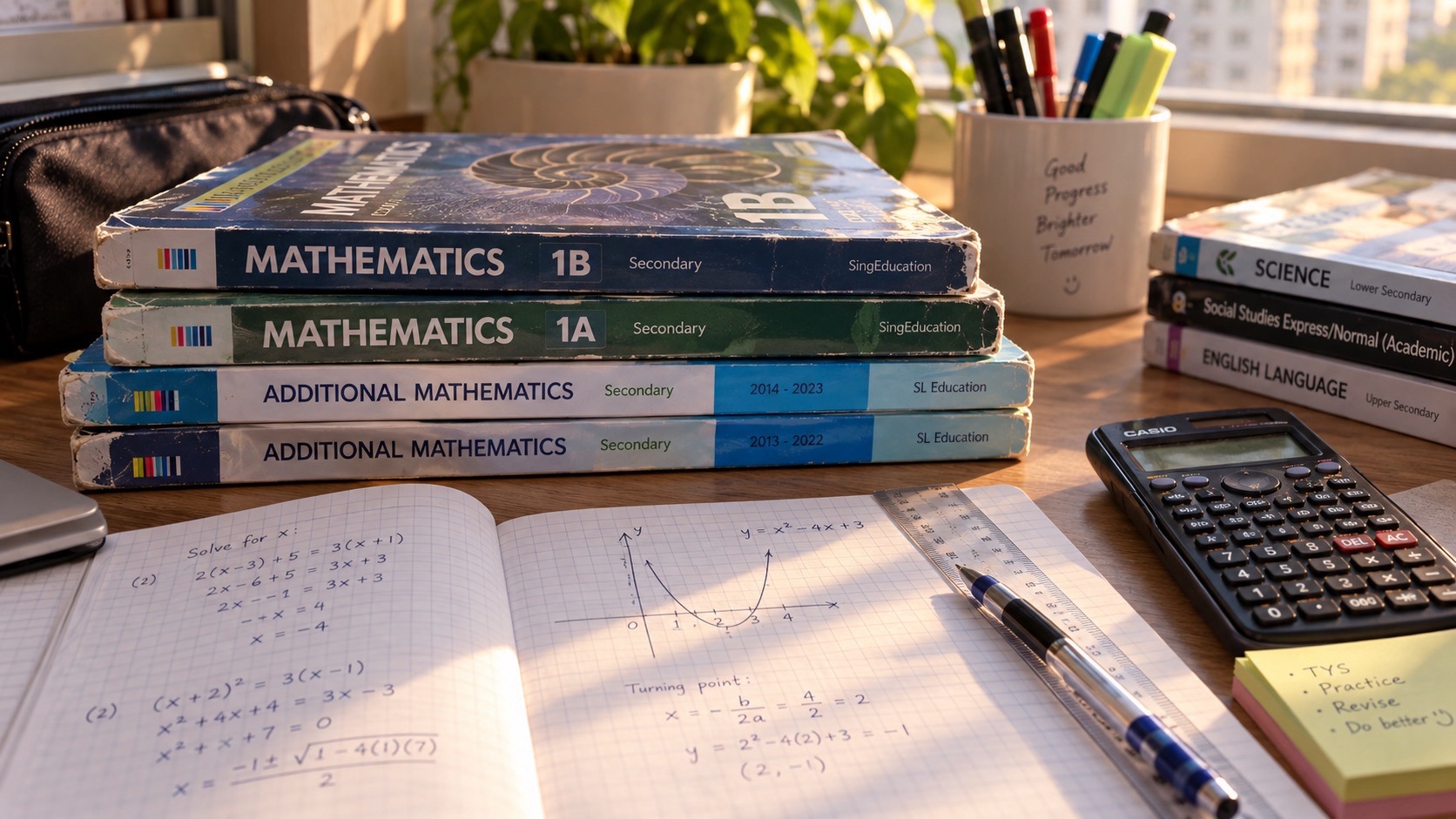
Quick answer. Arithmetic and Geometric Sequences from Secondary to JC is part of the progression from concrete number relationships to more abstract Secondary, JC and university Mathematics. Punggol pupils should follow the relevant Singapore MOE and SEAB syllabuses and the actual level offered by their school. This guide explains definitions, worked methods, common misconceptions, independent retests and practical parent support.
The strongest learning is not the ability to copy a familiar solution. A student should identify the unknown, select the right representation, justify the steps, preserve units and explain a changed problem independently. Some topics here are later-stage extensions rather than required Primary content. All examples are original teaching illustrations.
Updated October 2026. Official subject coverage and examination requirements must be verified against current MOE and SEAB syllabuses. Neither a tuition programme nor this article can guarantee a particular national examination grade.
Fast facts and learning approach
- Start with a clearly defined quantity, diagram or function.
- State the mathematical relationship before substituting numbers.
- Check signs, units, domains and assumptions.
- Use a second method or substitution to verify the answer.
- Compare a correct method with a plausible wrong one.
- Return to a changed problem after several days without prompts.
- Follow the learner’s actual school syllabus and readiness.
Find a topic
- 1. Recognising a sequence
- 2. Arithmetic differences
- 3. Nth arithmetic term
- 4. Arithmetic series
- 5. Sum formula
- 6. Finding first term
- 7. Finding common difference
- 8. Geometric ratios
- 9. Nth geometric term
- 10. Geometric sums
- 11. Growth models
- 12. Decay models
- 13. Recursive rules
- 14. Explicit rules
- 15. Convergence as extension
- 16. Checking general claims
1. Recognising a sequence
Concept and representation. Recognising a sequence is best learned by identifying the relevant quantities and the relationship between them. A diagram or table can reveal the structure before a formula is used. More advanced learners should define variables and state restrictions explicitly. The meaning of an answer depends on whether it represents a coordinate, length, angle, probability, rate or accumulated total.
Complete worked example. The sequence 4,7,10,13 increases by three. Its nth term is 4+3(n−1)=3n+1; term ten is 31. The solution is valid because the operations reflect the specified mathematical conditions. A learner should explain each transformation and check that the final result has the right interpretation rather than memorising only the numerical answer.
Common misconception. A learner uses 3n+4, which gives seven rather than four at n=1. The first wrong decision should be identified and discussed. Errors in recognising a sequence may involve the reference quantity, diagram orientation, sign convention, formula condition or output unit. Repeating the same arithmetic without repairing the relationship will not necessarily improve understanding.
Independent transfer question. For 5,9,13,… derive 4n+1 and find term ten as 41. Ask the student to complete it without viewing the preceding model. After a delay, use a further school-level recognising a sequence question with different numbers, orientation or unknown and request a verbal explanation.
Check with a simpler relationship. Consider 2 groups of 3 objects. There are 6 altogether. If one group is added, the total increases by 3; if the objects are rearranged, it stays 6. This elementary distinction between what changes and what remains invariant is a useful foundation for advanced reasoning, including functions, transformations and proofs. Identify the corresponding invariant or change in the actual topic.
Teaching decision. Record whether the learner could name the unknown, choose a method, justify the first step, calculate accurately and check independently. A wrong formula choice and an arithmetic copying slip need different responses. Select one attainable next target and avoid turning the mistake into a permanent label.
2. Arithmetic differences
Concept and representation. Arithmetic differences is best learned by identifying the relevant quantities and the relationship between them. A diagram or table can reveal the structure before a formula is used. More advanced learners should define variables and state restrictions explicitly. The meaning of an answer depends on whether it represents a coordinate, length, angle, probability, rate or accumulated total.
Complete worked example. The first ten terms of 4,7,10,… sum to 10/2×(4+31)=175. Pairing first and last terms explains the formula. The solution is valid because the operations reflect the specified mathematical conditions. A learner should explain each transformation and check that the final result has the right interpretation rather than memorising only the numerical answer.
Common misconception. A learner multiplies ten by the final term, ignoring the earlier smaller terms. The first wrong decision should be identified and discussed. Errors in arithmetic differences may involve the reference quantity, diagram orientation, sign convention, formula condition or output unit. Repeating the same arithmetic without repairing the relationship will not necessarily improve understanding.
Independent transfer question. Sum the first ten terms of 5,9,13,…: first five, tenth 41, total 230. Ask the student to complete it without viewing the preceding model. After a delay, use a further school-level arithmetic differences question with different numbers, orientation or unknown and request a verbal explanation.
Check with a simpler relationship. Consider 3 groups of 4 objects. There are 12 altogether. If one group is added, the total increases by 4; if the objects are rearranged, it stays 12. This elementary distinction between what changes and what remains invariant is a useful foundation for advanced reasoning, including functions, transformations and proofs. Identify the corresponding invariant or change in the actual topic.
Teaching decision. Record whether the learner could name the unknown, choose a method, justify the first step, calculate accurately and check independently. A wrong formula choice and an arithmetic copying slip need different responses. Select one attainable next target and avoid turning the mistake into a permanent label.
3. Nth arithmetic term
Concept and representation. Nth arithmetic term is best learned by identifying the relevant quantities and the relationship between them. A diagram or table can reveal the structure before a formula is used. More advanced learners should define variables and state restrictions explicitly. The meaning of an answer depends on whether it represents a coordinate, length, angle, probability, rate or accumulated total.
Complete worked example. The sequence 3,6,12,24 doubles. Term n is 3×2^(n−1), so term six is 96. The solution is valid because the operations reflect the specified mathematical conditions. A learner should explain each transformation and check that the final result has the right interpretation rather than memorising only the numerical answer.
Common misconception. A student adds two each time, confusing a constant ratio with a constant difference. The first wrong decision should be identified and discussed. Errors in nth arithmetic term may involve the reference quantity, diagram orientation, sign convention, formula condition or output unit. Repeating the same arithmetic without repairing the relationship will not necessarily improve understanding.
Independent transfer question. For 5,15,45,… term five is 5×3⁴=405. Ask the student to complete it without viewing the preceding model. After a delay, use a further school-level nth arithmetic term question with different numbers, orientation or unknown and request a verbal explanation.
Check with a simpler relationship. Consider 4 groups of 5 objects. There are 20 altogether. If one group is added, the total increases by 5; if the objects are rearranged, it stays 20. This elementary distinction between what changes and what remains invariant is a useful foundation for advanced reasoning, including functions, transformations and proofs. Identify the corresponding invariant or change in the actual topic.
Teaching decision. Record whether the learner could name the unknown, choose a method, justify the first step, calculate accurately and check independently. A wrong formula choice and an arithmetic copying slip need different responses. Select one attainable next target and avoid turning the mistake into a permanent label.
4. Arithmetic series
Concept and representation. Arithmetic series is best learned by identifying the relevant quantities and the relationship between them. A diagram or table can reveal the structure before a formula is used. More advanced learners should define variables and state restrictions explicitly. The meaning of an answer depends on whether it represents a coordinate, length, angle, probability, rate or accumulated total.
Complete worked example. The first four terms 3,6,12,24 sum to 45. Formula S₄=3(2⁴−1)/(2−1)=45. The solution is valid because the operations reflect the specified mathematical conditions. A learner should explain each transformation and check that the final result has the right interpretation rather than memorising only the numerical answer.
Common misconception. A learner treats the fourth term 24 as the total or uses the arithmetic-series formula. The first wrong decision should be identified and discussed. Errors in arithmetic series may involve the reference quantity, diagram orientation, sign convention, formula condition or output unit. Repeating the same arithmetic without repairing the relationship will not necessarily improve understanding.
Independent transfer question. For 2,6,18,54, sum four terms to obtain 80. Ask the student to complete it without viewing the preceding model. After a delay, use a further school-level arithmetic series question with different numbers, orientation or unknown and request a verbal explanation.
Check with a simpler relationship. Consider 5 groups of 6 objects. There are 30 altogether. If one group is added, the total increases by 6; if the objects are rearranged, it stays 30. This elementary distinction between what changes and what remains invariant is a useful foundation for advanced reasoning, including functions, transformations and proofs. Identify the corresponding invariant or change in the actual topic.
Teaching decision. Record whether the learner could name the unknown, choose a method, justify the first step, calculate accurately and check independently. A wrong formula choice and an arithmetic copying slip need different responses. Select one attainable next target and avoid turning the mistake into a permanent label.
5. Sum formula
Concept and representation. Sum formula is best learned by identifying the relevant quantities and the relationship between them. A diagram or table can reveal the structure before a formula is used. More advanced learners should define variables and state restrictions explicitly. The meaning of an answer depends on whether it represents a coordinate, length, angle, probability, rate or accumulated total.
Complete worked example. The sequence 4,7,10,13 increases by three. Its nth term is 4+3(n−1)=3n+1; term ten is 31. The solution is valid because the operations reflect the specified mathematical conditions. A learner should explain each transformation and check that the final result has the right interpretation rather than memorising only the numerical answer.
Common misconception. A learner uses 3n+4, which gives seven rather than four at n=1. The first wrong decision should be identified and discussed. Errors in sum formula may involve the reference quantity, diagram orientation, sign convention, formula condition or output unit. Repeating the same arithmetic without repairing the relationship will not necessarily improve understanding.
Independent transfer question. For 5,9,13,… derive 4n+1 and find term ten as 41. Ask the student to complete it without viewing the preceding model. After a delay, use a further school-level sum formula question with different numbers, orientation or unknown and request a verbal explanation.
Check with a simpler relationship. Consider 6 groups of 7 objects. There are 42 altogether. If one group is added, the total increases by 7; if the objects are rearranged, it stays 42. This elementary distinction between what changes and what remains invariant is a useful foundation for advanced reasoning, including functions, transformations and proofs. Identify the corresponding invariant or change in the actual topic.
Teaching decision. Record whether the learner could name the unknown, choose a method, justify the first step, calculate accurately and check independently. A wrong formula choice and an arithmetic copying slip need different responses. Select one attainable next target and avoid turning the mistake into a permanent label.
6. Finding first term
Concept and representation. Finding first term is best learned by identifying the relevant quantities and the relationship between them. A diagram or table can reveal the structure before a formula is used. More advanced learners should define variables and state restrictions explicitly. The meaning of an answer depends on whether it represents a coordinate, length, angle, probability, rate or accumulated total.
Complete worked example. The first ten terms of 4,7,10,… sum to 10/2×(4+31)=175. Pairing first and last terms explains the formula. The solution is valid because the operations reflect the specified mathematical conditions. A learner should explain each transformation and check that the final result has the right interpretation rather than memorising only the numerical answer.
Common misconception. A learner multiplies ten by the final term, ignoring the earlier smaller terms. The first wrong decision should be identified and discussed. Errors in finding first term may involve the reference quantity, diagram orientation, sign convention, formula condition or output unit. Repeating the same arithmetic without repairing the relationship will not necessarily improve understanding.
Independent transfer question. Sum the first ten terms of 5,9,13,…: first five, tenth 41, total 230. Ask the student to complete it without viewing the preceding model. After a delay, use a further school-level finding first term question with different numbers, orientation or unknown and request a verbal explanation.
Check with a simpler relationship. Consider 7 groups of 3 objects. There are 21 altogether. If one group is added, the total increases by 3; if the objects are rearranged, it stays 21. This elementary distinction between what changes and what remains invariant is a useful foundation for advanced reasoning, including functions, transformations and proofs. Identify the corresponding invariant or change in the actual topic.
Teaching decision. Record whether the learner could name the unknown, choose a method, justify the first step, calculate accurately and check independently. A wrong formula choice and an arithmetic copying slip need different responses. Select one attainable next target and avoid turning the mistake into a permanent label.
7. Finding common difference
Concept and representation. Finding common difference is best learned by identifying the relevant quantities and the relationship between them. A diagram or table can reveal the structure before a formula is used. More advanced learners should define variables and state restrictions explicitly. The meaning of an answer depends on whether it represents a coordinate, length, angle, probability, rate or accumulated total.
Complete worked example. The sequence 3,6,12,24 doubles. Term n is 3×2^(n−1), so term six is 96. The solution is valid because the operations reflect the specified mathematical conditions. A learner should explain each transformation and check that the final result has the right interpretation rather than memorising only the numerical answer.
Common misconception. A student adds two each time, confusing a constant ratio with a constant difference. The first wrong decision should be identified and discussed. Errors in finding common difference may involve the reference quantity, diagram orientation, sign convention, formula condition or output unit. Repeating the same arithmetic without repairing the relationship will not necessarily improve understanding.
Independent transfer question. For 5,15,45,… term five is 5×3⁴=405. Ask the student to complete it without viewing the preceding model. After a delay, use a further school-level finding common difference question with different numbers, orientation or unknown and request a verbal explanation.
Check with a simpler relationship. Consider 8 groups of 4 objects. There are 32 altogether. If one group is added, the total increases by 4; if the objects are rearranged, it stays 32. This elementary distinction between what changes and what remains invariant is a useful foundation for advanced reasoning, including functions, transformations and proofs. Identify the corresponding invariant or change in the actual topic.
Teaching decision. Record whether the learner could name the unknown, choose a method, justify the first step, calculate accurately and check independently. A wrong formula choice and an arithmetic copying slip need different responses. Select one attainable next target and avoid turning the mistake into a permanent label.
8. Geometric ratios
Concept and representation. Geometric ratios is best learned by identifying the relevant quantities and the relationship between them. A diagram or table can reveal the structure before a formula is used. More advanced learners should define variables and state restrictions explicitly. The meaning of an answer depends on whether it represents a coordinate, length, angle, probability, rate or accumulated total.
Complete worked example. The first four terms 3,6,12,24 sum to 45. Formula S₄=3(2⁴−1)/(2−1)=45. The solution is valid because the operations reflect the specified mathematical conditions. A learner should explain each transformation and check that the final result has the right interpretation rather than memorising only the numerical answer.
Common misconception. A learner treats the fourth term 24 as the total or uses the arithmetic-series formula. The first wrong decision should be identified and discussed. Errors in geometric ratios may involve the reference quantity, diagram orientation, sign convention, formula condition or output unit. Repeating the same arithmetic without repairing the relationship will not necessarily improve understanding.
Independent transfer question. For 2,6,18,54, sum four terms to obtain 80. Ask the student to complete it without viewing the preceding model. After a delay, use a further school-level geometric ratios question with different numbers, orientation or unknown and request a verbal explanation.
Check with a simpler relationship. Consider 9 groups of 5 objects. There are 45 altogether. If one group is added, the total increases by 5; if the objects are rearranged, it stays 45. This elementary distinction between what changes and what remains invariant is a useful foundation for advanced reasoning, including functions, transformations and proofs. Identify the corresponding invariant or change in the actual topic.
Teaching decision. Record whether the learner could name the unknown, choose a method, justify the first step, calculate accurately and check independently. A wrong formula choice and an arithmetic copying slip need different responses. Select one attainable next target and avoid turning the mistake into a permanent label.
9. Nth geometric term
Concept and representation. Nth geometric term is best learned by identifying the relevant quantities and the relationship between them. A diagram or table can reveal the structure before a formula is used. More advanced learners should define variables and state restrictions explicitly. The meaning of an answer depends on whether it represents a coordinate, length, angle, probability, rate or accumulated total.
Complete worked example. The sequence 4,7,10,13 increases by three. Its nth term is 4+3(n−1)=3n+1; term ten is 31. The solution is valid because the operations reflect the specified mathematical conditions. A learner should explain each transformation and check that the final result has the right interpretation rather than memorising only the numerical answer.
Common misconception. A learner uses 3n+4, which gives seven rather than four at n=1. The first wrong decision should be identified and discussed. Errors in nth geometric term may involve the reference quantity, diagram orientation, sign convention, formula condition or output unit. Repeating the same arithmetic without repairing the relationship will not necessarily improve understanding.
Independent transfer question. For 5,9,13,… derive 4n+1 and find term ten as 41. Ask the student to complete it without viewing the preceding model. After a delay, use a further school-level nth geometric term question with different numbers, orientation or unknown and request a verbal explanation.
Check with a simpler relationship. Consider 10 groups of 6 objects. There are 60 altogether. If one group is added, the total increases by 6; if the objects are rearranged, it stays 60. This elementary distinction between what changes and what remains invariant is a useful foundation for advanced reasoning, including functions, transformations and proofs. Identify the corresponding invariant or change in the actual topic.
Teaching decision. Record whether the learner could name the unknown, choose a method, justify the first step, calculate accurately and check independently. A wrong formula choice and an arithmetic copying slip need different responses. Select one attainable next target and avoid turning the mistake into a permanent label.
10. Geometric sums
Concept and representation. Geometric sums is best learned by identifying the relevant quantities and the relationship between them. A diagram or table can reveal the structure before a formula is used. More advanced learners should define variables and state restrictions explicitly. The meaning of an answer depends on whether it represents a coordinate, length, angle, probability, rate or accumulated total.
Complete worked example. The first ten terms of 4,7,10,… sum to 10/2×(4+31)=175. Pairing first and last terms explains the formula. The solution is valid because the operations reflect the specified mathematical conditions. A learner should explain each transformation and check that the final result has the right interpretation rather than memorising only the numerical answer.
Common misconception. A learner multiplies ten by the final term, ignoring the earlier smaller terms. The first wrong decision should be identified and discussed. Errors in geometric sums may involve the reference quantity, diagram orientation, sign convention, formula condition or output unit. Repeating the same arithmetic without repairing the relationship will not necessarily improve understanding.
Independent transfer question. Sum the first ten terms of 5,9,13,…: first five, tenth 41, total 230. Ask the student to complete it without viewing the preceding model. After a delay, use a further school-level geometric sums question with different numbers, orientation or unknown and request a verbal explanation.
Check with a simpler relationship. Consider 11 groups of 7 objects. There are 77 altogether. If one group is added, the total increases by 7; if the objects are rearranged, it stays 77. This elementary distinction between what changes and what remains invariant is a useful foundation for advanced reasoning, including functions, transformations and proofs. Identify the corresponding invariant or change in the actual topic.
Teaching decision. Record whether the learner could name the unknown, choose a method, justify the first step, calculate accurately and check independently. A wrong formula choice and an arithmetic copying slip need different responses. Select one attainable next target and avoid turning the mistake into a permanent label.
11. Growth models
Concept and representation. Growth models is best learned by identifying the relevant quantities and the relationship between them. A diagram or table can reveal the structure before a formula is used. More advanced learners should define variables and state restrictions explicitly. The meaning of an answer depends on whether it represents a coordinate, length, angle, probability, rate or accumulated total.
Complete worked example. The sequence 3,6,12,24 doubles. Term n is 3×2^(n−1), so term six is 96. The solution is valid because the operations reflect the specified mathematical conditions. A learner should explain each transformation and check that the final result has the right interpretation rather than memorising only the numerical answer.
Common misconception. A student adds two each time, confusing a constant ratio with a constant difference. The first wrong decision should be identified and discussed. Errors in growth models may involve the reference quantity, diagram orientation, sign convention, formula condition or output unit. Repeating the same arithmetic without repairing the relationship will not necessarily improve understanding.
Independent transfer question. For 5,15,45,… term five is 5×3⁴=405. Ask the student to complete it without viewing the preceding model. After a delay, use a further school-level growth models question with different numbers, orientation or unknown and request a verbal explanation.
Check with a simpler relationship. Consider 12 groups of 3 objects. There are 36 altogether. If one group is added, the total increases by 3; if the objects are rearranged, it stays 36. This elementary distinction between what changes and what remains invariant is a useful foundation for advanced reasoning, including functions, transformations and proofs. Identify the corresponding invariant or change in the actual topic.
Teaching decision. Record whether the learner could name the unknown, choose a method, justify the first step, calculate accurately and check independently. A wrong formula choice and an arithmetic copying slip need different responses. Select one attainable next target and avoid turning the mistake into a permanent label.
12. Decay models
Concept and representation. Decay models is best learned by identifying the relevant quantities and the relationship between them. A diagram or table can reveal the structure before a formula is used. More advanced learners should define variables and state restrictions explicitly. The meaning of an answer depends on whether it represents a coordinate, length, angle, probability, rate or accumulated total.
Complete worked example. The first four terms 3,6,12,24 sum to 45. Formula S₄=3(2⁴−1)/(2−1)=45. The solution is valid because the operations reflect the specified mathematical conditions. A learner should explain each transformation and check that the final result has the right interpretation rather than memorising only the numerical answer.
Common misconception. A learner treats the fourth term 24 as the total or uses the arithmetic-series formula. The first wrong decision should be identified and discussed. Errors in decay models may involve the reference quantity, diagram orientation, sign convention, formula condition or output unit. Repeating the same arithmetic without repairing the relationship will not necessarily improve understanding.
Independent transfer question. For 2,6,18,54, sum four terms to obtain 80. Ask the student to complete it without viewing the preceding model. After a delay, use a further school-level decay models question with different numbers, orientation or unknown and request a verbal explanation.
Check with a simpler relationship. Consider 13 groups of 4 objects. There are 52 altogether. If one group is added, the total increases by 4; if the objects are rearranged, it stays 52. This elementary distinction between what changes and what remains invariant is a useful foundation for advanced reasoning, including functions, transformations and proofs. Identify the corresponding invariant or change in the actual topic.
Teaching decision. Record whether the learner could name the unknown, choose a method, justify the first step, calculate accurately and check independently. A wrong formula choice and an arithmetic copying slip need different responses. Select one attainable next target and avoid turning the mistake into a permanent label.
13. Recursive rules
Concept and representation. Recursive rules is best learned by identifying the relevant quantities and the relationship between them. A diagram or table can reveal the structure before a formula is used. More advanced learners should define variables and state restrictions explicitly. The meaning of an answer depends on whether it represents a coordinate, length, angle, probability, rate or accumulated total.
Complete worked example. The sequence 4,7,10,13 increases by three. Its nth term is 4+3(n−1)=3n+1; term ten is 31. The solution is valid because the operations reflect the specified mathematical conditions. A learner should explain each transformation and check that the final result has the right interpretation rather than memorising only the numerical answer.
Common misconception. A learner uses 3n+4, which gives seven rather than four at n=1. The first wrong decision should be identified and discussed. Errors in recursive rules may involve the reference quantity, diagram orientation, sign convention, formula condition or output unit. Repeating the same arithmetic without repairing the relationship will not necessarily improve understanding.
Independent transfer question. For 5,9,13,… derive 4n+1 and find term ten as 41. Ask the student to complete it without viewing the preceding model. After a delay, use a further school-level recursive rules question with different numbers, orientation or unknown and request a verbal explanation.
Check with a simpler relationship. Consider 14 groups of 5 objects. There are 70 altogether. If one group is added, the total increases by 5; if the objects are rearranged, it stays 70. This elementary distinction between what changes and what remains invariant is a useful foundation for advanced reasoning, including functions, transformations and proofs. Identify the corresponding invariant or change in the actual topic.
Teaching decision. Record whether the learner could name the unknown, choose a method, justify the first step, calculate accurately and check independently. A wrong formula choice and an arithmetic copying slip need different responses. Select one attainable next target and avoid turning the mistake into a permanent label.
14. Explicit rules
Concept and representation. Explicit rules is best learned by identifying the relevant quantities and the relationship between them. A diagram or table can reveal the structure before a formula is used. More advanced learners should define variables and state restrictions explicitly. The meaning of an answer depends on whether it represents a coordinate, length, angle, probability, rate or accumulated total.
Complete worked example. The first ten terms of 4,7,10,… sum to 10/2×(4+31)=175. Pairing first and last terms explains the formula. The solution is valid because the operations reflect the specified mathematical conditions. A learner should explain each transformation and check that the final result has the right interpretation rather than memorising only the numerical answer.
Common misconception. A learner multiplies ten by the final term, ignoring the earlier smaller terms. The first wrong decision should be identified and discussed. Errors in explicit rules may involve the reference quantity, diagram orientation, sign convention, formula condition or output unit. Repeating the same arithmetic without repairing the relationship will not necessarily improve understanding.
Independent transfer question. Sum the first ten terms of 5,9,13,…: first five, tenth 41, total 230. Ask the student to complete it without viewing the preceding model. After a delay, use a further school-level explicit rules question with different numbers, orientation or unknown and request a verbal explanation.
Check with a simpler relationship. Consider 15 groups of 6 objects. There are 90 altogether. If one group is added, the total increases by 6; if the objects are rearranged, it stays 90. This elementary distinction between what changes and what remains invariant is a useful foundation for advanced reasoning, including functions, transformations and proofs. Identify the corresponding invariant or change in the actual topic.
Teaching decision. Record whether the learner could name the unknown, choose a method, justify the first step, calculate accurately and check independently. A wrong formula choice and an arithmetic copying slip need different responses. Select one attainable next target and avoid turning the mistake into a permanent label.
15. Convergence as extension
Concept and representation. Convergence as extension is best learned by identifying the relevant quantities and the relationship between them. A diagram or table can reveal the structure before a formula is used. More advanced learners should define variables and state restrictions explicitly. The meaning of an answer depends on whether it represents a coordinate, length, angle, probability, rate or accumulated total.
Complete worked example. The sequence 3,6,12,24 doubles. Term n is 3×2^(n−1), so term six is 96. The solution is valid because the operations reflect the specified mathematical conditions. A learner should explain each transformation and check that the final result has the right interpretation rather than memorising only the numerical answer.
Common misconception. A student adds two each time, confusing a constant ratio with a constant difference. The first wrong decision should be identified and discussed. Errors in convergence as extension may involve the reference quantity, diagram orientation, sign convention, formula condition or output unit. Repeating the same arithmetic without repairing the relationship will not necessarily improve understanding.
Independent transfer question. For 5,15,45,… term five is 5×3⁴=405. Ask the student to complete it without viewing the preceding model. After a delay, use a further school-level convergence as extension question with different numbers, orientation or unknown and request a verbal explanation.
Check with a simpler relationship. Consider 16 groups of 7 objects. There are 112 altogether. If one group is added, the total increases by 7; if the objects are rearranged, it stays 112. This elementary distinction between what changes and what remains invariant is a useful foundation for advanced reasoning, including functions, transformations and proofs. Identify the corresponding invariant or change in the actual topic.
Teaching decision. Record whether the learner could name the unknown, choose a method, justify the first step, calculate accurately and check independently. A wrong formula choice and an arithmetic copying slip need different responses. Select one attainable next target and avoid turning the mistake into a permanent label.
16. Checking general claims
Concept and representation. Checking general claims is best learned by identifying the relevant quantities and the relationship between them. A diagram or table can reveal the structure before a formula is used. More advanced learners should define variables and state restrictions explicitly. The meaning of an answer depends on whether it represents a coordinate, length, angle, probability, rate or accumulated total.
Complete worked example. The first four terms 3,6,12,24 sum to 45. Formula S₄=3(2⁴−1)/(2−1)=45. The solution is valid because the operations reflect the specified mathematical conditions. A learner should explain each transformation and check that the final result has the right interpretation rather than memorising only the numerical answer.
Common misconception. A learner treats the fourth term 24 as the total or uses the arithmetic-series formula. The first wrong decision should be identified and discussed. Errors in checking general claims may involve the reference quantity, diagram orientation, sign convention, formula condition or output unit. Repeating the same arithmetic without repairing the relationship will not necessarily improve understanding.
Independent transfer question. For 2,6,18,54, sum four terms to obtain 80. Ask the student to complete it without viewing the preceding model. After a delay, use a further school-level checking general claims question with different numbers, orientation or unknown and request a verbal explanation.
Check with a simpler relationship. Consider 17 groups of 3 objects. There are 51 altogether. If one group is added, the total increases by 3; if the objects are rearranged, it stays 51. This elementary distinction between what changes and what remains invariant is a useful foundation for advanced reasoning, including functions, transformations and proofs. Identify the corresponding invariant or change in the actual topic.
Teaching decision. Record whether the learner could name the unknown, choose a method, justify the first step, calculate accurately and check independently. A wrong formula choice and an arithmetic copying slip need different responses. Select one attainable next target and avoid turning the mistake into a permanent label.
Four full mathematical clinics
Arithmetic progression
Original problem and solution. The sequence 4,7,10,13 increases by three. Its nth term is 4+3(n−1)=3n+1; term ten is 31.
Tempting incorrect reasoning. A learner uses 3n+4, which gives seven rather than four at n=1.
Changed independent retest. For 5,9,13,… derive 4n+1 and find term ten as 41.
The learner should explain the conditions that make the method valid and check the result using a second representation or substitution.
Arithmetic series
Original problem and solution. The first ten terms of 4,7,10,… sum to 10/2×(4+31)=175. Pairing first and last terms explains the formula.
Tempting incorrect reasoning. A learner multiplies ten by the final term, ignoring the earlier smaller terms.
Changed independent retest. Sum the first ten terms of 5,9,13,…: first five, tenth 41, total 230.
The learner should explain the conditions that make the method valid and check the result using a second representation or substitution.
Geometric progression
Original problem and solution. The sequence 3,6,12,24 doubles. Term n is 3×2^(n−1), so term six is 96.
Tempting incorrect reasoning. A student adds two each time, confusing a constant ratio with a constant difference.
Changed independent retest. For 5,15,45,… term five is 5×3⁴=405.
The learner should explain the conditions that make the method valid and check the result using a second representation or substitution.
Geometric sum
Original problem and solution. The first four terms 3,6,12,24 sum to 45. Formula S₄=3(2⁴−1)/(2−1)=45.
Tempting incorrect reasoning. A learner treats the fourth term 24 as the total or uses the arithmetic-series formula.
Changed independent retest. For 2,6,18,54, sum four terms to obtain 80.
The learner should explain the conditions that make the method valid and check the result using a second representation or substitution.
Six-week revision and transition routine
Week 1. Diagnose current prerequisites from authentic schoolwork and the applicable syllabus. Keep the workload realistic and distinguish understanding from speed.
Week 2. Rebuild one concept with a diagram, table and explanation. Keep the workload realistic and distinguish understanding from speed.
Week 3. Practise a complete worked example and fade the displayed steps. Keep the workload realistic and distinguish understanding from speed.
Week 4. Revisit with changed numbers and a new representation after a gap. Keep the workload realistic and distinguish understanding from speed.
Week 5. Mix two secure topics with the recently repaired topic and justify method selection. Keep the workload realistic and distinguish understanding from speed.
Week 6. Check a new independent task and discuss the next learning goal with the teacher. Keep the workload realistic and distinguish understanding from speed.
Frequently asked questions
Is this a separate Punggol Mathematics syllabus? No. Relevant mainstream schools use national MOE curricula and the student’s actual subject-level arrangements.
Does every Primary child need these advanced topics? No. Later-stage material is for appropriate Secondary, JC or university progression.
Can I rely on a formula without a diagram? A formula can be valid, but its conditions and quantities still need checking.
What if the answer is right but the explanation is wrong? Use a changed example and ask for reasoning to see whether the relationship is secure.
Should revision be timed immediately? Establish accurate concepts first, then add appropriate bounded timed practice.
Can tuition guarantee a grade or admission? No. National examination and admission outcomes cannot be guaranteed.
What is the best parent support? Review authentic work, identify the first incorrect step and encourage independent changed-question checking.
How does this lead to university Mathematics? The same habits of defining variables, justifying relationships and checking assumptions support higher study.
Official references and further Mathematics reading
- MOE Primary Mathematics syllabus
- SEAB SEC Mathematics subject syllabuses
- SEAB A-Level examinations
- Clementi Mathematics teaching reference
- 24-question Mathematics diagnostic
- Spaced retrieval and mixed practice
The lasting achievement is a learner who understands what a quantity means, can justify a method, checks assumptions and solves an unfamiliar version without a prompt. That is useful across Singapore’s Primary-to-university Mathematics education pathway.


