
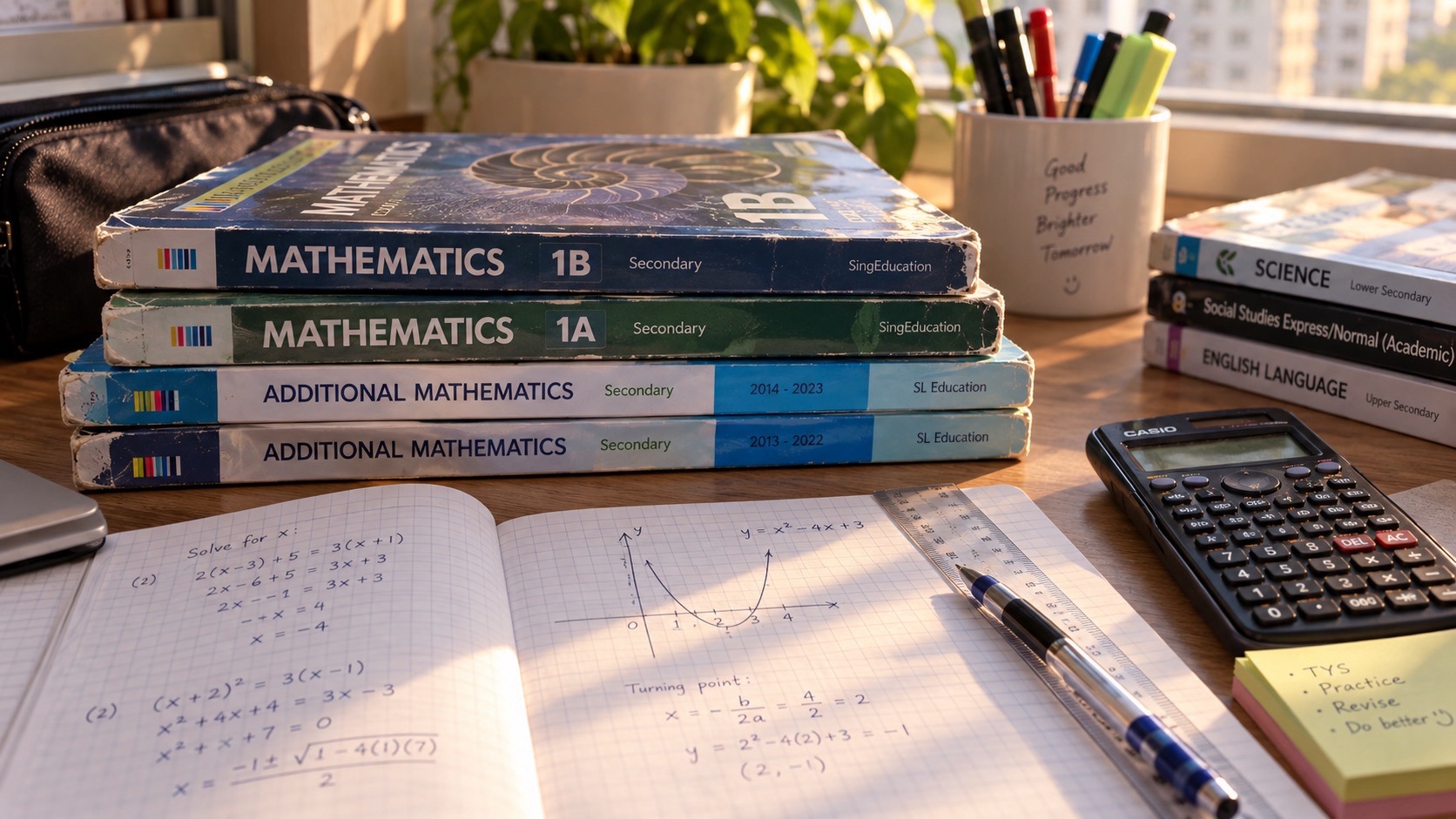
Quick answer. Mathematical communication helps a student justify calculations, label units and connect equations to words. This guide is for families learning about the progression from Singapore Primary Mathematics to Secondary, JC and university. Advanced ideas are extensions rather than compulsory requirements for every child.
The learner should define the unknown, choose a suitable representation, justify the method, check the result and solve a changed problem independently. All exercises are original educational illustrations. The actual national examination syllabus and subject level take precedence over general enrichment examples.
Quick reference
Begin with meaning, not a keyword. State assumptions and units. Explain the first wrong step when a solution fails. Use worked examples as temporary support, then remove prompts and test retention after a delay.
Topic index
- 1. Defining variables
- 2. Writing units
- 3. Explaining equality
- 4. Fraction representations
- 5. Comparing methods
- 6. Reference wholes
- 7. Geometric vocabulary
- 8. Graph interpretation
- 9. Estimating
- 10. Inverse checks
- 11. Model assumptions
- 12. Conclusions
1. Defining variables
Meaning. Defining variables involves identifying a mathematical relationship and its valid conditions. The student should explain what each number or symbol represents, whether the claim is general or conditional, and which part of the situation is being modelled. At higher levels, examples must not be confused with proofs or guarantees.
Worked example. Three notebooks cost S$21. Let x represent the price of one notebook: 3x=21, x=7. The unit is dollars per notebook. This demonstrates how the result follows from a stated relationship. A complete explanation identifies the quantity, performs the operation and interprets the conclusion rather than reporting a number without context.
Common misconception. Writing x=7 without defining the unknown. Ask which exact line stopped following from the question. Repeating the same worksheet without repairing that interpretation may strengthen an unreliable shortcut.
Independent retest. Change total to S$27: x=9. Hide the model first. Ask the learner to solve, explain and check the new example. Then use an actual school-level defining variables question with changed values or wording.
A useful second check is to compare three equal groups of four objects, twelve objects altogether, with four equal groups of three objects. The total remains twelve although the grouping changes. If a fifth group of three is added, the total becomes fifteen. The learner should explain which features remain invariant and which change. This habit is transferable to algebra, modelling and logical reasoning.
Parents can record whether the learner began without a hint, used appropriate vocabulary, justified the chosen method and detected an unreasonable answer. A wrong concept and a copying slip need different remedies. The aim is to observe progress through a changed independent attempt after a few days.
2. Writing units
Meaning. Writing units involves identifying a mathematical relationship and its valid conditions. The student should explain what each number or symbol represents, whether the claim is general or conditional, and which part of the situation is being modelled. At higher levels, examples must not be confused with proofs or guarantees.
Worked example. A rectangle 8 cm by 5 cm has area 40 cm² and perimeter 26 cm. This demonstrates how the result follows from a stated relationship. A complete explanation identifies the quantity, performs the operation and interprets the conclusion rather than reporting a number without context.
Common misconception. Calling 40 cm the area, omitting the squared unit. Ask which exact line stopped following from the question. Repeating the same worksheet without repairing that interpretation may strengthen an unreliable shortcut.
Independent retest. Use 10 cm by 4 cm: area 40 cm², perimeter 28 cm. Hide the model first. Ask the learner to solve, explain and check the new example. Then use an actual school-level writing units question with changed values or wording.
A useful second check is to compare three equal groups of four objects, twelve objects altogether, with four equal groups of three objects. The total remains twelve although the grouping changes. If a fifth group of three is added, the total becomes fifteen. The learner should explain which features remain invariant and which change. This habit is transferable to algebra, modelling and logical reasoning.
Parents can record whether the learner began without a hint, used appropriate vocabulary, justified the chosen method and detected an unreasonable answer. A wrong concept and a copying slip need different remedies. The aim is to observe progress through a changed independent attempt after a few days.
3. Explaining equality
Meaning. Explaining equality involves identifying a mathematical relationship and its valid conditions. The student should explain what each number or symbol represents, whether the claim is general or conditional, and which part of the situation is being modelled. At higher levels, examples must not be confused with proofs or guarantees.
Worked example. For y=2x+1, gradient is two and intercept one. At x=3, y=7. This demonstrates how the result follows from a stated relationship. A complete explanation identifies the quantity, performs the operation and interprets the conclusion rather than reporting a number without context.
Common misconception. Calling the intercept the gradient. Ask which exact line stopped following from the question. Repeating the same worksheet without repairing that interpretation may strengthen an unreliable shortcut.
Independent retest. For y=3x−2, gradient three and intercept −2. Hide the model first. Ask the learner to solve, explain and check the new example. Then use an actual school-level explaining equality question with changed values or wording.
A useful second check is to compare three equal groups of four objects, twelve objects altogether, with four equal groups of three objects. The total remains twelve although the grouping changes. If a fifth group of three is added, the total becomes fifteen. The learner should explain which features remain invariant and which change. This habit is transferable to algebra, modelling and logical reasoning.
Parents can record whether the learner began without a hint, used appropriate vocabulary, justified the chosen method and detected an unreasonable answer. A wrong concept and a copying slip need different remedies. The aim is to observe progress through a changed independent attempt after a few days.
4. Fraction representations
Meaning. Fraction representations involves identifying a mathematical relationship and its valid conditions. The student should explain what each number or symbol represents, whether the claim is general or conditional, and which part of the situation is being modelled. At higher levels, examples must not be confused with proofs or guarantees.
Worked example. An illustrative journey of 12 km in forty minutes has average speed 18 km/h after converting time to two-thirds of an hour. This demonstrates how the result follows from a stated relationship. A complete explanation identifies the quantity, performs the operation and interprets the conclusion rather than reporting a number without context.
Common misconception. Dividing twelve by forty and labelling it km/h. Ask which exact line stopped following from the question. Repeating the same worksheet without repairing that interpretation may strengthen an unreliable shortcut.
Independent retest. Nine km in thirty minutes also gives 18 km/h. Hide the model first. Ask the learner to solve, explain and check the new example. Then use an actual school-level fraction representations question with changed values or wording.
A useful second check is to compare three equal groups of four objects, twelve objects altogether, with four equal groups of three objects. The total remains twelve although the grouping changes. If a fifth group of three is added, the total becomes fifteen. The learner should explain which features remain invariant and which change. This habit is transferable to algebra, modelling and logical reasoning.
Parents can record whether the learner began without a hint, used appropriate vocabulary, justified the chosen method and detected an unreasonable answer. A wrong concept and a copying slip need different remedies. The aim is to observe progress through a changed independent attempt after a few days.
5. Comparing methods
Meaning. Comparing methods involves identifying a mathematical relationship and its valid conditions. The student should explain what each number or symbol represents, whether the claim is general or conditional, and which part of the situation is being modelled. At higher levels, examples must not be confused with proofs or guarantees.
Worked example. Three notebooks cost S$21. Let x represent the price of one notebook: 3x=21, x=7. The unit is dollars per notebook. This demonstrates how the result follows from a stated relationship. A complete explanation identifies the quantity, performs the operation and interprets the conclusion rather than reporting a number without context.
Common misconception. Writing x=7 without defining the unknown. Ask which exact line stopped following from the question. Repeating the same worksheet without repairing that interpretation may strengthen an unreliable shortcut.
Independent retest. Change total to S$27: x=9. Hide the model first. Ask the learner to solve, explain and check the new example. Then use an actual school-level comparing methods question with changed values or wording.
A useful second check is to compare three equal groups of four objects, twelve objects altogether, with four equal groups of three objects. The total remains twelve although the grouping changes. If a fifth group of three is added, the total becomes fifteen. The learner should explain which features remain invariant and which change. This habit is transferable to algebra, modelling and logical reasoning.
Parents can record whether the learner began without a hint, used appropriate vocabulary, justified the chosen method and detected an unreasonable answer. A wrong concept and a copying slip need different remedies. The aim is to observe progress through a changed independent attempt after a few days.
6. Reference wholes
Meaning. Reference wholes involves identifying a mathematical relationship and its valid conditions. The student should explain what each number or symbol represents, whether the claim is general or conditional, and which part of the situation is being modelled. At higher levels, examples must not be confused with proofs or guarantees.
Worked example. A rectangle 8 cm by 5 cm has area 40 cm² and perimeter 26 cm. This demonstrates how the result follows from a stated relationship. A complete explanation identifies the quantity, performs the operation and interprets the conclusion rather than reporting a number without context.
Common misconception. Calling 40 cm the area, omitting the squared unit. Ask which exact line stopped following from the question. Repeating the same worksheet without repairing that interpretation may strengthen an unreliable shortcut.
Independent retest. Use 10 cm by 4 cm: area 40 cm², perimeter 28 cm. Hide the model first. Ask the learner to solve, explain and check the new example. Then use an actual school-level reference wholes question with changed values or wording.
A useful second check is to compare three equal groups of four objects, twelve objects altogether, with four equal groups of three objects. The total remains twelve although the grouping changes. If a fifth group of three is added, the total becomes fifteen. The learner should explain which features remain invariant and which change. This habit is transferable to algebra, modelling and logical reasoning.
Parents can record whether the learner began without a hint, used appropriate vocabulary, justified the chosen method and detected an unreasonable answer. A wrong concept and a copying slip need different remedies. The aim is to observe progress through a changed independent attempt after a few days.
7. Geometric vocabulary
Meaning. Geometric vocabulary involves identifying a mathematical relationship and its valid conditions. The student should explain what each number or symbol represents, whether the claim is general or conditional, and which part of the situation is being modelled. At higher levels, examples must not be confused with proofs or guarantees.
Worked example. For y=2x+1, gradient is two and intercept one. At x=3, y=7. This demonstrates how the result follows from a stated relationship. A complete explanation identifies the quantity, performs the operation and interprets the conclusion rather than reporting a number without context.
Common misconception. Calling the intercept the gradient. Ask which exact line stopped following from the question. Repeating the same worksheet without repairing that interpretation may strengthen an unreliable shortcut.
Independent retest. For y=3x−2, gradient three and intercept −2. Hide the model first. Ask the learner to solve, explain and check the new example. Then use an actual school-level geometric vocabulary question with changed values or wording.
A useful second check is to compare three equal groups of four objects, twelve objects altogether, with four equal groups of three objects. The total remains twelve although the grouping changes. If a fifth group of three is added, the total becomes fifteen. The learner should explain which features remain invariant and which change. This habit is transferable to algebra, modelling and logical reasoning.
Parents can record whether the learner began without a hint, used appropriate vocabulary, justified the chosen method and detected an unreasonable answer. A wrong concept and a copying slip need different remedies. The aim is to observe progress through a changed independent attempt after a few days.
8. Graph interpretation
Meaning. Graph interpretation involves identifying a mathematical relationship and its valid conditions. The student should explain what each number or symbol represents, whether the claim is general or conditional, and which part of the situation is being modelled. At higher levels, examples must not be confused with proofs or guarantees.
Worked example. An illustrative journey of 12 km in forty minutes has average speed 18 km/h after converting time to two-thirds of an hour. This demonstrates how the result follows from a stated relationship. A complete explanation identifies the quantity, performs the operation and interprets the conclusion rather than reporting a number without context.
Common misconception. Dividing twelve by forty and labelling it km/h. Ask which exact line stopped following from the question. Repeating the same worksheet without repairing that interpretation may strengthen an unreliable shortcut.
Independent retest. Nine km in thirty minutes also gives 18 km/h. Hide the model first. Ask the learner to solve, explain and check the new example. Then use an actual school-level graph interpretation question with changed values or wording.
A useful second check is to compare three equal groups of four objects, twelve objects altogether, with four equal groups of three objects. The total remains twelve although the grouping changes. If a fifth group of three is added, the total becomes fifteen. The learner should explain which features remain invariant and which change. This habit is transferable to algebra, modelling and logical reasoning.
Parents can record whether the learner began without a hint, used appropriate vocabulary, justified the chosen method and detected an unreasonable answer. A wrong concept and a copying slip need different remedies. The aim is to observe progress through a changed independent attempt after a few days.
9. Estimating
Meaning. Estimating involves identifying a mathematical relationship and its valid conditions. The student should explain what each number or symbol represents, whether the claim is general or conditional, and which part of the situation is being modelled. At higher levels, examples must not be confused with proofs or guarantees.
Worked example. Three notebooks cost S$21. Let x represent the price of one notebook: 3x=21, x=7. The unit is dollars per notebook. This demonstrates how the result follows from a stated relationship. A complete explanation identifies the quantity, performs the operation and interprets the conclusion rather than reporting a number without context.
Common misconception. Writing x=7 without defining the unknown. Ask which exact line stopped following from the question. Repeating the same worksheet without repairing that interpretation may strengthen an unreliable shortcut.
Independent retest. Change total to S$27: x=9. Hide the model first. Ask the learner to solve, explain and check the new example. Then use an actual school-level estimating question with changed values or wording.
A useful second check is to compare three equal groups of four objects, twelve objects altogether, with four equal groups of three objects. The total remains twelve although the grouping changes. If a fifth group of three is added, the total becomes fifteen. The learner should explain which features remain invariant and which change. This habit is transferable to algebra, modelling and logical reasoning.
Parents can record whether the learner began without a hint, used appropriate vocabulary, justified the chosen method and detected an unreasonable answer. A wrong concept and a copying slip need different remedies. The aim is to observe progress through a changed independent attempt after a few days.
10. Inverse checks
Meaning. Inverse checks involves identifying a mathematical relationship and its valid conditions. The student should explain what each number or symbol represents, whether the claim is general or conditional, and which part of the situation is being modelled. At higher levels, examples must not be confused with proofs or guarantees.
Worked example. A rectangle 8 cm by 5 cm has area 40 cm² and perimeter 26 cm. This demonstrates how the result follows from a stated relationship. A complete explanation identifies the quantity, performs the operation and interprets the conclusion rather than reporting a number without context.
Common misconception. Calling 40 cm the area, omitting the squared unit. Ask which exact line stopped following from the question. Repeating the same worksheet without repairing that interpretation may strengthen an unreliable shortcut.
Independent retest. Use 10 cm by 4 cm: area 40 cm², perimeter 28 cm. Hide the model first. Ask the learner to solve, explain and check the new example. Then use an actual school-level inverse checks question with changed values or wording.
A useful second check is to compare three equal groups of four objects, twelve objects altogether, with four equal groups of three objects. The total remains twelve although the grouping changes. If a fifth group of three is added, the total becomes fifteen. The learner should explain which features remain invariant and which change. This habit is transferable to algebra, modelling and logical reasoning.
Parents can record whether the learner began without a hint, used appropriate vocabulary, justified the chosen method and detected an unreasonable answer. A wrong concept and a copying slip need different remedies. The aim is to observe progress through a changed independent attempt after a few days.
11. Model assumptions
Meaning. Model assumptions involves identifying a mathematical relationship and its valid conditions. The student should explain what each number or symbol represents, whether the claim is general or conditional, and which part of the situation is being modelled. At higher levels, examples must not be confused with proofs or guarantees.
Worked example. For y=2x+1, gradient is two and intercept one. At x=3, y=7. This demonstrates how the result follows from a stated relationship. A complete explanation identifies the quantity, performs the operation and interprets the conclusion rather than reporting a number without context.
Common misconception. Calling the intercept the gradient. Ask which exact line stopped following from the question. Repeating the same worksheet without repairing that interpretation may strengthen an unreliable shortcut.
Independent retest. For y=3x−2, gradient three and intercept −2. Hide the model first. Ask the learner to solve, explain and check the new example. Then use an actual school-level model assumptions question with changed values or wording.
A useful second check is to compare three equal groups of four objects, twelve objects altogether, with four equal groups of three objects. The total remains twelve although the grouping changes. If a fifth group of three is added, the total becomes fifteen. The learner should explain which features remain invariant and which change. This habit is transferable to algebra, modelling and logical reasoning.
Parents can record whether the learner began without a hint, used appropriate vocabulary, justified the chosen method and detected an unreasonable answer. A wrong concept and a copying slip need different remedies. The aim is to observe progress through a changed independent attempt after a few days.
12. Conclusions
Meaning. Conclusions involves identifying a mathematical relationship and its valid conditions. The student should explain what each number or symbol represents, whether the claim is general or conditional, and which part of the situation is being modelled. At higher levels, examples must not be confused with proofs or guarantees.
Worked example. An illustrative journey of 12 km in forty minutes has average speed 18 km/h after converting time to two-thirds of an hour. This demonstrates how the result follows from a stated relationship. A complete explanation identifies the quantity, performs the operation and interprets the conclusion rather than reporting a number without context.
Common misconception. Dividing twelve by forty and labelling it km/h. Ask which exact line stopped following from the question. Repeating the same worksheet without repairing that interpretation may strengthen an unreliable shortcut.
Independent retest. Nine km in thirty minutes also gives 18 km/h. Hide the model first. Ask the learner to solve, explain and check the new example. Then use an actual school-level conclusions question with changed values or wording.
A useful second check is to compare three equal groups of four objects, twelve objects altogether, with four equal groups of three objects. The total remains twelve although the grouping changes. If a fifth group of three is added, the total becomes fifteen. The learner should explain which features remain invariant and which change. This habit is transferable to algebra, modelling and logical reasoning.
Parents can record whether the learner began without a hint, used appropriate vocabulary, justified the chosen method and detected an unreasonable answer. A wrong concept and a copying slip need different remedies. The aim is to observe progress through a changed independent attempt after a few days.
Four extended worked clinics
Clinic 1
Calculation. Three notebooks cost S$21. Let x represent the price of one notebook: 3x=21, x=7. The unit is dollars per notebook.
Wrong step. Writing x=7 without defining the unknown.
Changed task. Change total to S$27: x=9. Require a reason for the chosen method and a check of the answer.
Clinic 2
Calculation. A rectangle 8 cm by 5 cm has area 40 cm² and perimeter 26 cm.
Wrong step. Calling 40 cm the area, omitting the squared unit.
Changed task. Use 10 cm by 4 cm: area 40 cm², perimeter 28 cm. Require a reason for the chosen method and a check of the answer.
Clinic 3
Calculation. For y=2x+1, gradient is two and intercept one. At x=3, y=7.
Wrong step. Calling the intercept the gradient.
Changed task. For y=3x−2, gradient three and intercept −2. Require a reason for the chosen method and a check of the answer.
Clinic 4
Calculation. An illustrative journey of 12 km in forty minutes has average speed 18 km/h after converting time to two-thirds of an hour.
Wrong step. Dividing twelve by forty and labelling it km/h.
Changed task. Nine km in thirty minutes also gives 18 km/h. Require a reason for the chosen method and a check of the answer.
Six-week learning plan
Week 1. Confirm the current syllabus and diagnose one or two prerequisites. Keep the workload realistic and use school feedback to choose the next target.
Week 2. Explain the core relationship with a diagram, table or equation. Keep the workload realistic and use school feedback to choose the next target.
Week 3. Compare a complete worked example with a tempting wrong solution. Keep the workload realistic and use school feedback to choose the next target.
Week 4. Revisit the idea after a gap with different values. Keep the workload realistic and use school feedback to choose the next target.
Week 5. Mix this topic with familiar material so the student chooses a method. Keep the workload realistic and use school feedback to choose the next target.
Week 6. Use an unseen independent question and review the earliest remaining error. Keep the workload realistic and use school feedback to choose the next target.
Parent questions
Is this compulsory in Primary school? Not necessarily. The actual school syllabus determines the level and advanced material is enrichment.
Does Punggol have its own national Mathematics syllabus? No. Mainstream schools follow Singapore’s MOE curriculum.
Does a correct number prove understanding? No. Ask for a valid explanation and a changed independent question.
Can these exercises predict examination grades? No. They are not standardised national assessment items.
How can parents help? Identify the first wrong step, support an explanation and coordinate with the teacher.
What about advanced university applications? They require additional definitions, formal assumptions and course-specific prerequisites.


