
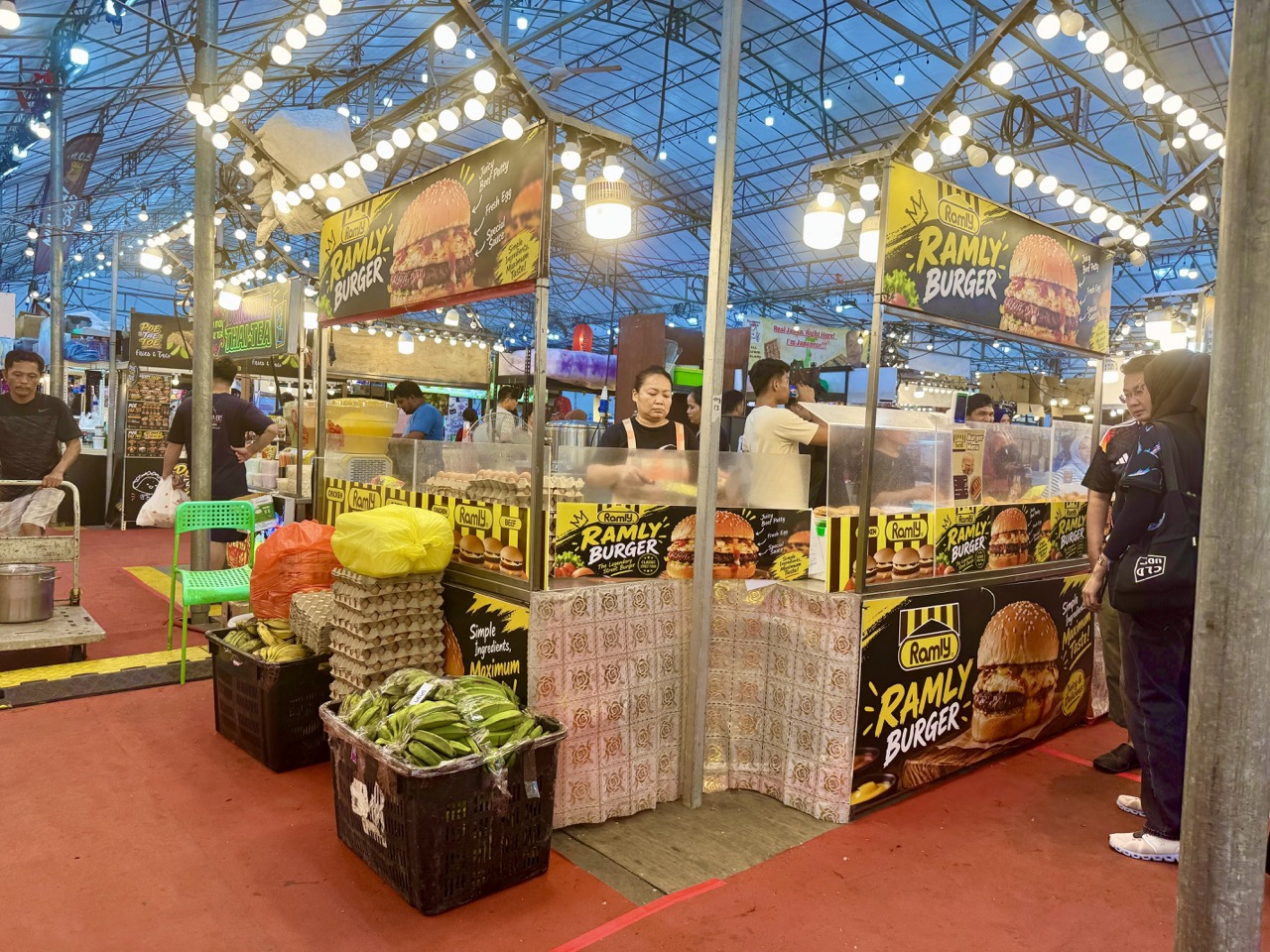
A Ramly-style burger stall appears in eduKatePunggol’s original October 2026 photographs of the Punggol MRT pasar malam. This photo-led guide tells you what the familiar Malaysian-style night-market burger is, how its brand name differs from the broader cooking style, what to check before ordering and why this type of street food remains part of Singapore’s pasar malam culture. It is a guide to a documented temporary event, not a promise that one vendor will be at the same spot after the market ends.
The key distinction: Ramly is a Malaysian food brand, while ‘Ramly-style burger’ is often used for a particular egg-wrapped, sauce-rich street burger style. The stall photographs are titled ‘Ramly Burger Stall’, but a filename or sign does not verify which patties the vendor used, the trademark status, exact ingredients, halal certification, prices or the seller’s licensing records. Those questions require current on-site information. The purpose of a reliable local guide is to make the picture useful without claiming that it proves more than it does.

Quick answers: Ramly burgers at Punggol’s October night market
- Photographed: a burger counter at the temporary pasar malam near Punggol MRT and Waterway Point.
- Food tradition: Malaysian-style roadside and pasar malam burgers, strongly associated with the Ramly name.
- Common preparation: a patty inside a cooked egg wrapping, placed in a soft bun with sauces; recipes vary widely.
- Time sensitivity: the Punggol market covered in our existing photo article was advertised for 30 September–31 October 2026; a later appearance requires verification.
- Before buying: check today’s menu, price, specific ingredients and any dietary needs.
- For families: supervise children near hot cooking counters and arrange a suitable place to eat away from the order queue.
- Evidence limit: photographs show the stall atmosphere, not a detailed recipe, food-safety inspection or taste ranking.
Sources: CNA Lifestyle on Ramly-inspired burgers documents the wider style; Singapore Food Agency’s temporary fair requirements explain food-stall rules. Our October Punggol Pasar Malam guide covers the event’s location, date limits and family logistics.
Why a Ramly-style burger belongs to the pasar malam experience
For many diners in Singapore, a pasar malam is as much about watching food being made as buying a meal. A burger stall can be compact, fast-moving and full of small choices about patty, sauce and egg. People may stop to look at a griddle and decide to order because the process is visible. Our photographs capture that environment without requiring us to invent an exchange between vendor and customer.
This makes the burger a good subject for a specific local article instead of a general list of foods. The street-food style has a history across the Causeway, but every vendor’s actual version deserves to be described on its own terms. Some people remember it as a nostalgic treat; others are trying it for the first time. Neither experience needs to become a claim about the entire town.
The Malaysian business behind the Ramly name
Ramly patties are associated with Malaysian entrepreneur Ramly Mokni and a food business that grew from early burger production into a recognised brand. Reporting by CNA and other outlets connects the brand’s development to demand for locally made patties, including among customers seeking halal food. The well-known street-burger style became popular at fairs and roadside stalls in Malaysia and Singapore.
That background describes a regional food tradition, not the supply chain of the pictured Punggol stall. The counter’s name or menu wording cannot prove which manufacturer supplied the meat. A writer should explain what the brand means, then make the limit clear. Readers who need an exact patty brand should ask the vendor, not assume a distant food-history story certifies the stall.
Brand versus style: an important distinction for customers
A commercial brand can identify a manufacturer or product range. A culinary style identifies a way of preparing and serving food. In everyday Singapore conversation, the words Ramly burger sometimes describe the familiar egg-wrapped night-market experience even when a vendor’s detailed recipe is not known. That difference matters when price, allergy needs or brand authenticity affect a buying decision.
Ask a precise question. ‘Is this the original Ramly patty?’ is different from ‘Is the burger made in the Ramly-style?’ Likewise, a food sign displaying the name is not a substitute for a product label or an official halal certificate. Respect the stallholder’s answer and avoid asserting trademark or licensing violations from a photograph.
What the egg wrapping contributes
One common Malaysian-style street-burger variation uses a thin layer of cooked egg to wrap the patty before it is placed into a bun. The egg can hold together some of the filling and adds its own taste and texture. CNA’s coverage describes the egg-wrapped patty as recognisable within the style. That is a useful explanation for curious first-time buyers.
However, an egg layer is not guaranteed at every counter. A customer should ask whether it is included, optional or prepared on shared equipment. For a person with an egg allergy, visual inspection or the burger’s familiar name is insufficient. If a requirement cannot be verified safely, choosing another food item is a sensible decision.
Why sauce is part of the identity
The style is often associated with generous sauces, which can make a burger rich, tangy, sweet, spicy or messy depending on the recipe. Different vendors combine sauces differently, and some allow alterations. The order of ingredients can change the bun’s texture and how comfortably the burger can be held. None of those exact details is established for the photographed burger.
Before paying, read the current menu and ask whether chilli or other sauces can be adjusted. A child who dislikes heat may appreciate a simpler option if the vendor can prepare one. Avoid assuming ‘less sauce’ means all allergens or traces of chilli have been eliminated, particularly when equipment is shared.
What the first photograph proves
The media record describes a Ramly burger counter in the October 2026 pasar malam, with shoppers at the stall. It supports a narrow claim: this type of food stall formed part of the photographed temporary market scene. It does not prove a particular menu price, exact portion, unique vendor identity, cooking temperature or permanent opening hours.
A good caption should stay within those boundaries. We can say ‘Customers at a burger counter during Punggol’s October 2026 pasar malam.’ We cannot claim ‘Punggol’s most popular burger’ because one picture provides neither a comparison of stalls nor an adequate sample of demand. Descriptive restraint improves a reader’s ability to trust local information.
The second photograph and the limits of another angle
A second media image records a similar stall view. More angles can make an environment easier to understand, showing how a counter fits into the food lane and how people approach it. Yet two images from one visit still cannot tell us how the stall behaves every evening. The same vendor might change menus, shorten hours or sell out of ingredients.
Don’t treat multiple photographs as a survey simply because there are several files. They are useful documentary images of a dated visit. The source article should credit the period and avoid creating a false sense of permanent availability. A street food story may be compelling precisely because the scene is temporary.
How the vendor’s working space differs from a restaurant
A compact fair stall has limited public-facing counter space. Customers may be close to the cooking process and other stalls may operate beside it. This produces a very different flow from a restaurant that has assigned tables, menus and servers. The queue, payment and collection arrangements are important parts of using the stall respectfully.
Move away from the counter after collecting your order, and never reach across a hot griddle to point out a topping. Give workers room to prepare food safely. The image does not suggest any particular vendor behaved badly; these are general practical habits suitable for a crowded temporary market.
What to read on the menu first
Start with the displayed item, base price and whether the offer includes an egg, cheese or multiple patties. Then check optional additions, sauces and the total cost. A photographed board can become outdated quickly, particularly at a short-lived event. Avoid repeating a guessed price in a review or sharing a menu photo without its date.
If the menu is crowded, ask a single clear question and let the seller complete the previous order. A parent can model polite communication for children: ‘What comes with the regular burger?’ That is both practical and a good real-world language skill. There is no need for a long interrogation at a busy counter.
Why a familiar dish does not remove allergy concerns
Burgers may involve bread containing wheat, eggs, dairy ingredients, sauces with multiple components and meat prepared on shared equipment. The actual recipe varies. A person with food allergy needs reliable ingredient and handling information; a brand-sounding name cannot establish that the meal is safe.
Ask about the specific item and possible cross-contact when relevant. If a staff member cannot confirm an important restriction, choose an alternative rather than pressuring them to guess. This approach protects the diner and prevents unfair expectations of the seller. A responsible family guide never declares a meal allergy-safe from a photograph.
Does a Ramly label automatically mean the stall is halal?
No. A brand associated with halal products is not proof that an entire vendor, all ingredients and the cooking environment have a particular certification. Singapore has its own halal certification framework and requirements. If certification is necessary for your decision, inspect current relevant displayed information and clarify which foods and practices it covers.
Avoid accusing a seller of wrongdoing because a certificate is not visible in a photograph. The photo might not include that part of the counter. It is more accurate to say certification was not independently verified in this article and should be checked by the customer. The distinction respects diners and traders alike.
SFA requirements for a temporary fair
The Singapore Food Agency states that qualifying temporary fairs need permits and that stalls preparing food or drinks must meet food-stall licensing requirements. The fair operator has responsibilities for coordinating stall licence applications and facilities. Those rules help explain why a temporary food market is more than a collection of independent tables.
But a photo alone cannot determine a particular stall’s licence status. A journalist or family visitor should not pronounce an individual business compliant or noncompliant from the width of an image. For real concerns, consult SFA’s current requirements and feedback routes. Describing the regulatory system is different from claiming to have inspected it.
The queue is not a five-star review
If people are waiting, the immediate observation is only that a line exists. It may reflect demand, a slow batch-cooking step, several customers buying multiple items, or the time commuters passed through the market. No single image tells us which explanation is most important. A long line does not automatically prove the burger is better than food at another stall.
Parents can help children separate an observation from an inference: ‘There are people waiting’ is observable; ‘this must be everyone’s favourite’ requires additional evidence. This is a gentle way to practise reasoning during a food outing without turning real strangers into research subjects.
How to estimate a wait without inventing one
The practical way is to look at the actual line and ask politely for an estimate if the staff can provide one. Counting people is not enough because a customer can order several burgers, and the vendor may cook multiple items together. A still photograph cannot generate an honest estimate of minutes.
If a family has a fixed appointment, choose the option that fits available time. If the wait is longer than expected, change plans rather than press workers to move unsafely. A good market visit need not depend on one special snack, especially with hungry children or older visitors waiting.
An age-appropriate way to order with children
For a young child, present a small number of choices after checking suitable ingredients: a regular burger, a mild variation if available, or an alternative food. Too many options in a noisy environment can be overwhelming. The supervising adult should handle important dietary questions, payment and collection of very hot food.
An older child can practise confirming the item and price, waiting politely and saying thank you. Let them make a manageable decision without treating the purchase as a performance. The vendor is working; a busy food counter is not the place for a lengthy classroom interview.
Eating neatly in a crowded fair
A saucy burger can be difficult to manage while walking. When possible, move to an appropriate eating area and keep drinks stable. Do not block the stall frontage or lean over another customer’s food. A child may need help holding the meal or waiting for hot components to cool.
Dispose of tissues and wrappers properly after eating. A temporary market depends on visitors sharing narrow paths, and a little consideration makes it easier for the next person to order. If a family is carrying several dishes, agree in advance where to regroup rather than trying to balance everything in the queue.
A hypothetical family budget
Suppose a family has a made-up S$45 snack budget and chooses three hypothetical burgers at S$7 each plus three drinks at S$3.50. The total would be S$31.50, leaving S$13.50 for another purpose. These are teaching figures, not actual prices at the pictured counter. The real menu may be different.
Ask a Primary 5 pupil to calculate the remainder and explain whether an optional addition is affordable. The point is not to require a child to spend every remaining dollar. It is to learn to read a menu, compare choices and account for what was actually purchased.
Food science: protein and heat
In cooking, egg proteins change structure as heat is applied, allowing a liquid egg mixture to set. This explains generally how an omelette layer can form around a patty in some street-burger techniques. The lesson does not require a child to stand over the vendor’s cooking surface or copy the process unsupervised.
At home, an older learner can discuss why a cooked egg holds shape while an uncooked egg does not. Keep the example general; the specific cooking temperature and preparation method at the photographed stall remain unknown. Real scientific reasoning begins by distinguishing a mechanism from an unmeasured case.
Why a bun can soften after assembly
Moisture from sauces and fillings can change bread texture. A burger eaten soon after preparation may feel different from one left in wrapping while a family queues for other dishes. This is one reason takeaway and timing can affect a street-food experience, independently of whether the original burger was well made.
A thoughtful diner can plan to collect hot items together where possible and avoid storing perishable food in warm conditions for long periods. The lesson is common-sense coordination, not a claim about this particular vendor’s process. Don’t make a seller responsible for a texture change caused by an extended delay after collection.
What makes a flavour comparison fair
If a family tries burgers from different markets, they might notice differences in patty seasoning, bun softness and sauces. Comparing them fairly requires describing what was actually ordered, not ranking all stallholders from memory. Recipes can vary even within one vendor’s menu.
Encourage precise language: ‘I preferred the milder sauce’ communicates an individual taste. ‘Every burger at this market is better than elsewhere’ asserts a broad fact without evidence. A local food article is most useful when it helps readers understand their own preferences without diminishing other vendors.
Punggol’s market offers more than burgers
The October media collection includes biryani queues, macaroni and cheese and sugarcane drinks. They illustrate the varied food choices available at the time. This variety can make the event comfortable for groups with different preferences, although dietary needs and prices still require checking with each vendor.
A family could agree that one person orders a burger while another buys a rice dish, then meet at a designated safe area. Keep children supervised and avoid dispersing everyone in a crowded market without a plan. The point of variety is freedom to choose, not pressure to try every stall.
How the Ramly story reflects regional food exchange
The popularity of a Malaysian-associated burger style in Singapore illustrates how recipes and business ideas cross borders. Singapore’s night markets have long attracted food that combines familiar regional tastes with convenient formats. The burger’s place among biryani and macaroni and cheese in the Punggol photos is one small example of that mixture.
We should not exaggerate it into a claim that every resident shares the same taste or that this vendor represents all Malaysian cuisine. Food traditions are diverse and develop through many people. A modest, sourced explanation is more informative than treating one item as the definitive symbol of cultural exchange.
The market is temporary, even when the photos last
The photographed October 2026 fair had an advertised end date. The photo record can remain online after the tents and stalls disappear. This is why dates are essential in a responsible local article. A picture can be an excellent record of a temporary place without being a live shopping suggestion.
Before making a trip specifically for the burger, check whether any current market or vendor is operating. If not, choose another appropriate outing rather than relying on an old caption. A family can still enjoy the historical story and look for future events when officially announced.
How to photograph the stall respectfully
A useful food photograph can include the counter and wider market context. It does not need a close-up of someone’s face, cash transaction or phone screen. Follow venue rules, keep circulation clear and ask before making an identifiable portrait of staff. People working at a stall need room to do their jobs.
The October images are presented as scene-level documentation. We do not identify the seller, infer wages or assign motives to shoppers. Respectful photography is especially important when the people photographed did not request to become part of a public story.
An English lesson using the burger photo
A child can describe the picture with words such as counter, stall, queue, customer and vendor. Older students can practise a short paragraph separating description from interpretation. ‘People stand at a burger counter’ is a visible observation; ‘they are all waiting because it is delicious’ is a guess.
Ask the pupil to add a date and a source: ‘October 2026, eduKatePunggol photo collection.’ That makes the account more useful. The goal is not to create a promotional review but to practise accurate communication in a familiar local context.
A Mathematics lesson from a hypothetical queue
Imagine a model in which a vendor can complete four burgers every eight minutes. At a constant rate, that is one burger every two minutes on average. But if three customers order six burgers in total, counting customers instead of items gives the wrong waiting estimate.
This model is deliberately hypothetical. Real cooking can overlap, items can be prepared in batches and the queue may change. An older student learns to state assumptions, calculate carefully and explain why the photograph cannot establish a precise waiting time. That is stronger mathematics than producing a confident but unsupported number.
A Social Studies question about a short-term business
Temporary markets require coordination among an organiser, vendors, workers, customers and regulators. Stallholders must prepare for an event that lasts for a limited period rather than operate a fixed shop at the same place all year. SFA’s permit rules give one part of the public framework.
A student can ask what challenges that business model creates, such as planning supplies or managing a customer queue. But the photograph contains no ledger, so it cannot prove the seller’s rent, profit, income or particular financial challenges. Use clearly marked hypothetical examples instead of inventing private business data.
How to keep this article distinct from other food guides
Our general Punggol pasar malam article covers the whole event. Our biryani article concentrates on that rice dish. The sugarcane guide is for fresh drinks and hygiene.
This page focuses on the Ramly-inspired burger’s Malaysian roots, style versus brand, menu questions and the two specific photos. Distinct search intent matters. Someone asking what a Ramly-style burger is shouldn’t have to dig through a general market directory to find the answer.
A useful checklist before buying
Find the present menu. Confirm the burger style and any relevant ingredients. Check the price and extras. Ask about certification if it matters to your household. Consider whether the queue fits your available time. Keep children away from hot equipment, and decide where you will eat without blocking another customer’s path.
After the meal, dispose of packaging properly. The checklist is not meant to make a simple burger stressful. It removes uncertainty so a family can enjoy the market on its own terms. Street food is part of everyday pleasure, and sound information supports that pleasure.
What this October burger photograph will mean later
A few years from now, the exact vendor or event lineup may have changed. The October photograph will still show a recognisable street-food scene at Punggol in 2026. It helps record how the town’s public spaces were used and which foods appeared in a particular temporary market.
To preserve that value, captions must stay factual and dated. The photo can show a burger counter without promising permanent availability. It can illustrate regional food history without certifying a specific product. That combination is a stronger public record than a flattering but unverified review.

Frequently asked questions
Where was the Ramly burger stall photographed?
At the October 2026 temporary pasar malam in the main Punggol MRT town-centre area.
Is Ramly a Malaysian brand?
Yes. Ramly patties are associated with a Malaysian food company and the street-burger culture that developed around its name.
What is a Ramly-style burger?
A common version is a patty wrapped in cooked egg, placed in a bun with sauces; recipes vary.
Does the photograph prove the patty manufacturer?
No. The photo identifies a counter style but cannot verify its ingredient supply chain.
Is it automatically halal-certified?
No. Certification and preparation arrangements must be checked for the specific vendor and item.
Does every burger include an egg?
No general label guarantees ingredients. Ask, particularly where egg is an allergy concern.
How much did it cost?
No independently verified price for the pictured stall is available in this article. The worked money examples are hypothetical.
Can I request less chilli?
Ask whether the current vendor offers that option; don’t assume it is always possible.
Is the stall open after October 2026?
This photo documents a temporary event. Continued availability is not verified.
Are pasar malam food stalls regulated?
SFA sets temporary fair permit and food-stall licence requirements.
Can I eat while walking?
For safety and courtesy, choose an appropriate place that doesn’t block movement, especially with a hot, sauce-rich burger.
Does a queue mean the burger is best?
No. A queue is not a verified food rating.
Why is egg wrapping associated with the style?
It is a familiar assembly technique reported in descriptions of Malaysian-style street burgers.
Can I photograph the vendor?
Follow local rules and be considerate; seek permission for close identifiable portraits.
Does this replace the main pasar malam guide?
No. It focuses on the burger’s food heritage, ordering and photographic evidence.
Where can I verify food requirements?
The Singapore Food Agency’s food-retail and temporary-fair pages are the official sources.
Can students use the photo for writing?
Yes, with appropriate attribution, by describing visible facts and labelling inferences.
What is the best way to know the current stall menu?
Read the current counter display or ask the vendor directly.
Sources and further reading
- CNA Lifestyle: Ramly-inspired burgers in Singapore.
- IIUM Today: Ramly brand business history.
- SFA: Requirements for Temporary Fair Food Stalls.
- SFA: Food Businesses that Need Licences.
- Punggol Pasar Malam 2026: General Photo Guide.
- Nasi Biryani at Punggol Pasar Malam.
- Complete Punggol Guide
Editorial note, 23 October 2026: photographs are original October eduKatePunggol media items (IDs 99239 and 99240). They document a temporary burger stall, not ingredient sourcing, halal certification, active licences, exact menu or prices. The broader food-history sources do not independently verify details of this individual counter. Check current event and vendor information for an actual purchase.


