
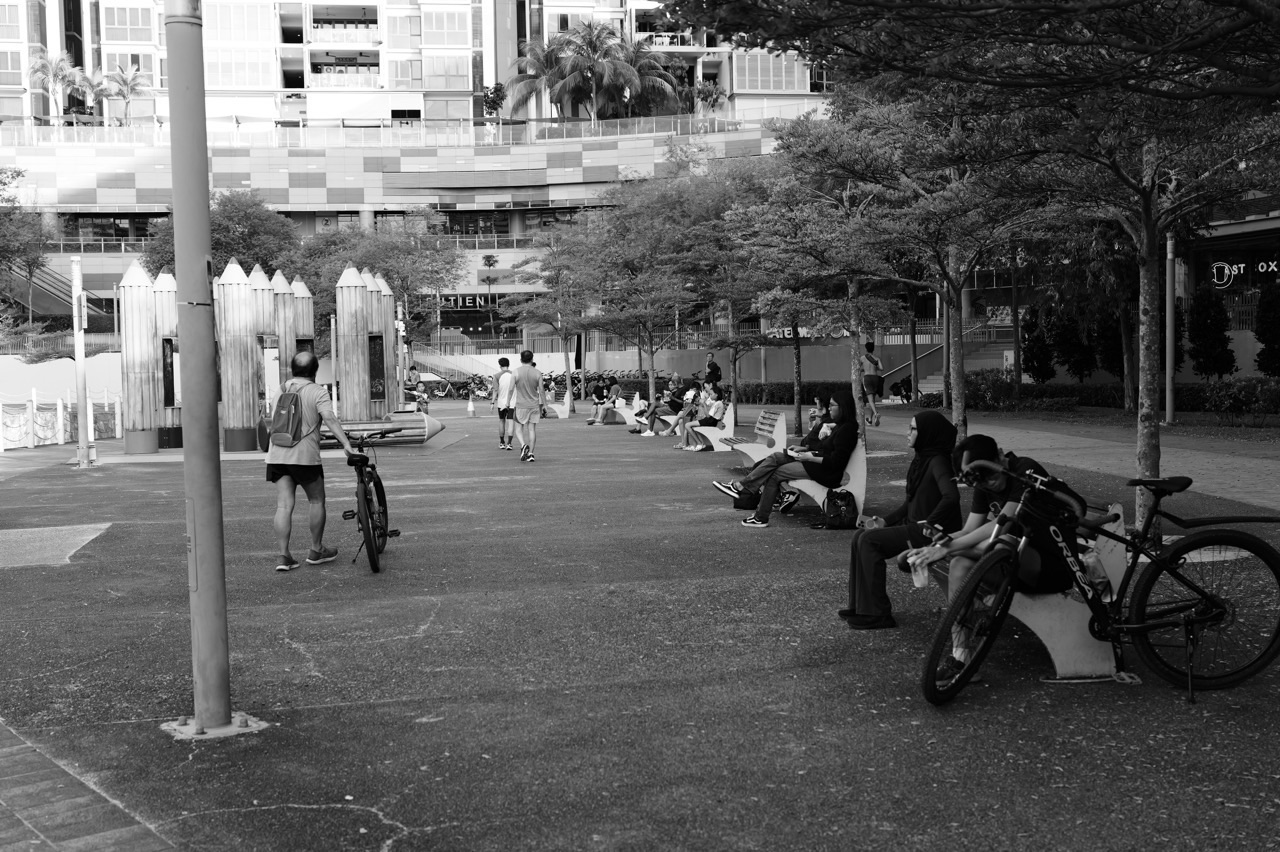
You don’t have to walk the length of Punggol Waterway Park to enjoy it. An October 2026 series of eduKatePunggol photographs documents seating and resting corners along the Punggol Waterway beside Waterway Point. The pictures show an important part of everyday park use: sometimes the most useful destination is a comfortable place to sit, watch the water, let a child pause or give an older relative time to recover before returning to the mall or MRT.
Punggol Waterway Park is an NParks-managed park along Sentul Crescent, with an official area of 25.79 hectares, four themed zones and published 24-hour opening. NParks labels it wheelchair-accessible and elderly-friendly. Those broad facts do not tell us that any specific seat is empty, shaded, dry, near a toilet or suitable for every mobility need today. This article uses original photographs to show the types of rest space near Waterway Point and then provides a practical way to build a short, low-pressure visit.

Before you plan a short Waterway Park visit
- Official park: Punggol Waterway Park, along Sentul Crescent, Singapore; NParks lists it as 25.79 hectares and open 24 hours.
- Accessibility: NParks describes the park as wheelchair-accessible and elderly-friendly; specific paths and seats still need current inspection.
- Photographed context: benches and seating/rest corners beside park paths near Waterway Point, plus a nearby walking/running path.
- Main mall landmark: Waterway Point, 83 Punggol Central, beside Punggol MRT/LRT.
- Purpose of this page: find a comfortable amount of walking with intentional rest stops—not a complete four-zone tourist itinerary.
- What photos can’t confirm: exact number of seats, live occupancy, shade hours, temporary closures, detailed step-free routes or cleanliness.
- For children: stay away from unguarded water edges and supervise near cyclists or runners.
- For hot, rainy or hazy conditions: use present NEA/weather information and change plans when needed.
- Important site rule: NParks explicitly prohibits fishing inside Punggol Waterway Park.
Use NParks’ official Punggol Waterway Park page for location, current notices, accessibility, rules and themed zones. The Punggol Waterway park connector page describes the wider 8.4 km route, not an instruction that every visitor must walk all of it. For air quality, check haze.gov.sg; for mosquito prevention, consult NEA’s repellent guidance. Existing general park guides remain the place for bridges and full-zone exploration.
Why a bench can be the real destination
People often plan a park trip around distance: how many kilometres, which bridge, which part of the connector. For somebody accompanying a toddler, grandparent or person rebuilding a walking routine, a useful bench can matter more than an ambitious endpoint. It gives the group permission to enjoy being outside without needing to finish a route.
The October images are valuable because they highlight the overlooked ordinary infrastructure of a park. A bench is not glamorous, but it can turn an otherwise tiring trip into a manageable experience. The photos cannot tell us how comfortable that exact seat feels to everybody, so the visitor still needs to make an individual choice.
How the Waterway Point area differs from the whole park
Punggol Waterway Park covers a substantial stretch of town, with four official themed areas. The photos in this guide specifically document seating and paths beside Waterway Point. That is a narrower local setting than the entire park, and a visitor should not treat every feature in a broad Punggol Waterway guide as being beside the mall.
If you want the park near Punggol’s town-centre shopping area, begin with the actual mall and current public waterfront signs. If you are looking for a specific bridge or another zone, use the NParks map rather than relying on these photos. The distinction reduces needless walking.
What the first rest-area photograph proves
The primary image shows a seating/rest area near Waterway Point. It records that a place to sit was present when the photograph was taken. It doesn’t establish that the same seat is unoccupied now, has a particular material, stays dry during wind-driven rain or sits exactly a measured number of metres from the mall.
A useful image caption stays with the visible scene: ‘Seating beside a Punggol Waterway Park path near Waterway Point, October 2026.’ Readers can then use current signs and ground conditions for the actual visit. An attractive photograph should never become a fake real-time amenity directory.
Why a second camera angle matters
Another October image shows a seating area from a different angle. Together the two frames provide more architectural context: where the rest corner sits relative to a path and surrounding landscaping. This makes it easier to imagine the experience than reading a bare sentence saying ‘there are benches’.
However, two photographs may show the same furniture rather than two independent seats. We should not count photo files as separate rest stations. A careful guide treats image quantity as editorial coverage and avoids inventing a park-wide bench inventory from repeated views.
Planning by energy instead of kilometres
Ask the people going what they want from the visit. One person may enjoy fifteen minutes outside; another wants a short walk followed by a seated conversation. A young child might need a break after only a few minutes. Matching the plan to the group is more important than completing a named route.
A good starting arrangement is to identify one suitable rest point and one clear way back before going farther. If the first seat is occupied, do not make the whole outing depend on it. Check other permitted seating or decide to return to the mall. Flexible plans are not failed plans.
The five-minute outside break
A simple hypothetical outing is to leave the mall, reach a suitable public waterfront viewpoint, pause briefly and return. Five minutes here refers to the intended length of a break, not a verified walking time between a named entrance and a particular bench. Actual routes vary.
This short version may be helpful for a family waiting between appointments or an older visitor who would enjoy fresh air without a longer excursion. If weather is unsuitable or the path isn’t comfortable, there’s no reason to force it. The entire purpose is a small, pleasant change of scene.
The fifteen-minute gentle outing
With more time, a group might walk for a few minutes, sit when a suitable public rest point becomes available, notice the water and return along the same lawful route. A fifteen-minute plan is a personal budget of time, not a claim that the photographed seat lies on a measured loop.
Parents can let a child choose one thing to observe—a bridge, tree or reflection—without turning the outing into a race. An older adult can decide whether to pause longer or head back. A flexible small outing often feels more sustainable than a complicated itinerary.
The half-hour outing with a deliberate rest
If the group feels comfortable, half an hour can include a longer pause or a short section of the waterfront. Don’t assume the person who agrees to thirty minutes wants thirty continuous minutes of walking. The seat is part of the experience, not an interruption.
Choose a turnaround based on real energy and weather. The 8.4 km park connector is a much larger route and should not be mistaken for a suggested half-hour family walk. Punggol’s green network offers many choices, and the correct length depends on the actual visitor.
Why a path can feel different in the morning and afternoon
Sun angle affects which sections are shaded, and the same seat may face different glare through the day. A photograph taken at one time cannot establish that the area remains cool at lunchtime or dry during rain. Even a tree that looks mature may provide uneven shade depending on the direction of light.
For someone sensitive to heat, choose a time and seat that feels comfortable on the actual day. Bring water and allow a quicker return to an indoor space if needed. Never promise a fully sheltered outing based on the presence of a roof or leafy canopy in one image.
Reading the nearby walking and running path
One photograph is explicitly labelled ‘Walking and running path along the Punggol Waterway beside Waterway Point’. It shows that a rest corner may sit close to a path used by people travelling at different speeds. This can make the environment lively but also means a group should avoid blocking movement.
Keep bags, strollers and mobility aids to the side where permitted. Children should know not to dart into a cyclist’s or runner’s path when leaving a seat. Sharing space responsibly helps everyone enjoy the waterway without turning an ordinary rest into a collision risk.
A stroller-friendly rest plan
For families with a stroller, the key question is where the stroller can pause safely without obstructing the public path. Avoid parking across a narrow passage or on a turning corner. If the child needs to get out, an adult should supervise and consider nearby movement.
Check the full route to the seating area, not merely whether the final photo appears flat. Kerbs, slopes and temporary obstacles may lie outside the frame. An official park accessibility label is useful context, but real step-free continuity must be confirmed for the chosen entrance and seat.
An older relative and the value of choice
An elderly-friendly park designation is a useful planning signal, not a statement that every senior enjoys the same distance or seat. Ask what the person prefers: a brief view, quiet conversation, room to use a walking aid or time to sit after a journey.
If they want to turn back early, honour that decision. A comfortable trip may consist largely of talking on a bench. Quality time doesn’t require an elaborate destination. Avoid using age alone to assume somebody needs assistance or should avoid walking farther.
Wheelchair access is a route, not only a symbol
NParks marks Punggol Waterway Park wheelchair-accessible. That establishes a public design intention, but a specific journey involves getting from an entrance to a particular rest space, and then returning. Actual gradients, surfaces, temporary works and safe turning space may vary.
The person using the chair should help select the route that works. If a path is obstructed, use current official diversions rather than creating a shortcut over landscaping. A photograph of a wide path is not a guarantee that every adjoining section has the same width.
Why a suitable seat must be assessed on arrival
A seat can be useful for one person and unsuitable for another because of height, back support, sun exposure or nearby activity. The photo cannot prove ergonomics or whether a bench is currently clean and stable. If a structure is damaged, don’t use it; report the problem to the relevant authority.
People can choose a different public rest area or end the outing. There is no benefit in insisting that the precise seat pictured online must work. The practical goal is an enjoyable pause, not recreating a photograph at the expense of comfort.
What if every bench is occupied?
Public seating isn’t bookable simply because it appears in a local guide. On a busy day, the photographed area may be full. Avoid standing over seated visitors to pressure them into leaving. A quiet alternative could be another permitted public rest point or a return to an indoor mall area.
An outing that depends on continuous access to a particular seat should be planned with extra care. For somebody who cannot comfortably stand for long, verify suitable options before leaving. It’s better to adapt than to promise a seat that the writer has no way of reserving.
Seating near a water edge requires supervision
The waterway is appealing, but children may be curious about railings, edges and water movement. Don’t allow them to climb barriers or approach restricted edges for a better view. A seat close to water does not turn the area into a water-play zone.
An adult can explain the simple rule that public waterfronts are for looking and walking where permitted. Swimming and other activities require designated approved venues. Safety should be part of a relaxed outing, not a source of drama created by preventable choices.
Why fishing isn’t a bench-side activity here
NParks expressly states that fishing is not permitted within Punggol Waterway Park. A photograph of calm water and a convenient railing does not override that rule. Other nearby water bodies may have different designated angling arrangements, but their permissions must be verified separately.
If a family wants to fish, choose a presently authorised location from official information instead of improvising from a bench. The correct activity for this article is resting and observing the waterway, not using a seating corner as an unauthorised fishing platform.
The difference between rest and leaving belongings unattended
A visitor might be tempted to leave a bag on a seat while taking photographs farther along the path. Don’t treat a public bench as a private locker or reserved chair. Keep valuables secure and avoid obstructing seating that other people may need.
For parents, an adult should maintain supervision of children rather than rely on a bag or pram to hold a place. A short trip works best when there are fewer objects and fewer separate responsibilities to manage.
A wet-weather walk deserves a different plan
After rain, paving and seating surfaces can be slippery or damp. A photographer might enjoy reflections on the water, but a family with a young child or mobility aid may need a dry, secure place to pause. Don’t assume that a bench under some foliage will be dry.
Follow current weather advisories and leave outdoor areas during lightning risk. There’s no need to seek shelter under a tree simply because a photo shows shade there. Waterway Point offers an indoor destination nearby, subject to its own operating conditions.
Evening lighting and the return journey
NParks says the park is open 24 hours, which describes access to the park. It doesn’t imply every rest area has the same lighting, staff presence or nearby services throughout the night. A photograph made in daylight cannot be used to guarantee the comfort of a late-evening walk.
Choose a return route that suits the group and current conditions. An adult responsible for children should not continue along a dim unfamiliar path simply to reach another bench. The beauty of a short outing is that turning back is always part of the original plan.
Heat, hydration and knowing when to pause
Warm and humid conditions can make a modest walk tiring. Water and comfortable clothing are simple considerations, but individual needs differ. A bench gives a chance to slow down and notice whether everyone wants to continue. Don’t set a fixed distance as a requirement.
If someone feels unwell, abandon the recreational itinerary and follow appropriate health guidance. This guide is not a fitness prescription. Its practical message is that rest is a legitimate part of enjoying a public green space.
Haze: an October 2026 photo is not an air-quality reading
Singapore experienced a documented haze episode in October 2026. NEA’s dated advisories describe changes in PSI and hourly PM2.5, but a clear-looking or hazy-looking waterfront photo is not a reliable numerical reading. Lighting and camera processing also affect visibility.
For immediate outdoor plans, check current official air-quality readings and guidance appropriate to the people going. Postpone an optional long walk when conditions make it unsuitable. The photo record remains useful as history without pretending to show today’s air quality.
Mosquito prevention without guessing a local infestation
Waterside vegetation and evening outings may lead families to think about mosquitoes. That doesn’t mean the photographed rest area is a confirmed dengue cluster. NEA provides current guidance on registered repellents and recommends following product labels, with extra precautions for young children.
Parents can choose appropriate clothing and a suitable protection plan. Don’t spray repellents indiscriminately around other park users or use a product beyond its instructions. Current NEA information is better evidence than a photograph of trees and water.
The soundscape: why photographs can’t tell us how quiet a seat is
A photograph of an empty-looking rest corner may suggest silence, but it cannot record traffic, conversations, nearby construction or the sound of passing bicycles. A person seeking a calm space may find that the experience changes with time and activity.
Instead of guaranteeing a sensory profile, encourage readers to assess the actual environment and be ready to move or leave. Someone sensitive to sound may prefer a different place or time. A public park is shared, and its atmosphere is never completely under one visitor’s control.
How to spend ten quiet minutes with a child
Let the child name three things they can see: perhaps water, leaves and a path. Ask what they notice changing, such as light or movement. This is an everyday observation exercise, not a formal assessment. The adult stays responsible for safety near the water and shared path.
A child who gets bored quickly may still enjoy the visit because the plan is brief. You do not need binoculars, an educational worksheet or a paid programme. The value can simply be time outside and a conversation.
Upper-primary Geography: park versus park connector
NParks calls Punggol Waterway Park a 25.79-hectare park and the related connector an 8.4 km route. Those numbers describe different properties: area and length. A pupil can practise explaining why a connector’s length doesn’t mean a person must walk eight kilometres to reach one bench.
Draw two simple shapes: an area and a line. Discuss how a small accessible section of a large park can serve someone who only needs a short rest. The real-world lesson is that an outdoor space offers choices at several scales.
Mathematics: a rest-break schedule that is explicitly hypothetical
Imagine a family planning 25 minutes outside: seven minutes walking, ten minutes sitting and eight minutes returning. The pieces add to 25 minutes. This is an invented timetable for arithmetic practice, not a measured route from Waterway Point to a specific photographed bench.
Ask the child what happens if they need five extra minutes of rest. The total becomes 30 minutes, or the walking portions must shorten. This illustrates simple time allocation and why a flexible plan matters. The calculation should never be presented as a verified walking estimate.
A second Mathematics question: distance and pace
Suppose, for a classroom example, two people travel a hypothetical 300 m path. One averages 60 metres per minute and takes five minutes; another averages 40 metres per minute and takes seven and a half minutes. Neither figure describes the actual photographed route.
The exercise shows why identical distances can mean different experiences. A family should plan around the actual walker, crossing conditions and needed breaks rather than assume the fastest person’s time is the correct forecast for everybody.
English composition: describe a bench without inventing a stranger
A photograph can support a grounded description: ‘A bench stood beside a paved path, with the waterway beyond.’ A fictional story might invent an older character resting there, but the story should be identified as imaginative. Don’t claim the actual person in another frame is tired, lonely or waiting for family when none of that is known.
Clear separation between observation and invention is a useful writing habit. The local photo helps the child find real setting details, while the creative element remains clearly the student’s own story.
A Science question about shade and surface temperature
A shaded seat may feel different from one in full sun, but a photograph can’t establish actual temperature. Scientific comparison would require suitable observations and instruments at a known time. Shadows vary with weather and sun position, and surfaces have different thermal properties.
An older student can devise a simple, safe classroom investigation using appropriate non-hazardous surfaces and a thermometer under supervision. There’s no need to conduct experiments that obstruct park paths or touch potentially hot metal without precautions.
A Social Studies question about a shared bench
A public bench illustrates shared community infrastructure. Different people may need it for different reasons—resting after a walk, waiting for companions or pausing with children. Courtesy means not treating it as personal storage, keeping the nearby path clear and allowing others space.
An older student can consider how park design accommodates varied mobility needs without assuming every resident uses the space identically. The photographed rest area becomes a prompt to think about inclusion as a real everyday feature, not a slogan.
A photo-reading lesson about selecting evidence
The images include a seat, a rest corner, a path and a runner nearby. Together they suggest how stopping and moving can coexist. But the upload selection may overrepresent that short stretch because the photographer took several angles. It doesn’t prove a particular percentage of the whole park contains benches.
Students can learn that media coverage is not a statistical survey. To map actual rest furniture, a proper location-based inventory would be needed. This guide deliberately avoids publishing an invented count or fake bench map.
Why the nearest toilet cannot be determined from the bench photo
A person considering a longer outing may need nearby toilets, water or other facilities. The image of a bench cannot verify the distance to those services or whether they are open. Consult the current park and mall directory when such details are important.
Planning for the individual matters more than adding amenities to a list. For a family with a very young child or an older relative, checking facilities beforehand can make the difference between a comfortable break and a stressful one.
Don’t confuse Waterway Park with Punggol Promenade Riverside Walk
Waterway Park near Waterway Point is not the same formally named location as NParks’ Punggol Promenade Riverside Walk by Tebing Lane and Serangoon Reservoir. Both are pleasant waterfront environments within Punggol’s green network, but they have different location references.
Our Waterway Park versus Riverside Walk comparison resolves the names. This rest-bench article concerns the Waterway Point side, not a verified seat along the 1.2 km Riverside Walk.
A good exit plan makes a short walk easy
Before leaving the mall or station, decide what counts as a successful outing. Perhaps it’s one suitable bench and ten minutes of watching the water. Know how you’ll return by a legal public route. If the nearest rest area is crowded or wet, change the plan without argument.
That flexibility is particularly useful for multigenerational outings. The point is shared time, not proving that a small child or grandparent can complete a lengthy connector. A public park becomes more accessible when visitors feel free to choose a modest version of the experience.
What makes the October pictures a useful archive
Seating details can change through maintenance, landscaping or improvements. The October 2026 images preserve how the Waterway Point-side rest spaces looked at that time. Future readers may compare them with updated park furniture, but the old images should retain their dates rather than pretend to be live infrastructure records.
Caption the place accurately, avoid identifying incidental runners or families, and let NParks own current operational claims. A quiet bench photograph can become meaningful local history precisely because it preserves an ordinary detail carefully.
The one-paragraph plan to remember
Choose Punggol Waterway Park beside Waterway Point, check current weather and park information, and follow a public path toward a suitable rest corner. Pause for as long as the group finds comfortable. Keep children supervised near water and shared routes, leave the seat and path tidy, and return by the planned route.
If the outing ends after only a few minutes, that can still be worthwhile. Punggol has enough large-scale attractions without turning every moment outside into an achievement. Sometimes sitting together and looking at the water is the experience.


Frequently asked questions
Are there seats near Waterway Point along the park?
Yes, original October 2026 photos document seating and rest corners in the Waterway Park area beside the mall.
Can I reserve the photographed bench?
No public reservation is established. Seating depends on current availability and site rules.
Where exactly is the seat?
The images are broadly labelled near Waterway Point; no independent coordinate or bench number is verified here.
Is Punggol Waterway Park open at night?
NParks lists the park as open 24 hours, but amenities, lighting and individual path conditions may differ.
Is the park wheelchair-accessible?
NParks describes it as wheelchair accessible and elderly friendly; check the actual chosen path.
Is the whole 8.4 km connector required?
No. The 8.4 km figure describes a park connector route, not a compulsory family walk.
What are the four park zones?
NParks names Nature Cove, Recreation Zone, Heritage Zone and Green Gallery.
Can I choose a five-minute outing?
Yes as a personal plan, but the exact walking time to a particular seat is not verified.
Will there always be shade?
No. Shade changes with time, weather and vegetation; the photograph cannot guarantee it.
What if benches are full?
Use another appropriate public rest area or change the outing; don’t pressure seated people to leave.
Are all seats dry after rain?
Not necessarily. Inspect the actual furniture and surface conditions.
Can children play beside the water unsupervised?
No. Provide appropriate adult supervision and keep to permitted paths and safe boundaries.
Can I fish from a bench?
No. NParks explicitly prohibits fishing within Punggol Waterway Park.
Is this the same as Riverside Walk near Tebing Lane?
No. The formally named Punggol Promenade Riverside Walk is a different waterfront section.
Is the seating area quiet?
Sound levels change with other park users and nearby activity; a still photograph cannot guarantee quiet.
What about haze in October 2026?
Check current NEA readings and advisories before an outing. An old photograph isn’t an air-quality measurement.
Do I need mosquito protection?
Assess current conditions and follow NEA’s repellent guidance, especially for young children.
Can a stroller stay beside the seat?
Only where it doesn’t obstruct paths and the chosen location is suitable; actual widths and access need checking.
Can I bring food?
Follow park rules, keep the area clean and don’t leave litter or feed wildlife.
Does the image prove a nearby public toilet?
No. Check current NParks or mall information for specific facilities.
Where is the general park guide?
Use the existing Punggol Waterway Park guide for the full park, bridges and activities.
Sources and related Punggol guides
- NParks — Punggol Waterway Park (location, area, accessibility, rules, 24-hour listing).
- NParks — Punggol Waterway Park Connector (8.4 km broader route).
- NEA — Current Haze and Air-Quality Information.
- NEA — Use of Mosquito Repellents.
- LTA — Public Path Courtesy and Movement Rules.
- Punggol Waterway Park Guide.
- Waterway Park vs Riverside Walk.
- Complete Punggol Guide
Editorial review: 23 October 2026. Original October Waterway Point-side waterway seating photographs were retrieved from eduKatePunggol’s WordPress library. Exact bench locations, seat inventory, cleanliness, accessibility and current availability are not independently verified. NParks and current on-site notices supersede historical images; examples of short outings are illustrative plans, not measured routes.


