
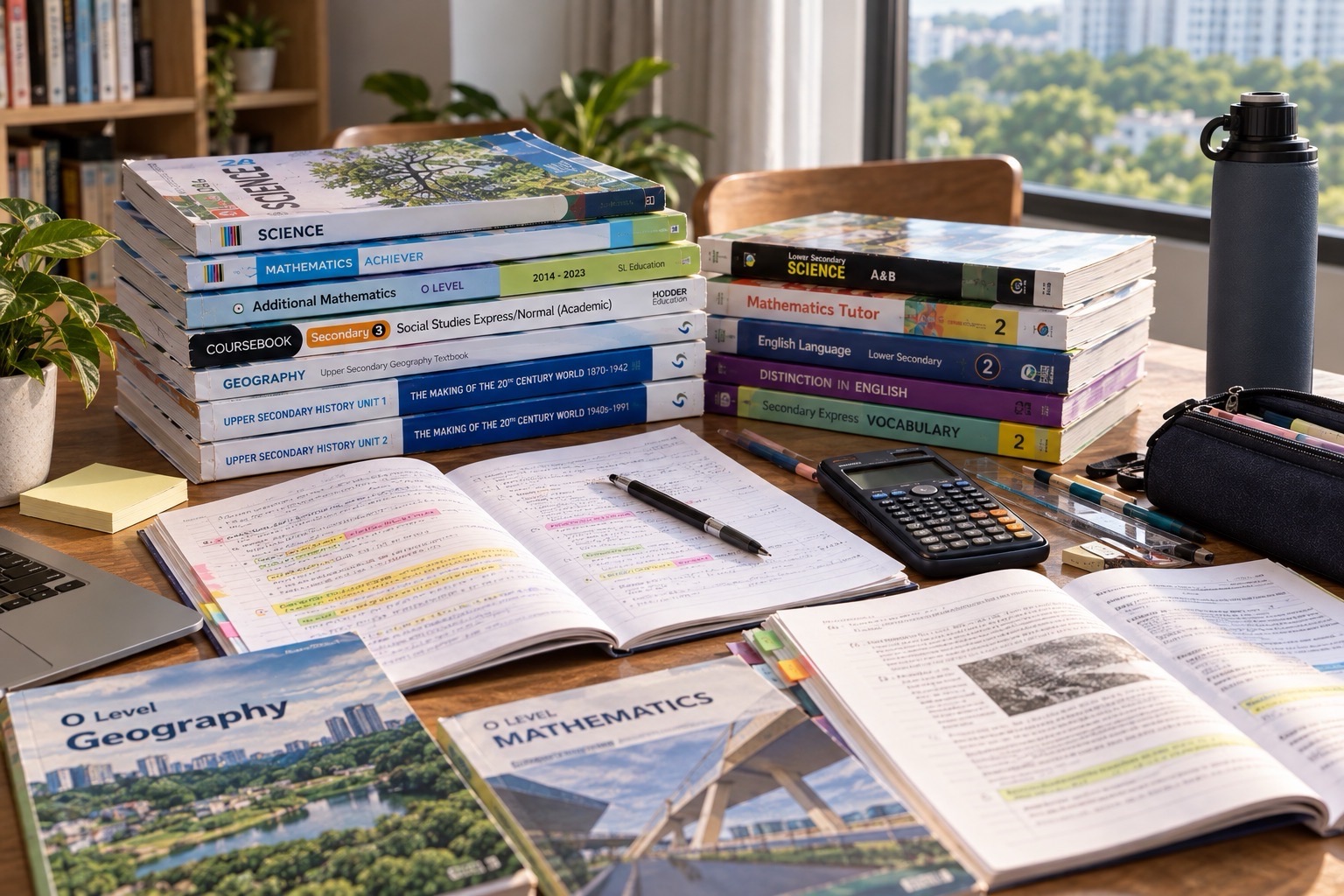
The quick answer: A useful student learning portfolio is a small, honest collection of actual work that shows how a learner’s understanding and skills developed. It is not a folder containing every worksheet, an impressive list of unverified prizes or a parent-designed advertisement for future university admission. A Punggol Primary 3 pupil might keep an early attempt, a corrected explanation and one independent new example. A secondary student might document a coding or Science project with its errors and improvements. A polytechnic or university student may show selected authorised work and explain their own contribution, respecting academic integrity, confidentiality and intellectual-property requirements.
Start with three evidence items: One meaningful task the student attempted, one example of feedback or a genuine correction, and one later task showing what they can do independently. Add the date, level and a short sentence explaining what changed. Store materials privately by default. When a legitimate application later requests a portfolio, curate the most relevant authorised evidence for that specific course rather than publish a child’s whole educational history.
This Life in Punggol guide follows learning portfolios from primary school through the 2027 SEC, ITE, polytechnic Early Admissions Exercise and university projects, including examples using everyday Punggol learning. It has a different reader purpose from the family’s official education-documents guide, which concerns secure handling of certificates, notices and qualified records. Here the objective is *learning evidence*, not long-term administrative storage.
Portfolio is not another word for report card
A report card reflects an institution’s formal assessment and feedback under its own rules. A portfolio may contain selected work, reflections, projects, performance records or other genuine examples that the student is permitted to retain. The two can complement one another but are not interchangeable.
A student might have received a good Mathematics mark while still struggling to explain an unfamiliar question. Another might have improved noticeably in writing without winning a school award. A learning portfolio can show what was actually attempted, how reasoning changed and whether progress transferred to a new example.
Do not change grades on scanned documents or create an imitation official certificate to make the collection more impressive. Formal results remain issued and verified by the appropriate authority.
The three-folder portfolio: attempts, improvements and evidence
Attempts contains a small number of representative first drafts, worked problems or project plans. Improvements records accurate corrections or feedback and what the learner did differently. Evidence contains a later independent result, credible performance record or permitted project outcome.
The folders should not grow without purpose. One meaningful example per skill may be enough for a simple primary-school portfolio. Older learners can select more sophisticated material, but even university work benefits from clear curation rather than quantity.
For a child with several learning challenges, privacy and dignity matter. Do not turn the portfolio into a permanent public catalogue of mistakes. A correction is useful when it leads toward greater understanding, not because adults want to display the child’s weaknesses.
Begin by asking what the portfolio is for
There are at least three legitimate purposes. A personal learning portfolio helps a student notice progress. A school-assigned portfolio must follow the teacher’s actual brief and assessment conditions. An admissions or professional portfolio presents relevant evidence to an authorised reviewer under specific entry, copyright or confidentiality rules.
A family should choose the format based on the purpose. An informal home notebook does not automatically meet a polytechnic admissions requirement. Conversely, a Primary 2 child does not need a polished recruitment website to learn from one corrected comprehension exercise.
The distinction keeps adults from introducing premature career pressure. An enjoyable hobby can remain a hobby unless an actual educational task or later application gives its evidence another purpose.
Primary 1 and 2: one page can show real growth
For early primary, select an age-appropriate reading, writing or number task that the child can understand. A pupil might draw a story sequence or write a short sentence at the beginning of a term, then attempt a related task later. The adult can ask what feels easier and what still needs help.
Avoid demanding that every piece of work look neat enough for public display. A child’s authentic first attempt may be imperfect. If a teacher provides feedback, let the child understand and apply it rather than have a parent quietly rewrite the page.
The portfolio belongs to the learner’s development, not a parent’s social-media aesthetic. Praise the specific change: identifying the relevant sentence, explaining a number relationship or asking a question with greater clarity.
Primary 3 and 4: record an inference, then check transfer
Suppose a pupil reads a short fictional story: “Aisha put her bicycle under the shelter when she saw dark clouds.” A direct observation is that Aisha moved the bicycle. A reasonable inference is that she may have expected rain. The statement does not prove that rain had already begun.
The first attempt might write, “Aisha ran away because there was a storm,” which adds unsupported details. The corrected work explains the evidence more carefully. The child then receives an unrelated new passage and attempts the same evidence–inference distinction without copying the model.
The three pieces create a genuine portfolio sequence: initial mistake, better reasoning and new independent application. The learner has learned more than how to decorate a page.
The Mathematics portfolio should reveal the first wrong step
Consider 3(x + 4) = 24. A student who expands the left side as 3x + 4 has made a distribution error. A correct method divides both sides by three to obtain x + 4 = 8, giving x = 4. Alternatively, expanding correctly gives 3x + 12 = 24, so 3x = 12, again yielding x = 4.
The portfolio entry should name the principle, not only circle the corrected answer. The three multiplies both terms inside the brackets. A fresh question, 2(y + 5) = 22, gives y + 5 = 11 and y = 6, checked by substitution.
If the student solves the second question independently and explains why the transformation is legal, the portfolio contains evidence of transfer. This is consistent with targeted teaching: diagnose the earliest error rather than assign numerous repetitive pages with no analysis.
The Science portfolio must distinguish evidence and claims
A school Science portfolio might begin with a question about evaporation, plant growth or another suitable syllabus topic. The student records what was actually observed, which conditions were varied and whether the conclusion follows. Scientific honesty includes acknowledging when a comparison was not controlled well enough.
Imagine a child notices water in two different containers disappears at different rates. The learner cannot immediately attribute the difference to temperature if container shape, location and airflow also differed. A strong reflection states those limitations and suggests how a fairer comparison could be designed safely.
Do not conduct hazardous experiments or claim a school-authorised procedure from a home hobby. The learning objective is careful observation and valid reasoning, not creating a dramatic photograph or inventing measurements.
A fictional data example with a visible limitation
Suppose a fictional student records a plant’s height as 8 cm, then 10 cm one week later. The apparent increase is 10 − 8 = 2 cm. That is an arithmetic fact within the invented example, not measured growth from an actual Punggol garden.
The student should ask whether the same plant and measurement method were used and whether the observations are accurate. Two heights alone cannot prove that one fertiliser caused the change. A portfolio can include the arithmetic while clearly describing the uncertain explanation.
This habit becomes useful in secondary practical work, applied technical education and university research. A polished chart does not remove the need for sound method and honest limitations.
Use local Punggol observations responsibly
Punggol Waterway, parks, library collections and public buildings can inspire suitable questions. A learner might describe how people share a pathway or compare the accuracy of two public signs. All observations should be gathered in permitted areas without obstructing the public or photographing children inappropriately.
The student can distinguish what they personally noticed from what a government agency officially reports. A photograph of a shaded walkway cannot establish a measured reduction in temperature without appropriate data.
For responsible local inquiry ideas see Life in Punggol | Everyday Family Hobbies as Learning. The portfolio should remain evidence-led, not a collection of unsupported claims about the neighbourhood.
A reading portfolio can include the learner’s own questions
A child visiting Punggol Library can choose an age-appropriate book and write one question or short response. The useful evidence might be that the child later supports an inference with text rather than merely recites the plot.
Do not photograph or reproduce entire books as if they are the student’s own creation. Record titles and authors where appropriate and follow school instructions on quotation or source acknowledgement.
A portfolio entry can be only a paragraph. Its purpose is to make the learner’s growth understandable, not to turn every reading visit into a compulsory essay.
Secondary school: the portfolio should follow genuine interests
Teenagers may develop interests in computing, art, design, engineering, literature, sport or community service. An honest collection could show a small coding project, draft artwork, revised speech, responsible volunteering reflection or technical explanation.
The student should describe their actual contribution, especially when classmates or a teacher helped. Do not attribute a group project’s entire output to one individual. The source and permission for images, code or external datasets also matter.
This remains optional personal learning practice unless the school assigns a formal portfolio. Its value comes from genuine ownership and reflection, not a promise that a broad interest list guarantees admission.
Don’t infer permanent ability from G1, G2 or G3
Under Full Subject-Based Banding, students may take subjects at G1, G2 or G3 levels according to the relevant curriculum and school arrangements. These levels describe subject-study pathways, not a permanent measure of the student’s potential or character.
A learning portfolio should reflect the student’s actual syllabus and knowledge. A G2 or G3 mathematics example must be evaluated against the learning objective appropriate to that task, not inflated merely for appearance.
The first SEC examinations will be in 2027 for the relevant cohort. For formal qualification details use SEAB’s SEC information. A student portfolio is not an unofficial replacement for a national examination certificate.
Difference between achievement and progress
An award certificate may show recognition under a formal selection scheme. A draft-and-revision pair can show a change in skill. A transcript shows academic results. All can have legitimate uses, but they answer different questions.
Parents should not insist that every portfolio page display a medal. A student who used feedback to make a scientific explanation accurate may have important learning evidence even if the work received no prize.
Similarly, collecting certificates without explaining what the learner actually did may create a large archive with little educational meaning. A relevant, accurate example can be stronger than twenty unrelated participation screenshots.
Polytechnic EAE portfolio is a specific admissions tool
The Polytechnic Early Admissions Exercise is an aptitude-based route with course-specific selection and conditional offers. The official MySkillsFuture EAE guide describes organising evidence of accomplishments, interests, skills and experiences. It is not a guarantee that a collection of projects will secure a diploma place.
Different courses may use interviews, aptitude tests, portfolio evidence or other methods, with requirements controlled by the actual polytechnic. An applicant should read the current course and intake conditions before submitting material.
A personal portfolio built during school years may supply useful examples, but it must be curated. An engineering applicant may need relevant technical reasoning; a design applicant may be better served by authentic drafts and visual work. A generic all-subject scrapbook is not automatically competitive evidence.
What Republic Polytechnic’s 2026 advice illustrates
Republic Polytechnic’s EAE portfolio tips, updated in April 2026, encourage applicants to show strengths and experiences beyond grades, including relevant achievements, hobbies, service and projects.
This advice highlights selection: include evidence that helps explain the applicant’s actual interest and aptitude for a specific course. A student who enjoys game programming should be prepared to discuss their own code and debugging decisions, not simply show a colourful screenshot.
The current application requirements still belong to the receiving polytechnic. A 2026 guidance page should not be assumed to specify the exact deadlines or formats for an unannounced later intake.
A portfolio cannot repair missing formal eligibility
Even an impressive admissions portfolio does not automatically satisfy minimum subject requirements, medical or other legitimate course conditions. The student must distinguish being invited for an interview from receiving a confirmed offer and completing enrolment.
For a current pathway, verify the application portal, academic eligibility, selection process and any conditional offer requirements. A school career counsellor can help students investigate options accurately.
The Punggol Early Admissions and Portfolio guide handles those formal application questions. The present article remains about collecting and explaining real work over time.
ITE portfolios should demonstrate actual technical skill
ITE learning may involve applied tasks, workshops, safe procedures and industry-related experiences. A student can document what they designed, measured, tested or improved where the programme permits it. A photograph of equipment is not proof that the learner can operate it competently.
A stronger record includes the purpose, conditions, permitted method, outcome and feedback. It should identify what was performed independently and what required staff supervision. Technical safety standards and authorised assessment conditions must not be bypassed for the sake of portfolio content.
Do not publish confidential workplace information or another trainee’s individual work as personal achievement. The institution’s and employer’s rules control what may be shared.
Applied projects at polytechnic need a contribution statement
Group projects can be substantial, but admissions or employment reviewers may want to know what an individual did. A portfolio should identify the team context honestly and explain specific tasks: coding one module, researching a component, testing a design or presenting results.
Do not write “I invented the full system” if the work belongs to five people. Credit external libraries, datasets and sources appropriately, following their usage terms. A student who admits a design failed and explains how they diagnosed the problem may demonstrate more understanding than one who hides every unsuccessful iteration.
This is closely related to Punggol’s academic integrity guide, which clarifies permitted collaboration and authorship.
University portfolios are not always public
At SIT Punggol and other universities, learners may complete capstones, industry-linked projects, research posters, code, design work or professional assignments. Some materials can be shared publicly; others are constrained by copyright, employer confidentiality, research ethics or assessment rules.
SIT’s open-house student project gallery demonstrates the different types of authorised work that can be showcased, including technical posters and applied prototypes. A publicly displayed example does not mean every student’s project is automatically cleared for publication.
The undergraduate should consult the actual supervisor or institution before sharing unpublished data, employer materials, client details or restricted technical content. A portfolio is a professional responsibility, not simply a personal gallery.
A portfolio is not a government-verified credential
Singapore’s official Careers & Skills Passport can provide access to verified qualifications and relevant career-related records where supported. A self-made learning portfolio can show how someone worked, but it does not certify grades, degrees or professional licences.
Keep these systems separate. An applicant may legitimately provide both an official qualification and selected project evidence. They should never present a personal summary as though it were an issuing authority’s signed transcript.
Our Punggol education records guide explains how to store and retrieve formal results safely.
A six-field portfolio entry that can grow with age
Each selected work sample can record date and level, original task, what the learner attempted, relevant feedback, revised or independent outcome, and source or permission status. Younger pupils may complete only a few fields with an adult. Older learners should progressively own the documentation.
An entry needs to answer a real question. “Here is my project poster” is incomplete if it never explains the student’s contribution or whether the measurements are real. “This shows how I corrected a coding error and retested it under documented conditions” is more informative.
Do not use private medical, safeguarding or household information as ordinary portfolio content. Legitimate support records belong in protected institutional channels, not public career pages.
A worked comparison of before and after
Imagine a student initially writes, “Punggol Coast MRT opened in 2023.” They later check the LTA official opening information and correct the claim to the opening in December 2024.
The before–after record demonstrates verification and factual correction. It should also explain that the official station-opening date alone does not prove a measured reduction in the student’s personal commute. That would need actual journey evidence.
This is a useful information-literacy portfolio example. It includes a concrete error, an authoritative source, a corrected fact and a stated limit on the inference.
Feedback belongs alongside the revised work
A teacher’s comment can be useful when the student understands what action it suggests. “Support inference with textual evidence” becomes meaningful only when the learner can identify the relevant sentence in a new passage. “Show mathematical working” is useful when steps are valid and clearly justify the result.
Keep a small record of the feedback and the learner’s own revision. Do not reproduce private teacher emails or another pupil’s marked work in a public portfolio.
For deeper ways to interpret reports and feedback, read Life in Punggol | School Reports and Teacher Feedback.
The role of parents: curator, not ghostwriter
Parents may help younger children select representative samples, organise files or understand teacher feedback. They should not silently create work and publish it under the child’s name to make a perfect admissions story.
Ask the learner to explain what they attempted and what changed. If they cannot reproduce or defend the reasoning, help them learn the missing skill rather than enhance the artwork of the portfolio. A polished page is not proof of independent competence.
The same boundary applies to external tutors and generative AI. The institution’s assessment rules control permitted support and required disclosure, and student work should be represented honestly.
AI-generated images and text require care
A portfolio may contain digital tools or AI-assisted content where appropriately permitted. If an assignment requires disclosure of AI use, the student must follow that rule. An unverified AI-generated diagram is not automatically valid scientific evidence, and a fabricated research citation should never enter a serious project.
For a public personal site, distinguish the student’s original work from properly licensed or permitted material. Avoid generating images that impersonate actual pupils or falsely document events that never happened.
A responsible portfolio can be modest. Authentic drafts, accurate citations and thoughtful explanation usually tell a clearer learning story than impressive material of uncertain origin.
Privacy: a child’s progress is not a public-data project
Student names, faces, classes, addresses, grades, support records and identifiable classmates can be personal information. The family should not publish them simply to document a learning journey. A private home notebook may be sufficient for a younger pupil.
Where a legitimate admissions application requires identifying information, submit it through the authorised institutional process. Do not upload an entire class list or medical document to a general portfolio website, public cloud folder or unapproved AI tool.
Review who has access when the learner changes school or reaches adulthood. A teenager or university student should increasingly control their own legitimate work and privacy choices.
The right length is determined by evidence quality
A portfolio of five strong, relevant items can be more useful than fifty unrelated certificates. The number is an illustrative principle, not an official limit. Some courses will request a particular format or amount, and those instructions override generic advice.
Ask of each item: does it demonstrate a skill, interest, improvement or genuine contribution relevant to the purpose? Can the learner explain it? Is its source and permission status clear? If not, consider leaving it out.
Editing is part of intellectual work. Removing irrelevant content is not hiding failure when the portfolio’s purpose is specific and the evidence remains truthful.
An annual portfolio reset
At the end of a year, the learner can identify one example of a concept they now understand, one project or activity they completed and one skill they want to develop. Older entries need not be deleted if they serve a useful private reflection purpose, but they should not dominate every new application.
Check whether any certificate is actually official, whether a project can legally be shared and whether its claims still stand. A portfolio should not preserve a false fact merely because it once looked convincing.
For young pupils, review briefly and celebrate growth. For older learners, connect the evidence to possible next academic or professional choices without pretending a single portfolio determines the future.
Four weeks to make a portfolio that teaches
Week 1 — Choose a real learning target. Select one subject skill or genuine hobby project with permission to retain the work. Keep the initial attempt in an appropriate private format.
Week 2 — Correct one meaningful error. Use actual teacher feedback or appropriate instruction. Ask the student to explain the principle rather than copy a model answer silently.
Week 3 — Test transfer. Give a different suitable task and let the learner work independently under the relevant school rules. Record what the evidence supports and where difficulty remains.
Week 4 — Curate and reflect. Keep the first attempt, one correction and one independent demonstration if they are useful. Note sources and privacy restrictions. The goal is a small trustworthy learning record, not a constant stream of public achievements.
Case study: a Primary 4 portfolio with two sentences
A fictional Punggol child repeatedly writes unsupported inferences about stories. The parent initially saves only the final polished compositions, which conceal the underlying difficulty. The teacher’s feedback points to the need for evidence.
The pupil retains one original sentence, explains why it overstates the passage and writes a stronger response based on a clear clue. On a new story, they identify the relevant clue without help.
The family now has a meaningful record of learning. It does not need a certificate, expensive portfolio software or public sharing.
Case study: a Secondary 3 learner preparing relevant EAE evidence
A teenager interested in design keeps sketches, prototypes and a record of one project iteration. A parent suggests adding every unrelated school certificate to make the portfolio larger. The student reads the current receiving polytechnic’s EAE advice and prioritises authentic work connected to the intended course.
They explain their own contribution, what feedback changed and which skills they want to develop. They separately check formal entry criteria and application dates, knowing the portfolio itself does not guarantee an offer.
The outcome is a clearer presentation of genuine aptitude, not a promised EAE selection result.
Case study: an SIT student cannot publish an industry dataset
A fictional SIT undergraduate worked on an approved industry-related project and wants to include the full dataset and client details in a personal portfolio. The student checks the supervisor’s and partner’s confidentiality instructions before sharing.
They create an authorised high-level description of the problem and their contribution, avoiding restricted content and unsupported performance claims. The portfolio respects academic and professional conditions while communicating real competence.
This demonstrates a mature portfolio decision: knowing which evidence is appropriate to share is itself part of professional responsibility.
Ten frequently asked questions
Is a learning portfolio the same as a report card?
No. It contains selected evidence of work and development, while official report cards and qualifications follow institutional assessment processes.
Must a Primary 1 child have a professional online portfolio?
No such universal requirement exists. A simple private example of reading, writing or mathematical progress can be sufficient for family learning.
Should parents keep every completed worksheet?
Not automatically. Retain representative items with a clear learning purpose instead of building an unmanageable archive.
Can mistakes appear in a useful portfolio?
Yes. A first attempt, correct feedback and independent revision can demonstrate how the learner developed understanding.
Does Polytechnic EAE always use an identical portfolio format?
No. Courses and polytechnics can have different selection requirements and assessment methods. Check the current admissions instructions.
Does a portfolio guarantee a diploma or university place?
No. Formal eligibility, selection, competition and institutional decisions still apply.
Can a student use a complete group project as an individual achievement?
They should describe their actual role honestly and follow assessment, copyright and publication permissions.
Can SIT industry project documents be uploaded publicly?
Only where the relevant university, partner and assessment rules permit. Confidential material should not be disclosed for portfolio purposes.
Is a personal portfolio equivalent to a government-verified qualification?
No. Official examination and qualification records are issued and verified through authorised services.
What is the most useful first portfolio item?
An authentic task with one clear learning objective, a legitimate correction and evidence that the student can apply the principle independently.
Official sources and Punggol reading path
Useful sources include MySkillsFuture EAE portfolio guidance, Republic Polytechnic 2026 portfolio tips, the Polytechnic EAE portal, SEAB’s SEC framework, SIT student project gallery, SIT Academic Matters, Careers & Skills Passport and NLB Punggol Library. Actual submission conditions and permissions remain with the receiving institution. All student cases and sample calculations are fictional.
Continue with official education documents and records, academic integrity and responsible AI, teacher feedback and report cards and Punggol independent learning. A trustworthy learning portfolio does not say that a student was always excellent. It shows what they attempted, how their thinking improved and what they can now genuinely do.


