
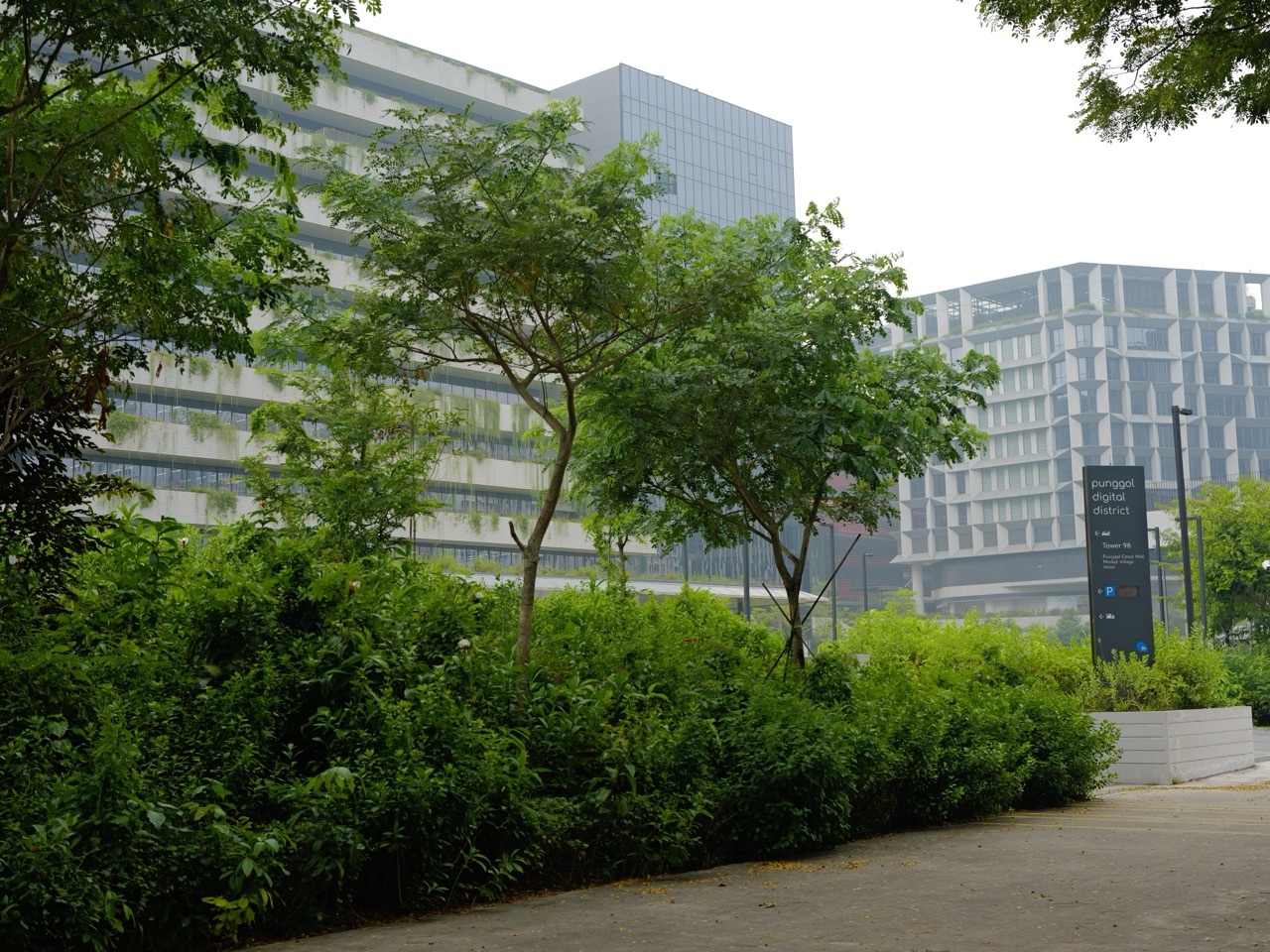
Punggol Digital District has a larger EV charging story than simply locating a plug. JTC designed its first phase around 96 charging lots and electrical provision to expand towards 151 as demand grows, while a smart-grid programme examines how flexible electricity use can be managed safely. Here is what that means for residents, workers and visitors—and what the planning figures do not establish.

The answer first: the 151-lot figure is planned provision, not an availability feed
As at 23 October 2026, JTC’s Green Mark Platinum District announcement describes an initial 96 EV charging lots for the first phase of Punggol Digital District, with electrical provisions designed to support an increase to 151 charging lots as demand develops. The current JTC site confirms that dedicated EV charging bays are available at the district. These statements do not establish that exactly 151 chargers are energised today, that every planned bay is publicly available or that a particular charger is free when a driver arrives.
The project is part of the broader car-lite design: main vehicular routes are on the district’s perimeter, many service roads and shared carparks are underground, and pedestrians and cyclists have more direct ground-level space. PDD also plans over 1,500 bicycle parking lots. Charging infrastructure is therefore one component of a transportation system that continues to prioritise public transport and walking rather than an invitation to bring a private car for every visit.
The most important future question is how PDD will add charging capacity sensibly as use grows. A number of electrical provisions is different from physical plugs and operational chargers. Residents and visitors should verify the actual charging operator, connector, price, access rights and live availability using an authorised current source before travelling.
What the original JTC statement actually says
JTC’s May 2024 sustainability release discusses 96 charging lots in the first development phase and provision for expansion to 151 in line with market demand. That is a design commitment to preparing infrastructure for later adoption. It does not give a dated list of chargers by carpark level, guarantee a fixed charging tariff or confirm all bays will be in public-access areas.
Its current smart-grid materials describe dedicated EV bays and the possibility of connecting vehicles and energy storage to demand-response programmes. These plans belong to different stages: a functional charger can operate without participation in a sophisticated demand-response test. A future integration pilot would require technical safeguards, regulatory approval and suitable agreements.
A careful reporter should preserve the source date. By 2026, some elements of the 2024 future plan have become real. The correct way to describe the count is to identify the original planned phase and the further provision rather than silently declaring all 151 chargers live.
What ‘electrical provision’ means
A development can reserve electrical capacity, conduits, space or other supporting infrastructure before fitting out every individual charger. This can reduce the cost and disruption of future expansion. It is not the same as an operational charging socket or a functioning charger with an active service provider.
In practice, an expansion decision may depend on carpark demand, suitable grid arrangements, physical layout, technology standards and commercial operation. The eventual number of chargers can be changed by later decisions. A property brochure’s capacity figure is not a reliable estimate of what a driver can use at a particular hour.
For a student learning about urban planning, the idea is similar to providing spare pathways for future communications cables: designers anticipate growth while allowing investment to occur in stages. The trade-off is to reserve enough useful capacity without overspending on equipment that might sit idle.
Why PDD’s car-lite master plan includes EVs
Car-lite planning does not mean cars vanish entirely. People may need vehicles for disability-related journeys, deliveries, business operations or other legitimate purposes. PDD’s design moves much of the vehicle infrastructure underground or to the district edges to make the shared public realm more walkable. EV charging can support lower-emission vehicle use within that managed system.
A driver should not assume that every underground parking area is open to all users. Some spaces may be reserved for tenants, service vehicles or authorised staff. Public charging requires clear lawful access, safe operation and suitable signage. The label “car-lite” should not be interpreted as proof that parking is free or unrestricted.
The planning value lies in choosing mobility options appropriate to the journey. For many visitors, Punggol Coast MRT and the integrated transport hub remain more convenient than searching for parking. Adding EV chargers does not remove the need for buses, accessible pedestrian routes or cycling storage.
Punggol Coast MRT and bus connections are already operating
The Punggol Coast MRT station opened in December 2024 and the Punggol Coast Bus Interchange opened in June 2025. JTC’s current directions identify the station, Teck Lee LRT and buses serving the area. These are actual alternatives to driving; they should not be presented as unopened parts of a future mobility concept.
An office worker may choose transit for everyday travel and use a car only when needed. A guest visiting the university can assess whether a rail journey is simpler than parking and charging. The choice depends on origin, mobility, timing and destination, not only on the availability of a charger.
A sound local guide should include both kinds of infrastructure while keeping their current status clear. Punggol Coast Bus Interchange is distinct from the older Punggol Bus Interchange at the town centre.
Why charging bays and connectors must be counted carefully
A charging lot is a parking position intended to support charging, whereas a charger is a piece of electrical equipment that may have one or more connectors and operating constraints. A development announcement might describe lots, points or chargers. Those words should not be treated as interchangeable without checking the operator’s definition.
The presence of a vehicle in a marked bay also does not prove it is actively receiving power. Charging may have completed, equipment may be unavailable or the bay may have a different access policy. If publishing availability, use an authorised live service rather than inferring status from a photo.
This precision matters for public confidence. Announcing “151 free chargers” when the source actually says “provision for 151 charging lots” can send drivers to a location without the infrastructure they expect.
The difference between AC and DC charging
Alternating-current charging generally uses power conversion equipment in the vehicle, while direct-current charging supplies converted electrical power to the vehicle from external equipment. Their practical suitability depends on the car’s capability, connector, charger rating and battery state. A driver’s charging time is not determined only by the headline power rating.
In Singapore, publicly accessible charging equipment must comply with applicable connector and safety rules. LTA states that Type 2 AC and Combo-2 DC, also called CCS2, are the principal permitted public charging connector types, with CHAdeMO available as an additional option where allowed. That describes national standards; it does not certify the installed connector mix at PDD.
A visitor should therefore check the specific equipment listing. “EV charging available at the district” is insufficient to guarantee that a car with a particular inlet can charge at an intended parking level.
What changed in Singapore’s standards in April 2026
LTA and Enterprise Singapore announced that the national EV-charging technical reference would be elevated to Singapore Standard SS 722 from 1 April 2026. The expanded standard includes safety and reliability provisions, cybersecurity for charging management systems and support for smart charging. This is directly relevant to future charging infrastructure.
The standard also addresses emerging technologies such as wireless charging systems under defined safety requirements. That does not mean PDD has installed public wireless pads or that a car can be charged by parking over any marked surface. A technical standard defines how approved systems should be designed and operated; real site deployment requires separate evidence.
For the PDD expansion, the practical implication is that future chargers should meet the regulatory and technical conditions in force when installed and operated. Readers should not rely only on pre-2026 descriptions of charging technology.
Why charge-point registration matters
Singapore’s Electric Vehicles Charging Act establishes safety regulation for chargers, including type approval, installation, certification and registration. LTA states that owners are responsible for ensuring registration before use. The process provides accountability for proper maintenance and safe operation.
An individual EV owner does not need to inspect internal charging equipment. Instead, use legitimate registered charging services and follow instructions. If equipment appears damaged, do not use it; report the issue to the appropriate operator. Never improvise a connection with an extension cable or incompatible adapter.
The rules apply regardless of whether the charger is inside a highly advanced digital district or an ordinary public carpark. A smart-city label cannot substitute for safe electrical systems.
How the district-level smart grid could help
JTC appointed Univers and PacificLight to develop PDD’s smart grid integrating rooftop solar, battery storage and data-driven management. One opportunity is to coordinate flexible electricity demand across different systems. EV charging may be able to participate in carefully managed arrangements where appropriate vehicle users and operators have agreed to them.
For example, a future system could encourage some charging to occur at times with lower demand or appropriate available supply. But users still need enough electricity for their planned travel, and charging safety must be maintained. The value depends on reliable communication, pricing arrangements and transparent consent.
No driver should assume that plugging into an ordinary PDD charger automatically enters a wholesale electricity market or earns money. Those possibilities require specific approved programmes and operating terms.
What demand response actually asks participants to do
Demand response generally involves changing electricity consumption patterns in response to grid conditions or price signals under an applicable programme. For some EV users, charging time may be flexible enough to shift; for others, a departure deadline makes the energy need relatively fixed. A useful system must respect those different constraints.
An employer might consider managed charging for fleet vehicles during long parked periods, while a visitor may need a faster top-up before travelling elsewhere. The two cases should not be treated as identical. A pilot must explain how choices are made and what happens if charging cannot be completed as requested.
The economics also need attention. A potential saving depends on tariffs, programme rules and actual energy use. “Smart charging” is a method, not a blanket promise of cheaper electricity for every vehicle.
Vehicle-to-grid is a pilot idea, not a public offer
JTC’s November 2024 smart-grid announcement mentions a potential vehicle-to-grid (V2G) demonstration with support from the relevant authorities. In principle, V2G concerns the controlled flow of power between suitable vehicles and the electricity system, under approved arrangements. It requires compatible vehicles, equipment, management and technical safeguards.
The announcement does not establish that every EV charging at PDD may sell electricity back to the grid, that the vehicle’s battery warranty covers such use or that a public tariff has been approved. A visitor cannot assume participation merely by parking at the district.
This distinction is vital because energy pilots may use carefully selected equipment and participants. A general public charger and a monitored research demonstration can look similar from the outside while having very different operating requirements.
A parking decision remains different from a charging decision
A driver may be able to park without charging, or may find a charger whose bay is unavailable. Parking charges and charging charges can be set by different operators. A reserved charging lot might have rules about overstaying or non-charging vehicles. The exact combination must be checked at the location.
The district’s planned count of charging lots is not a guarantee of an available carpark space, and a full carpark may not imply all chargers are busy. For events or peak workdays, it is prudent to consider public transport as an alternative rather than relying on speculative real-time charger availability.
Visitors should never park across access paths or in designated accessible spaces without entitlement in an attempt to reach a charger. Good charging infrastructure must coexist with ordinary parking and safety rules.
What 2026 national utilisation evidence does and does not show
In May 2026, the Ministry of Transport answered a parliamentary question about charger utilisation. It said HDB chargers averaged roughly 20% utilisation, with higher use at night and particularly strong demand in areas including Punggol and Sengkang. JTC-managed carparks averaged around 9% utilisation, with greater demand in the day. These are aggregate figures for different groups of carparks, not a live measurement of PDD’s particular chargers.
The figures illustrate why location and user patterns matter. Residents returning home may charge at night, while business-park users may charge during work hours. Yet it would be inaccurate to assume exactly 9% of PDD’s bays are occupied at any given hour or that Punggol town’s average describes every parking facility.
A good expansion decision needs site-specific utilisation and user needs, alongside the cost of installing and operating more equipment. General statistics can frame the question but cannot substitute for local records.
Why expanding to 151 lots depends on demand
JTC’s original wording explicitly conditions the ramp-up on market demand. That is sensible because installing the full possible capacity before anyone uses it can tie up capital, while waiting too long can create inconvenience. Infrastructure planning is a balance between current service and plausible future growth.
A responsible operator would assess utilisation by time, charger type, dwell time, failures and the number of users unable to charge when needed. It may find that one carpark level needs additional points while another has spare capacity. A single district-wide count does not reveal those local patterns.
Therefore the promise to prepare for 151 is best understood as flexibility in the design. It should not be reported as a dated construction commitment unless a more recent announcement provides that date.
How workplace charging could change habits
A person working at PDD may leave a car parked for several hours, giving some flexibility for slower charging if appropriate bays are available. A visiting customer may remain for a short appointment and need a different charging pattern. Staff fleets or service vehicles can have their own operating requirements. An effective system recognises those use cases.
Workplace charging may shift some electricity demand towards daytime, potentially aligning with periods when solar production is available. But actual coordination depends on energy management and the grid, and solar power is not constant. A charger drawing energy during a cloudy afternoon may still rely on the broader supply network.
The practical benefit to workers depends on access rights, price, vehicle compatibility and a clear way to know whether charging has completed. None should be assumed from the planned lot count alone.
How public visitors should plan a charging stop
If a driver hopes to charge at Punggol Digital District while attending an event, start with the exact destination and identify the authorised public carpark entrance. JTC directs cars via Punggol Way near Towers 80, 82 and 84. Next check the actual charging operator and the equipment suitable for the vehicle, including price, connector and current operational status.
Do not assume a charger is open simply because JTC’s master plan includes it. On arrival, read the bay signs and follow the provider’s instructions. Observe any time restrictions, payment requirements and rules about moving the car after charging. Keep a backup charging location only if independently verified, rather than inventing one near the district.
A journey that can be made conveniently by MRT may require less planning than a charging stop. Choosing public transport is consistent with the district’s own car-lite intentions.
An EV driver is not automatically part of a research experiment
The district is designed as a smart-city testbed, and its energy partners have proposed advanced uses involving storage and grid demand. That does not mean every driver’s battery is monitored beyond ordinary service operations or used as a controllable grid asset. Special arrangements would require suitable permissions, contracts and transparency.
Drivers should read what data a charger provider collects, including account, session and payment information, rather than assume all sensors in the district share the same purpose. A well-governed system distinguishes billing data from research data and secures both appropriately.
Responsible innovation depends on informed participation and clear accountability. A pilot should provide a meaningful explanation of what is being tested and who is responsible for outcomes.
Safety near underground carparks
A car-lite precinct may locate parking and services below public plazas to preserve ground-level walkability. Underground access brings its own safety rules: follow directional signs, keep fire lanes and service routes clear and avoid obstructing charging cables or equipment. Charging bays are electrical installations, not ordinary empty corners for casual storage.
Drivers should not stretch cables across pedestrian paths or operate damaged equipment. People walking through a carpark should use designated routes and remain alert to moving vehicles. The best infrastructure is one that separates conflicting movements clearly.
The presence of hundreds of potential charging spaces does not mean a visitor should search private service areas looking for a charger. Use the officially designated public parking and charging facilities.
How to tell whether a published charger map is current
A charger map may show installed equipment, provider listings or planned locations, depending on its source and update cycle. A map pin can remain after equipment becomes temporarily unavailable. The correct decision requires checking what the operator means by available, out of service or reserved.
Look for a date, a legitimate operator, the exact carpark and connector specifications. A screenshot forwarded in a chat may be useful as a clue but is not proof of current usability. Where availability is crucial, prefer a current authorised application or direct operator information.
This discipline prevents a planned capacity figure from being mistaken for a functioning charger network. It is as important for residents as for visitors coming from elsewhere in Singapore.
What future parking layouts should consider
Charging equipment needs suitable placement for drivers to reach the vehicle socket without stretching cables unsafely or blocking walkways. Different vehicle designs have charge ports in different positions. A useful layout also makes instructions and payment clear and leaves appropriate access for maintenance personnel.
As charging bays are added, operators should consider traffic flow, wayfinding, accessible parking obligations and the consequences of vehicles remaining after charging is complete. Expansion should not turn a shared carpark into a maze of restricted spaces with confusing signs.
The best user experience is often invisible: people can find the right bay, use safe equipment, finish charging and leave without obstructing others. That outcome matters more than a headline number alone.
Frequently asked questions
Does PDD have EV charging? JTC’s current material confirms dedicated charging bays are available. How many were planned originally? Its first phase was described with 96 charging lots and provision to expand to 151 as demand developed. Are 151 charging points all live now? The original announcement does not establish that.
Are the bays public? Access varies by specific carpark and operator; do not assume every bay is public. What connectors should I look for? Check the particular charger. National public-charging standards include Type 2 AC and CCS2 DC. Can I sell power from my EV to the grid? A V2G demonstration was contemplated, but that is not a general public service guarantee.
Does charging cost less in PDD? Check the live tariff; no universal discount is established. Will charging become faster when capacity reaches 151? More lots need not mean higher power per charger. Will I be able to park without charging? Use the carpark’s actual rules.
Official sources and where this differs from existing guides
Primary source: JTC’s May 2024 Green Mark PDD announcement, describing 96 initial EV charging lots and provision to expand to 151. JTC’s smart-grid explainer shows dedicated bays and sets out possible demand-response participation. The current vehicle entrance is shown on JTC’s PDD transport and directions page.
Regulatory reading: LTA EV charger safety rules and 31 March 2026 LTA/Enterprise Singapore SS 722 announcement. For general Punggol charging etiquette, use the existing EV charging guide; this page focuses on PDD’s planned capacity and future grid integration.
Editorial boundary: Planned charging lots, actual registered chargers, live availability and V2G research are different statuses. No live booking, tariff or individual bay availability is asserted.
How demand changes at different times of day
Workplace charging demand may build in the morning as staff arrive, while residential demand can peak later as households return home. The national figures published by the Ministry of Transport show that those patterns can differ between JTC-managed and HDB carparks. They do not determine the exact profile of PDD’s own bays.
A future capacity plan should measure the distribution of sessions throughout a week, not only their total count. A charger available most of the time might still be overwhelmed for two hours on certain days. Conversely, a few busy bays do not prove the entire district lacks capacity. Time-series data are central to the decision.
What happens if a charger fails?
A carpark with many advertised charging spaces can still provide a poor experience if equipment is frequently unavailable. Maintenance, reliable network connections, clear error messages and a practical customer-support process determine whether a charger works when needed. Drivers should be able to identify how to report a malfunction without attempting to repair electrical equipment themselves.
Future expansion should therefore examine reliability per bay, not just the number installed. A stable network with transparent information may be more useful than a larger network whose operating status is uncertain. Charge-point owners and operators have responsibilities under Singapore’s regulatory framework for proper use and maintenance.
An illustrative calculation: charger utilisation
Imagine ten hypothetical chargers, each observed over a ten-hour period. Together they provide one hundred charger-hours of possible operation. If vehicles are actively charging for twenty charger-hours, a simple utilisation measure is twenty per cent. But this ignores differences in power, charging sessions, technical downtime and people occupying bays without drawing power.
Students should therefore ask which definition a published percentage uses: time occupied, time dispensing electricity, energy delivered divided by potential capacity or something else. A percentage with no definition is hard to compare. The Ministry of Transport’s nationwide figures are useful context but should not be pasted onto PDD as though measured there.
A worked example: office employee versus evening visitor
Suppose an employee parks for eight hours and requires a modest energy top-up before returning home. A lower-power charging option may fit that schedule if available. A visitor who remains for forty minutes may find the same facility unsuitable, even though both vehicles use compatible connectors. The appropriate service depends on power availability, battery conditions, waiting time and expected departure.
A good charging expansion would consider that mixture of needs. Simply increasing the number of low-power lots may not solve a shortage of short-stay charging, while installing expensive high-power chargers everywhere may be unjustified when vehicles remain parked all day. The final mix needs actual usage evidence and operating economics.
A practical family plan for attending a PDD event
A family visiting a public event at SIT or PDD first confirms the event location and entry permissions. If travelling by car, it checks the designated public carpark, access hours and expected parking payment. If charging is part of the plan, the driver checks a suitable operator’s live listing for the correct connector and available service. A general JTC sustainability page is not a live booking platform.
If charging availability is uncertain, the household should not arrive with a dangerously low battery assuming a space will be guaranteed. Choosing public transport may be simpler for many journeys, especially because Punggol Coast MRT and the integrated transport hub already serve the district. The event and the charging stop are separate decisions.
How smart charging differs from ordinary charging
Ordinary charging supplies electrical energy under the charger’s equipment and service limits. Smart charging may adjust timing or demand under agreed control arrangements, with relevant safeguards and user preferences. The fact that a charger has a network connection does not necessarily mean it participates in advanced electricity-market programmes.
JTC’s smart-grid ambition is to support flexible energy management across buildings, solar generation and storage. For EVs, future possibilities depend on equipment capability, user consent, programmes and regulatory arrangements. Readers should not confuse a research ambition with a current promise that every charging bill will be lower.
An employer considering an electric delivery fleet
A logistics provider with several EVs has a different charging problem from a single visitor. It may need to schedule charging around delivery shifts, track vehicle readiness and avoid simultaneous peak demand where practical. A future PDD energy-management programme could be relevant, but any participation would require clear technical and commercial terms.
A sensible fleet plan calculates vehicle routes, energy needs, time parked, reliability of backup charging and the consequences of a delayed delivery. The operator should not commit to a contract assuming the future 151-lot provision translates into an exclusive fleet charging allocation. Access must be negotiated and verified.
Why cybersecurity belongs in the story
Connected chargers and management systems exchange operational information. An insecure system might be vulnerable to misuse, disrupted service or improper exposure of user information. Singapore’s 2026 move to SS 722 explicitly includes expanded cybersecurity considerations for charging equipment and systems. That makes digital security part of physical transport infrastructure.
A Punggol student interested in cybersecurity can learn from publicly documented technical standards and authorised lab exercises. They must not attempt to probe a real charging station or interfere with payments and communication. Critical infrastructure should be studied responsibly, not used as a playground for unauthorised testing.
What data a driver may generate
A legitimate charging session can involve vehicle or account identifiers, energy supplied, timing and payment information. The exact fields depend on the provider. A smart district may also monitor aggregate energy demand for building operations. These uses should be distinguished and governed appropriately rather than assumed to form one unrestricted database.
Privacy and transparency require clear explanations of collection, retention and access where applicable. A driver should be able to understand which service provider is responsible for a session and whom to contact about billing. Broad claims about AI-powered management do not remove ordinary consumer rights or data-protection obligations.
Where the 151-lot provision fits in urban design
PDD combines shared underground parking with more pedestrian-oriented ground-level spaces. Preparing electrical infrastructure for additional EV charging within managed carparks can reduce pressure to scatter unrelated charging equipment across open public areas. But adding chargers must still preserve safe traffic circulation, emergency access and appropriate pedestrian routes.
A future installation may involve electrical works, signage and new operator equipment. These are detailed operational changes separate from the green design on the surface. A successful public realm is one in which drivers can access permitted services without dominating the spaces intended for walking and gathering.
What building owners elsewhere might learn
A new mixed-use district can prepare capacity for future chargers even when immediate demand is uncertain. Older buildings may have less space in their electrical distribution systems and can face more expensive retrofits. PDD’s phased approach illustrates why anticipating future load can be useful, although every building requires its own engineering assessment.
The general lesson is to reserve options responsibly. Too little planning can create costly disruptions later, while providing too much equipment too early can waste resources. The correct balance depends on site demand, grid constraints and practical maintenance capacity.
Why new national standards are not proof of wireless charging at PDD
LTA’s 2026 charging standard update includes technical provisions for wireless EV charging where suitably equipped vehicles and infrastructure are used. This creates a regulatory pathway for approved systems, not evidence that every smart-city development has implemented wireless charging. Drivers should never assume that a painted symbol or flat surface is an energised charging pad.
For this PDD article, the confirmed design story remains the initial 96 charging lots and provision to expand to 151. Any future wireless installation would need a separate site-specific announcement. The same principle applies to V2G and virtual power plants: enabling rules and real-world deployments are distinct stages.
An honest checklist for reporting expansion
A proper future update would identify the date on which added chargers were commissioned, the site, number of operational connectors, operator, access policy and whether the number describes bays or charging units. It would then distinguish electrical provision from tested availability and report any formal smart-grid programme separately.
If only a total capacity figure becomes available, the article should not invent a location map, tariff or charging time. If a provider adds bays to one level, that should not be described as completion of every planned bay in the district. Accuracy means resisting tempting shortcuts in an area where technology and infrastructure are developing quickly.
School learning: a local electricity-demand problem
A Mathematics class can imagine a carpark with a limited electrical supply and several vehicles requesting different amounts of energy before departure. Students can allocate charging periods under clearly invented conditions and discuss which assumptions affect fairness. The model need not use real charging-equipment values and should never be treated as a professional electrical design.
A Science or Computing class can examine why battery storage may help manage peaks and why a system needs safe limits. It can also ask how data should be collected and secured. The best outcome is stronger reasoning about resources and responsible technology, not an attempt to access live PDD charging systems.
An EV is only one part of an inclusive transport system
Even with improved charging infrastructure, many residents and visitors will walk, ride buses, use MRT and LRT, cycle or require accessible pick-up arrangements. A town designed only around car charging would fail those users. PDD’s car-lite concept deliberately gives substantial emphasis to public transit and active mobility.
The future measure of success should include comfortable public routes, reliable transport transfers and appropriate access for people with disabilities, alongside a functioning charging network. More chargers can be beneficial without being the primary reason a neighbourhood becomes easier to use.
The next evidence to watch
Useful signals include a dated JTC or operator announcement of additional commissioned bays, updated charging-location listings and any officially approved smart-grid pilot involving EVs. A future plan for 151 lots is an investment framework; it does not substitute for those operational records.
Readers should also distinguish a public charging facility from restricted tenant systems and a pilot. As PDD matures, more of the original plan may become operational, but the date and scope of each change must be recorded independently. This makes it possible to compare the original ambitions with real outcomes without rewriting history.
| Statement | Correct reading |
| 96 initial charging lots | JTC’s planned first-phase provision; no live availability count here |
| 151 charging lots | Infrastructure provision for potential increase with demand, not 151 proven active chargers |
| Dedicated charging bays | JTC confirms availability at PDD; check individual operators |
| SS 722 from April 2026 | Technical and safety standard, not a newly deployed PDD technology |
| Vehicle-to-grid | Proposed demonstration with regulatory support, not a public earnings offer |
| PDD carpark | Enter through authorised Punggol Way entrance; obey current rules |


