
Singapore’s preschool Mother Tongue policy is being tested before any wider expansion: MOE increased the daily Mother Tongue curriculum in a selected group of MOE Kindergartens from one hour to one and a half hours. The trial began at MK@Hougang and MK@Elias Park in 2025 and expanded to six participating centres in 2026. MOE was still studying the effects and whether further expansion should take place. No confirmed 2027 nationwide rollout is established by those announcements.

For Punggol parents, this does not mean that every neighbourhood kindergarten now teaches ninety minutes of Chinese, Malay or Tamil. It is a targeted national pilot, not a blanket rule for all preschools or all MOE Kindergartens. The schools publicly identified in the expanded group are MK@Hougang, MK@Elias Park, MK@Anchor Green, MK@Dazhong, MK@Yishun and MK@Pioneer; none is named MK@Punggol.
The reason the experiment matters is larger than thirty extra minutes. MOE wants to understand whether more purposeful opportunities to hear and use Mother Tongue in everyday preschool activities can strengthen children’s confidence before Primary 1. Parents should focus on what a young child can understand, say and enjoy in the language, rather than treating preschool as an early race to complete formal writing exercises.
The Current Answer: What Is Planned and What Is Not
MOE’s 2025 Committee of Supply announcements set out the expansion from the two initial sites to four additional MOE Kindergartens in 2026. The pilot increases daily Mother Tongue curriculum duration from sixty to ninety minutes for participating children. Research and implementation reports in 2026 identified the additional sites as Anchor Green, Dazhong, Yishun and Pioneer.
At the Mother Tongue Languages Symposium in August 2026, Education Minister Desmond Lee described the six-centre pilot and said MOE was studying whether and how it should be scaled up. Encouraging early observations are not a substitute for a formal expansion decision.
A responsible forecast therefore has two layers. The confirmed layer is the existing six-centre pilot and its stated educational purpose. The uncertain layer is whether other kindergartens, including any in Punggol, will adopt a similar increase later. Families should wait for an official school or MOE announcement before organising enrolment plans around an unconfirmed change.
Why More Time Is Being Tested
A language becomes useful when children have frequent opportunities to listen, respond, ask for something, tell a small story and participate in a shared activity. An extra block of curriculum time can potentially create room for those interactions.
But duration is only one part of a preschooler’s experience. Ninety minutes of lively, age-appropriate conversation and activity may have a very different effect from ninety minutes of repetitive drilling. The purpose is not simply to expose children to more sounds while they remain passive.
The pilot is relevant to Singapore families who predominantly use English at home and may have fewer routine opportunities to use the child’s formal Mother Tongue. It also matters to multilingual households where children understand relatives but are less confident replying in that language.
The crucial design question is what the additional time enables children to do, not only the figure displayed on the timetable.
How the Six Centres Were Identified
The initial pilot in 2025 involved MK@Hougang and MK@Elias Park. The additional four named for the 2026 expansion were MK@Anchor Green, MK@Dazhong, MK@Yishun and MK@Pioneer. This information was reported in March 2026 by NIE’s news service in connection with coverage of the Mother Tongue pilot and research.
The locations demonstrate that the trial was not announced as a Punggol-only programme. In particular, a family should not mistake an MOE Kindergarten located within a comfortable travel distance for an automatic place in the pilot. Kindergarten location, eligibility, vacancies and whether that specific centre is involved are separate matters.
For current operational details and applications, parents must consult MOE’s actual kindergarten directory and the relevant centre. A news article about a pilot is not an admission letter or a confirmation of a vacancy.
What a Good Preschool Language Session Looks Like
A young learner needs purposeful communication. Instead of memorising a page of disconnected vocabulary, children might hear a short story, handle objects related to it, play a matching game and talk about what happens next.
For example, a small group could pretend to operate a grocery stall. Children name familiar foods, ask one another for an item, count a few objects, describe a preference and respond to a teacher’s question. The language is attached to a task that makes sense.
Another group could read a picture book about visiting a park. The teacher asks children to identify a character’s feelings, imitate a familiar action and explain which event happened first. The child hears useful words many times while using them to understand a story.
These are illustrative teaching scenarios, not claims that every pilot centre uses these exact activities.
Two Possible Models for Extended Mother Tongue Time
Research commentary from NIE in March 2026 described two approaches being explored. One extends existing Mother Tongue activities, allowing more time for storytelling, role play and discussion. The other connects Mother Tongue experiences to topics the child has already encountered in English, helping familiar concepts become expressible in another language.
Both approaches have educational logic. Extending a language-specific story may let the child experience richer repetition and discussion. Re-expressing a familiar idea from another part of the curriculum may reduce the cognitive burden of learning new content and a new language simultaneously.
Neither approach means children should mechanically translate every English sentence. Young learners need opportunities to use words naturally, make mistakes safely and experience the language as a medium for communication.
Parents can borrow the principle without pretending to deliver a formal pilot lesson: discuss something familiar in the child’s stronger language, then introduce a few meaningful Mother Tongue expressions through play.
Why Punggol Parents Should Care Even Without a Pilot Centre
Punggol has many families preparing children for entry into Primary schools. Parents may hear that a national preschool pilot is expanding and wonder whether they need to change kindergarten or pay for additional language enrichment.
The useful response is to understand the underlying educational problem. Does the child listen with understanding? Can they respond in short phrases? Can they express a preference or retell a simple event? Is the child willing to try the language without fear of public correction?
A child may be ready for Primary 1 in many developmental areas while still having limited Mother Tongue vocabulary. More language exposure can help, but it should be proportionate to the child’s current ability and family circumstances.
Do not remove a child from a well-suited current preschool simply because another centre appears in a research pilot. Overall preschool quality, relationships, safety, access and the child’s wellbeing remain important.
The Difference Between Oral Language and Early Literacy
Listening, speaking, print awareness and formal writing are related but distinct skills. A child can understand a bedtime story but not recognise the printed words. Another may identify familiar characters yet struggle to explain what happened in the narrative.
The preschool pilot’s aim is not to require mastery of Primary 1 spelling lists before school starts. MOE Kindergarten’s curriculum places strong emphasis on holistic development, communication and positive learning dispositions.
Families can support oral language by telling stories, talking during routines and inviting children to respond. Early print awareness may grow through appropriate books, signs and games. Formal reading and writing expectations should be guided by the receiving Primary school rather than an invented preschool examination.
A child who can ask for help, understand simple instructions and enjoy a story has important foundations for later academic learning, even if many written forms remain new.
The Wrong Home Response: Make Every Dinner a Test
Suppose a parent hears that children at six kindergartens receive thirty more minutes of Mother Tongue and decides their own child must answer twenty vocabulary questions after dinner. The child becomes reluctant to speak and begins responding in the shortest possible phrases.
The problem is not necessarily that thirty minutes is too long. It is that the interaction has changed from communication to evaluation. A preschool child needs play, predictable routines and successful exchanges, not constant correction of every sentence.
A better response is to attach a few phrases to an existing family activity. Name ingredients while cooking, describe toys while sorting them or discuss what happened on a walk. Repeat language patterns naturally and give the child enough time to answer.
If the child resists, shorten the activity or choose a more interesting context. The objective is sustained willingness to use language over months, not a single evening of perfect answers.
Worked Scenario: A K1 Child Who Understands but Rarely Replies
A five-year-old understands a grandparent’s Mother Tongue instructions but usually answers in English. Adults sometimes interpret this as stubbornness. Yet receptive language and expressive language can develop at different rates, and the child may be choosing the language in which they feel most confident.
Begin with a familiar activity. The grandparent asks a question with two concrete choices, shows the relevant objects and gives the child a moment to respond. If the child replies with one Mother Tongue word, the adult can expand it into a natural phrase and continue the conversation.
Gradually invite a longer response without turning the interaction into a performance. The child might move from naming a fruit to saying which fruit they want and later explaining why.
The adult’s patience and the authenticity of the exchange matter more than forcing every response into a full sentence immediately.
Worked Scenario: A K2 Child Who Mixes Languages
A six-year-old describes a playground in a mixture of English and their Mother Tongue. The parent worries that ‘mixing’ proves the child cannot speak either language. Yet a child’s use of more than one language can reflect the resources currently available for expressing a thought.
Listen for what the child actually means. If the missing word is central, model it naturally in the target language. You might repeat the child’s idea using an appropriate phrase and invite them to add one detail.
If communication remains clear and the child is engaged, avoid stopping every sentence to police the language boundary. Later, choose one short activity in which the child practises using more of the target language, with prompts and support.
Persistent concerns about language development across settings should be discussed with qualified professionals rather than diagnosed from occasional code-switching alone.
Worked Scenario: A Child Who Will Listen but Will Not Read
An early learner enjoys being read to but refuses to point out written characters or words. The adult assumes the child is behind and begins drilling print recognition. The child then loses interest in books.
Return to the story’s meaning. Let the child select a short illustrated text, ask about the pictures and encourage them to anticipate an event. Introduce one familiar written symbol or word where it naturally appears, but do not require independent reading of the entire book.
A pleasant shared-reading relationship supports the motivation needed for later literacy. Print recognition can be extended in small stages when the child is ready and with guidance from the teacher.
The aim of preschool language exposure is a foundation for learning, not an adult-like reading performance.
Worked Scenario: A Parent Who Does Not Speak the Mother Tongue Fluently
A caregiver may have limited proficiency in the child’s school Mother Tongue and fear they cannot help. That does not mean the home must surrender every language interaction to a screen or external tutor.
The caregiver can support access to suitable storybooks, listen to an authorised audio resource, encourage conversation with a proficient relative and learn a few expressions alongside the child. Seeing an adult make an effort can make mistakes feel less threatening.
Be transparent when you do not know a word. Check a reliable resource or ask the teacher rather than confidently teaching an incorrect translation. The child can learn that responsible language use involves curiosity and verification.
Emotional support, time and a predictable routine are meaningful contributions even when the caregiver is not the best linguistic model for every sentence.
Worked Scenario: A Child Who Speaks Confidently but Cannot Follow a Story
Another preschooler speaks in familiar phrases but gets lost when a story describes a sequence of events. More speaking time alone may not repair the comprehension gap.
Try a three-picture sequence. Discuss what happened first, what changed and how the story ended. Let the child arrange pictures and explain the order in their own words. Revisit a few key terms with gestures or objects.
Later, use a different simple story with the same sequence structure. If the learner can connect events without constant adult prompts, they are building transferable language comprehension.
This approach is a hypothetical teaching model, not a compulsory activity from the six-centre pilot.
Chinese, Malay and Tamil Need Language-Aware Teaching
Singapore’s MOE Kindergarten framework offers English and the three official Mother Tongue Languages: Chinese, Malay and Tamil. Their scripts, grammatical patterns and relationships between speech and print differ, so classroom activities cannot all use exactly the same decoding exercise.
A Chinese learner may gradually encounter characters and sound patterns. A Malay learner may engage with alphabetic text and word formations. A Tamil learner uses a different script and sound system. Teachers should select resources appropriate to each language and each child’s developmental level.
Across all three, children need listening comprehension, meaningful vocabulary, confidence to participate and chances to connect language with family and culture. A successful early language experience should not be reduced to how many written forms a child can reproduce on demand.
Parents can ask what their child’s teacher is emphasising now rather than borrowing a worksheet designed for an unrelated language or school level.
What Kindergartens Can Learn from the Pilot
The educational question is not whether every centre can add thirty minutes immediately. Schools must consider staffing, classroom routines, available time, programme coherence, children’s attention and how additional activities fit the existing holistic curriculum.
Evaluation should look at children’s engagement and language use over time. If participation improves during familiar play but drops during formal questioning, the design lesson may concern activity type, not only minutes. If progress varies across children, teachers need to understand who benefits and what additional support is necessary.
A trial also needs feasible measures. Counting the number of new words repeated during one session may not reveal whether the child can use them independently a week later. Rich observation can help distinguish passive exposure from emerging communication competence.
These are sensible evaluation questions, not claims about the unpublished results of the pilot.
How to Read Early Results Carefully
NIE-linked coverage in 2026 described encouraging early observations, including greater enthusiasm and confidence among participating children. Such observations are useful but should not be inflated into proof of a particular future policy or a guaranteed numerical improvement for every child.
An educational pilot needs enough evidence about implementation and outcomes to guide decisions. Families should ask how language development was observed, whether teachers saw sustained improvement, which groups of children benefited and whether any trade-offs appeared.
A child showing increased willingness to join a language activity is a meaningful outcome. It does not by itself demonstrate improved Primary 1 grades several years later. Conversely, a lack of immediate formal writing improvement does not prove that oral language activities are ineffective.
The distinction between early promise and confirmed long-term results is essential for responsible planning.
Can Parents Add Thirty Minutes at Home?
A national trial of ninety-minute kindergarten curriculum does not create a requirement for every family to schedule an extra thirty minutes daily. Home routines have different constraints, and an exhausted child may gain little from another prolonged structured session.
It may be more sustainable to introduce three five-minute language encounters during existing activities: choosing breakfast, telling a short story after school and describing a picture before bedtime. These are examples, not a formula parents must follow.
Evaluate whether the child understands, responds and participates willingly. If they need more systematic support, discuss it with the preschool teacher. More time is beneficial only when the experiences during that time contribute to learning.
The purpose is to increase meaningful contact with the language without displacing sleep, play, movement and relationships.
A Family Plan for a Child Entering K1 in 2027
Before enrolling, check the MOE Kindergarten or preschool’s current official information: actual programme, language offerings, location, session arrangements, eligibility and vacancies. Do not assume a centre has joined the extended-time pilot merely because it is an MOE Kindergarten.
At home, begin by observing the child’s communication in ordinary settings. Can they follow a simple instruction, name familiar objects, ask for help, participate in a song or show interest in a story? These behaviours provide useful starting points.
For the first term, select one manageable goal, such as using simple greetings comfortably or retelling one favourite picture book. Review progress with the preschool teacher and adjust as the child’s confidence develops.
This is a planning approach for the family, not an invented 2027 MOE enrolment rule or prediction of which centres will receive more curriculum time.
What About Children Already in K2?
Families with a child entering Primary 1 soon should not respond to the pilot by racing through Primary textbooks. They should concentrate on participation, listening, speaking, self-care and the ability to manage unfamiliar routines.
The child benefits from being able to seek help when a teacher’s instruction is unclear. It is also valuable to take turns speaking, follow a story and express needs appropriately. Stronger language ability can support those routines, but the child does not need adult-like fluency.
Ask the receiving Primary school or preschool about transition guidance. Different children’s needs may require different supports. A simple, accurate picture of current strengths is better than a comparison with a neighbouring child’s vocabulary count.
How Punggol Regional Library Fits the Picture
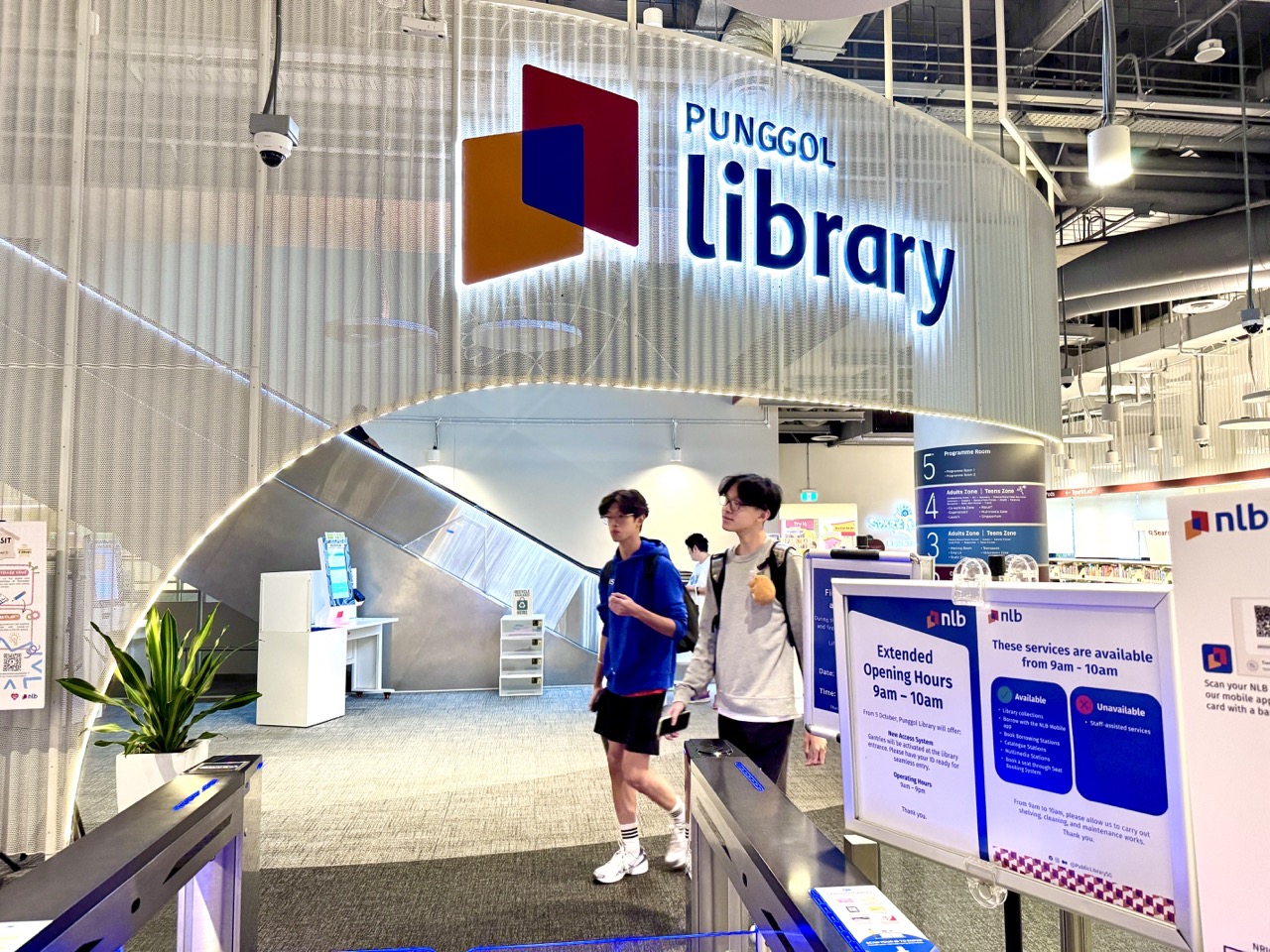
Punggol Regional Library at One Punggol is a practical place to explore age-appropriate books and family reading habits. The library is not a participating MOE Kindergarten in the ninety-minute pilot, but its resources can complement language experiences at home.
Let a child browse illustrated stories and choose one that attracts them. A parent may read aloud, discuss pictures and ask a simple question about a character’s feelings. If the book is beyond the child’s independent reading level, that is not a problem for a shared read-aloud.
Check the National Library Board’s catalogue and current visiting information for available materials and programmes. Do not assume that a particular Mother Tongue title is always on the shelf.
A repeated positive library experience can help children view language as part of life rather than an obligation attached only to school.
Connecting Home Language to Everyday Punggol Life
A neighbourhood provides countless opportunities for language use. The child sees vehicles, trees, shops, food and people involved in ordinary work. A caregiver can describe an object, ask where it is, compare two shapes or retell an event from a walk using appropriate language.
The activity should be safe and natural. Children should not be pushed to practise phrases with strangers or photographed for a language exercise without appropriate consent. A short conversation with a caregiver is enough.
Try revisiting the same vocabulary in different settings. A word used in a picture book about rain can reappear when the family sees wet paths outside. Repetition with variation helps the child connect a term to meaning instead of memorising one fixed sentence.
The child’s own curiosity is a valuable guide. A question about a bus or bird may open a more meaningful exchange than a randomly assigned vocabulary worksheet.
What to Ask When Comparing Preschools
Ask how teachers support listening and speaking, not only how many minutes are allocated to a subject. What materials do they use? Are children invited to speak in groups and individually? How do teachers respond to hesitation and different levels of language confidence?
Ask how families receive feedback. Does the school provide age-appropriate suggestions without implying that parents need to become formal teachers? Is the child engaged in stories, music, games and real communication? How does the school balance language learning with play and the wider curriculum?
For any claimed pilot participation, ask for an official source and the relevant cohort. A centre may offer a good Mother Tongue programme without being part of the specific national research pilot. Those two facts can coexist.
A preschool decision should consider relationships, safety, affordability, logistics and the child’s readiness as well as curriculum features.
What Teachers May Want to Observe
A child who answers after one prompt is showing a different level of confidence from a child who needs several demonstrations. Teachers may notice whether the learner spontaneously uses a phrase, joins group storytelling or can apply a word from a book in another activity.
Meaningful observation also accounts for context. Some children speak comfortably with one familiar adult but hesitate in a large group. Others respond through gestures before using words. Educators can create supportive opportunities without interpreting every quiet moment as a deficiency.
Progress records should guide the next activity rather than turn preschool into high-stakes assessment. The purpose of evaluation is to understand learning and improve teaching.
If difficulties persist across languages and settings, the family can discuss whether additional professional assessment is appropriate, instead of diagnosing a child solely from comparison with the pilot cohort.
The Difference Between More Exposure and More Drilling
Exposure is not simply repeating the same word many times. It can involve hearing that word in a story, responding to a request, seeing the relevant object, using it in play and retrieving it later in a different situation.
Drilling may have a limited role in particular later skills, but a preschool programme needs richer experiences. Young children learn through movement, sensory exploration, social interaction and meaningful repetition.
A family can check the difference by asking what the child can do with the language. If they repeat a sentence only while looking at a card, the learning may be context-bound. If they can use a similar expression when playing, asking for something or explaining an event, the language is becoming functional.
This principle applies even when the child’s school remains on the standard sixty-minute curriculum.
What the Research Cannot Promise Yet
The pilot does not establish a new national requirement that all parents must use Mother Tongue for ninety minutes at home. It does not guarantee that every MOE Kindergarten will extend lessons in 2027. It does not define a new PSLE or Primary 1 examination standard.
It also does not prove that increased daily curriculum time will benefit every child in an identical way. Children’s starting proficiency, home environment, interest and learning needs vary. Any broader implementation should be guided by evaluation and operational planning.
When a future announcement appears, check its effective date, participating institutions, relevant cohorts and practical conditions. Do not treat a politician’s statement about studying a possibility as though it were an implemented enrolment policy.
A good education plan handles present choices accurately while staying open to verified change.
Timeline of the Pilot and Its Future
2025: The initial increase from sixty to ninety minutes begins at MK@Hougang and MK@Elias Park for participating children.
2026: Four additional MKs join, bringing the publicly identified group to six. Researchers and educators study implementation and early outcomes. In August, MOE states that the question of further scaling remains under examination.
2027: This is a future school year as of the review date. Families must not assume a wider rollout or newly included Punggol centres without an official announcement. Verify the actual kindergarten curriculum and enrolment arrangements.
2028 and beyond: Later outcomes and decisions may clarify whether the pilot approach is extended. The policy should be updated only when authoritative information is available, not when an estimate becomes convenient.
The timeline is not a schedule of guaranteed expansion dates.
Common Mistakes to Avoid
‘Ninety minutes applies to every Punggol preschool.’ The cited national programme is a six-centre MOE Kindergarten pilot, not a blanket rule for all local centres.
‘MK@Anchor Green is in Punggol.’ It is a separately named MOE Kindergarten and should not be misidentified as a Punggol campus because it lies in the wider north-east region.
‘A longer language lesson must mean more writing homework.’ The educational emphasis is meaningful exposure and communication, not necessarily additional formal worksheets.
‘Every child will become fluent in one term.’ Learning trajectories differ and the official sources do not support such a guarantee.
‘Encouraging observations mean a 2027 national rollout is confirmed.’ MOE said it was studying whether and how to expand.
‘Parents must abandon English at home.’ Support for Mother Tongue can be added through appropriate routines without erasing natural family communication.
Frequently Asked Questions
How long is the Mother Tongue pilot lesson? The selected MK pilot increases daily Mother Tongue curriculum time from one hour to one and a half hours.
When did it begin? The first two participating MOE Kindergartens began in 2025.
Which are the six pilot centres in 2026? MK@Hougang, MK@Elias Park, MK@Anchor Green, MK@Dazhong, MK@Yishun and MK@Pioneer.
Is a Punggol MOE Kindergarten on that published list? No centre named MK@Punggol appears in the six-centre list reported in 2026. Check any later official changes rather than assuming local participation.
Is the programme compulsory at every MK? The cited increase is a pilot at selected centres. It is not a confirmed nationwide ninety-minute rule.
What happens in 2027? MOE has said it is studying whether and how to expand. An automatic 2027 rollout to additional centres is not established by the cited information.
Must children be able to read Mother Tongue before K1? Do not treat formal independent reading as the sole measure of preschool readiness. Check the kindergarten’s age-appropriate curriculum and admissions rules.
Will thirty extra minutes improve Primary 1 grades? No individual grade improvement is guaranteed. The pilot concerns early language exposure and confidence, and longer-term outcomes require evaluation.
What if the family mainly speaks English? Add manageable, meaningful exposure to the child’s Mother Tongue through stories, conversations and play while respecting the family’s circumstances.
Can a parent who is not fluent help? Yes, through materials, routines and encouragement, while seeking reliable pronunciation and language guidance where needed.
Is this the same as MTL SOAR? No. MTL SOAR is a separate Primary-school reading programme with a progressive rollout to all Primary levels by 2029.
Should I move my child to a pilot kindergarten? That decision requires the whole preschool fit, actual eligibility and places. Do not move a child on the assumption that pilot participation alone makes a centre better for every learner.
Where can I find official updates? Check MOE’s kindergarten guidance and dated policy announcements, and ask the relevant centre for current implementation.
What can we do this week? Choose one enjoyable story and one ordinary family routine in which the child can hear, understand and try a few meaningful Mother Tongue expressions.
Sources and Further Reading
The policy baseline is the MOE Committee of Supply 2025 announcements, which set out the increase and its planned 2026 expansion. The six participating centres and early research context are identified in NIE’s March 2026 report. For the wider 2026 discussion of future scale-up, see MOE’s Mother Tongue Languages Symposium press release. Current general curriculum and admission information remains with MOE Kindergarten.
The Punggol MTL SOAR reading guide covers the separate Primary-school rollout. Families can use the Punggol Education and Town-Life Index for other stage-specific guidance. The immutable Clementi Mathematics learning example demonstrates the wider idea of checking understanding before increasing difficulty, but it is not a preschool Mother Tongue policy document.
The Future Is About Better Language Experiences
A pilot adding thirty minutes to a kindergarten day may seem like a minor timetable change. Its significance lies in testing whether children benefit from more supported opportunities to use a language they may rarely speak elsewhere. The outcome worth seeking is confidence, comprehension and growing independence, not the longest vocabulary list in the neighbourhood.
Punggol parents can act sensibly without predicting a new rule. Choose a suitable current preschool, use official information about pilot participation and give the child regular, enjoyable language experiences at home. When MOE eventually publishes a decision about wider scale-up, evaluate it on its real terms. Until then, the best preparation is to help a child discover that another language can be useful, welcoming and worth speaking.
Information reviewed on 23 October 2026. The six-centre pilot is confirmed from contemporary reporting and official policy statements; any wider post-2026 rollout remains subject to MOE decisions. Teaching examples are illustrative.


