
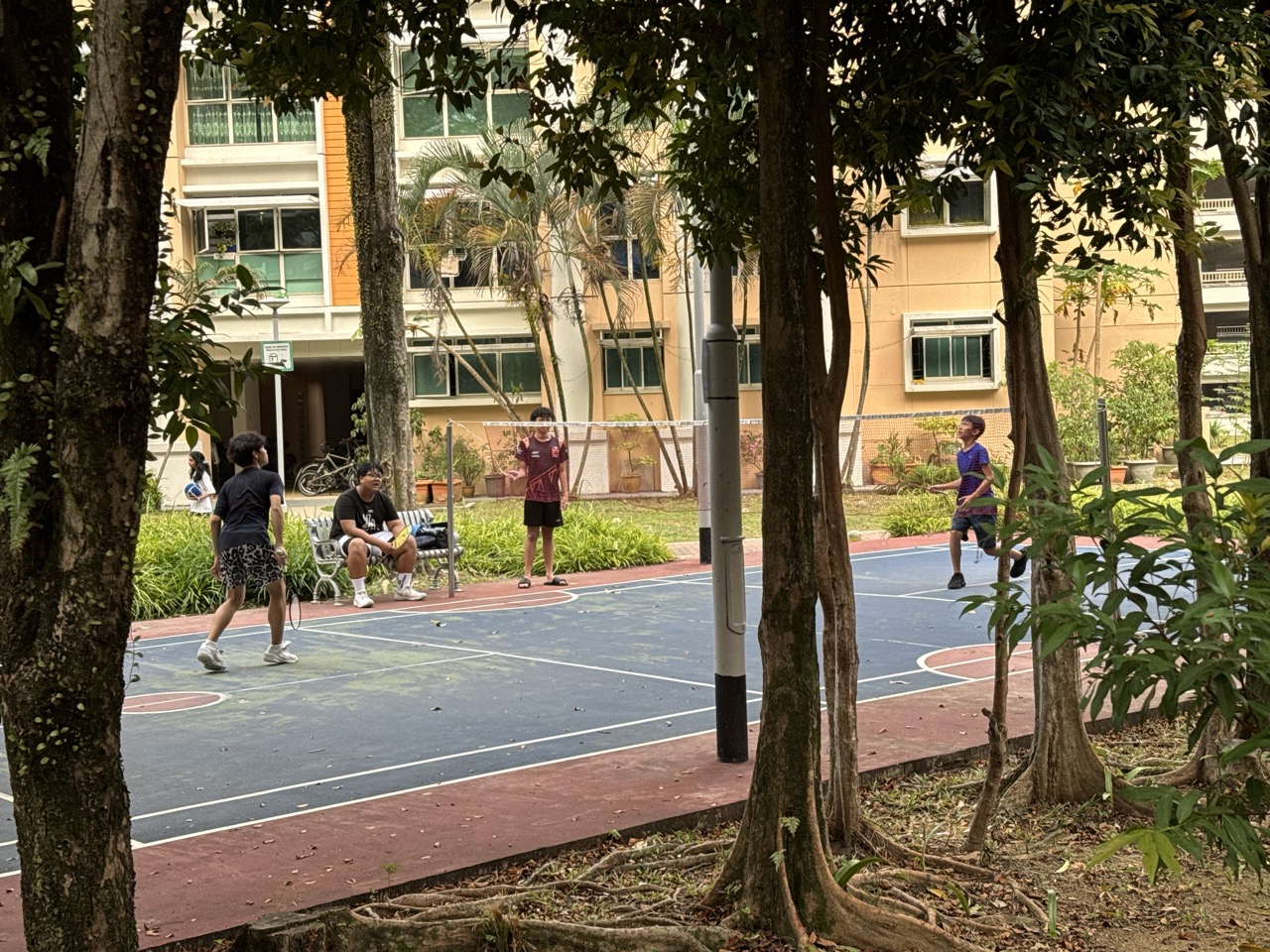
Why does a badminton shuttlecock slow down so quickly—and why does outdoor wind make even an easy return unpredictable? Our new October 2026 photographs from the courts near the Punggol 295 playground show recreational badminton taking place outside. The images invite a useful scientific question: what happens to a lightweight, skirt-shaped object as it moves through air? The answer involves gravity, aerodynamic drag, air movement, racket contact and the difference between a repeatable experiment and an enjoyable casual game.
The key distinction is that a photograph of a badminton game is a starting point for inquiry, not a measurement of shuttle speed, wind or any player’s ability. The same Punggol photo collection contains basketball nearby, which makes a wonderful contrast: a shuttlecock and a basketball are both moving objects, yet their shapes, masses, spin and interactions with air are very different. This science article is separate from our Playground 295 visitor guide, which handles family play and shared-court etiquette.

The science in thirty seconds
- Gravity: pulls a shuttlecock downward throughout its flight.
- Air resistance: opposes its motion relative to the air; for a shuttlecock, aerodynamic effects are especially important.
- Shape matters: the skirt creates a flight behaviour very different from that of a compact ball.
- Speed matters: the standard drag model includes speed squared, with other factors held fixed.
- Wind matters: a moving parcel of air changes the shuttle’s motion relative to the air and therefore its flight.
- Not all tests are fair: changing the racket swing, shuttle type and wind at the same time makes a result difficult to explain.
- Outdoor safety: never conduct a trial near vehicles, crowded playgrounds, active paths or during lightning; use a suitable permitted court.
For physics, the NASA Glenn Research Center drag equation explains how air density, area, drag coefficient and the square of velocity affect aerodynamic drag. For equipment, the Badminton World Federation’s shuttlecock specifications describe the familiar feathered design and acceptable masses. The photographs establish where the activity was seen, not the technical properties of the particular shuttles in play.
What is a shuttlecock actually shaped to do?
A badminton shuttlecock has a comparatively heavy base and an open, high-drag skirt. The classic feathered specification uses 16 feathers attached to the base; synthetic alternatives can imitate the overall flight. That geometry is not decoration. It makes the shuttle behave unlike a compact ball, often slowing sharply and turning its base toward the direction of travel in stable flight.
Ask a child to compare the visible silhouette of a shuttlecock with a tennis ball or basketball. The amount of air flowing around these shapes differs. You cannot prove aerodynamic stability from one still photograph, but the shape invites a testable explanation. For actual BWF law and competition equipment, use the official standard rather than guess from a toy-shop product.
Gravity acts even while the shuttle is rising
A racket can send the shuttle upward, but gravity still pulls it down. If the shuttle rises, its upward motion gradually changes as forces act. Children sometimes think gravity begins only at the top of a trajectory, because that is when the direction reverses. In reality, gravity has acted throughout the ascent.
A simple language exercise helps: separate velocity from force. The shuttle’s velocity can point upward at one moment while the gravitational force points downward. The two are not required to point in the same direction. This prepares older pupils for formal Newtonian mechanics without using the outdoor court as an unsafe demonstration site.
What aerodynamic drag means
Drag is the force exerted by air that opposes an object’s movement relative to the surrounding air. It depends on speed, air properties and shape. NASA’s standard model writes drag as D = 1/2 × Cd × ρ × V² × A. Here V is speed relative to the air, ρ is air density, A a reference area and Cd a drag coefficient that captures more complex flow effects.
The formula is an engineering model, not a statement that every child’s racket swing produces an easily predictable number. A real shuttle may rotate or deform, and its relative air speed changes continuously. The useful first lesson is qualitative: air is not ‘nothing’; it exerts forces on moving objects, and the shuttle’s distinctive shape makes those forces particularly noticeable.
Why speed squared changes the story
In the basic drag equation, holding all other factors constant, doubling the relative air speed makes the drag term four times as large. Tripling it makes the term nine times as large. These are algebraic consequences of the V² term, not measured results from the photographed Punggol match.
Ask a Secondary 2 pupil to compare V=2 with V=4 in a simplified D=kV² model. At V=2 the drag proxy is 4k; at V=4 it is 16k. The ratio is four to one. Then explain what the calculation leaves out: the shuttle’s shape and orientation may change, so k cannot always be treated as truly constant during flight.
Why a shuttlecock can lose speed rapidly
Research on badminton aerodynamics describes unusually large drag and rapid deceleration compared with many other sporting projectiles. The skirt creates a strong resistance to motion. A shuttle that begins fast after a hard hit can slow dramatically before reaching the other side, which helps give badminton its distinctive combination of quick reactions and changing flight.
Do not assume that every shuttle reaches the same speed or follows the same trajectory. Feather and synthetic products can differ, as can temperature, wear, racket action and airflow. An outdoor photograph doesn’t identify the exact product or quantify the deceleration. We can discuss the physical mechanism while leaving unknown values unknown.
Wind is movement of the air, not a mysterious extra push
When wind blows, the air through which the shuttle travels is moving relative to the ground. Aerodynamic drag depends on the shuttle’s motion relative to that air. That means a tailwind, headwind or crosswind can change the trajectory and apparent range of a shot.
A simple outdoor observation may suggest the shuttle drifts in one direction, but one shot cannot establish the wind as the cause. The player might have struck the shuttle at a different angle. A careful explanation considers both possibilities and avoids blaming wind for every mishit. For actual play, outdoor gusts make repetition harder than in controlled indoor conditions.
Headwind and tailwind are not interchangeable
A headwind is air moving against the shuttle’s general forward direction; a tailwind moves broadly along it. Relative air speed can differ between these cases, changing drag and trajectory. The actual result also depends on the shuttle’s orientation, the player’s stroke and wind variability.
An older child can draw arrows for shuttle motion and wind. The direction of the velocity relative to air is the shuttle’s ground velocity minus the air’s ground velocity, considered as vectors. You do not need to solve the full aerodynamic equation to understand the idea. Use a sketch first and keep numerical problems clearly hypothetical.
Crosswind makes accuracy a different challenge
A crosswind can push the shuttle’s flight laterally relative to its intended path. The player may react by changing aim or timing, but that adjustment introduces another variable. The effect differs from simply hitting the shuttle harder. Real conditions can vary from moment to moment, particularly outdoors among buildings.
One photo of a badminton court cannot show a breeze’s speed or direction. If the goal is to measure wind, use appropriate instruments or official observations, and record the time and location. If the goal is only an enjoyable game, the simplest response is to accept that outdoor rallies are less predictable and adjust play without turning the court into a laboratory.
Why badminton differs from basketball
A basketball is much larger and heavier than a shuttlecock, and its compact rounded shape responds differently to air. Gravity affects both, and air can act on both. The difference is not that basketball has ‘no drag’; it is that the effects of shape, mass, speed and spin lead to different trajectories and practical experiences.
The photograph collection includes basketball and badminton at nearby courts, giving students a natural comparison. But an image cannot establish which player is stronger or which sport is harder. The science question should focus on physical properties and movement, not a ranking of the people shown.
Mass and the same force are not the same as acceleration
Newton’s second law tells us acceleration equals net force divided by mass. If two objects experience the same net force, the less massive object would undergo the larger acceleration. But in real sport, the forces acting on differently shaped objects are not necessarily equal. It would be inaccurate to explain every flight difference with mass alone.
A useful worksheet can present an explicitly fictional case: a 0.02-newton net force acting on a 0.005-kilogram object gives an acceleration magnitude of 4 metres per second squared. This is not a measured shuttlecock force. The calculation shows how units and variables relate, while the discussion reminds students not to substitute an imaginary number for field evidence.
Why the court photograph is not a motion-tracking dataset
A still image freezes one instant. It does not include the shuttle’s position before and after the frame, the actual time interval or a calibrated scale. Without those, a reader cannot calculate a trustworthy velocity, acceleration or launch angle. Perspective can also distort apparent distances.
If a student wishes to study motion properly, they need consent, a safe location, suitable frame-rate video and a clear method. They should avoid filming identifiable strangers without permission. An ordinary family photograph is perfect for generating questions and demonstrating context; it is not secretly a scientific instrument.
What an honest observation sounds like
‘Two people are playing badminton on an outdoor court’ is a grounded description of the image metadata. ‘The shuttlecock was blown left by a strong crosswind’ is not grounded unless airflow and the flight were independently observed. ‘Wind might affect outdoor badminton’ is a valid general physical statement.
Teaching children to separate these three levels—description, hypothesis and established principle—is one of the strongest lessons the photographs can provide. The quality of an explanation lies as much in accurate evidence language as in remembering physics vocabulary.
Testing one variable at a time
Suppose a family wants to compare how different shuttle designs behave. They should try to keep player, racket, approximate stroke, space and weather as consistent as practical. Change the type of shuttle, record repeated results and consider whether the differences are larger than natural variation between hits. It is a simple experimental-design idea, not a certified aerodynamic test.
If the breeze is gusty or the player cannot repeat the motion, the results may not be conclusive. That does not make the exercise useless. Students can learn to identify sources of error and say ‘we could not isolate the variable’. This is better science than forcing an impressive conclusion from weak data.
Why repeated trials matter
One shot can be unusually high, low or off-centre. Repeating a safe trial gives a better picture of the range of outcomes. You may calculate a mean or median, but the statistic only describes your actual observations; it doesn’t magically remove all bias or confounding variables.
A family could record five short, controlled practice attempts in an appropriate private or permitted area rather than stage a formal experiment in a busy public court. If the court is occupied or conditions are unsuitable, defer the activity. Other people’s recreation takes priority over an unsolicited science demonstration.
Choosing what to measure
Distance travelled, time in flight, landing position and number of successful rallies are different measures. A student must select one based on the question. If the question is whether wind changes landing position, the number of rallies may be a poor proxy because player skill changes the result. If the question is beginner cooperation, rally count might be more meaningful.
Write a simple operational definition before gathering data. For instance, ‘landing location’ may be the closest marked court grid to where the shuttle first touches the ground. But ensure the method is safe, appropriate and not disruptive. A clearly defined simple measure beats an elaborate unexplained number.
Mean and range from a hypothetical five-shot trial
Imagine a fictional experiment records landing distances of 4.0, 4.5, 4.2, 4.8 and 4.5 metres. Their sum is 22.0 metres, the mean is 4.4 metres and the range is 0.8 metres. These values are teaching data, not measurements taken in Punggol.
Ask the student what the mean represents and why two groups could have the same mean but different ranges. If one player’s attempts are highly variable, a single average may hide the inconsistency. This connection makes statistics relevant without misrepresenting the photo archive as a dataset.
A fair comparison needs comparable conditions
If you compare two shuttles under different gusts, you may attribute a difference to equipment when weather caused part of it. If one player changes the racket swing or position between sets, the interpretation becomes weaker still. Fair testing is about recognising such limitations and designing a manageable comparison.
A child who says ‘we do not know’ after identifying several uncontrolled factors has made a valid scientific judgement. There is no need to manufacture certainty for a school activity. The goal is evidence-based reasoning, not presenting a local game as a published research experiment.
The question of feathers versus synthetic shuttles
BWF laws specify properties of feathered shuttles and permit synthetic designs with broadly similar intended flight characteristics under their rules. In informal recreation, people may choose different products for durability, price or availability. But this article doesn’t identify the type in the photo or rank a particular brand.
For an educational comparison, examine the materials, skirt shape and base. Ask how these features might change stability and drag, then test appropriately if safe. The proper conclusion depends on what you actually observe and on the conditions, not on assumptions that one material must always be superior.
Why an outdoor court is not a wind tunnel
A laboratory wind tunnel controls airflow so researchers can isolate aerodynamic variables. An outdoor neighbourhood court has gusts, buildings, players, movement and changing weather. You cannot reproduce controlled research merely by standing at one spot and hitting a shuttle repeatedly.
That doesn’t make outdoor observation worthless. It offers a realistic example of why scientists design controlled tests. The court provides context for asking questions, while reliable scientific references such as NASA explain general principles. Students should know which claims come from controlled evidence and which are local observations.
The role of the racket and timing
A shuttle’s trajectory also depends on the force and angle transferred by the racket, as well as where contact occurs. Players may deliberately hit high clears, low drives or short net shots, producing very different flights. If we don’t know the stroke, we cannot attribute a pictured trajectory solely to drag or wind.
Older children can describe a qualitative cause-and-effect chain: racket contact changes the shuttle’s velocity; gravity and air forces alter it during flight; the shuttle reaches another player or the ground. This sequence is more accurate than the slogan ‘wind makes it fall’.
Outdoor game safety before scientific curiosity
A badminton racket needs room to swing, and a shuttle can travel into a neighbouring path. Always use a suitable, available court for actual play. Keep spectators outside active areas and avoid conducting experiments near roads, toddlers, cyclists or other groups. Observe any facility booking or access notices.
If surfaces are wet or lightning threatens, do not play merely to collect data. Stop, follow weather guidance and return on a more suitable day. An unsuccessful field session is better than an avoidable accident. Research does not override the rights or safety of other court users.
Why the photo does not prove the court is open today
The October 2026 pictures show people using a court near Playground 295 when photographed. They do not establish present booking rules, reserved hours, surface condition or official access. A game recorded once is not a permanent guarantee of availability.
Our separate Playground 295 family guide covers the site-specific cautions. For structured badminton activities, check the responsible booking system or operator rather than relying on a media-library title.
What younger children can notice safely
For an early primary child, the simplest learning question is which objects look different and why. Compare a shuttlecock, a ball and a leaf while remaining in a safe observation area. Ask which is light, which is round and which seems most affected by the breeze. Avoid demanding scientific vocabulary before the child has described what they notice.
A caregiver can say ‘The shuttle has a wide skirt that pushes against the air’ without requiring the child to memorise the drag equation. Enjoyable curiosity is a good beginning. If the child would rather watch a rally or play a suitable game, let the outing remain pleasant.
A Primary 4 science explanation
Primary pupils can practise the idea that forces affect moving objects. Describe how a racket applies a contact force and how gravity acts continuously. Air resistance can be discussed in age-appropriate terms, with careful distinction between what was observed and what the science explains. Avoid claiming a particular exam topic solely from a photograph.
A short learning activity might involve drawing arrows on a picture of a shuttle in flight: one representing gravity and another representing air resistance opposite its motion relative to air. The direction of drag changes with the flight; do not draw a permanently fixed drag arrow without considering velocity.
A Secondary 2 algebra problem about drag
Let D=kV² for a simplified constant k. If drag has a value of 3 arbitrary units at speed V, what is it at 2V? It becomes 12 units, four times as large. At half the speed, it becomes 0.75 units, one quarter as much. The questions test proportional relationships rather than actual measurements.
Students must explain that k includes assumptions about air, shape and orientation. The shuttle’s real flight may be much more complex. Stating the domain of a model is part of strong mathematical reasoning. A formula only becomes useful when its variables are defined.
A Secondary 3 physics discussion
More advanced learners can compare gravitational force mg with drag proportional to V². The shuttle experiences a net force depending on its motion and surrounding air. As the shuttle slows, the drag term may decrease, though its orientation and the airflow field can also change. It is a dynamic system rather than a uniform acceleration problem.
Keep calculations at a level appropriate to the syllabus, and distinguish a conceptual model from a complete aerodynamics simulation. For students seeking greater depth, NASA’s drag and falling-object explanations provide reputable entry points. Avoid inventing numerical drag coefficients for the pictured equipment.
Why an outdoor breeze is hard to measure by looking
A small movement in leaves or clothing suggests air motion but cannot reliably quantify the flow at the shuttle’s precise location. Wind can vary with height, between buildings and from one moment to the next. A player may also produce airflow by moving. The conditions at ground level need not match conditions higher in a shuttle’s arc.
Students who want quantitative measurements should choose an appropriate instrument and method, note its limitations and record observations safely. A single image is not enough. If the available evidence only supports ‘conditions were outdoors’, that is an acceptable and accurate observation.
An ethics note about photographing sport
The new pictures include identifiable public activity, but they do not give permission to label the players by name, skill, occupation or school. A responsible article can show a wide court scene and explain the science without making personal claims about the people in it.
If you are filming your own physics trial, secure appropriate consent from participants and avoid recording other court users or minors unnecessarily. Do not block a walkway or direct a camera at a child to make the video more dramatic. Good data ethics and good scientific practice belong together.
What a family could do at home instead
An indoor paper experiment can illustrate drag without requiring a public court. Drop two equally sized sheets of paper, with one crumpled, from a safe small height and observe differences in falling behaviour. The sheets have similar mass but different shapes and projected areas. Keep the drop away from children who might trip over the setup.
This is an illustration of air resistance, not an exact model of shuttlecock aerodynamics. Younger children can describe what they see; older ones can identify the changed variable and possible sources of error. Connecting the home activity to the Punggol court photo makes the learning concrete without disrupting players.
A better question than ‘Who hit harder?’
A shuttle travelling farther in one rally does not prove one player exerted more force. Contact angle, wind, shuttle type and trajectory all matter. Likewise, a faster-looking movement in a still photograph is not a speed measurement. Respect the uncertainty.
A scientifically useful question is ‘Which variables would we need to control to compare the strokes fairly?’ This shifts attention from judging people to understanding evidence. A family can have that conversation simply and respectfully after watching a game.
Three key takeaways from Punggol’s outdoor courts
First, the shuttle’s shape and very low mass make aerodynamic forces important. Second, outdoor airflow means two apparently similar hits may produce different outcomes. Third, good conclusions require an appropriate test, repeated observations and an honest account of variables. These principles are supported by physics, even though the Punggol photograph supplies only a scene.
Use the photo as a gateway to learning rather than pretending it provides lab-grade data. The court is a place for sport before it is a teaching aid; visit and play only where allowed, observe safely and thank the people whose public recreation makes the neighbourhood lively.


Frequently asked questions
Why does a shuttlecock slow down so quickly?
Its skirt creates substantial aerodynamic drag. Shuttlecock flight is strongly influenced by air resistance.
Does gravity stop acting when the shuttle rises?
No. Gravity acts downward throughout the flight.
Why does wind affect outdoor badminton?
Wind changes the air motion relative to the shuttle and therefore changes aerodynamic forces and flight.
Does wind always make the shuttle go farther?
No. Direction and strength matter, as do the stroke, shuttle orientation and surrounding conditions.
What is drag?
A force associated with an object moving relative to a fluid such as air.
Does drag increase with speed?
Under the familiar fixed-coefficient model it varies with the square of relative speed, with other variables held constant.
Is the shuttlecock in the photographs feathered or synthetic?
That product detail is not independently verified in this photo set.
Does badminton use 16 feathers?
The BWF’s standard feathered shuttlecock specification uses 16 feathers fixed in the base.
Can I measure shuttle speed from one picture?
No. Reliable motion analysis needs calibrated distance and time information, often over several frames.
Does basketball have no air resistance?
It has air resistance too; the effects differ because of the ball’s shape, mass, speed and spin.
Can children conduct an experiment at this court?
Only if the court is appropriately available and the experiment is safe, permitted and non-disruptive. A home demonstration may be better.
What is a fair test?
A comparison designed to change one target factor while controlling other relevant factors as well as reasonably possible.
Why repeat a trial?
Repeated trials help reveal variability and reduce the danger of drawing a conclusion from one unusual result.
Can I play during rain or lightning?
Do not continue outdoor sport during lightning; wet surfaces may also be unsafe. Follow current warnings and facility rules.
Is Playground 295’s badminton court always available?
No constant availability is established here. Read on-site rules and verify any bookings.
What Maths links to shuttle flight?
Proportion, square relationships, statistics, charts and simple modelling.
What Science links to shuttle flight?
Gravity, contact forces, air resistance, motion, forces and experimental design.
What should a parent ask after a game?
Try ‘What changed between those two shots?’ and ‘How could we check that explanation?’
Can I film strangers to analyse their strokes?
Seek appropriate consent and respect others’ privacy and the rules of the venue.
Is this a replacement for coaching?
No. It is a physics and learning guide, not an individual training or medical programme.
Trusted science and Punggol reading
- NASA Glenn — Drag Equation.
- NASA Glenn — Falling Object with Air Resistance.
- BWF — Shuttlecock Equipment Overview.
- Published Science of Badminton review (research compilation).
- Playground 295 Punggol: Basketball, Badminton and Family Play.
- Air Resistance and Drag — Science Explained.
- Punggol in Pictures — October 2026
Photography and research note, 23 October 2026. New eduKatePunggol images show outdoor badminton near a neighbourhood playground. Scientific principles are sourced to NASA and BWF. Any numerical exercise is a hypothetical classroom model, not a measurement of the players, shuttle or wind in the photographs. Sport and field testing remain subject to current weather, venue rules, supervision and consent.


