
The first batch of flats in Punggol 21 was offered under the Housing & Development Board’s Registration for Flats System on 1 April 1998. A Straits Times report on 2 April described around 800 flats, predominantly four-room and five-room units, available that quarter to households at the head of the dedicated Punggol 21 queue.
This was a sales and allocation milestone, not the day the whole new town was complete. HDB’s 1998–1999 annual report expected the first new Punggol 21 homes to be completed in 2000/2001. The larger housing programme unfolded over years and was affected by economic conditions.
For readers looking up the beginnings of Punggol 21, 1998 HDB flats, the first housing launches or the old flat-registration queue, the essential distinction is 1996 planning vision → April 1998 first offer → 2000 onward first completed public housing → later expansion.
Find the answer you need
- Exactly what the 1998 announcements recorded
- The promise preceded the sale by nearly two years
- Why the first sale was a distinct event
- What the Registration for Flats System meant
- The importance of a dedicated Punggol 21 queue
- Why mostly four- and five-room flats mattered
- What 800 flats does and does not measure
- A newspaper clipping needs its publication date
- What HDB thought the completion horizon would be
- The Asian financial crisis was already changing the economy
- Construction had a different rhythm from national announcements
- The first buyers faced a town still being built
- Why old prices should not be invented from current flats
- Punggol 21 and Punggol 21 Plus were not simultaneous
- How the first estate differs from the older coastal settlement
- An education example: turning a source into a timeline
- A mathematics example: calculate but do not overstate
- What can a 2026 photograph of Punggol prove?
- What still needs more detailed archival checking
- Frequently asked questions
- Read the documentary evidence
Exactly what the 1998 announcements recorded
HDB’s annual report calendar lists the offer of the first batch of Punggol 21 flats on 1 April 1998 under the Registration for Flats System (RFS). A newspaper report dated the next day makes the milestone tangible: approximately 800 apartments were on offer that quarter, mainly four-room and five-room types.
One source is an institutional retrospective calendar; the other is a near-contemporaneous news account. Together they establish the event without implying that all 800 homes were built or occupied on 1 April. The distinction between offering units and occupying them is critical to interpreting the new town’s timeline.
The promise preceded the sale by nearly two years
The national Punggol 21 vision was presented in 1996 as a future waterfront town. It linked ambitious residential planning with recreation, a modern town centre and access to water. Those planning visuals did not immediately place new homes or amenities on the ground.
By April 1998, the story had moved from a proposal to a buying opportunity. The gap is not evidence that nothing had happened between; planners, engineers and housing agencies had been working on land, design and future public facilities. The 1996 brochure history explains how a proposed town was introduced to the public.
Why the first sale was a distinct event
A plan is an intention, while a flat offer is an invitation for eligible households to buy within a specified allocation scheme. The opening of a sales batch requires actual project definition and pricing arrangements, even though its homes may still be under construction.
This difference helps families understand public housing more generally. The launch of a new town is not synonymous with the launch of every block in it. Construction, flat selection, keys, moving in and access to nearby services each have their own dates.
What the Registration for Flats System meant
RFS was HDB’s allocation approach for applicants waiting to be offered new flats. The 1998 article referred specifically to people in the dedicated Punggol 21 queue, indicating that this neighbourhood had an identifiable pool of intending buyers.
It should not be rewritten as an application under a modern BTO exercise. The later Build-To-Order system operated on different principles. Our December 2002 Punggol BTO history describes a later stage in housing allocation, not the scheme used for this first 1998 offer.
The importance of a dedicated Punggol 21 queue
People in the Punggol 21 queue had already identified a wish to live in the projected town. The April 1998 invitation gave selected households a more concrete opportunity to act on that interest.
The queue did not guarantee that every registered family received a flat in the first batch. It is inappropriate to convert ‘800 on offer’ into ‘800 successful buyers’ without documentation of take-up, cancellations and individual selections.
Why mostly four- and five-room flats mattered
The newspaper identified the first batch as mainly four-room and five-room units. That is a useful clue about the housing mix initially marketed to families, but it does not specify the exact number of each type.
Avoid a tempting but invalid calculation: the phrase ‘mainly four- and five-room’ does not support an invented split of 400 each. Nor does it prove that no other flat types were available in Punggol 21 at any later date. The early mix is evidence about one batch.
What 800 flats does and does not measure
Eight hundred is a supply figure associated with the reported offer. It is not a verified count of households already living in the estate, a census number or a measure of the number of bedrooms built.
To illustrate why the distinction matters, imagine a wholly hypothetical project of 800 flats with an illustrative take-up rate of 75%. The multiplication 800 × 0.75 = 600 is mathematically valid as a classroom exercise, but 600 would not be a historical Punggol outcome without a recorded take-up rate. The example must never be published as a fact about 1998.
A newspaper clipping needs its publication date
The relevant Straits Times coverage was published on 2 April 1998. It reported a housing offer taking place in that quarter. The newspaper’s date and the HDB calendar’s 1 April entry are consistent but not interchangeable.
A headline containing ‘first’ identifies the first batch of Punggol 21 flats, not the first HDB flats ever anywhere in the larger historic Punggol area. Older rural-centre housing had existed before the new-town scheme.
What HDB thought the completion horizon would be
HDB’s 1998–1999 report stated that the first Punggol 21 flats were expected to be completed in 2000/2001. That is a forward-looking completion estimate recorded after the early sale, not a separate promise about the exact key-collection date of each flat.
A later account records the first public housing project in Punggol as completed in 2000. These documents can be reconciled by distinguishing an estimated completion range from the first finished project; they do not imply every 1998 offered unit reached completion together.
The Asian financial crisis was already changing the economy
The 1997 Asian financial crisis affected the wider regional economic climate and contributed to Punggol’s slower development. The April 1998 sale took place against that backdrop, even as planning for the first neighbourhoods progressed.
A careful account does not attribute a specific household’s decision to buy or defer to the crisis without personal evidence. Nor should the downturn be presented as the only reason for every subsequent change in Punggol. For a broader chronology, read why the Punggol 21 build-out slowed.
Construction had a different rhythm from national announcements
Punggol was not created through one ribbon-cutting. Architects, contractors, transport planners and utilities providers worked on overlapping schedules. HDB’s report describes the need to coordinate institutional facilities and infrastructure as future homes came forward.
In history writing, distinguish the planning blueprint of 1996, HDB’s April 1998 offer, the project’s first completion and the growth of local services in the early 2000s. The more precisely those stages are dated, the better a reader can understand how a new town actually develops.
The first buyers faced a town still being built
An early buyer was considering housing in a place whose promised future facilities had not yet all arrived. The practical questions may have included future transport, schools, convenience and the timing of relocation from an existing home.
This is a general inference about buying into an emerging town, not a quotation from a specific buyer. Without a household interview we cannot report that an individual considered a particular school or priced a particular bus journey.
Why old prices should not be invented from current flats
The 2 April 1998 report excerpt establishes unit numbers and types; it does not provide a full price schedule for every offered flat in the material relied on here. If historic prices are needed, consult the relevant complete HDB sales document.
Today’s BTO and resale prices cannot be back-calculated into accurate 1998 prices simply by subtracting inflation. Location, flat size, subsidies, tenure and estate maturity vary, so the comparison must use actual records and state what is being measured.
Punggol 21 and Punggol 21 Plus were not simultaneous
The 1998 offer belongs to the original Punggol 21 stage. Punggol 21 Plus, associated with the waterway-focused redevelopment strategy, was announced in 2007. Treating waterway projects and later amenities as things already offered to the first batch of buyers would compress more than a decade of history.
This temporal separation is useful for explaining why early residents may recall extensive building works. A locality can have a named vision long before every major feature of that vision is accessible to families.
How the first estate differs from the older coastal settlement
Long before the new-town sales, the wider area had fishing villages, farms, coastal businesses and some earlier housing. The 1998 HDB offer marked the new planned housing phase, not the start of human settlement at Punggol.
Readers should hold both histories together. A celebratory ‘first’ about the new town is historically valid when its scope is clear, but false when it erases the people who lived and worked in the place before planned redevelopment.
An education example: turning a source into a timeline
For a secondary-school history exercise, give students four evidence cards: the 1996 plan, the 1 April 1998 HDB annual-calendar entry, the 2 April newspaper report and an official account of completion around 2000. Ask what happened in each.
The model answer should use different verbs: ‘announced’ or ‘presented’ for the plan, ‘offered’ for the 1998 batch, and ‘completed’ for the first built housing. Historians choose precise verbs because they preserve how one event differs from another.
A mathematics example: calculate but do not overstate
Eight hundred flats is a count, and a four-room flat type is a formal category. It is not sound to multiply 800 by four to estimate bedrooms, occupants or household population because a ‘four-room’ label does not mean four bedrooms or four residents.
A better exercise asks students to describe what additional data would be required to find the number of buyers, the fraction of four-room flats or the number of occupants at move-in. The lesson is as much about insufficient information as it is about arithmetic.
What can a 2026 photograph of Punggol prove?
A photograph of current HDB towers demonstrates how the town looks decades after its first launches. It does not identify a particular block as one of the original 800 unless linked to the relevant development records.
For before-and-after comparisons, label each image’s date and location. The later picture is a useful visual aid, but it should never be captioned as an authentic 1998 sales or construction photograph.
What still needs more detailed archival checking
The two main sources do not independently establish exact prices for every unit, the full list of blocks offered, how many households eventually booked or the precise key-collection date of every development. Those are useful follow-up questions for specific project brochures and HDB records.
Rather than guessing, a sound local history identifies this evidence boundary openly. A precise milestone is more useful than a long account that fills unknowns with invented detail.
Frequently asked questions
When were the first Punggol 21 flats offered? HDB’s calendar says 1 April 1998. How many? A 2 April newspaper report says around 800 that quarter. What types? Mainly four-room and five-room flats. Were all 800 occupied in April? No; they were on offer, with construction and completion to follow.
Was this a BTO launch? The 1998 first offer was under RFS; Punggol BTO exercises came later. Was this the opening of the entire town? No. Were the waterway and Punggol 21 Plus already open? No; those were later developments.
Read the documentary evidence
Consult the HDB 1998–1999 Annual Report for the calendar entry and expected 2000/2001 completion horizon, the 1997–1998 Annual Report for the separate Punggol 21 queue and related allocation background, and NewspaperSG’s 2 April 1998 issue of The Straits Times for the first-batch report.
The National Heritage Board Punggol history places construction and delays in the wider chronology. Continue through our Punggol history directory. The central fact remains simple: in April 1998, a planned Punggol began turning into a place where families could choose a new home.
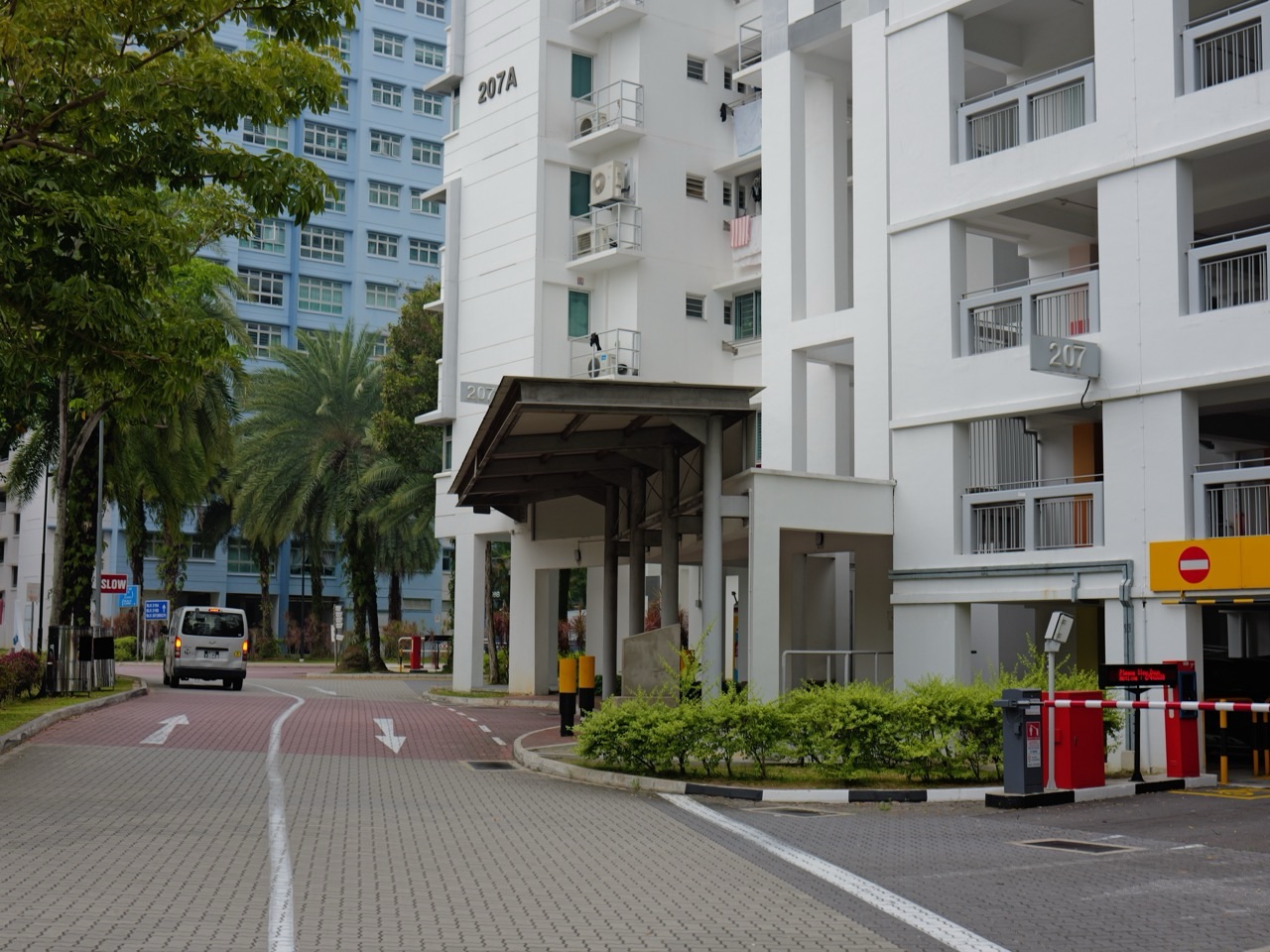
Featured photo: Punggol HDB housing photographed decades after the 1998 sale. It illustrates the later built town and does not purport to show one of the original 800 offered flats.


