
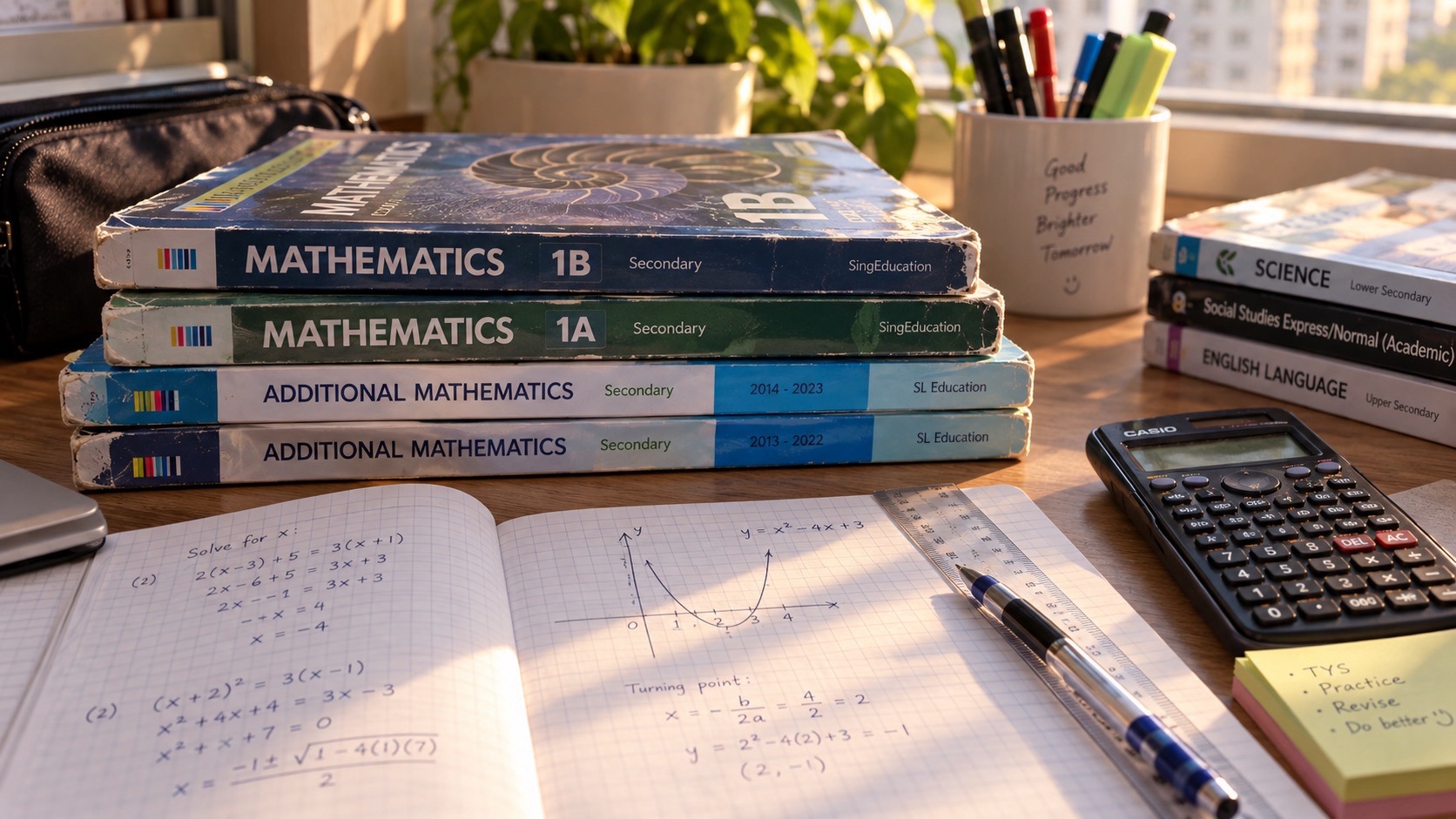
Quick answer. Understanding geometric measures through diagrams, units and physical meaning. For Punggol families, the correct starting point is the student’s actual Singapore school level, the current MOE Mathematics learning outcomes, and the first incorrect reasoning step. Good teaching makes the meaning of each quantity visible, uses an appropriate representation, checks units, and tests a new question independently. This guide connects practical home learning with the wider Primary-to-university Mathematics education pathway.
A learner who can reproduce a familiar solution has not necessarily mastered its mathematical structure. A stronger demonstration is to explain why a step works, compare a tempting incorrect method, and solve a changed problem several days later. The examples here are original learning illustrations, not official examination questions or promises of a PSLE, SEC or A-Level grade.
Reviewed 22 October 2026. This is a reader’s educational reference. School offerings and assessments are determined by current MOE, SEAB and the student’s own institution. Age-appropriate support and individual needs take precedence over rushing into harder chapters.
Find the right Mathematics concept
- 1. Length and unit conversion
- 2. Perimeter of rectangles
- 3. Area of rectangles
- 4. Area of triangles
- 5. Composite areas
- 6. Area versus perimeter
- 7. Volume of cuboids
- 8. Capacity and litres
- 9. Square and cubic units
- 10. Parallel and perpendicular
- 11. Angles in triangles
- 12. Angles on a straight line
- 13. Angles around a point
- 14. Symmetry
- 15. Nets and solids
- 16. Scale drawings
- 17. Pythagoras as later extension
- 18. Similar shapes as later extension
- 19. Coordinate geometry
- 20. A measurement error log
1. Length and unit conversion
Understand the idea. Length and unit conversion is best understood through the quantities, conditions and relationships in a problem, not a memorised keyword. Begin by naming what is known, what must be found, and what unit or mathematical object the answer represents. At Primary level, use objects, bars, tables and clear language; at Secondary level, connect the same structure to equations and graphs. For advanced learners, state assumptions and test whether the conclusion still holds when conditions change.
Original worked reasoning. Consider 2 equal groups containing 3 items each. The total is 6 items because 2 × 3 = 6. If the total and group count are given instead, divide 6 by 2 to recover 3 items per group. This simple relationship can be represented by an array, a labelled bar or an equation. For length and unit conversion, extend the same disciplined approach: identify the mathematical object, select the correct representation, calculate, and interpret the result in the original context.
What a wrong answer may reveal. A learner may add 2 and 3 merely because two numbers appear, or calculate 6 but label the result as groups rather than items. In length and unit conversion, analogous errors occur when a reference whole, measurement dimension, graph scale or assumption is ignored. The first invalid decision matters more than the final red cross; a correct arithmetic step applied to the wrong quantity is still an interpretation error.
Repair and independent transfer. Ask the student to draw or describe the relation, explain why the chosen operation applies, and check the original values. Then change the group count to 3, keeping 3 items in each group: the new total is 9. The child should reconstruct that result without looking at the first solution. For length and unit conversion, use a fresh level-appropriate question from the actual school topic and test again after a short delay.
Parent and teacher check. Record whether the pupil could begin without a hint, use accurate mathematical vocabulary, justify the model, complete calculations and explain units or assumptions. If they needed support, describe the support precisely. Avoid a permanent label such as weak at Mathematics and choose one attainable next step.
2. Perimeter of rectangles
Understand the idea. Perimeter of rectangles is best understood through the quantities, conditions and relationships in a problem, not a memorised keyword. Begin by naming what is known, what must be found, and what unit or mathematical object the answer represents. At Primary level, use objects, bars, tables and clear language; at Secondary level, connect the same structure to equations and graphs. For advanced learners, state assumptions and test whether the conclusion still holds when conditions change.
Original worked reasoning. Consider 3 equal groups containing 4 items each. The total is 12 items because 3 × 4 = 12. If the total and group count are given instead, divide 12 by 3 to recover 4 items per group. This simple relationship can be represented by an array, a labelled bar or an equation. For perimeter of rectangles, extend the same disciplined approach: identify the mathematical object, select the correct representation, calculate, and interpret the result in the original context.
What a wrong answer may reveal. A learner may add 3 and 4 merely because two numbers appear, or calculate 12 but label the result as groups rather than items. In perimeter of rectangles, analogous errors occur when a reference whole, measurement dimension, graph scale or assumption is ignored. The first invalid decision matters more than the final red cross; a correct arithmetic step applied to the wrong quantity is still an interpretation error.
Repair and independent transfer. Ask the student to draw or describe the relation, explain why the chosen operation applies, and check the original values. Then change the group count to 4, keeping 4 items in each group: the new total is 16. The child should reconstruct that result without looking at the first solution. For perimeter of rectangles, use a fresh level-appropriate question from the actual school topic and test again after a short delay.
Parent and teacher check. Record whether the pupil could begin without a hint, use accurate mathematical vocabulary, justify the model, complete calculations and explain units or assumptions. If they needed support, describe the support precisely. Avoid a permanent label such as weak at Mathematics and choose one attainable next step.
3. Area of rectangles
Understand the idea. Area of rectangles is best understood through the quantities, conditions and relationships in a problem, not a memorised keyword. Begin by naming what is known, what must be found, and what unit or mathematical object the answer represents. At Primary level, use objects, bars, tables and clear language; at Secondary level, connect the same structure to equations and graphs. For advanced learners, state assumptions and test whether the conclusion still holds when conditions change.
Original worked reasoning. Consider 4 equal groups containing 5 items each. The total is 20 items because 4 × 5 = 20. If the total and group count are given instead, divide 20 by 4 to recover 5 items per group. This simple relationship can be represented by an array, a labelled bar or an equation. For area of rectangles, extend the same disciplined approach: identify the mathematical object, select the correct representation, calculate, and interpret the result in the original context.
What a wrong answer may reveal. A learner may add 4 and 5 merely because two numbers appear, or calculate 20 but label the result as groups rather than items. In area of rectangles, analogous errors occur when a reference whole, measurement dimension, graph scale or assumption is ignored. The first invalid decision matters more than the final red cross; a correct arithmetic step applied to the wrong quantity is still an interpretation error.
Repair and independent transfer. Ask the student to draw or describe the relation, explain why the chosen operation applies, and check the original values. Then change the group count to 5, keeping 5 items in each group: the new total is 25. The child should reconstruct that result without looking at the first solution. For area of rectangles, use a fresh level-appropriate question from the actual school topic and test again after a short delay.
Parent and teacher check. Record whether the pupil could begin without a hint, use accurate mathematical vocabulary, justify the model, complete calculations and explain units or assumptions. If they needed support, describe the support precisely. Avoid a permanent label such as weak at Mathematics and choose one attainable next step.
4. Area of triangles
Understand the idea. Area of triangles is best understood through the quantities, conditions and relationships in a problem, not a memorised keyword. Begin by naming what is known, what must be found, and what unit or mathematical object the answer represents. At Primary level, use objects, bars, tables and clear language; at Secondary level, connect the same structure to equations and graphs. For advanced learners, state assumptions and test whether the conclusion still holds when conditions change.
Original worked reasoning. Consider 5 equal groups containing 6 items each. The total is 30 items because 5 × 6 = 30. If the total and group count are given instead, divide 30 by 5 to recover 6 items per group. This simple relationship can be represented by an array, a labelled bar or an equation. For area of triangles, extend the same disciplined approach: identify the mathematical object, select the correct representation, calculate, and interpret the result in the original context.
What a wrong answer may reveal. A learner may add 5 and 6 merely because two numbers appear, or calculate 30 but label the result as groups rather than items. In area of triangles, analogous errors occur when a reference whole, measurement dimension, graph scale or assumption is ignored. The first invalid decision matters more than the final red cross; a correct arithmetic step applied to the wrong quantity is still an interpretation error.
Repair and independent transfer. Ask the student to draw or describe the relation, explain why the chosen operation applies, and check the original values. Then change the group count to 6, keeping 6 items in each group: the new total is 36. The child should reconstruct that result without looking at the first solution. For area of triangles, use a fresh level-appropriate question from the actual school topic and test again after a short delay.
Parent and teacher check. Record whether the pupil could begin without a hint, use accurate mathematical vocabulary, justify the model, complete calculations and explain units or assumptions. If they needed support, describe the support precisely. Avoid a permanent label such as weak at Mathematics and choose one attainable next step.
5. Composite areas
Understand the idea. Composite areas is best understood through the quantities, conditions and relationships in a problem, not a memorised keyword. Begin by naming what is known, what must be found, and what unit or mathematical object the answer represents. At Primary level, use objects, bars, tables and clear language; at Secondary level, connect the same structure to equations and graphs. For advanced learners, state assumptions and test whether the conclusion still holds when conditions change.
Original worked reasoning. Consider 6 equal groups containing 7 items each. The total is 42 items because 6 × 7 = 42. If the total and group count are given instead, divide 42 by 6 to recover 7 items per group. This simple relationship can be represented by an array, a labelled bar or an equation. For composite areas, extend the same disciplined approach: identify the mathematical object, select the correct representation, calculate, and interpret the result in the original context.
What a wrong answer may reveal. A learner may add 6 and 7 merely because two numbers appear, or calculate 42 but label the result as groups rather than items. In composite areas, analogous errors occur when a reference whole, measurement dimension, graph scale or assumption is ignored. The first invalid decision matters more than the final red cross; a correct arithmetic step applied to the wrong quantity is still an interpretation error.
Repair and independent transfer. Ask the student to draw or describe the relation, explain why the chosen operation applies, and check the original values. Then change the group count to 7, keeping 7 items in each group: the new total is 49. The child should reconstruct that result without looking at the first solution. For composite areas, use a fresh level-appropriate question from the actual school topic and test again after a short delay.
Parent and teacher check. Record whether the pupil could begin without a hint, use accurate mathematical vocabulary, justify the model, complete calculations and explain units or assumptions. If they needed support, describe the support precisely. Avoid a permanent label such as weak at Mathematics and choose one attainable next step.
6. Area versus perimeter
Understand the idea. Area versus perimeter is best understood through the quantities, conditions and relationships in a problem, not a memorised keyword. Begin by naming what is known, what must be found, and what unit or mathematical object the answer represents. At Primary level, use objects, bars, tables and clear language; at Secondary level, connect the same structure to equations and graphs. For advanced learners, state assumptions and test whether the conclusion still holds when conditions change.
Original worked reasoning. Consider 2 equal groups containing 8 items each. The total is 16 items because 2 × 8 = 16. If the total and group count are given instead, divide 16 by 2 to recover 8 items per group. This simple relationship can be represented by an array, a labelled bar or an equation. For area versus perimeter, extend the same disciplined approach: identify the mathematical object, select the correct representation, calculate, and interpret the result in the original context.
What a wrong answer may reveal. A learner may add 2 and 8 merely because two numbers appear, or calculate 16 but label the result as groups rather than items. In area versus perimeter, analogous errors occur when a reference whole, measurement dimension, graph scale or assumption is ignored. The first invalid decision matters more than the final red cross; a correct arithmetic step applied to the wrong quantity is still an interpretation error.
Repair and independent transfer. Ask the student to draw or describe the relation, explain why the chosen operation applies, and check the original values. Then change the group count to 3, keeping 8 items in each group: the new total is 24. The child should reconstruct that result without looking at the first solution. For area versus perimeter, use a fresh level-appropriate question from the actual school topic and test again after a short delay.
Parent and teacher check. Record whether the pupil could begin without a hint, use accurate mathematical vocabulary, justify the model, complete calculations and explain units or assumptions. If they needed support, describe the support precisely. Avoid a permanent label such as weak at Mathematics and choose one attainable next step.
7. Volume of cuboids
Understand the idea. Volume of cuboids is best understood through the quantities, conditions and relationships in a problem, not a memorised keyword. Begin by naming what is known, what must be found, and what unit or mathematical object the answer represents. At Primary level, use objects, bars, tables and clear language; at Secondary level, connect the same structure to equations and graphs. For advanced learners, state assumptions and test whether the conclusion still holds when conditions change.
Original worked reasoning. Consider 3 equal groups containing 9 items each. The total is 27 items because 3 × 9 = 27. If the total and group count are given instead, divide 27 by 3 to recover 9 items per group. This simple relationship can be represented by an array, a labelled bar or an equation. For volume of cuboids, extend the same disciplined approach: identify the mathematical object, select the correct representation, calculate, and interpret the result in the original context.
What a wrong answer may reveal. A learner may add 3 and 9 merely because two numbers appear, or calculate 27 but label the result as groups rather than items. In volume of cuboids, analogous errors occur when a reference whole, measurement dimension, graph scale or assumption is ignored. The first invalid decision matters more than the final red cross; a correct arithmetic step applied to the wrong quantity is still an interpretation error.
Repair and independent transfer. Ask the student to draw or describe the relation, explain why the chosen operation applies, and check the original values. Then change the group count to 4, keeping 9 items in each group: the new total is 36. The child should reconstruct that result without looking at the first solution. For volume of cuboids, use a fresh level-appropriate question from the actual school topic and test again after a short delay.
Parent and teacher check. Record whether the pupil could begin without a hint, use accurate mathematical vocabulary, justify the model, complete calculations and explain units or assumptions. If they needed support, describe the support precisely. Avoid a permanent label such as weak at Mathematics and choose one attainable next step.
8. Capacity and litres
Understand the idea. Capacity and litres is best understood through the quantities, conditions and relationships in a problem, not a memorised keyword. Begin by naming what is known, what must be found, and what unit or mathematical object the answer represents. At Primary level, use objects, bars, tables and clear language; at Secondary level, connect the same structure to equations and graphs. For advanced learners, state assumptions and test whether the conclusion still holds when conditions change.
Original worked reasoning. Consider 4 equal groups containing 3 items each. The total is 12 items because 4 × 3 = 12. If the total and group count are given instead, divide 12 by 4 to recover 3 items per group. This simple relationship can be represented by an array, a labelled bar or an equation. For capacity and litres, extend the same disciplined approach: identify the mathematical object, select the correct representation, calculate, and interpret the result in the original context.
What a wrong answer may reveal. A learner may add 4 and 3 merely because two numbers appear, or calculate 12 but label the result as groups rather than items. In capacity and litres, analogous errors occur when a reference whole, measurement dimension, graph scale or assumption is ignored. The first invalid decision matters more than the final red cross; a correct arithmetic step applied to the wrong quantity is still an interpretation error.
Repair and independent transfer. Ask the student to draw or describe the relation, explain why the chosen operation applies, and check the original values. Then change the group count to 5, keeping 3 items in each group: the new total is 15. The child should reconstruct that result without looking at the first solution. For capacity and litres, use a fresh level-appropriate question from the actual school topic and test again after a short delay.
Parent and teacher check. Record whether the pupil could begin without a hint, use accurate mathematical vocabulary, justify the model, complete calculations and explain units or assumptions. If they needed support, describe the support precisely. Avoid a permanent label such as weak at Mathematics and choose one attainable next step.
9. Square and cubic units
Understand the idea. Square and cubic units is best understood through the quantities, conditions and relationships in a problem, not a memorised keyword. Begin by naming what is known, what must be found, and what unit or mathematical object the answer represents. At Primary level, use objects, bars, tables and clear language; at Secondary level, connect the same structure to equations and graphs. For advanced learners, state assumptions and test whether the conclusion still holds when conditions change.
Original worked reasoning. Consider 5 equal groups containing 4 items each. The total is 20 items because 5 × 4 = 20. If the total and group count are given instead, divide 20 by 5 to recover 4 items per group. This simple relationship can be represented by an array, a labelled bar or an equation. For square and cubic units, extend the same disciplined approach: identify the mathematical object, select the correct representation, calculate, and interpret the result in the original context.
What a wrong answer may reveal. A learner may add 5 and 4 merely because two numbers appear, or calculate 20 but label the result as groups rather than items. In square and cubic units, analogous errors occur when a reference whole, measurement dimension, graph scale or assumption is ignored. The first invalid decision matters more than the final red cross; a correct arithmetic step applied to the wrong quantity is still an interpretation error.
Repair and independent transfer. Ask the student to draw or describe the relation, explain why the chosen operation applies, and check the original values. Then change the group count to 6, keeping 4 items in each group: the new total is 24. The child should reconstruct that result without looking at the first solution. For square and cubic units, use a fresh level-appropriate question from the actual school topic and test again after a short delay.
Parent and teacher check. Record whether the pupil could begin without a hint, use accurate mathematical vocabulary, justify the model, complete calculations and explain units or assumptions. If they needed support, describe the support precisely. Avoid a permanent label such as weak at Mathematics and choose one attainable next step.
10. Parallel and perpendicular
Understand the idea. Parallel and perpendicular is best understood through the quantities, conditions and relationships in a problem, not a memorised keyword. Begin by naming what is known, what must be found, and what unit or mathematical object the answer represents. At Primary level, use objects, bars, tables and clear language; at Secondary level, connect the same structure to equations and graphs. For advanced learners, state assumptions and test whether the conclusion still holds when conditions change.
Original worked reasoning. Consider 6 equal groups containing 5 items each. The total is 30 items because 6 × 5 = 30. If the total and group count are given instead, divide 30 by 6 to recover 5 items per group. This simple relationship can be represented by an array, a labelled bar or an equation. For parallel and perpendicular, extend the same disciplined approach: identify the mathematical object, select the correct representation, calculate, and interpret the result in the original context.
What a wrong answer may reveal. A learner may add 6 and 5 merely because two numbers appear, or calculate 30 but label the result as groups rather than items. In parallel and perpendicular, analogous errors occur when a reference whole, measurement dimension, graph scale or assumption is ignored. The first invalid decision matters more than the final red cross; a correct arithmetic step applied to the wrong quantity is still an interpretation error.
Repair and independent transfer. Ask the student to draw or describe the relation, explain why the chosen operation applies, and check the original values. Then change the group count to 7, keeping 5 items in each group: the new total is 35. The child should reconstruct that result without looking at the first solution. For parallel and perpendicular, use a fresh level-appropriate question from the actual school topic and test again after a short delay.
Parent and teacher check. Record whether the pupil could begin without a hint, use accurate mathematical vocabulary, justify the model, complete calculations and explain units or assumptions. If they needed support, describe the support precisely. Avoid a permanent label such as weak at Mathematics and choose one attainable next step.
11. Angles in triangles
Understand the idea. Angles in triangles is best understood through the quantities, conditions and relationships in a problem, not a memorised keyword. Begin by naming what is known, what must be found, and what unit or mathematical object the answer represents. At Primary level, use objects, bars, tables and clear language; at Secondary level, connect the same structure to equations and graphs. For advanced learners, state assumptions and test whether the conclusion still holds when conditions change.
Original worked reasoning. Consider 2 equal groups containing 6 items each. The total is 12 items because 2 × 6 = 12. If the total and group count are given instead, divide 12 by 2 to recover 6 items per group. This simple relationship can be represented by an array, a labelled bar or an equation. For angles in triangles, extend the same disciplined approach: identify the mathematical object, select the correct representation, calculate, and interpret the result in the original context.
What a wrong answer may reveal. A learner may add 2 and 6 merely because two numbers appear, or calculate 12 but label the result as groups rather than items. In angles in triangles, analogous errors occur when a reference whole, measurement dimension, graph scale or assumption is ignored. The first invalid decision matters more than the final red cross; a correct arithmetic step applied to the wrong quantity is still an interpretation error.
Repair and independent transfer. Ask the student to draw or describe the relation, explain why the chosen operation applies, and check the original values. Then change the group count to 3, keeping 6 items in each group: the new total is 18. The child should reconstruct that result without looking at the first solution. For angles in triangles, use a fresh level-appropriate question from the actual school topic and test again after a short delay.
Parent and teacher check. Record whether the pupil could begin without a hint, use accurate mathematical vocabulary, justify the model, complete calculations and explain units or assumptions. If they needed support, describe the support precisely. Avoid a permanent label such as weak at Mathematics and choose one attainable next step.
12. Angles on a straight line
Understand the idea. Angles on a straight line is best understood through the quantities, conditions and relationships in a problem, not a memorised keyword. Begin by naming what is known, what must be found, and what unit or mathematical object the answer represents. At Primary level, use objects, bars, tables and clear language; at Secondary level, connect the same structure to equations and graphs. For advanced learners, state assumptions and test whether the conclusion still holds when conditions change.
Original worked reasoning. Consider 3 equal groups containing 7 items each. The total is 21 items because 3 × 7 = 21. If the total and group count are given instead, divide 21 by 3 to recover 7 items per group. This simple relationship can be represented by an array, a labelled bar or an equation. For angles on a straight line, extend the same disciplined approach: identify the mathematical object, select the correct representation, calculate, and interpret the result in the original context.
What a wrong answer may reveal. A learner may add 3 and 7 merely because two numbers appear, or calculate 21 but label the result as groups rather than items. In angles on a straight line, analogous errors occur when a reference whole, measurement dimension, graph scale or assumption is ignored. The first invalid decision matters more than the final red cross; a correct arithmetic step applied to the wrong quantity is still an interpretation error.
Repair and independent transfer. Ask the student to draw or describe the relation, explain why the chosen operation applies, and check the original values. Then change the group count to 4, keeping 7 items in each group: the new total is 28. The child should reconstruct that result without looking at the first solution. For angles on a straight line, use a fresh level-appropriate question from the actual school topic and test again after a short delay.
Parent and teacher check. Record whether the pupil could begin without a hint, use accurate mathematical vocabulary, justify the model, complete calculations and explain units or assumptions. If they needed support, describe the support precisely. Avoid a permanent label such as weak at Mathematics and choose one attainable next step.
13. Angles around a point
Understand the idea. Angles around a point is best understood through the quantities, conditions and relationships in a problem, not a memorised keyword. Begin by naming what is known, what must be found, and what unit or mathematical object the answer represents. At Primary level, use objects, bars, tables and clear language; at Secondary level, connect the same structure to equations and graphs. For advanced learners, state assumptions and test whether the conclusion still holds when conditions change.
Original worked reasoning. Consider 4 equal groups containing 8 items each. The total is 32 items because 4 × 8 = 32. If the total and group count are given instead, divide 32 by 4 to recover 8 items per group. This simple relationship can be represented by an array, a labelled bar or an equation. For angles around a point, extend the same disciplined approach: identify the mathematical object, select the correct representation, calculate, and interpret the result in the original context.
What a wrong answer may reveal. A learner may add 4 and 8 merely because two numbers appear, or calculate 32 but label the result as groups rather than items. In angles around a point, analogous errors occur when a reference whole, measurement dimension, graph scale or assumption is ignored. The first invalid decision matters more than the final red cross; a correct arithmetic step applied to the wrong quantity is still an interpretation error.
Repair and independent transfer. Ask the student to draw or describe the relation, explain why the chosen operation applies, and check the original values. Then change the group count to 5, keeping 8 items in each group: the new total is 40. The child should reconstruct that result without looking at the first solution. For angles around a point, use a fresh level-appropriate question from the actual school topic and test again after a short delay.
Parent and teacher check. Record whether the pupil could begin without a hint, use accurate mathematical vocabulary, justify the model, complete calculations and explain units or assumptions. If they needed support, describe the support precisely. Avoid a permanent label such as weak at Mathematics and choose one attainable next step.
14. Symmetry
Understand the idea. Symmetry is best understood through the quantities, conditions and relationships in a problem, not a memorised keyword. Begin by naming what is known, what must be found, and what unit or mathematical object the answer represents. At Primary level, use objects, bars, tables and clear language; at Secondary level, connect the same structure to equations and graphs. For advanced learners, state assumptions and test whether the conclusion still holds when conditions change.
Original worked reasoning. Consider 5 equal groups containing 9 items each. The total is 45 items because 5 × 9 = 45. If the total and group count are given instead, divide 45 by 5 to recover 9 items per group. This simple relationship can be represented by an array, a labelled bar or an equation. For symmetry, extend the same disciplined approach: identify the mathematical object, select the correct representation, calculate, and interpret the result in the original context.
What a wrong answer may reveal. A learner may add 5 and 9 merely because two numbers appear, or calculate 45 but label the result as groups rather than items. In symmetry, analogous errors occur when a reference whole, measurement dimension, graph scale or assumption is ignored. The first invalid decision matters more than the final red cross; a correct arithmetic step applied to the wrong quantity is still an interpretation error.
Repair and independent transfer. Ask the student to draw or describe the relation, explain why the chosen operation applies, and check the original values. Then change the group count to 6, keeping 9 items in each group: the new total is 54. The child should reconstruct that result without looking at the first solution. For symmetry, use a fresh level-appropriate question from the actual school topic and test again after a short delay.
Parent and teacher check. Record whether the pupil could begin without a hint, use accurate mathematical vocabulary, justify the model, complete calculations and explain units or assumptions. If they needed support, describe the support precisely. Avoid a permanent label such as weak at Mathematics and choose one attainable next step.
15. Nets and solids
Understand the idea. Nets and solids is best understood through the quantities, conditions and relationships in a problem, not a memorised keyword. Begin by naming what is known, what must be found, and what unit or mathematical object the answer represents. At Primary level, use objects, bars, tables and clear language; at Secondary level, connect the same structure to equations and graphs. For advanced learners, state assumptions and test whether the conclusion still holds when conditions change.
Original worked reasoning. Consider 6 equal groups containing 3 items each. The total is 18 items because 6 × 3 = 18. If the total and group count are given instead, divide 18 by 6 to recover 3 items per group. This simple relationship can be represented by an array, a labelled bar or an equation. For nets and solids, extend the same disciplined approach: identify the mathematical object, select the correct representation, calculate, and interpret the result in the original context.
What a wrong answer may reveal. A learner may add 6 and 3 merely because two numbers appear, or calculate 18 but label the result as groups rather than items. In nets and solids, analogous errors occur when a reference whole, measurement dimension, graph scale or assumption is ignored. The first invalid decision matters more than the final red cross; a correct arithmetic step applied to the wrong quantity is still an interpretation error.
Repair and independent transfer. Ask the student to draw or describe the relation, explain why the chosen operation applies, and check the original values. Then change the group count to 7, keeping 3 items in each group: the new total is 21. The child should reconstruct that result without looking at the first solution. For nets and solids, use a fresh level-appropriate question from the actual school topic and test again after a short delay.
Parent and teacher check. Record whether the pupil could begin without a hint, use accurate mathematical vocabulary, justify the model, complete calculations and explain units or assumptions. If they needed support, describe the support precisely. Avoid a permanent label such as weak at Mathematics and choose one attainable next step.
16. Scale drawings
Understand the idea. Scale drawings is best understood through the quantities, conditions and relationships in a problem, not a memorised keyword. Begin by naming what is known, what must be found, and what unit or mathematical object the answer represents. At Primary level, use objects, bars, tables and clear language; at Secondary level, connect the same structure to equations and graphs. For advanced learners, state assumptions and test whether the conclusion still holds when conditions change.
Original worked reasoning. Consider 2 equal groups containing 4 items each. The total is 8 items because 2 × 4 = 8. If the total and group count are given instead, divide 8 by 2 to recover 4 items per group. This simple relationship can be represented by an array, a labelled bar or an equation. For scale drawings, extend the same disciplined approach: identify the mathematical object, select the correct representation, calculate, and interpret the result in the original context.
What a wrong answer may reveal. A learner may add 2 and 4 merely because two numbers appear, or calculate 8 but label the result as groups rather than items. In scale drawings, analogous errors occur when a reference whole, measurement dimension, graph scale or assumption is ignored. The first invalid decision matters more than the final red cross; a correct arithmetic step applied to the wrong quantity is still an interpretation error.
Repair and independent transfer. Ask the student to draw or describe the relation, explain why the chosen operation applies, and check the original values. Then change the group count to 3, keeping 4 items in each group: the new total is 12. The child should reconstruct that result without looking at the first solution. For scale drawings, use a fresh level-appropriate question from the actual school topic and test again after a short delay.
Parent and teacher check. Record whether the pupil could begin without a hint, use accurate mathematical vocabulary, justify the model, complete calculations and explain units or assumptions. If they needed support, describe the support precisely. Avoid a permanent label such as weak at Mathematics and choose one attainable next step.
17. Pythagoras as later extension
Understand the idea. Pythagoras as later extension is best understood through the quantities, conditions and relationships in a problem, not a memorised keyword. Begin by naming what is known, what must be found, and what unit or mathematical object the answer represents. At Primary level, use objects, bars, tables and clear language; at Secondary level, connect the same structure to equations and graphs. For advanced learners, state assumptions and test whether the conclusion still holds when conditions change.
Original worked reasoning. Consider 3 equal groups containing 5 items each. The total is 15 items because 3 × 5 = 15. If the total and group count are given instead, divide 15 by 3 to recover 5 items per group. This simple relationship can be represented by an array, a labelled bar or an equation. For pythagoras as later extension, extend the same disciplined approach: identify the mathematical object, select the correct representation, calculate, and interpret the result in the original context.
What a wrong answer may reveal. A learner may add 3 and 5 merely because two numbers appear, or calculate 15 but label the result as groups rather than items. In pythagoras as later extension, analogous errors occur when a reference whole, measurement dimension, graph scale or assumption is ignored. The first invalid decision matters more than the final red cross; a correct arithmetic step applied to the wrong quantity is still an interpretation error.
Repair and independent transfer. Ask the student to draw or describe the relation, explain why the chosen operation applies, and check the original values. Then change the group count to 4, keeping 5 items in each group: the new total is 20. The child should reconstruct that result without looking at the first solution. For pythagoras as later extension, use a fresh level-appropriate question from the actual school topic and test again after a short delay.
Parent and teacher check. Record whether the pupil could begin without a hint, use accurate mathematical vocabulary, justify the model, complete calculations and explain units or assumptions. If they needed support, describe the support precisely. Avoid a permanent label such as weak at Mathematics and choose one attainable next step.
18. Similar shapes as later extension
Understand the idea. Similar shapes as later extension is best understood through the quantities, conditions and relationships in a problem, not a memorised keyword. Begin by naming what is known, what must be found, and what unit or mathematical object the answer represents. At Primary level, use objects, bars, tables and clear language; at Secondary level, connect the same structure to equations and graphs. For advanced learners, state assumptions and test whether the conclusion still holds when conditions change.
Original worked reasoning. Consider 4 equal groups containing 6 items each. The total is 24 items because 4 × 6 = 24. If the total and group count are given instead, divide 24 by 4 to recover 6 items per group. This simple relationship can be represented by an array, a labelled bar or an equation. For similar shapes as later extension, extend the same disciplined approach: identify the mathematical object, select the correct representation, calculate, and interpret the result in the original context.
What a wrong answer may reveal. A learner may add 4 and 6 merely because two numbers appear, or calculate 24 but label the result as groups rather than items. In similar shapes as later extension, analogous errors occur when a reference whole, measurement dimension, graph scale or assumption is ignored. The first invalid decision matters more than the final red cross; a correct arithmetic step applied to the wrong quantity is still an interpretation error.
Repair and independent transfer. Ask the student to draw or describe the relation, explain why the chosen operation applies, and check the original values. Then change the group count to 5, keeping 6 items in each group: the new total is 30. The child should reconstruct that result without looking at the first solution. For similar shapes as later extension, use a fresh level-appropriate question from the actual school topic and test again after a short delay.
Parent and teacher check. Record whether the pupil could begin without a hint, use accurate mathematical vocabulary, justify the model, complete calculations and explain units or assumptions. If they needed support, describe the support precisely. Avoid a permanent label such as weak at Mathematics and choose one attainable next step.
19. Coordinate geometry
Understand the idea. Coordinate geometry is best understood through the quantities, conditions and relationships in a problem, not a memorised keyword. Begin by naming what is known, what must be found, and what unit or mathematical object the answer represents. At Primary level, use objects, bars, tables and clear language; at Secondary level, connect the same structure to equations and graphs. For advanced learners, state assumptions and test whether the conclusion still holds when conditions change.
Original worked reasoning. Consider 5 equal groups containing 7 items each. The total is 35 items because 5 × 7 = 35. If the total and group count are given instead, divide 35 by 5 to recover 7 items per group. This simple relationship can be represented by an array, a labelled bar or an equation. For coordinate geometry, extend the same disciplined approach: identify the mathematical object, select the correct representation, calculate, and interpret the result in the original context.
What a wrong answer may reveal. A learner may add 5 and 7 merely because two numbers appear, or calculate 35 but label the result as groups rather than items. In coordinate geometry, analogous errors occur when a reference whole, measurement dimension, graph scale or assumption is ignored. The first invalid decision matters more than the final red cross; a correct arithmetic step applied to the wrong quantity is still an interpretation error.
Repair and independent transfer. Ask the student to draw or describe the relation, explain why the chosen operation applies, and check the original values. Then change the group count to 6, keeping 7 items in each group: the new total is 42. The child should reconstruct that result without looking at the first solution. For coordinate geometry, use a fresh level-appropriate question from the actual school topic and test again after a short delay.
Parent and teacher check. Record whether the pupil could begin without a hint, use accurate mathematical vocabulary, justify the model, complete calculations and explain units or assumptions. If they needed support, describe the support precisely. Avoid a permanent label such as weak at Mathematics and choose one attainable next step.
20. A measurement error log
Understand the idea. A measurement error log is best understood through the quantities, conditions and relationships in a problem, not a memorised keyword. Begin by naming what is known, what must be found, and what unit or mathematical object the answer represents. At Primary level, use objects, bars, tables and clear language; at Secondary level, connect the same structure to equations and graphs. For advanced learners, state assumptions and test whether the conclusion still holds when conditions change.
Original worked reasoning. Consider 6 equal groups containing 8 items each. The total is 48 items because 6 × 8 = 48. If the total and group count are given instead, divide 48 by 6 to recover 8 items per group. This simple relationship can be represented by an array, a labelled bar or an equation. For a measurement error log, extend the same disciplined approach: identify the mathematical object, select the correct representation, calculate, and interpret the result in the original context.
What a wrong answer may reveal. A learner may add 6 and 8 merely because two numbers appear, or calculate 48 but label the result as groups rather than items. In a measurement error log, analogous errors occur when a reference whole, measurement dimension, graph scale or assumption is ignored. The first invalid decision matters more than the final red cross; a correct arithmetic step applied to the wrong quantity is still an interpretation error.
Repair and independent transfer. Ask the student to draw or describe the relation, explain why the chosen operation applies, and check the original values. Then change the group count to 7, keeping 8 items in each group: the new total is 56. The child should reconstruct that result without looking at the first solution. For a measurement error log, use a fresh level-appropriate question from the actual school topic and test again after a short delay.
Parent and teacher check. Record whether the pupil could begin without a hint, use accurate mathematical vocabulary, justify the model, complete calculations and explain units or assumptions. If they needed support, describe the support precisely. Avoid a permanent label such as weak at Mathematics and choose one attainable next step.
A six-week learning sequence
Week 1. Identify the actual syllabus, stage and two recurring misconceptions using original schoolwork. Record one example of the student’s own mathematical explanation and an appropriate check, rather than measuring success only by pages completed.
Week 2. Teach the meaning with objects, diagrams or a labelled equation, then ask for an explanation. Record one example of the student’s own mathematical explanation and an appropriate check, rather than measuring success only by pages completed.
Week 3. Give changed numbers and contexts after a short gap, without showing the earlier worked solution. Record one example of the student’s own mathematical explanation and an appropriate check, rather than measuring success only by pages completed.
Week 4. Mix the repaired topic with two secure topics so the learner must choose the method. Record one example of the student’s own mathematical explanation and an appropriate check, rather than measuring success only by pages completed.
Week 5. Introduce a realistic timed segment only when the underlying concept is stable. Record one example of the student’s own mathematical explanation and an appropriate check, rather than measuring success only by pages completed.
Week 6. Review independent transfer, teacher feedback and the next syllabus prerequisite. Record one example of the student’s own mathematical explanation and an appropriate check, rather than measuring success only by pages completed.
Frequently asked questions
Is this a separate Punggol Mathematics syllabus? No. Mainstream Singapore schools use national MOE curricula, with actual offerings and arrangements determined by the school.
Does this guide replace MOE and SEAB syllabuses? No. Check the current official syllabus and the student’s registered level before using any teaching resource.
Should every child complete the same advanced questions? No. Begin with prerequisites and adapt challenge to demonstrated readiness, interest and the school’s curriculum.
How can parents tell whether a correction lasted? Give a new question after several days, hide the worked answer and ask the learner to explain and check the method independently.
Can a school grade be predicted from one worksheet? No. A practice result can identify current gaps, but it cannot guarantee a national examination grade or posting outcome.
What if the student needs additional learning support? Discuss concrete examples with the teacher and seek appropriate school or professional guidance where warranted.
Official sources and connected Mathematics guides
- MOE Primary Mathematics curriculum and syllabuses
- SEAB Secondary Education Certificate and subject-level syllabuses
- Mathematics teaching reference and worked-learning structure
- Reading Mathematics word problems
- Spaced retrieval and mixed practice
- 24-question Mathematics diagnostic
Mathematical progress becomes visible when a learner understands the quantity, chooses a suitable method, checks the answer and independently explains a changed problem. This remains a valuable standard from Primary school through Secondary and later university study.


