
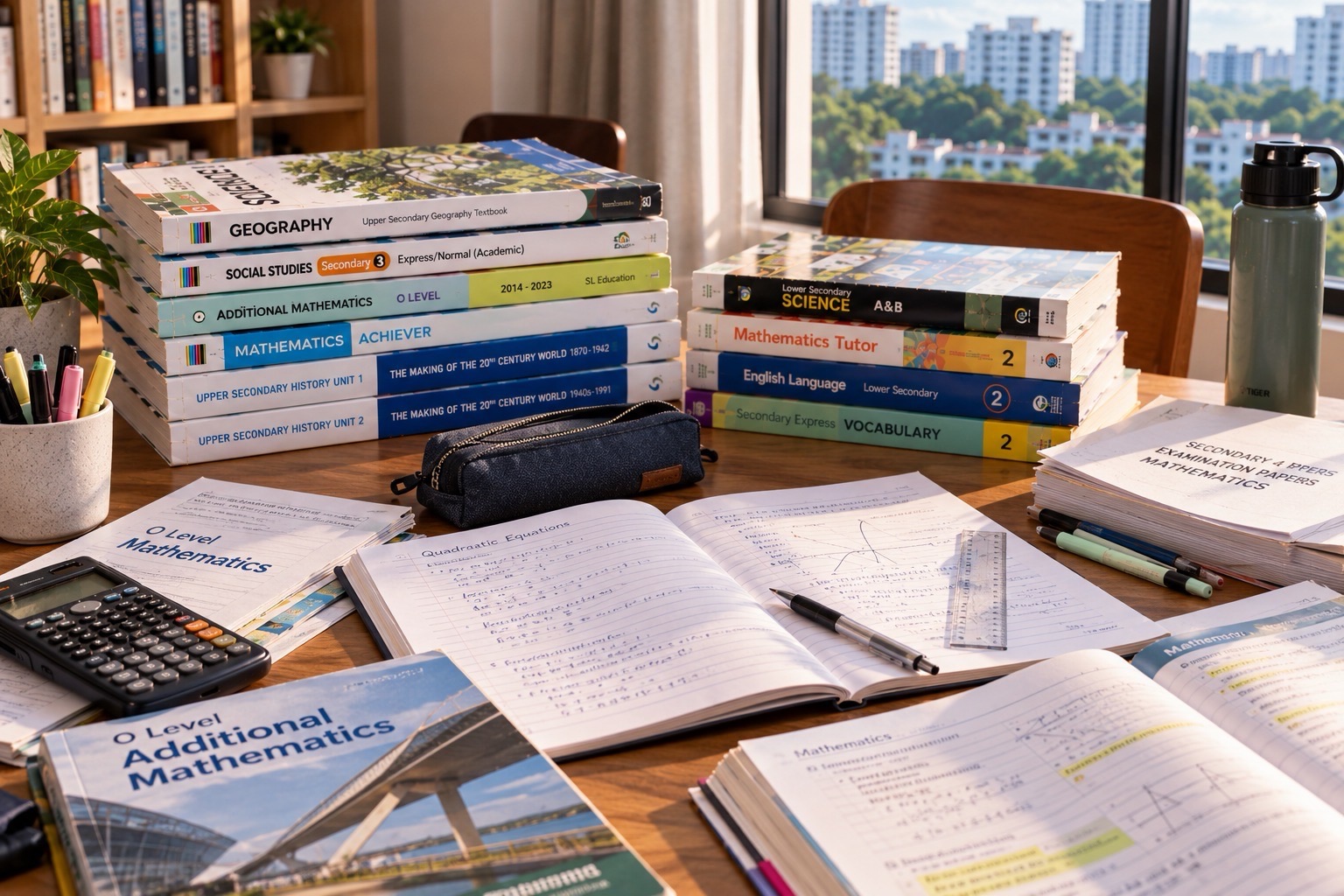
How should a Punggol pupil prepare for Secondary 1 geometry in 2028? Learn what each angle, length and region represents before selecting a formula. Read the given facts, mark a diagram, name the geometry property, calculate carefully and check whether the answer measures a boundary, an area or an angle. Understanding why an angle relationship holds is more dependable than memorising whichever subtraction appeared in the last worksheet.
Students sitting PSLE in 2027 will usually begin Secondary 1 in 2028. Under Full Subject-Based Banding the applicable G1, G2 or G3 Mathematics subject level and eventual school determine the precise curriculum sequence. This guide offers an accessible bridge from Primary 6 shapes into angle reasoning, two-dimensional measurement and composite figures. Later formal proof, polygon-angle generalisations and more advanced spatial work are labelled extension topics where relevant.
The original problems below use fictional shape dimensions, classroom diagrams and simple models. They are not measurements of Punggol parks, buildings or school facilities and are not official examination questions. The goal is to help learners explain why a geometric operation fits the shape, especially when a printed drawing looks unfamiliar or is not drawn to scale.
Geometry begins with facts the diagram actually provides
A drawn quadrilateral can resemble a rectangle without being a rectangle. To use a rectangle’s four right angles, the problem must provide enough information that the shape really is a rectangle. A parallelogram has opposite sides parallel, opposite angles equal and adjacent angles supplementary; a rhombus has four equal sides but need not have four right angles. An ordinary trapezium does not automatically have equal base angles.
Students should mark known equal sides, parallel lines, right angles and angle measures. Then ask what property is justified. The phrase ‘not drawn to scale’ is a warning that the sketch’s apparent lengths or angles should not replace mathematical facts. Measuring an image with a ruler cannot override the stated lengths or theorems.
A strong explanation is often short: ‘Angles on a straight line total 180°’, ‘The triangle interior angles total 180°’, or ‘Adjacent parallelogram angles are supplementary’. Naming the reason makes it possible to audit a multi-step solution. A number produced by a memorised 180° subtraction without identifying the relevant line may be a lucky guess.
Perimeter is a boundary; area is a region
Perimeter measures the total exposed outline of a shape and uses linear units such as centimetres. Area measures the region covered and uses square units such as cm². This difference remains crucial when a semicircle is joined to a rectangle: the semicircle’s straight diameter becomes an internal joining line and is not part of the exposed outer boundary. But the half-circle’s area is added to the rectangle’s area when the two regions do not overlap.
A cut-out can reduce area yet increase perimeter. Imagine removing a radius-7-cm semicircle from the side of a 20-by-14-cm rectangle along a matching 14-cm straight edge. The rectangle loses 77 cm² of area, but its exposed outline replaces a 14-cm straight boundary with a 22-cm curved indentation. The remaining region is smaller while the outer perimeter becomes longer.
Before calculating an area, shade the desired region and decompose it into familiar non-overlapping pieces. Before calculating perimeter, trace the entire actual outside boundary and name each segment. A pupil who uses the right formula for the wrong region still needs a representation lesson, not an extra multiplication drill.
The common geometric properties and their conditions
| Property | When it applies | What to avoid |
| Angles on a straight line total 180° | Adjacent angles covering one straight angle | Using 360° for half a turn |
| Angles around a point total 360° | Angles making a complete turn | Using 180° without a straight-line relationship |
| Vertically opposite angles equal | Two intersecting straight lines | Assuming all nearby angles are equal |
| Triangle interior sum 180° | All three interior angles of a triangle | Adding an exterior angle as if interior |
| Quadrilateral interior sum 360° | Four interior angles of a simple quadrilateral | Assuming extra side equalities |
| Opposite parallelogram angles equal | A confirmed parallelogram | Applying it to an arbitrary sketch |
| Adjacent parallelogram angles total 180° | Adjacent interior corners of a parallelogram | Treating opposite corners as supplementary |
| Area and perimeter units | Space versus exposed outline | Writing cm when the question asks for cm² |
Why geometry is connected to algebra
A missing angle is often an unknown with an equation behind it. If two adjacent angles on a straight line are x and 3x, then x + 3x = 180°, giving x = 45° and the larger angle 135°. This is an algebraic representation of the geometry fact, not a different mathematical law. The unknown must still be an angle and its unit is degrees.
Area equations use the same principle. If a rectangle has area 72 cm² and its width is 6 cm, the missing length satisfies 6l = 72 and equals 12 cm. Its area uses a product, not the perimeter formula. A pupil who knows elementary equations but chooses the wrong shape relationship needs geometry interpretation rather than more symbolic drills.
The Punggol Secondary 1 linear equations guide develops the balance method behind such unknowns. Geometry offers concrete situations in which a student can see why a correct equation represents the stated facts.
Twenty original worked geometry questions
Worked geometry case 1: 1. Straight-line pair
Question. An angle of 67° shares a straight line with angle x. Find x.
Answer. 113°. Reason. Straight-line angles total 180°.
Check. 67 + 113 = 180.
Worked geometry case 2: 2. Right-angle split
Question. A right angle is split into 38° and x. Find x.
Answer. 52°. Reason. A right angle is 90°.
Check. 38 + 52 = 90.
Worked geometry case 3: 3. Around a point
Question. Three angles around a point are 120°, 90° and 80°. Find the remaining angle.
Answer. 70°. Reason. Full turn 360° minus total 290°.
Check. 120 + 90 + 80 + 70 = 360.
Worked geometry case 4: 4. Triangle sum
Question. Two interior triangle angles are 45° and 65°. Find third.
Answer. 70°. Reason. All three interiors total 180°.
Check. 45 + 65 + 70 = 180.
Worked geometry case 5: 5. Isosceles triangle
Question. An isosceles triangle has equal base angles of 65° each. Find apex.
Answer. 50°. Reason. Two equal base angles sum 130°.
Check. 65 + 65 + 50 = 180.
Worked geometry case 6: 6. Equilateral triangle
Question. Find one interior angle of an equilateral triangle.
Answer. 60°. Reason. All three angles equal and total 180°.
Check. 3 × 60 = 180.
Worked geometry case 7: 7. Quadrilateral sum
Question. A quadrilateral has angles 90°, 110°, 80° and x. Find x.
Answer. 80°. Reason. Four interiors total 360°.
Check. 90 + 110 + 80 + 80 = 360.
Worked geometry case 8: 8. Parallelogram adjacent
Question. One parallelogram interior angle is 73°. Find adjacent.
Answer. 107°. Reason. Adjacent angles are supplementary.
Check. 73 + 107 = 180.
Worked geometry case 9: 9. Parallelogram opposite
Question. One angle of a parallelogram is 110°. Find its opposite.
Answer. 110°. Reason. Opposite angles are equal.
Check. Adjacent angles would be 70°.
Worked geometry case 10: 10. Rhombus adjacent
Question. A rhombus has one angle 110°. Find a neighbouring angle.
Answer. 70°. Reason. A rhombus is a parallelogram, so adjacent angles total 180°.
Check. 110 + 70 = 180.
Worked geometry case 11: 11. Rectangular perimeter
Question. A rectangle is 10 cm by 6 cm. Find perimeter.
Answer. 32 cm. Reason. Add two lengths and two widths.
Check. 2(10 + 6) = 32.
Worked geometry case 12: 12. Rectangular area
Question. The same 10-by-6 rectangle: find area.
Answer. 60 cm². Reason. Multiply perpendicular sides to cover region.
Check. 10 × 6 = 60.
Worked geometry case 13: 13. Triangle area
Question. A triangle has base 12 cm and perpendicular height 7 cm. Find area.
Answer. 42 cm². Reason. Use half base times perpendicular height.
Check. (1/2) ×12×7 =42.
Worked geometry case 14: 14. Parallelogram area
Question. Base 15 cm, perpendicular height 6 cm. Find area.
Answer. 90 cm². Reason. Area is base times perpendicular height.
Check. 15×6=90.
Worked geometry case 15: 15. Trapezium area
Question. A trapezium has parallel sides 8 cm and 12 cm with perpendicular height 5 cm. Find area.
Answer. 50 cm². Reason. Average parallel lengths multiplied by height.
Check. (8+12)/2 ×5 =50.
Worked geometry case 16: 16. Circle circumference
Question. Radius 7 cm, π = 22/7. Find full circumference.
Answer. 44 cm. Reason. 2πr gives the curved boundary.
Check. Diameter 14 cm times π also equals 44.
Worked geometry case 17: 17. Circle area
Question. Radius 7 cm, π = 22/7. Find area.
Answer. 154 cm². Reason. πr² measures coverage.
Check. 22/7 ×49=154.
Worked geometry case 18: 18. Standalone semicircle perimeter
Question. Semicircle radius 7 cm, π = 22/7. Find its complete perimeter.
Answer. 36 cm. Reason. Curved arc 22 plus straight diameter 14.
Check. 22 + 14 =36.
Worked geometry case 19: 19. Missing rectangle width
Question. Area 72 cm² and length 12 cm. Find width.
Answer. 6 cm. Reason. Divide area by perpendicular length.
Check. 12×6=72 cm².
Worked geometry case 20: 20. An attached semicircle
Question. A 20cm by 14cm rectangle has radius-7 semicircle attached without overlap along the 14cm side. Find total area.
Answer. 357 cm². Reason. Rectangle 280 plus semicircle 77.
Check. 280+77=357.
Twenty-four more worked figures: composites, line properties and proof
The first twenty questions focus on direct geometric relationships. The additional set deliberately changes the diagram structure: some edges become internal, some regions are removed, and several angle results depend on a stated parallel-line or shape condition. A line segment that is visually slanted does not automatically create a parallelogram, and a triangle that appears isosceles is not guaranteed to have equal sides unless the facts establish it.
The later questions about regular polygons and coordinate measurement are optional extensions when the pupil’s Mathematics level and school sequence have reached them. Even there, the first step remains the same: define the figure accurately, identify which length or angle is requested, name a valid relationship and then calculate. Drawings should be interpreted from given measurements and markings, not by ruler estimates.
Additional geometry case 21. Attached semicircle perimeter
Question. A 20-by-14-cm rectangle has a radius-7-cm semicircle attached along one 14-cm side. Find outer perimeter.
Solution. 76 cm.
Reason. Rectangle perimeter 68; remove internal join 14; add 22-cm arc.
Independent check. 68 − 14 + 22 = 76. The diameter is not exposed.
Additional geometry case 22. Semicircular notch area
Question. A radius-7-cm semicircle is cut from the 14-cm side of a 20-by-14-cm rectangle. Find remaining area.
Solution. 203 cm².
Reason. Rectangle area 280; remove semicircle area 77.
Independent check. 203 + 77 = 280.
Additional geometry case 23. Semicircular notch perimeter
Question. For the same rectangle with a semicircular notch, find exposed perimeter.
Solution. 76 cm.
Reason. Replace a straight 14-cm boundary with the curved 22-cm indentation.
Independent check. 68 − 14 + 22 = 76 even though area decreased.
Additional geometry case 24. Square minus a quarter circle
Question. A square has side 14 cm. A quarter-circle sector of radius 14 cm is removed from a corner. Find the region’s remaining area.
Solution. 42 cm².
Reason. Square area 196; sector area one quarter of 616 =154.
Independent check. 196 −154=42, assuming the sector lies within the square.
Additional geometry case 25. Remaining curved corner perimeter
Question. For the previous square-minus-quarter-circle region, find its perimeter.
Solution. 50 cm.
Reason. The remaining outline comprises top and right sides of 14 cm each and a quarter-circle arc of 22 cm.
Independent check. 14+14+22=50.
Additional geometry case 26. Quarter-circle perimeter
Question. A standalone quarter circle has radius 14 cm. Find full perimeter using π=22/7.
Solution. 50 cm.
Reason. Arc length is 22, and two exposed straight radii total 28.
Independent check. 22+14+14=50.
Additional geometry case 27. Quarter-circle area
Question. Find area of quarter circle with radius 14 cm.
Solution. 154 cm².
Reason. Full circle area is 616; divide by four.
Independent check. 4×154=616.
Additional geometry case 28. Exterior triangle angle
Question. Two remote interior angles of a triangle are 40° and 60°. Find the exterior angle at the third vertex.
Solution. 100°.
Reason. An exterior angle equals the sum of the two remote interior angles.
Independent check. Third interior angle is 80°, supplementary to the 100° exterior.
Additional geometry case 29. Vertically opposite angles
Question. Two straight lines intersect. One angle is 112°. Find its vertically opposite angle.
Solution. 112°.
Reason. Opposite angles at the intersection are equal.
Independent check. Adjacent ones are 180−112=68°.
Additional geometry case 30. Parallel-line corresponding angles
Question. Two explicitly parallel lines are crossed by a transversal. One corresponding angle is 68°. Find its corresponding partner.
Solution. 68°.
Reason. Corresponding angles are equal because the lines are parallel.
Independent check. The property requires the stated parallelism.
Additional geometry case 31. Parallel-line alternate angles
Question. Two marked parallel lines are crossed by a transversal. An alternate interior angle is 52°. Find the other alternate interior angle.
Solution. 52°.
Reason. Alternate interior angles are equal when the lines are parallel.
Independent check. They occupy opposite sides of transversal between the parallels.
Additional geometry case 32. Co-interior angles
Question. Along a transversal crossing parallel lines, one co-interior angle is 123°. Find the other.
Solution. 57°.
Reason. Co-interior angles are supplementary.
Independent check. 123+57=180°.
A geometry proof begins with a condition. Corresponding and alternate angles are not equal merely because two lines look parallel on the page; parallelism must be given or established. When a learner says ‘these two look the same’, ask which diagram marking or known theorem justifies equality. This discipline becomes increasingly valuable as geometry problems use multiple connected shapes.
Additional geometry case 33. Isosceles trapezium with conditions
Question. An isosceles trapezium has two equal bottom base angles of 70°. Find the two top base angles.
Solution. 110° each.
Reason. Each top angle is co-interior with a 70° bottom angle along one leg; parallel bases make 180° pairs.
Independent check. 70+110+70+110=360°.
Additional geometry case 34. Ordinary trapezium one leg
Question. A trapezium has parallel bases. Along one leg, the lower angle is 74°. Find the upper angle on that leg.
Solution. 106°.
Reason. These two angles are co-interior along a transversal.
Independent check. 74+106=180. Do not infer the other leg’s angles without more facts.
Additional geometry case 35. Rhombus perimeter
Question. A rhombus has four sides of 7 cm. Find its perimeter.
Solution. 28 cm.
Reason. All four side lengths of a rhombus are equal.
Independent check. 4×7=28.
Additional geometry case 36. Rhombus area from perpendicular height
Question. A rhombus has base 7 cm and perpendicular height 5 cm. Find its area.
Solution. 35 cm².
Reason. Treat it as a parallelogram: base times perpendicular height.
Independent check. 7×5=35; the side length is not automatically the perpendicular height.
Additional geometry case 37. Pentagon interior sum (extension)
Question. Find the sum of the interior angles of a simple pentagon.
Solution. 540°.
Reason. A pentagon can be partitioned into three triangles from one vertex.
Independent check. 3×180=540.
Additional geometry case 38. Regular pentagon angle (extension)
Question. Find one interior angle of a regular pentagon.
Solution. 108°.
Reason. Five equal interior angles total 540°.
Independent check. 5×108=540.
Additional geometry case 39. Regular hexagon angle (extension)
Question. Find one interior angle of a regular hexagon.
Solution. 120°.
Reason. Its interior sum is (6−2)×180=720; divide by six.
Independent check. 6×120=720.
Additional geometry case 40. Compound rectangle with triangle
Question. A rectangle 12 cm by 6 cm has a non-overlapping triangle of base 6 cm and perpendicular height 4 cm attached. Find combined area.
Solution. 84 cm².
Reason. Rectangle area 72; triangle area 12; add non-overlapping regions.
Independent check. 72+12=84. This question supplies the triangular perpendicular height.
Additional geometry case 41. Equal perimeter, unequal areas
Question. Compare 10×6 cm and 12×4 cm rectangles. Do they have equal perimeter and area?
Solution. Equal perimeter 32 cm; different areas 60 and 48 cm².
Reason. Perimeter sums boundaries, while area multiplies dimensions.
Independent check. 2(10+6)=2(12+4)=32, but 10×6≠12×4.
Additional geometry case 42. Coordinate rectangle (extension)
Question. A rectangle spans x=−2 to x=3 and y=1 to y=5 on a unit grid. Find area and perimeter.
Solution. 20 square units; perimeter 18 units.
Reason. Width 3−(−2)=5; height 5−1=4.
Independent check. Area 5×4=20; perimeter 2(5+4)=18.
Additional geometry case 43. Mixed length units for area
Question. A rectangle measures 2 m by 50 cm. Find area in square metres.
Solution. 1 m².
Reason. Convert 50 cm to 0.5 m, then 2×0.5.
Independent check. 1 m² equals 10,000 cm², consistent with 200×50.
Additional geometry case 44. Unknown perimeter via equation
Question. A rectangle has length 2w and width w. Its perimeter is 48 cm. Find width and length.
Solution. w=8 cm; length=16 cm.
Reason. 2(2w+w)=48 gives 6w=48.
Independent check. 2(16+8)=48.
How to decide whether an area should be added or subtracted
If two non-overlapping regions are joined, the combined area is their sum. If a region is cut away, the remaining area is the original region minus the removed area. That distinction sounds simple until a semicircle is drawn inward or outward from a rectangle. The direction of the arc does not alone determine whether it adds or removes material; the question’s description of what remains must control the calculation.
For a 20×14 rectangle, the full region covers 280 cm². A radius-seven semicircle covers 77 cm² with π=22/7. Attaching it externally gives 357 cm²; removing it as a notch gives 203 cm². Reconstructing the rectangle by adding back the cut-out region provides a strong independent check.
Perimeter uses a different logic. The attached and notched versions can both have perimeter 76 cm, because the original 14-cm straight edge is replaced by a 22-cm curve in either case. This illustrates why a shape losing area does not necessarily lose perimeter. Pupils should trace the current exposed outline rather than guess from the change in area.
What happens when the diagram is not drawn to scale?
In a printed question, a 70-degree angle may appear wider than an 80-degree angle due to perspective or printing. The stated numbers and given geometric properties govern the answer. A pupil should not choose an angle by how it looks when the problem provides an exact right angle, parallel mark or side equality.
A good diagram annotation procedure is to mark all given measurements in one pass, all guaranteed equal or parallel relationships in another, and the requested unknown last. Then name one theorem that connects the known pieces to the unknown. The drawn lines help organise the relationship but are not a source of unannounced facts.
If too little information is provided to determine an unknown, ‘cannot be uniquely determined’ may be the mathematically correct answer. For example, one interior angle of a general quadrilateral does not fix the other three. An ordinary trapezium has a pair of parallel sides, but its angles along opposite legs need not match unless additional conditions are given.
Six diagnostic mistakes that require six different repairs
| Visible wrong move | First conceptual issue | Next teaching question |
| Uses 360° for a straight-line pair | Full turn confused with half turn | Is the region a straight angle or a complete rotation? |
| Calls every four-sided slanted figure a parallelogram | Shape properties assumed from appearance | Which two pairs of opposite sides are known parallel? |
| Uses a side length as triangle height without perpendicularity | Height not understood | Where is the perpendicular from opposite vertex to the base line? |
| Adds an attached diameter to composite perimeter | Internal join counted as outer boundary | Can you walk along this line without entering the region? |
| Uses cm for computed area | Length and area conflated | How many unit squares would cover the region? |
| Treats a missing numeric answer as evidence to guess property | Proof reasoning absent | Which stated fact forces these angles to have the claimed relationship? |
The purpose of an error map is to prevent twenty additional drills from being prescribed for the wrong reason. A learner who knows all numerical operations but misreads a diagram needs representation and theorem selection. A learner who identifies the correct geometry yet multiplies incorrectly needs arithmetic retrieval. These are distinct teaching tasks even when both produce the same low mark on one item.
An accessible fifteen-minute parent geometry diagnostic
Give a pupil a rectangle of labelled sides 12 cm and 5 cm. Ask for its area and perimeter and explain the different units. Next attach a semicircle along an explicitly matching side, and ask which boundary becomes internal. You need not immediately calculate π: the conceptual check is whether the child knows which edge disappears from the outside perimeter.
Then show a parallelogram with one interior angle of 73 degrees and ask for an adjacent one. The answer is 107 degrees because neighbouring interior angles total 180. Change the diagram to an arbitrary quadrilateral without parallel marks and ask whether the same conclusion follows. A secure learner should say no and explain what fact is missing.
Finish by asking the pupil to verify one answer. For angles, reconstruct 180 or 360 degrees; for area, add or subtract regions to recover the original; for perimeter, trace exposed edges. Stop after useful evidence rather than keeping the child seated until every possible case is exhausted.
Geometry’s place in a Secondary 1 learning pathway
Measurement and geometry connect naturally with numerical operations, ratios and simple equations. Finding a missing rectangle width from area is an inverse multiplication problem. Finding an angle described as twice another is a linear equation. Comparing two shapes under a given scale requires proportional reasoning and units. A student who understands those foundations can combine them in a new geometry context.
This is why topic silos can be misleading. If a pupil continually fails composite geometry because they cannot handle decimals or signed subtraction, another sheet of shapes alone may not repair the weak link. The tutor should examine each line, decide where meaning first became unstable and rebuild that prerequisite before returning to the figure.
The linear equations guide, coordinate graphs guide and ratio and rate guide provide distinct representations that can reinforce geometry without competing with its main purpose.
A flexible six-week shape-and-reasoning plan
| Week | Focus | Evidence of independent skill |
| 1 | Angle sums and right/straight/full turns | Names the property and solves an unseen angle |
| 2 | Triangles, quadrilaterals, parallel lines | Distinguishes valid theorems from assumptions |
| 3 | Perimeter versus area and consistent units | Selects the right quantity before calculating |
| 4 | Composite regions and internal joins | Adds or subtracts area and traces true boundary |
| 5 | Missing measurements and equations | Models the unknown from facts rather than guessing |
| 6 | Mixed diagrams and delayed retrieval | Explains an unfamiliar figure without tutor hints |
This is an optional instructional outline rather than a fixed 2028 timetable or a claim that every school teaches advanced polygon facts in the first six weeks. Mathematics G-level curricula and school pacing determine what should be introduced, reviewed or extended. A pupil who is secure can practise unfamiliar combinations, while a pupil who is uncertain about rectangles should repair that earlier knowledge first.
What a purposeful three-student lesson would observe
One student may know the triangle-angle sum but accidentally include an external angle; another may identify a semicircle correctly but count its hidden diameter in the perimeter; a third may produce the correct numerical area but label it in centimetres. These students need distinct short corrections. A 90-minute small-group tutorial can share the concept demonstration while allowing individual attention to each student’s first wrong move.
After the tutor’s guidance, ask every pupil to solve an unseen variant and explain the reason. If the child can only reproduce the exact diagram shown moments earlier, the skill has not transferred. A small group is useful when its teaching includes inspection, explanation and later retrieval; it cannot honestly guarantee a certain grade simply because only three pupils attend.
Parents considering tuition should bring actual school examples and ask how the tutor will know that a repeated misconception has been repaired. School teaching remains central, and any supplementary lessons should match the child’s G1, G2 or G3 scope and wellbeing.
Frequently asked questions
Can a shape’s area decrease while its perimeter increases?
Yes. Replacing a straight edge with a longer inward curve can reduce covered region while increasing the exposed boundary length. Trace the new outline rather than guessing from the area change.
Why do we exclude an internal line from composite perimeter?
Perimeter follows the outside boundary of the combined region. A line along which two shapes are joined lies inside and is not part of the exterior path.
Is every rhombus a square?
No. A rhombus has equal sides but need not have right angles. A square is a special rhombus that also has four right angles.
Can I use my ruler to determine an unlabelled angle?
Only when a question explicitly requests measurement and the drawing is suitable. For standard deduction problems, rely on given angle facts and geometry properties; diagrams may not be drawn to scale.
Should a Secondary 1 pupil memorise every polygon formula before term one?
No. Learn the foundations appropriate to the actual school and subject level. General polygon-angle formulas can be useful extensions but should not replace secure triangles, quadrilaterals and measurement.
How do we know whether additional Mathematics help is useful?
Look for recurring specific misconceptions after school and home explanation. A short diagnostic, appropriate modelling and a successful independent retest can justify focused support more clearly than one percentage mark.
Sources and next Punggol Mathematics lessons
- MOE: transition to secondary school — wider learning and adaptation.
- MOE G2 and G3 Mathematics syllabus — official topic scope for applicable courses.
- MOE Full Subject-Based Banding — subject-level context.
- From PSLE 2027 to Secondary 1 Mathematics 2028 — parent pathway.
- Linear equations and unknown values — algebra connected to geometry.
- Coordinates and graphs — a different view of shape and measurements.
- eduKate Secondary 1 Mathematics three-student tutorial approach — diagnosis and first-principles teaching.
The purpose of geometry is to reason about shapes that may look unfamiliar. A pupil should identify which facts are actually given, choose the relevant property, calculate with the right units and check the answer against the whole figure. When those habits survive a changed diagram, the student is beginning to master the subject.
Four final geometry lessons that protect reasoning under pressure
Know exactly which part of the shape is being asked for. In a semicircle, curved arc length and complete perimeter are not the same quantity. A radius-seven semicircle using π=22/7 has a curved arc of twenty-two centimetres, but its complete perimeter is thirty-six centimetres after including the straight diameter. If the pupil writes twenty-two on a perimeter question, the main failure may be reading the requested boundary, not circle arithmetic. Asking the student to trace the edge with a finger often reveals the mistake immediately.
Do not turn a drawing’s appearance into an unstated property. A quadrilateral that looks like a parallelogram may not be marked as one. Opposite angles are only guaranteed equal under conditions that justify the parallelogram or another relevant theorem. Similarly, a triangle may appear to have equal base angles but cannot be assumed isosceles merely from printing. Have the child underline the facts given in words or symbols and distinguish them from things inferred by looking.
Separate a geometric relationship from numerical execution. A student may correctly decide that two co-interior angles on parallel lines total 180°, then subtract 123 from 180 incorrectly. That student needs a numerical accuracy check. Another may compute 180 − 123 perfectly but apply the relation to two angles that are not co-interior; this learner needs theorem selection. Diagnosing the first wrong line determines which task should come next.
Preserve units across every step. A triangle with a base of 2 metres and a perpendicular height of 50 centimetres has area one half times 2 m times 0.5 m, which is 0.5 m². If the pupil multiplies two by fifty and writes ‘50 metres squared’, they have mixed units before applying the correct formula. Common units are not decorative; they determine whether the computed quantity has a meaningful dimension.
One complete composite-shape audit
Consider a fictional rectangle 20 cm long and 14 cm high with a radius-seven semicircle attached along its short side. First identify that the two regions do not overlap. The rectangle covers 280 cm² and the semicircle covers 77 cm² when π=22/7, so the combined area is 357 cm². This is the area model: add the two non-overlapping regions.
Next trace the outside boundary. The original rectangle perimeter is 68 cm, but the joined 14-cm side is now inside and must not be counted. Add the curved semicircular arc of 22 cm instead, giving 68 − 14 + 22 = 76 cm. This is the perimeter model: sum only exposed edges. Notice that the two questions share the same diagram but demand different operations. A pupil who treats them as identical will often produce a plausible-looking wrong answer.
Finally compare the shape with a semicircular notch cut inward from the same side. The cut-out reduces area to 203 cm², yet the exposed boundary remains 76 cm because the same 14-cm straight segment is replaced by the 22-cm arc. Ask the pupil to explain that contrast in words without calculating again. If they can state why the area direction changes while the perimeter replacement does not, they understand the figure more deeply than someone who only remembers three numerical answers.
How to use a school script for the next lesson
Choose one wrong geometry question and ask the child to reconstruct what they believed the diagram meant. Did they consider an interior joining line part of the outside? Did they read a diameter as a radius? Did they assume an angle equality that was never stated? Write that belief beside the first incorrect step. Next offer an equivalent shape with changed measurements, and ask the student to solve it without being told the method.
A corrected answer written immediately after a tutor’s demonstration is useful practice, but it is not the strongest evidence that the concept has settled. Return to a changed diagram after two days, then mix it with a ratio or equation problem later. A child who can select the geometry property independently while other topics are present is developing the transferable reasoning that Secondary Mathematics requires.


