
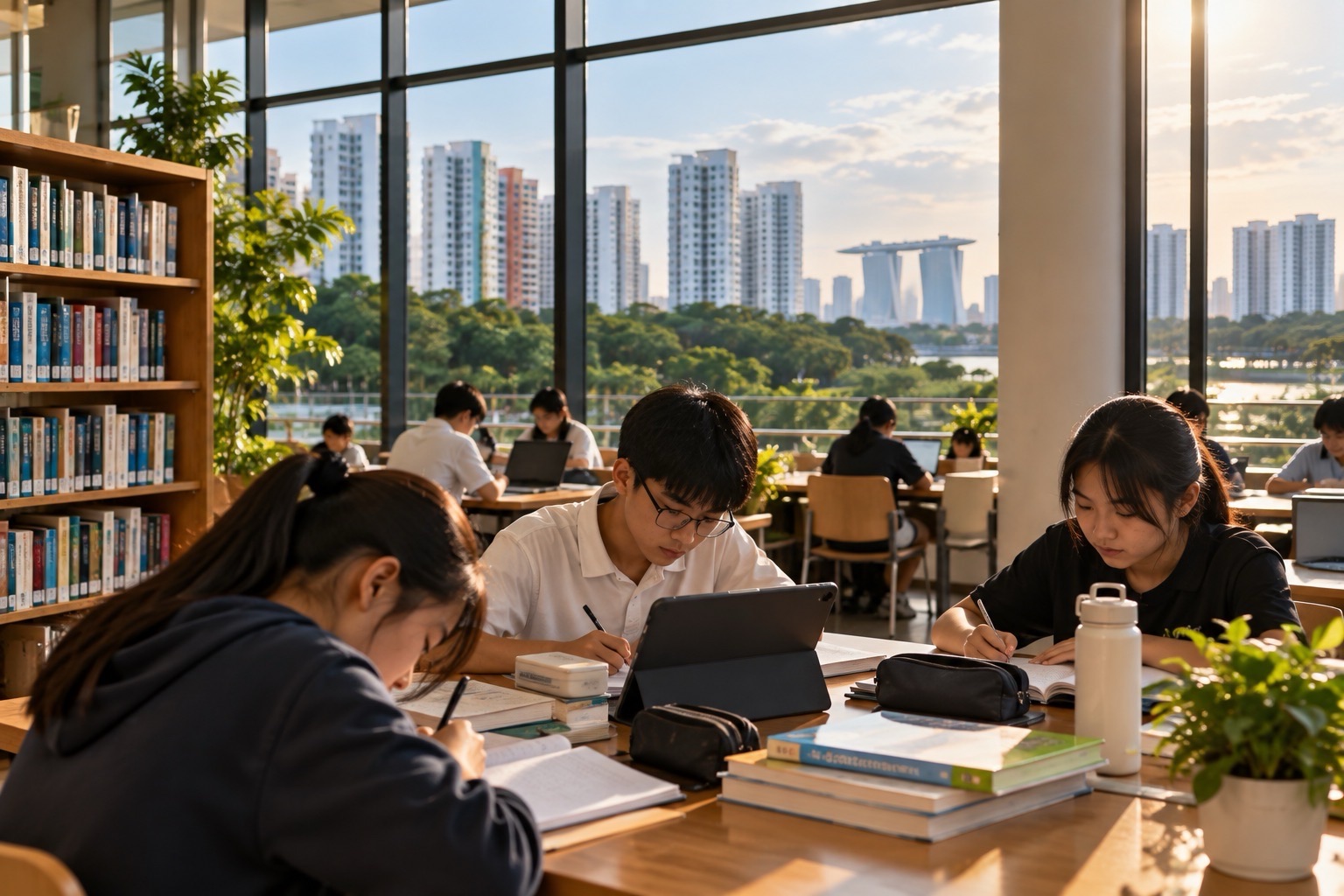
Primary 2 Mathematics: The Quick Punggol Haze Answer
How can a Primary 2 pupil learn Mathematics from a haze-related Punggol situation? Use an ordinary indoor family or classroom plan to practise numbers to 1,000, addition and subtraction with regrouping, multiplication tables of 2, 3, 4, 5 and 10, equal sharing, fractions, dollars and cents, length, mass, liquid volume, clock time, 3D shapes and picture graphs with scales.
These topics follow MOE’s 2021 Primary Mathematics Syllabus updated October 2025. A Punggol-based school example is Valour Primary School’s 2026 Mathematics curriculum, which lists its Primary 2 teaching topics by term. The guide includes 24 original, fully explained problems, age-appropriate correction methods and a four-week plan. It does not reproduce an official assessment or claim that haze is a required Mathematics chapter.
Any environmental values in these problems are invented. Real Punggol air-quality decisions should use NEA’s current haze service and the North region, rather than a fictional number or a forwarded photograph.
What Changes Between Primary 1 and Primary 2?
Primary 1 establishes numbers up to 100, number bonds, early groups, basic shapes, picture graphs and common money, time and length situations. Primary 2 extends that foundation to three-digit numbers and a richer set of mathematical representations.
A pupil may now regroup tens and hundreds, recognise even and odd numbers, use familiar multiplication tables, compare simple fractions, measure mass and liquid volume, and read graphs where a symbol can stand for more than one item.
The important shift is not simply handling bigger numbers. It is knowing what the numbers refer to. If one picture symbol represents five books, counting four symbols as four books is conceptually wrong even when counting skills are fine.
Haze provides a reason for a family to choose an appropriate indoor activity, but the Mathematics should remain understandable, safe and independent of real-time pollution levels.
A Safe Fictional Punggol Family Learning Day
Imagine three children arranging paper games in a Punggol flat during a fictional afternoon when adults have adjusted outdoor plans according to the relevant public guidance. They count storybooks, divide crayons into equal groups, buy pretend stationery and read a family timetable.
The family never asks the children to create smoke, test masks, collect outdoor particles or decide whether the current air is medically safe. Those questions belong to adults using the official NEA guidance and any relevant clinical advice.
For Mathematics, an invented notice reading “Reading activity at 2:35pm” provides time data. Five book symbols with a key of two books per symbol provide a picture-graph problem. The context can be changed to a normal school holiday without changing the mathematical relationship.
A familiar story builds confidence while the explicit fictional label prevents misinformation.
The Three P2 Content Strands
The current MOE Primary Mathematics syllabus organises topics under Number and Algebra, Measurement and Geometry, and Statistics. Primary 2 develops numbers to 1,000, calculations, multiplication and division, early fractions and money; measurement of length, mass, liquid volume and time; basic three-dimensional forms and picture graphs with scales.
A teacher should not automatically give P2 pupils P5-style rate, percentage change or algebraic functions. Those may appear in adult discussions of haze but they are not necessary to answer a P2 word problem.
Students can still learn a powerful information habit: before calculating, identify whether the figure describes pupils, litres, grams, dollars or a fictional environmental reading.
The goal is accurate operation selection and explanation, not the length of the worksheet or the complexity of its environmental terminology.
Place Value and Regrouping: Hundreds, Tens and Ones
The number 507 represents five hundreds, zero tens and seven ones. A pupil should not pronounce it or model it as five hundred seventy. Use place-value charts and bundles of ten to show the empty tens place explicitly.
Regrouping works because ten ones equal one ten, and ten tens equal one hundred. In addition, this helps when an answer crosses a tens or hundreds boundary. In subtraction, a pupil may need to rename a hundred as ten tens before proceeding.
For example, 605−278 is easier when the student understands why one hundred must be regrouped through the empty tens column. The written algorithm should reflect a meaningful base-ten exchange.
The same reasoning transfers from invented activity cards to money or book counts. That is a foundational P2 skill, not an environmental formula.
Original Worked Question 1 · Hundreds, Tens and Ones
Question: In a fictional card collection, a box has 608 cards. How many hundreds, tens and ones does this represent?
Worked answer: 6 hundreds, 0 tens and 8 ones.
Why the method works: Zero in the tens place matters. 608 is not 680. Use a place-value table with the columns hundreds, tens and ones.
Parent diagnostic: Let the child represent the calculation with base-ten blocks, fraction strips, a clock face, a picture graph or equal groups. Then ask for a short oral explanation and one way to verify the answer.
Learning boundary: All people, activities, monetary amounts and objects in the problem are imaginary. The question is about Mathematics, not current air pollution or a real Punggol school programme.
Original Worked Question 2 · Compare Three-Digit Numbers
Question: Two fictional shelves have 572 and 527 books. Which has more and by how many?
Worked answer: 572 > 527. Difference = 572−527 = 45 books.
Why the method works: Both have five hundreds; the tens digit determines which is greater. Then subtract with the appropriate unit.
Parent diagnostic: Let the child represent the calculation with base-ten blocks, fraction strips, a clock face, a picture graph or equal groups. Then ask for a short oral explanation and one way to verify the answer.
Learning boundary: All people, activities, monetary amounts and objects in the problem are imaginary. The question is about Mathematics, not current air pollution or a real Punggol school programme.
Original Worked Question 3 · Add Across a Hundred
Question: An activity cupboard contains 268 sheets, and another 175 arrive. Find the total.
Worked answer: 268+175 = 443 sheets.
Why the method works: Regroup ones and tens as needed. Check the result by subtracting 175 from 443.
Parent diagnostic: Let the child represent the calculation with base-ten blocks, fraction strips, a clock face, a picture graph or equal groups. Then ask for a short oral explanation and one way to verify the answer.
Learning boundary: All people, activities, monetary amounts and objects in the problem are imaginary. The question is about Mathematics, not current air pollution or a real Punggol school programme.
Original Worked Question 4 · Subtract with Regrouping
Question: A fictional centre has 605 story cards and distributes 278. How many remain?
Worked answer: 605−278 = 327 cards.
Why the method works: Regroup through the zero tens digit. Verify: 278+327=605.
Parent diagnostic: Let the child represent the calculation with base-ten blocks, fraction strips, a clock face, a picture graph or equal groups. Then ask for a short oral explanation and one way to verify the answer.
Learning boundary: All people, activities, monetary amounts and objects in the problem are imaginary. The question is about Mathematics, not current air pollution or a real Punggol school programme.
Original Worked Question 5 · An Even or Odd Number
Question: A fictional class prepares 234 counters. Is the total even or odd?
Worked answer: Even, because 234 ends in 4 and can be divided into two equal whole-number groups.
Why the method works: The last digit determines parity. The context does not change the number property.
Parent diagnostic: Let the child represent the calculation with base-ten blocks, fraction strips, a clock face, a picture graph or equal groups. Then ask for a short oral explanation and one way to verify the answer.
Learning boundary: All people, activities, monetary amounts and objects in the problem are imaginary. The question is about Mathematics, not current air pollution or a real Punggol school programme.
Original Worked Question 6 · Continue a Number Pattern
Question: A picture sequence of card counts reads 120, 130, 140, 150, …. Give the next two numbers.
Worked answer: 160 and 170.
Why the method works: Each term increases by ten. Explain the relationship rather than guessing only from the final number.
Parent diagnostic: Let the child represent the calculation with base-ten blocks, fraction strips, a clock face, a picture graph or equal groups. Then ask for a short oral explanation and one way to verify the answer.
Learning boundary: All people, activities, monetary amounts and objects in the problem are imaginary. The question is about Mathematics, not current air pollution or a real Punggol school programme.
Original Worked Question 7 · Table of Two
Question: Seven equal bags contain 2 crayons each. How many crayons altogether?
Worked answer: 7×2 = 14 crayons.
Why the method works: Multiplication expresses equal groups. Draw seven pairs if the child needs a visual check.
Parent diagnostic: Let the child represent the calculation with base-ten blocks, fraction strips, a clock face, a picture graph or equal groups. Then ask for a short oral explanation and one way to verify the answer.
Learning boundary: All people, activities, monetary amounts and objects in the problem are imaginary. The question is about Mathematics, not current air pollution or a real Punggol school programme.
Original Worked Question 8 · Table of Five
Question: Eight fictional tables hold 5 books each. Find the total.
Worked answer: 8×5 = 40 books.
Why the method works: Repeated addition or skip-counting by five gives the same answer.
Parent diagnostic: Let the child represent the calculation with base-ten blocks, fraction strips, a clock face, a picture graph or equal groups. Then ask for a short oral explanation and one way to verify the answer.
Learning boundary: All people, activities, monetary amounts and objects in the problem are imaginary. The question is about Mathematics, not current air pollution or a real Punggol school programme.
Original Worked Question 9 · Table of Ten
Question: Six stacks each contain 10 flashcards. Find the total.
Worked answer: 6×10 = 60 flashcards.
Why the method works: Ten is a place-value-friendly grouping. Make six physical bundles or draw them.
Parent diagnostic: Let the child represent the calculation with base-ten blocks, fraction strips, a clock face, a picture graph or equal groups. Then ask for a short oral explanation and one way to verify the answer.
Learning boundary: All people, activities, monetary amounts and objects in the problem are imaginary. The question is about Mathematics, not current air pollution or a real Punggol school programme.
Original Worked Question 10 · Table of Three
Question: Four teams each receive 3 stickers. How many stickers are used?
Worked answer: 4×3 = 12 stickers.
Why the method works: The number of groups is four, and the group size is three. Check 3+3+3+3=12.
Parent diagnostic: Let the child represent the calculation with base-ten blocks, fraction strips, a clock face, a picture graph or equal groups. Then ask for a short oral explanation and one way to verify the answer.
Learning boundary: All people, activities, monetary amounts and objects in the problem are imaginary. The question is about Mathematics, not current air pollution or a real Punggol school programme.
Original Worked Question 11 · Table of Four
Question: Five trays contain 4 paper shapes each. Find how many shapes there are.
Worked answer: 5×4 = 20 shapes.
Why the method works: Show repeated addition if the multiplication fact is not yet automatic.
Parent diagnostic: Let the child represent the calculation with base-ten blocks, fraction strips, a clock face, a picture graph or equal groups. Then ask for a short oral explanation and one way to verify the answer.
Learning boundary: All people, activities, monetary amounts and objects in the problem are imaginary. The question is about Mathematics, not current air pollution or a real Punggol school programme.
Original Worked Question 12 · Equal Division
Question: Twenty-seven activity cards are shared equally by 3 pupils. How many does each receive?
Worked answer: 27÷3 = 9 cards per pupil.
Why the method works: Check 3×9=27. Equal sharing uses the same number in each recipient’s group.
Parent diagnostic: Let the child represent the calculation with base-ten blocks, fraction strips, a clock face, a picture graph or equal groups. Then ask for a short oral explanation and one way to verify the answer.
Learning boundary: All people, activities, monetary amounts and objects in the problem are imaginary. The question is about Mathematics, not current air pollution or a real Punggol school programme.
Original Worked Question 13 · Number of Groups
Question: Thirty-five books are placed in piles of 5 books each. Find the number of piles.
Worked answer: 35÷5 = 7 piles.
Why the method works: Unlike equal sharing to a fixed number of people, this asks how many groups can be made from a known group size.
Parent diagnostic: Let the child represent the calculation with base-ten blocks, fraction strips, a clock face, a picture graph or equal groups. Then ask for a short oral explanation and one way to verify the answer.
Learning boundary: All people, activities, monetary amounts and objects in the problem are imaginary. The question is about Mathematics, not current air pollution or a real Punggol school programme.
Original Worked Question 14 · Half of a Collection
Question: A fictional set contains 18 cards, and half are blue. How many are blue?
Worked answer: 18÷2 = 9 cards.
Why the method works: Half means two equal groups. A drawing should show nine in each if the whole is eighteen.
Parent diagnostic: Let the child represent the calculation with base-ten blocks, fraction strips, a clock face, a picture graph or equal groups. Then ask for a short oral explanation and one way to verify the answer.
Learning boundary: All people, activities, monetary amounts and objects in the problem are imaginary. The question is about Mathematics, not current air pollution or a real Punggol school programme.
Original Worked Question 15 · Compare Fractions
Question: Two identical posters have 1/4 and 3/4 of their areas coloured. Which has more coloured area?
Worked answer: 3/4 is greater than 1/4.
Why the method works: The denominators match, and the poster wholes are identical. Three quarters is three equal parts rather than one.
Parent diagnostic: Let the child represent the calculation with base-ten blocks, fraction strips, a clock face, a picture graph or equal groups. Then ask for a short oral explanation and one way to verify the answer.
Learning boundary: All people, activities, monetary amounts and objects in the problem are imaginary. The question is about Mathematics, not current air pollution or a real Punggol school programme.
Original Worked Question 16 · Add Like Fractions
Question: A poster has 1/8 filled with green pictures and 3/8 with blue. What fraction is filled?
Worked answer: 1/8+3/8 = 4/8 = 1/2.
Why the method works: The eighths must refer to equal parts of the same whole. Add numerators, not denominators.
Parent diagnostic: Let the child represent the calculation with base-ten blocks, fraction strips, a clock face, a picture graph or equal groups. Then ask for a short oral explanation and one way to verify the answer.
Learning boundary: All people, activities, monetary amounts and objects in the problem are imaginary. The question is about Mathematics, not current air pollution or a real Punggol school programme.
Original Worked Question 17 · Subtract Like Fractions
Question: A fictional booklet has 5/6 of its pages marked, and the child unmarks 2/6 of the whole booklet. How much remains marked?
Worked answer: 5/6−2/6 = 3/6 = 1/2.
Why the method works: Both fractions refer to the same whole. Check by counting three sixths left marked.
Parent diagnostic: Let the child represent the calculation with base-ten blocks, fraction strips, a clock face, a picture graph or equal groups. Then ask for a short oral explanation and one way to verify the answer.
Learning boundary: All people, activities, monetary amounts and objects in the problem are imaginary. The question is about Mathematics, not current air pollution or a real Punggol school programme.
Original Worked Question 18 · Money in Dollars and Cents
Question: A pretend pack costs S$4.65 and a book costs S$2.30. Find the total.
Worked answer: 4.65+2.30 = S$6.95.
Why the method works: Align decimal points and write dollars and cents to two places. These are fictional prices.
Parent diagnostic: Let the child represent the calculation with base-ten blocks, fraction strips, a clock face, a picture graph or equal groups. Then ask for a short oral explanation and one way to verify the answer.
Learning boundary: All people, activities, monetary amounts and objects in the problem are imaginary. The question is about Mathematics, not current air pollution or a real Punggol school programme.
Original Worked Question 19 · Find the Change
Question: The fictional purchase totals S$6.95 and is paid with a S$10.00 note. Find the change.
Worked answer: 10.00−6.95 = S$3.05.
Why the method works: Verify 6.95+3.05=10.00. Rounding too early would produce an inaccurate answer.
Parent diagnostic: Let the child represent the calculation with base-ten blocks, fraction strips, a clock face, a picture graph or equal groups. Then ask for a short oral explanation and one way to verify the answer.
Learning boundary: All people, activities, monetary amounts and objects in the problem are imaginary. The question is about Mathematics, not current air pollution or a real Punggol school programme.
Original Worked Question 20 · Length Conversion
Question: An educational strip is 2 m long. Express the length in centimetres.
Worked answer: 2×100 = 200 cm.
Why the method works: One metre equals one hundred centimetres; do not confuse this with the kilometre conversion.
Parent diagnostic: Let the child represent the calculation with base-ten blocks, fraction strips, a clock face, a picture graph or equal groups. Then ask for a short oral explanation and one way to verify the answer.
Learning boundary: All people, activities, monetary amounts and objects in the problem are imaginary. The question is about Mathematics, not current air pollution or a real Punggol school programme.
Original Worked Question 21 · Mass Comparison
Question: A fictional craft kit has mass 650 g, while another is 480 g. Find the difference in mass.
Worked answer: 650−480 = 170 g.
Why the method works: Use grams for both quantities. The result is mass difference, not length or money.
Parent diagnostic: Let the child represent the calculation with base-ten blocks, fraction strips, a clock face, a picture graph or equal groups. Then ask for a short oral explanation and one way to verify the answer.
Learning boundary: All people, activities, monetary amounts and objects in the problem are imaginary. The question is about Mathematics, not current air pollution or a real Punggol school programme.
Original Worked Question 22 · Liquid Volume
Question: An illustrated jug has 3 litres of water. One litre is poured into a smaller container. How much remains?
Worked answer: 3−1 = 2 litres.
Why the method works: The unit refers to volume of liquid. Do not convert it into a mass unless further information is given.
Parent diagnostic: Let the child represent the calculation with base-ten blocks, fraction strips, a clock face, a picture graph or equal groups. Then ask for a short oral explanation and one way to verify the answer.
Learning boundary: All people, activities, monetary amounts and objects in the problem are imaginary. The question is about Mathematics, not current air pollution or a real Punggol school programme.
Original Worked Question 23 · Time to the Minute
Question: A reading activity begins at 2:25 pm and ends at 3:10 pm. How long does it last?
Worked answer: From 2:25 to 3:00 is 35 minutes. From 3:00 to 3:10 is 10 minutes. Total 45 minutes.
Why the method works: Use a timeline across the hour boundary. Clock minutes are not decimal hundredths.
Parent diagnostic: Let the child represent the calculation with base-ten blocks, fraction strips, a clock face, a picture graph or equal groups. Then ask for a short oral explanation and one way to verify the answer.
Learning boundary: All people, activities, monetary amounts and objects in the problem are imaginary. The question is about Mathematics, not current air pollution or a real Punggol school programme.
Original Worked Question 24 · Scaled Picture Graph
Question: An invented picture graph shows four book symbols for Group A and three for Group B. The key says one symbol = 2 books. How many more books does A have?
Worked answer: A has 4×2=8 books; B has 3×2=6. Difference = 2 books.
Why the method works: Always read the key. Four symbols do not always mean four actual objects in P2 scaled picture graphs.
Parent diagnostic: Let the child represent the calculation with base-ten blocks, fraction strips, a clock face, a picture graph or equal groups. Then ask for a short oral explanation and one way to verify the answer.
Learning boundary: All people, activities, monetary amounts and objects in the problem are imaginary. The question is about Mathematics, not current air pollution or a real Punggol school programme.
Understanding P2 Fractions Without Jumping Ahead
The concept of a fraction begins with equal parts of a given whole. Before calculating 1/8+3/8, ask whether the parts come from the same-sized poster. If not, the visual comparison may be invalid.
A child can shade eight equal boxes and identify one eighth, three eighths or four eighths. Then four eighths can be recognised as half. This concrete representation prevents the mistaken rule of adding denominators.
When fractions are compared, the denominator determines the size of equal parts while the numerator counts how many are selected. For equal denominators, the larger numerator represents more parts of the same whole.
Do not race into advanced mixed-number calculations if the child cannot yet explain the meaning of halves or quarters. The visual foundation is essential.
Picture Graphs with Scales: Read the Key First
Primary 1 often begins with one symbol standing for one item. Primary 2 introduces graphs where a symbol can represent multiple objects, such as two books or five votes.
If Group A has four book symbols and the key says one symbol equals two books, the total is eight. Group B with three symbols has six. The difference is two books, not one book merely because the symbol counts differ by one.
The key gives the mathematical relationship. A pupil should write it beside the graph before answering every comparison.
To make a safe home graph, choose favourite storybook types or simple indoor games. Pupils can record a fictional or actual small survey with permission, then label it accurately. No smoke exposure is needed.
Three-Dimensional Shapes in Household Objects
The P2 syllabus includes recognising, naming, describing and classifying familiar three-dimensional shapes such as cubes, cuboids, cylinders, cones and spheres.
A box is often approximately a cuboid, a dice is a cube, a paper roll is cylindrical, and a ball is spherical. Use clean ordinary objects or drawings. Ask which surfaces are flat, which are curved and whether the shape can roll.
Children should distinguish the three-dimensional object from a two-dimensional drawing of it. A circle on paper is not itself a sphere, even if a sphere may look circular from one viewpoint.
Do not introduce a room-volume formula solely because a haze air-purifier advertisement mentions cubic metres. Identifying shapes and describing their features is the P2 priority.
Measure Length, Mass and Liquid Volume Correctly
Length measures distance along an object or between points; Primary 2 pupils use metres and centimetres as appropriate. Mass describes how much matter an object has, measured in kilograms or grams. Liquid volume may be measured in litres.
The first challenge is to choose a suitable unit. A storybook may be twenty centimetres tall, a heavy bag may have mass measured in kilograms, and a jug may contain two litres of water.
Use simple home demonstrations with clean materials, adult supervision and reliable measuring instruments. Never ask a child to collect smoke particles or handle an active air-purifier filter for a Mathematics experiment.
A numerical answer without its unit is difficult to interpret. Make the child say “170 grams” instead of only “170”.
Use Time Calculations that Match Daily Life
A child can practise clocks by reading a fictional indoor activity timetable. A session from 2:25pm to 3:10pm is forty-five minutes, with a clear intermediate step through 3pm.
Some students incorrectly subtract the minute numbers as if the clock were a two-decimal-place number. Draw a timeline and count thirty-five minutes to the hour, then ten minutes after it.
The ability to read time to a minute supports later timetables and transport decisions. But the fictional schedule should not be presented as a verified opening time for Punggol Regional Library or a community centre.
For real visits, check the venue’s official schedule and current conditions. This article only trains the mathematical skill.
Why Odd, Even and Patterns Matter
Even and odd numbers provide an accessible way to think about equal grouping. An even number can be divided into two equal whole-number groups; an odd number leaves one when grouped in pairs.
Students can test the last digit of a whole number, then verify the property with counters. For number sequences, ask them to identify the rule—such as add ten—before writing the next two terms.
A child who only writes 160 and 170 in the example should be invited to explain “I add ten each time.” Explaining the rule shows understanding that can be applied to another sequence.
This prepares later algebraic pattern work without introducing unnecessary variables to a young learner.
Four-Week Primary 2 Learning Plan
Week 1: Strengthen three-digit place value, number comparison, odd/even numbers and addition or subtraction with regrouping. Use a place-value chart.
Week 2: Rehearse multiplication tables of two, five, ten, three and four, along with equal-sharing word problems. Check facts using arrays or repeated addition.
Week 3: Use fraction strips and money arithmetic; ask which whole a fraction refers to and whether price and change balance.
Week 4: Practise time, length, mass, liquid volume, 3D-shape identification and scaled picture graphs. Finish with unfamiliar questions from those concepts.
This is a suggested plan, not a school timetable. Adapt each session to topics already introduced by the pupil’s teacher.
Diagnostic Corrections: What to Say When an Answer Is Wrong
If a child says 608 is sixty-eight, revisit the place-value columns. If they write 605−278=433, use base-ten regrouping and verify by adding the answer back.
If the pupil reads four picture symbols as four books despite a key of two, explain that the key changes the value represented by every symbol. If they add denominators in a fraction problem, draw equal boxes and count the relevant parts instead.
If they confuse a cylinder with a circle, handle a safe real object and compare it with a paper outline. If the time answer is wrong, draw a clock and calculate through the nearest hour.
Correct the precise misconception, then change the context to check transfer. A child who can solve a different problem independently is developing lasting understanding.
Frequently Asked Questions
What is the main P2 Mathematics syllabus content?
MOE’s current progression covers numbers to 1,000, four operations, selected multiplication tables, fractions, money, length, mass, liquid volume, time, three-dimensional shapes and scaled picture graphs.
Does P2 include multiplication tables of 3 and 4?
Yes; these appear in the public 2026 P2 teaching breakdown at Valour Primary School.
Does a picture symbol always equal one object?
No. P2 graphs may use a key such as one picture representing two objects. Read the key first.
Is haze itself a compulsory Mathematics chapter?
No. It is an original story context used to practise published mathematical skills.
Are the numbers in the guide live PM2.5 readings?
No. The examples are fictional. Use NEA’s current North-region service for actual Punggol air quality.
Is a child expected to calculate a purifier’s room CADR?
Not here. The P2 focus is on measurement concepts, ordinary word problems and shape classification.
How do I teach a child to regroup correctly?
Use hundreds, tens and ones with a place-value chart or concrete blocks before relying solely on a vertical algorithm.
Are fractions easier with pictures?
Equal-part diagrams can be very helpful because they show exactly what the numerator and denominator mean.
Should a child use a calculator for these exercises?
Focus on conceptual and arithmetic methods appropriate to the level and follow the school’s actual expectations.
What comes after Primary 2?
Primary 3 extends whole numbers, multiplication, division and more detailed graph and geometry topics. Continue to the existing P3 guide.
Further Reading in the Punggol Haze Mathematics Series
Read the dedicated Primary 1 Mathematics and Haze article first if basic number bonds or early money skills need revision. Continue to Primary 3 Mathematics and Punggol Haze for bigger numbers, fractions, time and bar graphs.
For the broader Primary-to-PSLE structure, see Understanding Punggol Mathematics Education: Primary 1–6. The Punggol Haze Complete Guide links family, health and learning resources.
The immutable Clementi Secondary 1 Mathematics reference shows the wider learning principle: secure understanding in the earlier grades, then build towards independent problem solving.
Official Sources and Publication Note
Reviewed 18 October 2026. All sample counts, money, school activities and times are fictional. The mathematical concepts and progression are grounded in MOE’s syllabus and the named school’s publicly available curriculum outline. This article does not claim to reproduce an official examination paper.
- MOE: 2021 Primary Mathematics Syllabus, Updated October 2025
- Valour Primary School: 2026 Primary 2 Mathematics Topics
- NEA: Air Quality and Haze Readings
- NEA: Air-Pollution FAQ and Punggol Reporting Region
P2 pupils are ready for richer number relationships, but they still benefit from concrete models and familiar language. The strongest progress is a child who chooses the operation, explains the representation and checks the answer independently.
Punggol Haze Mathematics: Connected Level-by-Level Guides
These original educational guides continue the Punggol Mathematics progression with age-appropriate practice and official MOE or SEAB syllabus references. Their pollution values are fictional; use NEA’s current North-region readings for actual outdoor health decisions.
- Primary 1 Mathematics and Punggol Haze | Numbers, Shapes, Time and Picture Graphs
- 2027 A-Level H1 Mathematics 8865 | Functions, Calculus and Statistics
- 2027 A-Level H2 Mathematics 9758 | Vectors, Calculus and Statistical Models
- Primary 3 Mathematics and Punggol Haze
- SEC G3 Mathematics K310 and Punggol Haze
- Punggol Haze Complete Guide: Master Index
- eduKate Clementi Mathematics Learning Reference


