
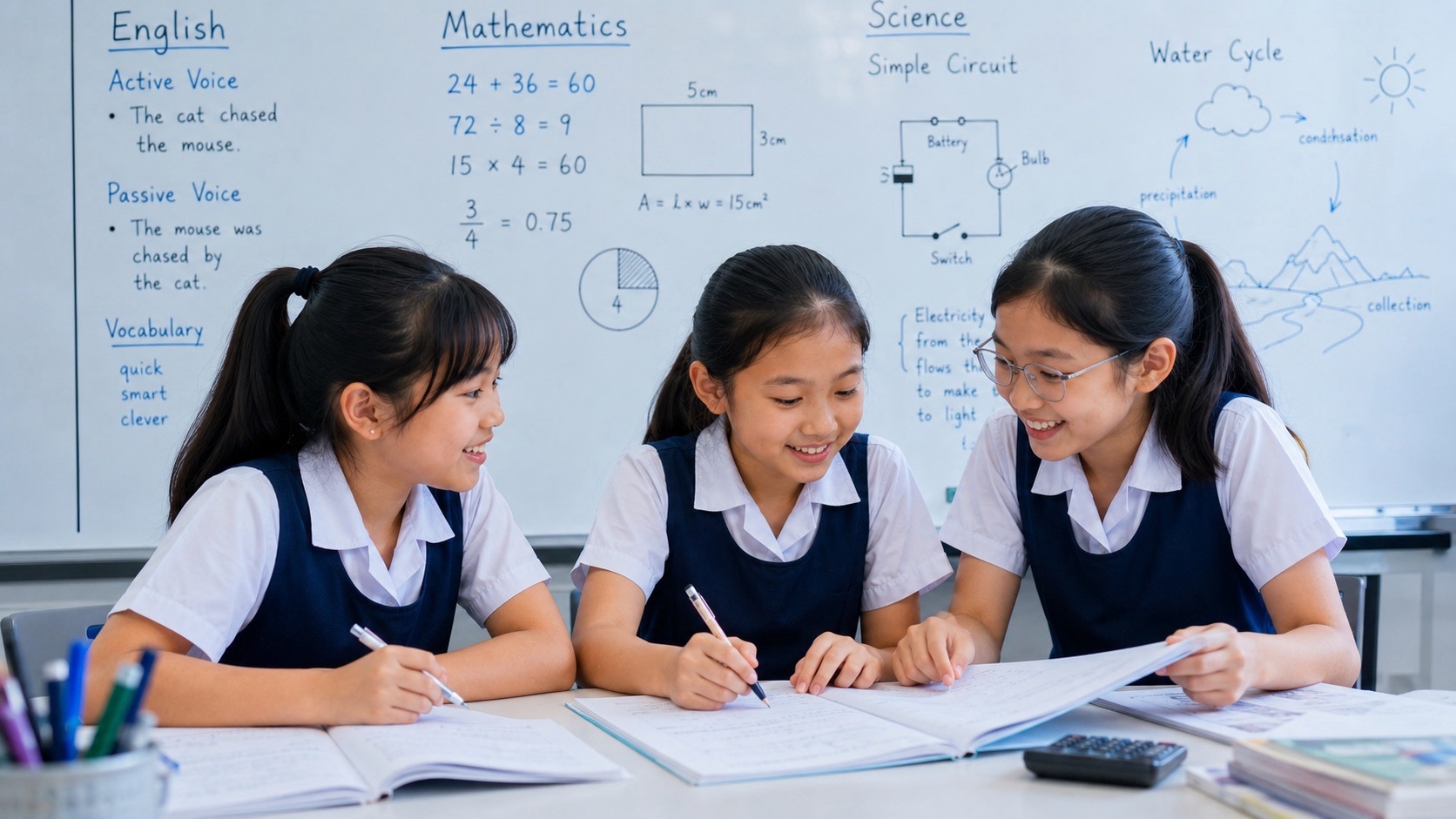
A wet hand can feel colder in front of a fan because moving air usually increases evaporation from the skin, and the escaping water molecules carry energy away. The actionable explanation is not ‘the fan makes cold’; it is ‘moving air replaces humid air near the wet surface, faster evaporation transfers more energy away, and the skin may cool.’
In Punggol Primary 5 Science tuition, this parent question connects evaporation, changes of state, thermal energy transfer, humidity, surface area, variables and claim–evidence–reasoning. A useful safe model compares equal damp paper squares under still and gently moving air instead of asking a child to keep wet skin chilled for a long time.
Parents searching for Primary 5 Science tuition in Punggol, evaporation cooling explanations, why a fan makes wet skin feel cold, fair-test practice or a Science tutor can use this focused guide. The MOE Primary Science syllabus 2023 is the current official curriculum reference, while the Punggol Science Article Index remains the broad owner.
For the broad level route through systems, evidence and application, read Primary 5 Science in Punggol. This page remains distinct by centring the parent’s sensation question, energy accounting and evidence limits.
This guide keeps one parent question narrow so the established subject hub remains the broad owner. Use the five reading routes to begin at the exact misunderstanding, then move through worked examples, contrasts, diagnostics, useful practice and a proportionate parent decision.
For the broader Primary Science route through cycles, energy and investigations, continue to the established subject index. Punggol Science Article Index
Find your next learning step
ROUTE 1 · CHAPTERS 1–3
Answer and diagnose
Resolve the parent question and locate the first unstable idea.
ROUTE 2 · CHAPTERS 4–6
Build the mechanism
Connect language, representations or observations to the governing relationship.
ROUTE 3 · CHAPTERS 7–9
Test the boundary
Use near-misses and changed conditions so the explanation remains accurate.
ROUTE 4 · CHAPTERS 10–12
Practise and explain
Work through varied examples, checks and school-style communication.
ROUTE 5 · CHAPTERS 13–15
Choose the next step
Use diagnostics, home practice, parent decisions and explicit FAQs.
Full chapter index · Start with the first checks · Existing Science article index
Full chapter index
1–3 · Answer and diagnose
4–6 · Build the mechanism
7–9 · Test the boundary
10–12 · Practise and explain
13–15 · Choose the next step
1. The short answer: evaporation removes energy from the skin
The target in this chapter is to explain why a wet hand can feel cooler in moving air. Begin with a prediction before offering a rule. Use this case: Water molecules that escape from the wet skin carry energy away; a fan usually speeds the replacement of moist air with drier air. Ask the learner to answer, justify the choice and point to the smallest piece of evidence that settles it. That first explanation is diagnostic evidence: it may reveal a vocabulary gap, a memorised shortcut, a confused representation, a missing mechanism or difficulty communicating a sound idea clearly.
Build a relationship that predicts unfamiliar cases. For Primary 5 Science, the learner should separate observation from inference, name the relevant process, trace the mechanism and change one variable at a time. The dependable idea here is to explain why a wet hand can feel cooler in moving air. A remembered answer is only a starting point. Remove a familiar word, number or object and ask what remains true. Then change just one controlling condition and ask whether the answer must change. This turns recognition into control.
Work the central case in visible stages. Water molecules that escape from the wet skin carry energy away; a fan usually speeds the replacement of moist air with drier air. First name what each word, number, symbol, object, measurement or observation represents. Next state the governing relationship in one ordinary sentence. Carry out one justified step at a time, then read the result back into the original question. A correct answer supported by an unsafe reason is not secure because that reason may fail when the surface details change.
Place a nearby case beside it: A dry hand in the same room may feel less cooling because there is much less liquid water evaporating. Keep most features constant while changing the controlling condition, then preserve the relationship while changing the context. This double comparison stops a keyword, visual pattern or recently practised phrase from replacing thought. It also gives the learner accurate language for explaining where two routes agree and where they separate.
The tempting wrong route is saying the fan creates cold. Treat that response as information rather than a character judgement. Ask what the learner noticed first, what rule or story was silently used and what evidence could change the answer. Repair the earliest unsafe decision while preserving later work that was sound. Present a fresh near-miss immediately so success cannot come from copying the model’s surface form.
Use this worked-practice sequence: compare wet and dry conditions safely and describe observations before causes. Require three outputs each time: the answer, a reason and a check. Include a familiar item, a boundary case, a changed representation and a delayed cold item. Variation should be purposeful. The aim is to make the learner select the relationship independently, communicate it accurately and notice when a familiar-looking method is no longer allowed.
A useful parent move is to use evaporation and energy transfer in the explanation. Praise a clear reason before speed. If the same weak link appears across several formats, keep two or three dated samples and describe the pattern precisely to the school teacher or tutor. A named pattern gives support a concrete job; broad labels such as weak in science hide the decision that actually needs repair.
Finish chapter 1 with this transfer check: the learner gives a mechanism rather than a slogan. Remove the heading and model, wait at least a day and change the setting. Ask the learner to solve, explain and invent one example that would make the answer different. If the reasoning remains stable, space the next review. If it collapses, return to the first unstable decision instead of adding a large pile of cloned questions.
Keep the emotional temperature low. A misconception that has become visible can now be improved. Let the learner compare two routes aloud, revise one sentence, diagram or line of working, and say what cue will matter next time. End with one independent success. That small receipt is more informative than a long session that finishes with fatigue, and it gives the family a specific starting point for the next review.
2. Evaporation happens at the liquid surface
The target in this chapter is to distinguish surface evaporation from boiling throughout a liquid. Begin with a prediction before offering a rule. Use this case: Some faster-moving surface molecules escape into the air even below boiling point. Ask the learner to answer, justify the choice and point to the smallest piece of evidence that settles it. That first explanation is diagnostic evidence: it may reveal a vocabulary gap, a memorised shortcut, a confused representation, a missing mechanism or difficulty communicating a sound idea clearly.
Build a relationship that predicts unfamiliar cases. For Primary 5 Science, the learner should separate observation from inference, name the relevant process, trace the mechanism and change one variable at a time. The dependable idea here is to distinguish surface evaporation from boiling throughout a liquid. A remembered answer is only a starting point. Remove a familiar word, number or object and ask what remains true. Then change just one controlling condition and ask whether the answer must change. This turns recognition into control.
Work the central case in visible stages. Some faster-moving surface molecules escape into the air even below boiling point. First name what each word, number, symbol, object, measurement or observation represents. Next state the governing relationship in one ordinary sentence. Carry out one justified step at a time, then read the result back into the original question. A correct answer supported by an unsafe reason is not secure because that reason may fail when the surface details change.
Place a nearby case beside it: Boiling produces vapour bubbles throughout the liquid at its boiling condition. Keep most features constant while changing the controlling condition, then preserve the relationship while changing the context. This double comparison stops a keyword, visual pattern or recently practised phrase from replacing thought. It also gives the learner accurate language for explaining where two routes agree and where they separate.
The tempting wrong route is claiming water must reach 100 degrees Celsius before it can become gas. Treat that response as information rather than a character judgement. Ask what the learner noticed first, what rule or story was silently used and what evidence could change the answer. Repair the earliest unsafe decision while preserving later work that was sound. Present a fresh near-miss immediately so success cannot come from copying the model’s surface form.
Use this worked-practice sequence: sort everyday examples into evaporation, boiling and neither. Require three outputs each time: the answer, a reason and a check. Include a familiar item, a boundary case, a changed representation and a delayed cold item. Variation should be purposeful. The aim is to make the learner select the relationship independently, communicate it accurately and notice when a familiar-looking method is no longer allowed.
A useful parent move is to connect the cool hand to ordinary-temperature evaporation. Praise a clear reason before speed. If the same weak link appears across several formats, keep two or three dated samples and describe the pattern precisely to the school teacher or tutor. A named pattern gives support a concrete job; broad labels such as weak in science hide the decision that actually needs repair.
Finish chapter 2 with this transfer check: the learner explains why a puddle can dry without boiling. Remove the heading and model, wait at least a day and change the setting. Ask the learner to solve, explain and invent one example that would make the answer different. If the reasoning remains stable, space the next review. If it collapses, return to the first unstable decision instead of adding a large pile of cloned questions.
Keep the emotional temperature low. A misconception that has become visible can now be improved. Let the learner compare two routes aloud, revise one sentence, diagram or line of working, and say what cue will matter next time. End with one independent success. That small receipt is more informative than a long session that finishes with fatigue, and it gives the family a specific starting point for the next review.
3. Energy is transferred from the hand and surroundings
The target in this chapter is to account for the cooling without saying energy disappears. Begin with a prediction before offering a rule. Use this case: Escaping molecules require energy, and the remaining water and skin can lose thermal energy. Ask the learner to answer, justify the choice and point to the smallest piece of evidence that settles it. That first explanation is diagnostic evidence: it may reveal a vocabulary gap, a memorised shortcut, a confused representation, a missing mechanism or difficulty communicating a sound idea clearly.
Build a relationship that predicts unfamiliar cases. For Primary 5 Science, the learner should separate observation from inference, name the relevant process, trace the mechanism and change one variable at a time. The dependable idea here is to account for the cooling without saying energy disappears. A remembered answer is only a starting point. Remove a familiar word, number or object and ask what remains true. Then change just one controlling condition and ask whether the answer must change. This turns recognition into control.
Work the central case in visible stages. Escaping molecules require energy, and the remaining water and skin can lose thermal energy. First name what each word, number, symbol, object, measurement or observation represents. Next state the governing relationship in one ordinary sentence. Carry out one justified step at a time, then read the result back into the original question. A correct answer supported by an unsafe reason is not secure because that reason may fail when the surface details change.
Place a nearby case beside it: The hand does not become colder because cold flows from the fan. Keep most features constant while changing the controlling condition, then preserve the relationship while changing the context. This double comparison stops a keyword, visual pattern or recently practised phrase from replacing thought. It also gives the learner accurate language for explaining where two routes agree and where they separate.
The tempting wrong route is treating cold as a substance that enters the skin. Treat that response as information rather than a character judgement. Ask what the learner noticed first, what rule or story was silently used and what evidence could change the answer. Repair the earliest unsafe decision while preserving later work that was sound. Present a fresh near-miss immediately so success cannot come from copying the model’s surface form.
Use this worked-practice sequence: draw an energy-transfer account with system boundaries. Require three outputs each time: the answer, a reason and a check. Include a familiar item, a boundary case, a changed representation and a delayed cold item. Variation should be purposeful. The aim is to make the learner select the relationship independently, communicate it accurately and notice when a familiar-looking method is no longer allowed.
A useful parent move is to ask where the energy came from and where it went. Praise a clear reason before speed. If the same weak link appears across several formats, keep two or three dated samples and describe the pattern precisely to the school teacher or tutor. A named pattern gives support a concrete job; broad labels such as weak in science hide the decision that actually needs repair.
Finish chapter 3 with this transfer check: the learner preserves energy in a verbal explanation. Remove the heading and model, wait at least a day and change the setting. Ask the learner to solve, explain and invent one example that would make the answer different. If the reasoning remains stable, space the next review. If it collapses, return to the first unstable decision instead of adding a large pile of cloned questions.
Keep the emotional temperature low. A misconception that has become visible can now be improved. Let the learner compare two routes aloud, revise one sentence, diagram or line of working, and say what cue will matter next time. End with one independent success. That small receipt is more informative than a long session that finishes with fatigue, and it gives the family a specific starting point for the next review.
4. Moving air removes the humid boundary layer
The target in this chapter is to explain the fan’s special role near the skin. Begin with a prediction before offering a rule. Use this case: Still air beside wet skin becomes more humid; moving air carries some of that vapour away and brings less humid air into contact. Ask the learner to answer, justify the choice and point to the smallest piece of evidence that settles it. That first explanation is diagnostic evidence: it may reveal a vocabulary gap, a memorised shortcut, a confused representation, a missing mechanism or difficulty communicating a sound idea clearly.
Build a relationship that predicts unfamiliar cases. For Primary 5 Science, the learner should separate observation from inference, name the relevant process, trace the mechanism and change one variable at a time. The dependable idea here is to explain the fan’s special role near the skin. A remembered answer is only a starting point. Remove a familiar word, number or object and ask what remains true. Then change just one controlling condition and ask whether the answer must change. This turns recognition into control.
Work the central case in visible stages. Still air beside wet skin becomes more humid; moving air carries some of that vapour away and brings less humid air into contact. First name what each word, number, symbol, object, measurement or observation represents. Next state the governing relationship in one ordinary sentence. Carry out one justified step at a time, then read the result back into the original question. A correct answer supported by an unsafe reason is not secure because that reason may fail when the surface details change.
Place a nearby case beside it: If incoming air is already very humid, the increase in evaporation may be smaller. Keep most features constant while changing the controlling condition, then preserve the relationship while changing the context. This double comparison stops a keyword, visual pattern or recently practised phrase from replacing thought. It also gives the learner accurate language for explaining where two routes agree and where they separate.
The tempting wrong route is saying faster air always causes identical cooling. Treat that response as information rather than a character judgement. Ask what the learner noticed first, what rule or story was silently used and what evidence could change the answer. Repair the earliest unsafe decision while preserving later work that was sound. Present a fresh near-miss immediately so success cannot come from copying the model’s surface form.
Use this worked-practice sequence: use arrows to model air replacement at the surface. Require three outputs each time: the answer, a reason and a check. Include a familiar item, a boundary case, a changed representation and a delayed cold item. Variation should be purposeful. The aim is to make the learner select the relationship independently, communicate it accurately and notice when a familiar-looking method is no longer allowed.
A useful parent move is to include conditions instead of overclaiming. Praise a clear reason before speed. If the same weak link appears across several formats, keep two or three dated samples and describe the pattern precisely to the school teacher or tutor. A named pattern gives support a concrete job; broad labels such as weak in science hide the decision that actually needs repair.
Finish chapter 4 with this transfer check: the learner explains why air movement changes the local environment. Remove the heading and model, wait at least a day and change the setting. Ask the learner to solve, explain and invent one example that would make the answer different. If the reasoning remains stable, space the next review. If it collapses, return to the first unstable decision instead of adding a large pile of cloned questions.
Keep the emotional temperature low. A misconception that has become visible can now be improved. Let the learner compare two routes aloud, revise one sentence, diagram or line of working, and say what cue will matter next time. End with one independent success. That small receipt is more informative than a long session that finishes with fatigue, and it gives the family a specific starting point for the next review.
5. Humidity changes the evaporation rate
The target in this chapter is to connect the amount of water vapour already in air with drying. Begin with a prediction before offering a rule. Use this case: Wet clothes often dry more slowly on a humid still day than in drier moving air. Ask the learner to answer, justify the choice and point to the smallest piece of evidence that settles it. That first explanation is diagnostic evidence: it may reveal a vocabulary gap, a memorised shortcut, a confused representation, a missing mechanism or difficulty communicating a sound idea clearly.
Build a relationship that predicts unfamiliar cases. For Primary 5 Science, the learner should separate observation from inference, name the relevant process, trace the mechanism and change one variable at a time. The dependable idea here is to connect the amount of water vapour already in air with drying. A remembered answer is only a starting point. Remove a familiar word, number or object and ask what remains true. Then change just one controlling condition and ask whether the answer must change. This turns recognition into control.
Work the central case in visible stages. Wet clothes often dry more slowly on a humid still day than in drier moving air. First name what each word, number, symbol, object, measurement or observation represents. Next state the governing relationship in one ordinary sentence. Carry out one justified step at a time, then read the result back into the original question. A correct answer supported by an unsafe reason is not secure because that reason may fail when the surface details change.
Place a nearby case beside it: Temperature can also affect drying, so humidity should not be confused with heat alone. Keep most features constant while changing the controlling condition, then preserve the relationship while changing the context. This double comparison stops a keyword, visual pattern or recently practised phrase from replacing thought. It also gives the learner accurate language for explaining where two routes agree and where they separate.
The tempting wrong route is using cloudy or sunny as a complete explanation. Treat that response as information rather than a character judgement. Ask what the learner noticed first, what rule or story was silently used and what evidence could change the answer. Repair the earliest unsafe decision while preserving later work that was sound. Present a fresh near-miss immediately so success cannot come from copying the model’s surface form.
Use this worked-practice sequence: compare hypothetical days by changing one variable at a time. Require three outputs each time: the answer, a reason and a check. Include a familiar item, a boundary case, a changed representation and a delayed cold item. Variation should be purposeful. The aim is to make the learner select the relationship independently, communicate it accurately and notice when a familiar-looking method is no longer allowed.
A useful parent move is to name humidity explicitly when evidence supports it. Praise a clear reason before speed. If the same weak link appears across several formats, keep two or three dated samples and describe the pattern precisely to the school teacher or tutor. A named pattern gives support a concrete job; broad labels such as weak in science hide the decision that actually needs repair.
Finish chapter 5 with this transfer check: the learner predicts relative drying and states assumptions. Remove the heading and model, wait at least a day and change the setting. Ask the learner to solve, explain and invent one example that would make the answer different. If the reasoning remains stable, space the next review. If it collapses, return to the first unstable decision instead of adding a large pile of cloned questions.
Keep the emotional temperature low. A misconception that has become visible can now be improved. Let the learner compare two routes aloud, revise one sentence, diagram or line of working, and say what cue will matter next time. End with one independent success. That small receipt is more informative than a long session that finishes with fatigue, and it gives the family a specific starting point for the next review.
6. Air temperature and air movement are different variables
The target in this chapter is to avoid attributing every sensation to evaporation alone. Begin with a prediction before offering a rule. Use this case: A fan can move room-temperature air without lowering the room’s measured temperature. Ask the learner to answer, justify the choice and point to the smallest piece of evidence that settles it. That first explanation is diagnostic evidence: it may reveal a vocabulary gap, a memorised shortcut, a confused representation, a missing mechanism or difficulty communicating a sound idea clearly.
Build a relationship that predicts unfamiliar cases. For Primary 5 Science, the learner should separate observation from inference, name the relevant process, trace the mechanism and change one variable at a time. The dependable idea here is to avoid attributing every sensation to evaporation alone. A remembered answer is only a starting point. Remove a familiar word, number or object and ask what remains true. Then change just one controlling condition and ask whether the answer must change. This turns recognition into control.
Work the central case in visible stages. A fan can move room-temperature air without lowering the room’s measured temperature. First name what each word, number, symbol, object, measurement or observation represents. Next state the governing relationship in one ordinary sentence. Carry out one justified step at a time, then read the result back into the original question. A correct answer supported by an unsafe reason is not secure because that reason may fail when the surface details change.
Place a nearby case beside it: If the air is hotter than the skin, convection may transfer energy toward the skin even while evaporation occurs. Keep most features constant while changing the controlling condition, then preserve the relationship while changing the context. This double comparison stops a keyword, visual pattern or recently practised phrase from replacing thought. It also gives the learner accurate language for explaining where two routes agree and where they separate.
The tempting wrong route is claiming a fan always cools every object. Treat that response as information rather than a character judgement. Ask what the learner noticed first, what rule or story was silently used and what evidence could change the answer. Repair the earliest unsafe decision while preserving later work that was sound. Present a fresh near-miss immediately so success cannot come from copying the model’s surface form.
Use this worked-practice sequence: separate thermometer readings from human sensations in scenarios. Require three outputs each time: the answer, a reason and a check. Include a familiar item, a boundary case, a changed representation and a delayed cold item. Variation should be purposeful. The aim is to make the learner select the relationship independently, communicate it accurately and notice when a familiar-looking method is no longer allowed.
A useful parent move is to keep evaporation, convection and sensation distinct. Praise a clear reason before speed. If the same weak link appears across several formats, keep two or three dated samples and describe the pattern precisely to the school teacher or tutor. A named pattern gives support a concrete job; broad labels such as weak in science hide the decision that actually needs repair.
Finish chapter 6 with this transfer check: the learner states what is measured and what is felt. Remove the heading and model, wait at least a day and change the setting. Ask the learner to solve, explain and invent one example that would make the answer different. If the reasoning remains stable, space the next review. If it collapses, return to the first unstable decision instead of adding a large pile of cloned questions.
Keep the emotional temperature low. A misconception that has become visible can now be improved. Let the learner compare two routes aloud, revise one sentence, diagram or line of working, and say what cue will matter next time. End with one independent success. That small receipt is more informative than a long session that finishes with fatigue, and it gives the family a specific starting point for the next review.
7. Surface area affects evaporation
The target in this chapter is to explain why spreading water changes drying time. Begin with a prediction before offering a rule. Use this case: The same amount of water spread thinly over skin exposes more surface than a rounded droplet. Ask the learner to answer, justify the choice and point to the smallest piece of evidence that settles it. That first explanation is diagnostic evidence: it may reveal a vocabulary gap, a memorised shortcut, a confused representation, a missing mechanism or difficulty communicating a sound idea clearly.
Build a relationship that predicts unfamiliar cases. For Primary 5 Science, the learner should separate observation from inference, name the relevant process, trace the mechanism and change one variable at a time. The dependable idea here is to explain why spreading water changes drying time. A remembered answer is only a starting point. Remove a familiar word, number or object and ask what remains true. Then change just one controlling condition and ask whether the answer must change. This turns recognition into control.
Work the central case in visible stages. The same amount of water spread thinly over skin exposes more surface than a rounded droplet. First name what each word, number, symbol, object, measurement or observation represents. Next state the governing relationship in one ordinary sentence. Carry out one justified step at a time, then read the result back into the original question. A correct answer supported by an unsafe reason is not secure because that reason may fail when the surface details change.
Place a nearby case beside it: More volume does not automatically mean faster complete drying. Keep most features constant while changing the controlling condition, then preserve the relationship while changing the context. This double comparison stops a keyword, visual pattern or recently practised phrase from replacing thought. It also gives the learner accurate language for explaining where two routes agree and where they separate.
The tempting wrong route is changing both amount and area in a supposed fair test. Treat that response as information rather than a character judgement. Ask what the learner noticed first, what rule or story was silently used and what evidence could change the answer. Repair the earliest unsafe decision while preserving later work that was sound. Present a fresh near-miss immediately so success cannot come from copying the model’s surface form.
Use this worked-practice sequence: compare equal water volumes spread over different areas. Require three outputs each time: the answer, a reason and a check. Include a familiar item, a boundary case, a changed representation and a delayed cold item. Variation should be purposeful. The aim is to make the learner select the relationship independently, communicate it accurately and notice when a familiar-looking method is no longer allowed.
A useful parent move is to identify surface area as one controlled variable. Praise a clear reason before speed. If the same weak link appears across several formats, keep two or three dated samples and describe the pattern precisely to the school teacher or tutor. A named pattern gives support a concrete job; broad labels such as weak in science hide the decision that actually needs repair.
Finish chapter 7 with this transfer check: the learner proposes a fair comparison. Remove the heading and model, wait at least a day and change the setting. Ask the learner to solve, explain and invent one example that would make the answer different. If the reasoning remains stable, space the next review. If it collapses, return to the first unstable decision instead of adding a large pile of cloned questions.
Keep the emotional temperature low. A misconception that has become visible can now be improved. Let the learner compare two routes aloud, revise one sentence, diagram or line of working, and say what cue will matter next time. End with one independent success. That small receipt is more informative than a long session that finishes with fatigue, and it gives the family a specific starting point for the next review.
8. Designing a fair test
The target in this chapter is to test air movement while controlling other factors. Begin with a prediction before offering a rule. Use this case: Use equal drops on identical absorbent pads at equal distance, with one exposed to a gentle fan and one shielded from moving air. Ask the learner to answer, justify the choice and point to the smallest piece of evidence that settles it. That first explanation is diagnostic evidence: it may reveal a vocabulary gap, a memorised shortcut, a confused representation, a missing mechanism or difficulty communicating a sound idea clearly.
Build a relationship that predicts unfamiliar cases. For Primary 5 Science, the learner should separate observation from inference, name the relevant process, trace the mechanism and change one variable at a time. The dependable idea here is to test air movement while controlling other factors. A remembered answer is only a starting point. Remove a familiar word, number or object and ask what remains true. Then change just one controlling condition and ask whether the answer must change. This turns recognition into control.
Work the central case in visible stages. Use equal drops on identical absorbent pads at equal distance, with one exposed to a gentle fan and one shielded from moving air. First name what each word, number, symbol, object, measurement or observation represents. Next state the governing relationship in one ordinary sentence. Carry out one justified step at a time, then read the result back into the original question. A correct answer supported by an unsafe reason is not secure because that reason may fail when the surface details change.
Place a nearby case beside it: Using two different fabrics would add a confounding variable. Keep most features constant while changing the controlling condition, then preserve the relationship while changing the context. This double comparison stops a keyword, visual pattern or recently practised phrase from replacing thought. It also gives the learner accurate language for explaining where two routes agree and where they separate.
The tempting wrong route is testing directly on people and relying only on feelings. Treat that response as information rather than a character judgement. Ask what the learner noticed first, what rule or story was silently used and what evidence could change the answer. Repair the earliest unsafe decision while preserving later work that was sound. Present a fresh near-miss immediately so success cannot come from copying the model’s surface form.
Use this worked-practice sequence: plan variables, repeats, timing and a simple mass or drying endpoint. Require three outputs each time: the answer, a reason and a check. Include a familiar item, a boundary case, a changed representation and a delayed cold item. Variation should be purposeful. The aim is to make the learner select the relationship independently, communicate it accurately and notice when a familiar-looking method is no longer allowed.
A useful parent move is to prefer safe material models over prolonged skin exposure. Praise a clear reason before speed. If the same weak link appears across several formats, keep two or three dated samples and describe the pattern precisely to the school teacher or tutor. A named pattern gives support a concrete job; broad labels such as weak in science hide the decision that actually needs repair.
Finish chapter 8 with this transfer check: the learner identifies independent, dependent and controlled variables. Remove the heading and model, wait at least a day and change the setting. Ask the learner to solve, explain and invent one example that would make the answer different. If the reasoning remains stable, space the next review. If it collapses, return to the first unstable decision instead of adding a large pile of cloned questions.
Keep the emotional temperature low. A misconception that has become visible can now be improved. Let the learner compare two routes aloud, revise one sentence, diagram or line of working, and say what cue will matter next time. End with one independent success. That small receipt is more informative than a long session that finishes with fatigue, and it gives the family a specific starting point for the next review.
9. Measurement and evidence limits
The target in this chapter is to distinguish a personal sensation from a robust conclusion. Begin with a prediction before offering a rule. Use this case: A hand may feel cooler, but a temperature probe can track surface change more consistently. Ask the learner to answer, justify the choice and point to the smallest piece of evidence that settles it. That first explanation is diagnostic evidence: it may reveal a vocabulary gap, a memorised shortcut, a confused representation, a missing mechanism or difficulty communicating a sound idea clearly.
Build a relationship that predicts unfamiliar cases. For Primary 5 Science, the learner should separate observation from inference, name the relevant process, trace the mechanism and change one variable at a time. The dependable idea here is to distinguish a personal sensation from a robust conclusion. A remembered answer is only a starting point. Remove a familiar word, number or object and ask what remains true. Then change just one controlling condition and ask whether the answer must change. This turns recognition into control.
Work the central case in visible stages. A hand may feel cooler, but a temperature probe can track surface change more consistently. First name what each word, number, symbol, object, measurement or observation represents. Next state the governing relationship in one ordinary sentence. Carry out one justified step at a time, then read the result back into the original question. A correct answer supported by an unsafe reason is not secure because that reason may fail when the surface details change.
Place a nearby case beside it: Automatic fan heat, room drafts and unequal water amounts can affect results. Keep most features constant while changing the controlling condition, then preserve the relationship while changing the context. This double comparison stops a keyword, visual pattern or recently practised phrase from replacing thought. It also gives the learner accurate language for explaining where two routes agree and where they separate.
The tempting wrong route is treating one dramatic trial as proof of a universal rule. Treat that response as information rather than a character judgement. Ask what the learner noticed first, what rule or story was silently used and what evidence could change the answer. Repair the earliest unsafe decision while preserving later work that was sound. Present a fresh near-miss immediately so success cannot come from copying the model’s surface form.
Use this worked-practice sequence: repeat measurements and compare ranges rather than one value. Require three outputs each time: the answer, a reason and a check. Include a familiar item, a boundary case, a changed representation and a delayed cold item. Variation should be purposeful. The aim is to make the learner select the relationship independently, communicate it accurately and notice when a familiar-looking method is no longer allowed.
A useful parent move is to discuss uncertainty in age-appropriate language. Praise a clear reason before speed. If the same weak link appears across several formats, keep two or three dated samples and describe the pattern precisely to the school teacher or tutor. A named pattern gives support a concrete job; broad labels such as weak in science hide the decision that actually needs repair.
Finish chapter 9 with this transfer check: the learner states what the evidence supports and what it does not. Remove the heading and model, wait at least a day and change the setting. Ask the learner to solve, explain and invent one example that would make the answer different. If the reasoning remains stable, space the next review. If it collapses, return to the first unstable decision instead of adding a large pile of cloned questions.
Keep the emotional temperature low. A misconception that has become visible can now be improved. Let the learner compare two routes aloud, revise one sentence, diagram or line of working, and say what cue will matter next time. End with one independent success. That small receipt is more informative than a long session that finishes with fatigue, and it gives the family a specific starting point for the next review.
10. Sweat uses the same useful mechanism
The target in this chapter is to connect the model to thermoregulation without oversimplifying. Begin with a prediction before offering a rule. Use this case: Sweat reaching the skin surface can evaporate and remove energy, helping the body release heat. Ask the learner to answer, justify the choice and point to the smallest piece of evidence that settles it. That first explanation is diagnostic evidence: it may reveal a vocabulary gap, a memorised shortcut, a confused representation, a missing mechanism or difficulty communicating a sound idea clearly.
Build a relationship that predicts unfamiliar cases. For Primary 5 Science, the learner should separate observation from inference, name the relevant process, trace the mechanism and change one variable at a time. The dependable idea here is to connect the model to thermoregulation without oversimplifying. A remembered answer is only a starting point. Remove a familiar word, number or object and ask what remains true. Then change just one controlling condition and ask whether the answer must change. This turns recognition into control.
Work the central case in visible stages. Sweat reaching the skin surface can evaporate and remove energy, helping the body release heat. First name what each word, number, symbol, object, measurement or observation represents. Next state the governing relationship in one ordinary sentence. Carry out one justified step at a time, then read the result back into the original question. A correct answer supported by an unsafe reason is not secure because that reason may fail when the surface details change.
Place a nearby case beside it: Sweat that drips away without evaporating contributes less evaporative cooling at that location. Keep most features constant while changing the controlling condition, then preserve the relationship while changing the context. This double comparison stops a keyword, visual pattern or recently practised phrase from replacing thought. It also gives the learner accurate language for explaining where two routes agree and where they separate.
The tempting wrong route is saying sweating cools only because the liquid starts cold. Treat that response as information rather than a character judgement. Ask what the learner noticed first, what rule or story was silently used and what evidence could change the answer. Repair the earliest unsafe decision while preserving later work that was sound. Present a fresh near-miss immediately so success cannot come from copying the model’s surface form.
Use this worked-practice sequence: trace production, movement, evaporation and energy transfer. Require three outputs each time: the answer, a reason and a check. Include a familiar item, a boundary case, a changed representation and a delayed cold item. Variation should be purposeful. The aim is to make the learner select the relationship independently, communicate it accurately and notice when a familiar-looking method is no longer allowed.
A useful parent move is to link the school model to a familiar body process. Praise a clear reason before speed. If the same weak link appears across several formats, keep two or three dated samples and describe the pattern precisely to the school teacher or tutor. A named pattern gives support a concrete job; broad labels such as weak in science hide the decision that actually needs repair.
Finish chapter 10 with this transfer check: the learner explains why humid weather can feel uncomfortable. Remove the heading and model, wait at least a day and change the setting. Ask the learner to solve, explain and invent one example that would make the answer different. If the reasoning remains stable, space the next review. If it collapses, return to the first unstable decision instead of adding a large pile of cloned questions.
Keep the emotional temperature low. A misconception that has become visible can now be improved. Let the learner compare two routes aloud, revise one sentence, diagram or line of working, and say what cue will matter next time. End with one independent success. That small receipt is more informative than a long session that finishes with fatigue, and it gives the family a specific starting point for the next review.
11. Drying clothes and other daily applications
The target in this chapter is to transfer the mechanism beyond skin. Begin with a prediction before offering a rule. Use this case: A spaced clothesline in moving air exposes wet fabric and carries away water vapour. Ask the learner to answer, justify the choice and point to the smallest piece of evidence that settles it. That first explanation is diagnostic evidence: it may reveal a vocabulary gap, a memorised shortcut, a confused representation, a missing mechanism or difficulty communicating a sound idea clearly.
Build a relationship that predicts unfamiliar cases. For Primary 5 Science, the learner should separate observation from inference, name the relevant process, trace the mechanism and change one variable at a time. The dependable idea here is to transfer the mechanism beyond skin. A remembered answer is only a starting point. Remove a familiar word, number or object and ask what remains true. Then change just one controlling condition and ask whether the answer must change. This turns recognition into control.
Work the central case in visible stages. A spaced clothesline in moving air exposes wet fabric and carries away water vapour. First name what each word, number, symbol, object, measurement or observation represents. Next state the governing relationship in one ordinary sentence. Carry out one justified step at a time, then read the result back into the original question. A correct answer supported by an unsafe reason is not secure because that reason may fail when the surface details change.
Place a nearby case beside it: A tightly packed pile traps moist air and reduces exposed area. Keep most features constant while changing the controlling condition, then preserve the relationship while changing the context. This double comparison stops a keyword, visual pattern or recently practised phrase from replacing thought. It also gives the learner accurate language for explaining where two routes agree and where they separate.
The tempting wrong route is crediting the fan with absorbing water. Treat that response as information rather than a character judgement. Ask what the learner noticed first, what rule or story was silently used and what evidence could change the answer. Repair the earliest unsafe decision while preserving later work that was sound. Present a fresh near-miss immediately so success cannot come from copying the model’s surface form.
Use this worked-practice sequence: compare laundry layouts, hair drying and puddles using the same variables. Require three outputs each time: the answer, a reason and a check. Include a familiar item, a boundary case, a changed representation and a delayed cold item. Variation should be purposeful. The aim is to make the learner select the relationship independently, communicate it accurately and notice when a familiar-looking method is no longer allowed.
A useful parent move is to ask which part of the mechanism each design changes. Praise a clear reason before speed. If the same weak link appears across several formats, keep two or three dated samples and describe the pattern precisely to the school teacher or tutor. A named pattern gives support a concrete job; broad labels such as weak in science hide the decision that actually needs repair.
Finish chapter 11 with this transfer check: the learner applies the model without changing its core. Remove the heading and model, wait at least a day and change the setting. Ask the learner to solve, explain and invent one example that would make the answer different. If the reasoning remains stable, space the next review. If it collapses, return to the first unstable decision instead of adding a large pile of cloned questions.
Keep the emotional temperature low. A misconception that has become visible can now be improved. Let the learner compare two routes aloud, revise one sentence, diagram or line of working, and say what cue will matter next time. End with one independent success. That small receipt is more informative than a long session that finishes with fatigue, and it gives the family a specific starting point for the next review.
12. Claim–evidence–reasoning answers
The target in this chapter is to write a complete school-style explanation. Begin with a prediction before offering a rule. Use this case: Claim: the wet hand feels cooler with the fan; evidence: moving air speeds drying; reasoning: faster evaporation transfers more energy away. Ask the learner to answer, justify the choice and point to the smallest piece of evidence that settles it. That first explanation is diagnostic evidence: it may reveal a vocabulary gap, a memorised shortcut, a confused representation, a missing mechanism or difficulty communicating a sound idea clearly.
Build a relationship that predicts unfamiliar cases. For Primary 5 Science, the learner should separate observation from inference, name the relevant process, trace the mechanism and change one variable at a time. The dependable idea here is to write a complete school-style explanation. A remembered answer is only a starting point. Remove a familiar word, number or object and ask what remains true. Then change just one controlling condition and ask whether the answer must change. This turns recognition into control.
Work the central case in visible stages. Claim: the wet hand feels cooler with the fan; evidence: moving air speeds drying; reasoning: faster evaporation transfers more energy away. First name what each word, number, symbol, object, measurement or observation represents. Next state the governing relationship in one ordinary sentence. Carry out one justified step at a time, then read the result back into the original question. A correct answer supported by an unsafe reason is not secure because that reason may fail when the surface details change.
Place a nearby case beside it: ‘Because the fan is cold’ gives neither measured evidence nor the correct mechanism. Keep most features constant while changing the controlling condition, then preserve the relationship while changing the context. This double comparison stops a keyword, visual pattern or recently practised phrase from replacing thought. It also gives the learner accurate language for explaining where two routes agree and where they separate.
The tempting wrong route is listing keywords without linking them causally. Treat that response as information rather than a character judgement. Ask what the learner noticed first, what rule or story was silently used and what evidence could change the answer. Repair the earliest unsafe decision while preserving later work that was sound. Present a fresh near-miss immediately so success cannot come from copying the model’s surface form.
Use this worked-practice sequence: write one sentence for claim, one for evidence and two for reasoning. Require three outputs each time: the answer, a reason and a check. Include a familiar item, a boundary case, a changed representation and a delayed cold item. Variation should be purposeful. The aim is to make the learner select the relationship independently, communicate it accurately and notice when a familiar-looking method is no longer allowed.
A useful parent move is to require arrows or because-therefore links. Praise a clear reason before speed. If the same weak link appears across several formats, keep two or three dated samples and describe the pattern precisely to the school teacher or tutor. A named pattern gives support a concrete job; broad labels such as weak in science hide the decision that actually needs repair.
Finish chapter 12 with this transfer check: the learner explains an unseen situation coherently. Remove the heading and model, wait at least a day and change the setting. Ask the learner to solve, explain and invent one example that would make the answer different. If the reasoning remains stable, space the next review. If it collapses, return to the first unstable decision instead of adding a large pile of cloned questions.
Keep the emotional temperature low. A misconception that has become visible can now be improved. Let the learner compare two routes aloud, revise one sentence, diagram or line of working, and say what cue will matter next time. End with one independent success. That small receipt is more informative than a long session that finishes with fatigue, and it gives the family a specific starting point for the next review.
13. A safe seven-minute home routine
The target in this chapter is to consolidate the idea without risky or wasteful experiments. Begin with a prediction before offering a rule. Use this case: Use two equal damp paper squares, observe drying, identify variables and explain energy transfer. Ask the learner to answer, justify the choice and point to the smallest piece of evidence that settles it. That first explanation is diagnostic evidence: it may reveal a vocabulary gap, a memorised shortcut, a confused representation, a missing mechanism or difficulty communicating a sound idea clearly.
Build a relationship that predicts unfamiliar cases. For Primary 5 Science, the learner should separate observation from inference, name the relevant process, trace the mechanism and change one variable at a time. The dependable idea here is to consolidate the idea without risky or wasteful experiments. A remembered answer is only a starting point. Remove a familiar word, number or object and ask what remains true. Then change just one controlling condition and ask whether the answer must change. This turns recognition into control.
Work the central case in visible stages. Use two equal damp paper squares, observe drying, identify variables and explain energy transfer. First name what each word, number, symbol, object, measurement or observation represents. Next state the governing relationship in one ordinary sentence. Carry out one justified step at a time, then read the result back into the original question. A correct answer supported by an unsafe reason is not secure because that reason may fail when the surface details change.
Place a nearby case beside it: Do not use extreme heat, electrical equipment near spills or prolonged chilling of skin. Keep most features constant while changing the controlling condition, then preserve the relationship while changing the context. This double comparison stops a keyword, visual pattern or recently practised phrase from replacing thought. It also gives the learner accurate language for explaining where two routes agree and where they separate.
The tempting wrong route is turning a simple model into an unsafe challenge. Treat that response as information rather than a character judgement. Ask what the learner noticed first, what rule or story was silently used and what evidence could change the answer. Repair the earliest unsafe decision while preserving later work that was sound. Present a fresh near-miss immediately so success cannot come from copying the model’s surface form.
Use this worked-practice sequence: predict, observe, record, explain and retest after a day. Require three outputs each time: the answer, a reason and a check. Include a familiar item, a boundary case, a changed representation and a delayed cold item. Variation should be purposeful. The aim is to make the learner select the relationship independently, communicate it accurately and notice when a familiar-looking method is no longer allowed.
A useful parent move is to supervise setup and keep the investigation modest. Praise a clear reason before speed. If the same weak link appears across several formats, keep two or three dated samples and describe the pattern precisely to the school teacher or tutor. A named pattern gives support a concrete job; broad labels such as weak in science hide the decision that actually needs repair.
Finish chapter 13 with this transfer check: the learner can reconstruct the mechanism from a new example. Remove the heading and model, wait at least a day and change the setting. Ask the learner to solve, explain and invent one example that would make the answer different. If the reasoning remains stable, space the next review. If it collapses, return to the first unstable decision instead of adding a large pile of cloned questions.
Keep the emotional temperature low. A misconception that has become visible can now be improved. Let the learner compare two routes aloud, revise one sentence, diagram or line of working, and say what cue will matter next time. End with one independent success. That small receipt is more informative than a long session that finishes with fatigue, and it gives the family a specific starting point for the next review.
14. When Primary 5 Science tuition has a clear job
The target in this chapter is to seek focused support when observations and mechanisms remain disconnected. Begin with a prediction before offering a rule. Use this case: A child may know the word evaporation yet say the fan creates cold or absorbs water. Ask the learner to answer, justify the choice and point to the smallest piece of evidence that settles it. That first explanation is diagnostic evidence: it may reveal a vocabulary gap, a memorised shortcut, a confused representation, a missing mechanism or difficulty communicating a sound idea clearly.
Build a relationship that predicts unfamiliar cases. For Primary 5 Science, the learner should separate observation from inference, name the relevant process, trace the mechanism and change one variable at a time. The dependable idea here is to seek focused support when observations and mechanisms remain disconnected. A remembered answer is only a starting point. Remove a familiar word, number or object and ask what remains true. Then change just one controlling condition and ask whether the answer must change. This turns recognition into control.
Work the central case in visible stages. A child may know the word evaporation yet say the fan creates cold or absorbs water. First name what each word, number, symbol, object, measurement or observation represents. Next state the governing relationship in one ordinary sentence. Carry out one justified step at a time, then read the result back into the original question. A correct answer supported by an unsafe reason is not secure because that reason may fail when the surface details change.
Place a nearby case beside it: One imprecise phrase corrected by an energy diagram may need only spaced review. Keep most features constant while changing the controlling condition, then preserve the relationship while changing the context. This double comparison stops a keyword, visual pattern or recently practised phrase from replacing thought. It also gives the learner accurate language for explaining where two routes agree and where they separate.
The tempting wrong route is buying a broad course because an everyday sensation seemed puzzling. Treat that response as information rather than a character judgement. Ask what the learner noticed first, what rule or story was silently used and what evidence could change the answer. Repair the earliest unsafe decision while preserving later work that was sound. Present a fresh near-miss immediately so success cannot come from copying the model’s surface form.
Use this worked-practice sequence: bring authentic answers and ask how support will diagnose, model and retest transfer. Require three outputs each time: the answer, a reason and a check. Include a familiar item, a boundary case, a changed representation and a delayed cold item. Variation should be purposeful. The aim is to make the learner select the relationship independently, communicate it accurately and notice when a familiar-looking method is no longer allowed.
A useful parent move is to define the exact reasoning that should become independent. Praise a clear reason before speed. If the same weak link appears across several formats, keep two or three dated samples and describe the pattern precisely to the school teacher or tutor. A named pattern gives support a concrete job; broad labels such as weak in science hide the decision that actually needs repair.
Finish chapter 14 with this transfer check: the parent can describe the support job with evidence. Remove the heading and model, wait at least a day and change the setting. Ask the learner to solve, explain and invent one example that would make the answer different. If the reasoning remains stable, space the next review. If it collapses, return to the first unstable decision instead of adding a large pile of cloned questions.
Keep the emotional temperature low. A misconception that has become visible can now be improved. Let the learner compare two routes aloud, revise one sentence, diagram or line of working, and say what cue will matter next time. End with one independent success. That small receipt is more informative than a long session that finishes with fatigue, and it gives the family a specific starting point for the next review.
15. Parent FAQs and final transfer
The target in this chapter is to consolidate evaporation, energy, moving air, humidity and fair tests. Begin with a prediction before offering a rule. Use this case: The final task compares a wet hand, damp cloth and covered cup under still and moving air. Ask the learner to answer, justify the choice and point to the smallest piece of evidence that settles it. That first explanation is diagnostic evidence: it may reveal a vocabulary gap, a memorised shortcut, a confused representation, a missing mechanism or difficulty communicating a sound idea clearly.
Build a relationship that predicts unfamiliar cases. For Primary 5 Science, the learner should separate observation from inference, name the relevant process, trace the mechanism and change one variable at a time. The dependable idea here is to consolidate evaporation, energy, moving air, humidity and fair tests. A remembered answer is only a starting point. Remove a familiar word, number or object and ask what remains true. Then change just one controlling condition and ask whether the answer must change. This turns recognition into control.
Work the central case in visible stages. The final task compares a wet hand, damp cloth and covered cup under still and moving air. First name what each word, number, symbol, object, measurement or observation represents. Next state the governing relationship in one ordinary sentence. Carry out one justified step at a time, then read the result back into the original question. A correct answer supported by an unsafe reason is not secure because that reason may fail when the surface details change.
Place a nearby case beside it: The explanation must separate observation, process and conditions. Keep most features constant while changing the controlling condition, then preserve the relationship while changing the context. This double comparison stops a keyword, visual pattern or recently practised phrase from replacing thought. It also gives the learner accurate language for explaining where two routes agree and where they separate.
The tempting wrong route is memorising fans make evaporation faster without saying why. Treat that response as information rather than a character judgement. Ask what the learner noticed first, what rule or story was silently used and what evidence could change the answer. Repair the earliest unsafe decision while preserving later work that was sound. Present a fresh near-miss immediately so success cannot come from copying the model’s surface form.
Use this worked-practice sequence: answer the FAQs, evaluate an experiment and teach the mechanism aloud. Require three outputs each time: the answer, a reason and a check. Include a familiar item, a boundary case, a changed representation and a delayed cold item. Variation should be purposeful. The aim is to make the learner select the relationship independently, communicate it accurately and notice when a familiar-looking method is no longer allowed.
A useful parent move is to connect this narrow question to the established Punggol Science hub. Praise a clear reason before speed. If the same weak link appears across several formats, keep two or three dated samples and describe the pattern precisely to the school teacher or tutor. A named pattern gives support a concrete job; broad labels such as weak in science hide the decision that actually needs repair.
Finish chapter 15 with this transfer check: the learner explains, tests and transfers independently. Remove the heading and model, wait at least a day and change the setting. Ask the learner to solve, explain and invent one example that would make the answer different. If the reasoning remains stable, space the next review. If it collapses, return to the first unstable decision instead of adding a large pile of cloned questions.
Keep the emotional temperature low. A misconception that has become visible can now be improved. Let the learner compare two routes aloud, revise one sentence, diagram or line of working, and say what cue will matter next time. End with one independent success. That small receipt is more informative than a long session that finishes with fatigue, and it gives the family a specific starting point for the next review.
Why does a wet hand feel colder in front of a fan?
Moving air usually speeds evaporation by carrying away humid air near the wet skin. Evaporation transfers energy away from the water and skin, so the skin may cool.
Does the fan make cold air?
Not necessarily. A fan mainly moves air; it can increase evaporation and convective heat transfer without lowering the whole room’s air temperature.
Why does evaporation cool?
Molecules that escape from the liquid surface carry energy. Energy is transferred from the remaining water, skin and surroundings rather than cold entering the hand.
Does humidity matter?
Yes. When nearby air already contains much water vapour, evaporation is usually slower than in drier air under otherwise similar conditions.
Is this the same as boiling?
No. Evaporation occurs at a liquid surface over a range of temperatures, while boiling involves vapour formation throughout the liquid at its boiling condition.
How can this be tested safely?
Compare equal damp paper squares in still and gently moving air, keeping material, water amount, distance, temperature and timing as consistent as possible.
When can Science tuition help?
Focused help is useful when a child can name evaporation but cannot connect moving air, humidity, energy transfer, fair-test variables and evidence in a complete explanation.


