
A Secondary 4 Biology student in Punggol picks up a flower diagram and confidently points to the pollen grain. “That is the seed,” she says, “and when it lands on another flower, fertilisation has happened.” The terms are familiar, and the picture looks convincing. Yet two different processes have been collapsed into one moment. Pollination has happened in a possible scenario; fertilisation is a later event involving the male and female gametes. The best tutoring opportunity is to help the child see the sequence rather than memorise another colourful drawing.
Secondary 4 Punggol Biology tuition is especially useful when a Pure Biology learner needs support with reproduction in flowering plants, pollination, self-pollination, cross-pollination, insect-pollinated and wind-pollinated flowers, pollen tubes and fertilisation. The official 2027 SEC G3 Pure Biology K325 syllabus includes sexual reproduction in flowering plants. By contrast, the 2027 G3 Combined Science (Biology) K327/K328 reproduction section focuses on reproduction in humans, so a tutor should not automatically treat this detailed flowering-plant chapter as compulsory for a Combined Science candidate. The actual exam year, school scheme of work and subject code determine what must be learned.
The topic is more interesting than a diagram quiz. A flower contains structures that support the transfer of pollen, the movement of male gametes and reproduction. Some flowers are pollinated by insects, others by wind, and their features make sense in relation to those methods. Once the student connects structures and processes, unfamiliar exam examples become much less frightening.
Why final-year Biology tuition can help with plant reproduction
A pupil may remember stamen, anther, stigma, ovary and ovule, yet place them in the wrong causal sequence. Another may distinguish self- from cross-pollination but confuse either one with asexual reproduction. A third can label a flower accurately but cannot explain why its features suggest wind pollination.
The correct intervention depends on the error. Simply giving the child more worksheets can rehearse the same misconception if the mechanism remains unclear.
Effective tuition starts with an unseen diagram or short process question, identifies the first failed link and teaches a corrected explanation. A new question then checks whether the pupil can apply it independently.
If the student already manages the syllabus comfortably and can answer unfamiliar questions accurately, more tuition may not be necessary. The purpose is capability, not automatically adding an evening class.
Check the exact 2027 SEC scope before studying
The SEAB 2027 SEC G3 Pure Biology K325 syllabus lists sexual reproduction in flowering plants under Topic 13, Reproduction. Its stated learning outcomes include identifying sepals, petals, stamens and carpels, comparing insect- and wind-pollinated flowers, explaining self- and cross-pollination, and outlining pollen tube growth and fertilisation.
The syllabus explicitly says that production of endosperm and details of development are not required for the pollen-tube and fertilisation learning outcome. This matters: adding sophisticated material about double fertilisation or seed development may be interesting, but it must not displace the required explanation.
The 2027 G3 Combined Science K327/K328 specification instead has Reproduction in Humans and does not list the corresponding flowering-plant reproduction topic. Check the official SEAB G3 subject directory and the learner’s enrolled subject before assigning the chapter.
For candidates sitting examinations in 2026, verify the appropriate O-Level Biology 6093 specifications rather than assuming that every code and paper label is unchanged.
The first map: different parts of a flower do different jobs
A typical flowering-plant reproduction model includes sepals, petals, stamens and carpels. The precise appearance varies among plant species, which is why diagrams and specimen photographs can look very different.
Sepals commonly protect the developing flower bud. Petals may help attract pollinators, though not all flowers have brightly coloured or conspicuous petals. Stamens are male reproductive structures that include anthers, which produce pollen grains. Carpels include female reproductive structures such as the stigma, style and ovary; the ovary contains ovules.
A student should connect each named structure to its role, not merely label its position. When the exam diagram is rotated or simplified, the function remains a more reliable guide than memorised colours.
The tutor can ask the child to explain why a structure is correctly identified in an unfamiliar flower diagram.
Stamen is not a synonym for pollen grain
A stamen is a flower’s male reproductive structure, typically consisting of a filament and anther. A pollen grain is produced by the relevant structures and contains the male reproductive components of the flowering plant’s life cycle.
Students sometimes treat an anther, stamen and pollen grain as interchangeable because they occur near each other in a diagram. A tutor should show the relationship among them without collapsing their different identities.
The anther is a structure of the flower. Pollen grains are produced and released from it under suitable conditions. They can then be transported to a compatible stigma.
The difference matters when the question asks what is being transferred during pollination. The answer is pollen, not the whole stamen.
Stigma, style, ovary and ovule: follow the pathway
The stigma is the receptive surface on which compatible pollen can land. The style connects the stigma with the ovary in many typical flower models. The ovary contains one or more ovules, which are involved in later fertilisation and seed development.
A student who confuses ovary and ovule may write that the pollen tube enters “an ovary inside an ovule,” reversing their relationship.
The tutor can use a simple nested representation: a flower can contain a carpel; a typical carpel includes an ovary; an ovary contains ovules. The learner should describe the actual relationship without assuming every flower looks identical.
Then introduce an unfamiliar specimen diagram and ask the pupil to locate these features based on their biological roles.
Pollination is the transfer of pollen
At school level, pollination is the transfer of pollen grains from the anther to a stigma of an appropriate flower. It is an essential process in sexual reproduction of many flowering plants, but it is not the same event as fertilisation.
The pupil should recognise that pollen may be carried by insects, wind or other agents depending on the species. The syllabus specifically compares insect-pollinated and wind-pollinated flower structures.
A useful short answer identifies the origin and destination of the pollen. It does not invent a fertilisation event simply because the pollen has reached the stigma.
To test understanding, a tutor can show pollen on a stigma and ask what would still need to happen before fertilisation. This is more informative than asking the child to recite “pollination” alone.
Self-pollination and cross-pollination
Self-pollination involves pollen transfer to the stigma of the same flower or another flower on the same plant, in the standard school definition. Cross-pollination involves pollen transfer between flowers of different plants of the same species.
A common error is to claim that self-pollination is asexual reproduction. It is still a form of pollination associated with a plant’s sexual reproductive process, despite the different source of pollen.
Another error is to treat cross-pollination as automatically causing fertilisation. Pollination does not guarantee that a compatible pollen grain will successfully lead to fertilisation under all circumstances.
A tutor should present two imagined plants and ask the student to trace where the pollen originates and where it lands. The distinction becomes much clearer when the source plants are visible.
Worked comparison: which pollination took place?
Question: Pollen moves from the anther of Flower A to the stigma of Flower B, and the two flowers are on different plants of the same species. Is this self-pollination or cross-pollination?
Answer: This is cross-pollination, because the pollen moves between flowers on different plants of the same species.
Now change the scenario: Flower A and Flower B are on the same plant. Under the standard school definition, that transfer is a form of self-pollination.
The key is not the number of flowers. It is the relationship between the plants. A student who checks that relationship before answering has learned the principle rather than the appearance of one diagram.
Insect-pollinated flowers: relate features to function
Insect-pollinated flowers often possess characteristics that help attract suitable pollinators or facilitate pollen transfer. Depending on the species, these may include conspicuous petals, scent or nectar, along with pollen and stigma features suited to insect-mediated transfer.
A student who lists “big petals” without explaining their purpose has only given a feature. A stronger response connects that feature with attracting appropriate pollinators under the stated conditions.
Avoid universal statements such as “every insect-pollinated flower is bright red.” Real flowering plants vary, and pollination biology is much richer than one stereotype.
The exam’s specimen or diagram should guide the comparison. Students should describe what is actually shown and link it to the likely method of pollination.
Wind-pollinated flowers: a different design challenge
Wind-pollinated flowers often have less conspicuous petals and features that assist pollen release and capture in moving air. Exposed anthers and relatively large or feathery stigmas are common school examples.
The function matters more than a label. An exposed anther can facilitate pollen release into the air; a feathery stigma can provide a favourable surface for catching airborne pollen.
Pupils should not assume that wind pollination requires insects to visit the flower, or that all wind-pollinated species share the same exact appearance.
A tutor can give two flower photographs and ask for an evidence-based comparison. The student should avoid inventing invisible details that the image does not provide.
Original comparison question: insect or wind?
Question: A fictional flower has small, inconspicuous petals, exposed anthers and a feathery stigma. Which pollination method does the structure suggest, and why?
Developing answer: “Wind, because it looks like a wind flower.”
Stronger answer: “The features are consistent with wind pollination. Exposed anthers can help pollen be released into moving air, while a feathery stigma offers an effective surface for trapping airborne pollen.”
The improved explanation links evidence to function. It does not rely on a memorised flower name.
Next, show a flower with conspicuous petals and an insect visitor. Ask for the other method and an appropriately cautious account of what the visitor may be doing. An insect on a flower is a useful clue, not automatic proof of successful pollination.
Fertilisation happens after a different set of events
After a compatible pollen grain lands on a stigma, it may germinate and produce a pollen tube. The pollen tube grows through appropriate female tissues towards an ovule. The male gamete nuclei are delivered along this route, enabling fertilisation under suitable conditions.
The school-level meaning of fertilisation is the fusion of male and female gamete nuclei to form a zygote. It is not simply pollen arriving on the stigma, nor the appearance of a seed.
This sequence is important enough to reconstruct step by step. Ask the learner to describe anther → stigma → pollen tube → ovule → fusion of gamete nuclei using accurate explanations between each stage.
A tutor who teaches only a list of flower parts has not yet taught the mechanism the examination expects.
Worked question: pollination is not fertilisation
Question: A pollen grain is seen on a stigma in a labelled classroom image. A student concludes that fertilisation has definitely taken place. Is that conclusion justified?
Better answer: “No. Pollen reaching the stigma is pollination. Fertilisation requires additional processes, including growth of a suitable pollen tube and fusion of the male and female gamete nuclei in an ovule. The image of pollen on the stigma alone does not show that fertilisation has happened.”
This answer identifies a useful boundary between observation and interpretation. It gives the next steps without claiming that they have already occurred.
The tutor can then present a later stage in the process and ask which event is being shown. If the child distinguishes them without prompts, understanding has improved.
The pollen tube is not a seed
A pollen tube is a growing structure associated with a compatible pollen grain and the transfer of male gamete nuclei towards the ovule. It is not a seed, root or stem.
Students may imagine that pollen itself becomes a tiny seed simply because the words appear close together in textbook diagrams. In reality, pollen and a developing seed play different roles in sexual reproduction.
A tutor should use one clear diagram to show the tube’s direction of growth and its function. The deeper development of seed tissues and endosperm is beyond the particular K325 pollen-tube outcome, which explicitly excludes those details.
Teaching to the correct level is more helpful than adding technical detail for its own sake.
Where fruit and seeds belong in the larger story
Following fertilisation, flowering plants can develop seeds and fruits under the appropriate biological conditions. In many familiar flowering plants, the ovule contributes to seed development and the ovary contributes to fruit development.
That is useful context for understanding why flowering-plant reproduction matters, but the 2027 G3 Pure Biology K325 learning outcome expressly does not require the production of endosperm or details of development. Do not turn optional context into a lengthy assessed checklist.
Similarly, seed dispersal is an interesting ecological connection but should not be presented as the central named requirement of this K325 reproduction outcome without checking the specific syllabus and school material.
The immediate examination priority is structure → pollination → pollen-tube pathway → fertilisation, taught accurately.
The difference between reproduction and dispersal
Reproduction concerns the formation of new individuals through biological processes. Dispersal concerns the movement of reproductive structures such as seeds away from a parent plant in many species.
These are related ideas, but they are not synonymous. A student who says that wind carrying a seed is pollination confuses a later dispersal process with pollen transfer before fertilisation.
A tutor can use a timeline: flower structures develop, pollination may occur, fertilisation may follow, and later reproductive structures can develop and disperse under suitable conditions.
The child should know which part of the timeline belongs to the current examined outcomes and which part is useful enrichment.
How microscope and specimen questions connect
The K325 syllabus includes identifying flower parts using suitable specimens and examining pollen grains with a hand lens or light microscope where relevant.
A student may see a pollen image that looks unfamiliar because it differs from a clean textbook illustration. That does not change the functional definitions. The learner should identify what features are actually visible and avoid pretending to observe a gamete nucleus or development stage that the instrument cannot resolve.
Biological line drawings and specimen comparisons reward attention to structure and accurate labels. Fancy shading is not a substitute for correct biological interpretation.
Practical handling of sharp dissecting tools, stains or biological materials must follow school supervision and laboratory safety requirements. An ordinary tuition lesson can use teacher-provided images and prepared data safely.
A two-flower diagnostic for the first lesson
A tutor can present two unfamiliar flower diagrams or accurate photographs. The first has characteristics associated with insect pollination, the second with wind pollination.
Ask the pupil to identify the likely pollination method, justify it with at least two structure–function connections, label the relevant reproductive parts and distinguish what pollination means from fertilisation.
The answers reveal different possible weaknesses. One student may recognise the parts but confuse their roles. Another knows the structure but cannot write a causal explanation. A third gives accurate facts but overstates what a static image can prove.
Each deserves a different short correction and a changed independent retest.
Why “explain” needs a mechanism
For a question such as “Explain how a feathery stigma is adapted for wind pollination,” writing “It is adapted to catch pollen” may be too vague for the required depth.
A stronger response links the structure to its purpose: the large or branched receptive surface increases the opportunity to intercept airborne pollen.
Similarly, “bright petals are for insects” needs the connection to attraction of suitable pollinators where the question requires it.
The tutor can teach feature → biological mechanism → consequence, then practise shortening the answer to the actual command word and marks. This is more useful than memorising entire pages of flower descriptions.
A Punggol flower walk, used responsibly
Parents and children may notice flowers around public landscaping in Punggol. The diversity of shapes and colours can inspire questions about pollination methods.
But a child should not remove flowers from public plantings, damage habitats or assume that a flower belongs to a named species without appropriate identification. A single insect visit does not prove fertilisation occurred.
A photograph can be an invitation to compare visible structures and pose hypotheses. The specific exam answer should still rely on the scenario and evidence provided.
A respectful walk is an opportunity for curiosity, not a substitute for supervised laboratory or syllabus work.
Why this topic tests cross-chapter understanding
Flower reproduction connects cell specialisation, structures and functions, transport processes and inheritance. It also requires careful language: a student must distinguish anther from pollen, ovary from ovule, pollination from fertilisation, and self-pollination from asexual reproduction.
Those distinctions can expose the same underlying learning issue as other Biology chapters: the pupil recognises terms but cannot use them in the correct relationships.
The tutor should address the earliest failed link, not simply tell the student to memorise every part again.
When the relationships are secure, unfamiliar diagrams become easier to interpret even when the plant species changes.
A six-week flowering-plant revision route
Week 1 — Syllabus and diagnosis: confirm Pure Biology or Combined Science and test one unseen flower diagram.
Week 2 — Structures and functions: identify sepals, petals, stamens and carpels, including important component structures.
Week 3 — Pollination types: distinguish self- and cross-pollination and explain the mechanism of pollen transfer.
Week 4 — Pollination adaptations: compare insect- and wind-pollinated flowers from unfamiliar images, justifying each proposed function.
Week 5 — Pollen tube and fertilisation: reconstruct the correct sequence and separate pollination from gamete fusion.
Week 6 — Independent transfer: answer changed structured questions and specimen-based tasks without prompts, then decide whether more support is needed.
This is an illustrative plan, not a guaranteed six-week class or the prescribed chapter order of every school. Combined Science students should prioritise their own required content rather than automatically follow the Pure Biology route.
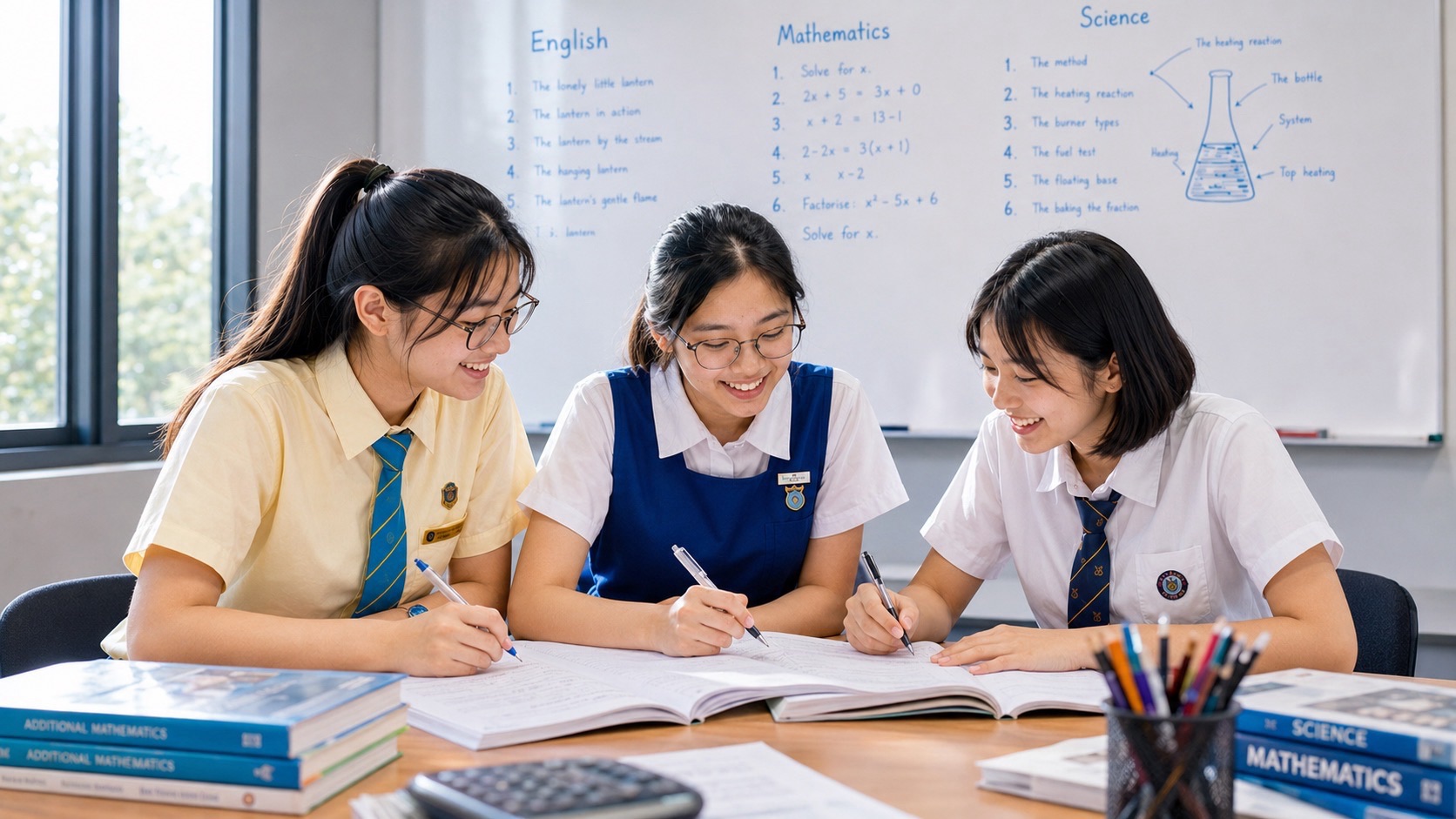
The value of focused three-student tuition
In a small group, the tutor might see that one student confuses ovary and ovule, another mistakes pollination for fertilisation, and a third can label diagrams but cannot explain wind-pollination features.
All three can attempt the same unfamiliar question independently before correction. The tutor then teaches the specific weak step and assigns a changed example to check transfer.
The immutable eduKateSG small-group tutorial reference illustrates this diagnostic approach in Mathematics. It is a method benchmark rather than evidence of an available Punggol Biology class, seat or timetable.
Families can discuss real arrangements at the eduKatePunggol tuition hub.
How parents know the support is working
A student should be able to identify flower parts accurately, explain why their structures suit particular pollination methods, distinguish self- and cross-pollination and outline the pollen tube and fertilisation sequence.
Use unseen questions of comparable difficulty, not only the same diagram repeatedly practised with the tutor. Look for more accurate scientific vocabulary, clearer causal explanations and fewer recurring confusions between adjacent processes.
School marks are useful but vary with topic and paper difficulty. The learner’s independent response to a new diagram is often a stronger early indicator of genuine progress.
When that skill becomes stable, tuition can become lighter or stop.
When this tuition is not the right choice
If the student takes Combined Science and the relevant 2027 syllabus does not include detailed flowering-plant sexual reproduction, extra examination drilling here may be a poor use of time. Interest-driven enrichment is different from compulsory revision.
If a Pure Biology student already knows the topic and handles unfamiliar comparisons independently, the family might gain more from practice in a different weak chapter or from ordinary school work.
If the student is exhausted by too many lessons, additional tuition may do more harm than good. The best intervention is proportionate to the learning need.
A good educator should know when not to recommend another worksheet.
FAQs about Secondary 4 plant reproduction
Is flowering-plant reproduction in 2027 G3 Pure Biology?
Yes. The official K325 syllabus lists sexual reproduction in flowering plants and specifies flower structures, self- and cross-pollination, pollination adaptations, pollen-tube growth and fertilisation.
Is it compulsory in G3 Combined Science Biology?
Not in the same way. The 2027 K327/K328 Biology reproduction topic focuses on reproduction in humans rather than the detailed flowering-plant reproduction outcomes of K325.
Is pollination the same as fertilisation?
No. Pollination is transfer of pollen to a stigma; fertilisation involves fusion of gamete nuclei after the appropriate subsequent processes.
Is self-pollination a form of asexual reproduction?
No. Self-pollination can participate in sexual reproduction because fertilisation involves male and female gametes.
What is the purpose of a feathery stigma?
In many wind-pollinated flowers, its structure provides a favourable surface for intercepting airborne pollen.
Does a pollen grain become a seed immediately?
No. Pollen transfer and tube growth precede fertilisation. Seed development involves later processes and should not be confused with pollination itself.
Must students learn detailed endosperm development?
The 2027 G3 Pure Biology K325 reproduction learning outcome explicitly says production of endosperm and details of development are not required.
How should I revise flower diagrams?
Learn the function of each structure, compare unfamiliar specimen drawings and practise explaining processes without relying on the original diagram’s colours.
Can tuition guarantee an A grade?
No. A tutor can improve syllabus-aligned reasoning and independent performance, but cannot guarantee a specific examination grade.
Continue the eduKate Biology route
Read the Secondary 2 Human Reproductive System, Puberty and Menstrual Cycle article for a related but distinctly human reproductive-system context. See Secondary 4 Mitosis, Meiosis, Cell Division and Inheritance for how gamete formation relates to genetic continuity.
For earlier plant processes, continue to Secondary 2 Plant Transport, Photosynthesis and Science Inquiry and The Core Aim of Punggol Biology Tuition: Photosynthesis and Plant Transport.
Use the official 2027 G3 Biology K325 syllabus as the authoritative reference for this course.
The best answer follows the sequence
The pupil in the opening scene had remembered pollen and seeds but had placed the two too close together in time. Good Biology tuition restores the sequence: flower structures have functions, pollination moves pollen, pollen-tube growth provides a route, and fertilisation is a later biological event.
That is why Secondary 4 Punggol Biology tuition can be worthwhile when a real gap exists. The student should not merely name a diagram. They should be able to explain a new flowering-plant question, distinguish what the evidence shows and reconstruct the process without a tutor standing beside them.


