
A candle burns, wax melts and the flame flickers. One student insists that everything happening is a physical change. Another claims every change must be chemical because there is a flame. Both have spotted something real; neither has yet separated the processes. Secondary 2 Science is full of such beautiful, slightly untidy puzzles.
Secondary 2 Punggol Chemistry tuition can help learners understand chemical changes, physical changes, reaction evidence, conservation of matter and the particle model within their lower-secondary Science work. A tutor should teach students to distinguish observations from interpretations and to explain what changes, what stays the same and how a conclusion can be supported. Secondary 2 is generally still a lower-secondary integrated Science stage, not a universal standalone Pure Chemistry course; the school’s teaching order and subject level remain essential.
For parents searching Sec 2 Science tuition Punggol, chemical reactions Secondary 2, physical versus chemical changes, Science exam questions, Secondary 3 Chemistry preparation or lower secondary Science revision, the question is not simply whether their child remembers the list of reaction examples. It is whether the child can reason about an unfamiliar example with the same Science ideas.
Why Secondary 2 Chemistry-focused tuition can be worthwhile
In Secondary 1, students begin sharpening observation, description and simple models. By Secondary 2, they can encounter more sophisticated questions about chemical composition and changes in matter. They may need to distinguish elements, compounds and mixtures, interpret particle diagrams or explain evidence from an experiment. The precise year in which each topic appears can vary by school.
A child may perform well on direct recall but lose confidence when two chapters appear inside one question. Tuition has value when it repairs that problem. The goal is transfer: use a principle when the familiar picture, material or wording changes.
It is also the stage before upper-secondary subject arrangements become more significant. Stronger Science learning can give families better information for later decisions, but no tutor can guarantee entry into a particular subject combination or examination route.
The candle that hides two different processes
A burning candle is memorable because physical and chemical changes occur together. Some of the wax melts and later may solidify again; these are physical changes of state. Wax vapour also reacts with oxygen in the flame during combustion, producing new substances. A single everyday scene therefore contains more than one process.
The unhelpful shortcut is “If you can reverse it, it is physical; if not, chemical.” Reversibility can sometimes provide useful context, but it is not a universal definition. A better question is whether the process produces new substance or substances with a different chemical composition.
A tutor might draw a line through a description of the candle and ask the student to label which sentences describe melting, which describe burning and which are merely observations. This makes students think about the process, not just the object.
A school worksheet might ask, “Explain why melting wax and burning wax are different.” A clear response identifies change of state without changing chemical composition in melting, and a chemical reaction with oxygen during burning. The child should not add invented products or conditions beyond what the question and level support.
Why bubbles are evidence, not an automatic verdict
Students are sometimes taught that bubbling signals a reaction. It often can, yet bubbles may form during boiling without a new chemical substance being produced. The presence of gas on its own is not sufficient to identify an unfamiliar reaction.
Similarly, a colour change can accompany a chemical reaction, but food dye spreading through a solution can change the observed colour distribution without requiring a new chemical substance. A precipitate may support an inference about a reaction, but an exact substance identification usually requires more information.
The scientifically useful routine is to ask: What do we observe? What possible process could cause it? What additional evidence or test would allow us to distinguish alternatives?
This guards against overconfident answers in school Science, and it sets students up for future Chemistry practical and qualitative analysis reasoning.
What does “a new substance” actually mean?
A chemical change involves substances being transformed into other substances with different chemical identities. Matter is not casually destroyed; atoms are rearranged during ordinary chemical reactions. Introducing this idea carefully helps students later understand chemical equations without prematurely demanding all the symbols of upper-secondary work.
A useful comparison is dissolving sugar in water versus reacting a suitable carbonate with an acid in a supervised laboratory scenario. Sugar dissolves and becomes distributed through the solvent, while the latter process can produce carbon dioxide gas, water and a salt, depending on the reactants. These are different phenomena, even if both situations produce a visible change.
The tutor can ask a child to describe the before-and-after substances in words before using formulae. “What was present before? What evidence is there for what is present afterwards?” is a more productive opening than demanding a memorised sentence about reactions.
A worked reasoning problem: why can a reacting beaker lose mass?
Imagine an examination question: a container holds a suitable acid and carbonate that produce a gas. Its mass is measured before the substances are combined and again after the reaction, while the top is open. The final measured mass is lower.
A student might conclude, “Matter was destroyed.” But a better explanation is that gas can escape from an open system, so the balance no longer measures the entire set of products and surroundings together. The measured mass of the container and its remaining contents falls even though ordinary chemical reactions conserve mass overall when the whole system is accounted for.
Now change the scenario to a genuinely closed and suitable experimental system with no materials entering or leaving. The total mass measured for that closed system is expected to remain constant, within measurement uncertainty, during an ordinary chemical reaction.
This problem teaches three ideas at once: chemical changes may produce gases, experiments measure specified systems rather than the entire universe, and a scientific conclusion must match the apparatus described.
The scenario is for written reasoning. Reactions that release gases, use acids or require closed containers must not be improvised at home; school laboratories assess appropriate equipment and safety conditions.
Chemical composition: the words must stay distinct
“Element,” “compound” and “mixture” are among the most useful concepts on the road towards upper-secondary Chemistry. An element contains only one type of atom. A compound contains two or more elements chemically combined in fixed proportions. A mixture combines substances without those constituents being chemically bonded into one new compound.
What makes the distinction difficult is that students may concentrate only on whether a drawing shows different colours. A drawing with two types of particles is not enough information unless the representation makes clear whether those particles are bonded together as the same chemical substance or simply mixed.
Try three examples: an oxygen sample, pure water and air. Their classifications differ, but not because of how many components a human observer can see. A tutor can use particle drawings, symbols and oral explanation to make the reasoning visible.
Our Secondary 2 atoms, molecules and Periodic Table foundations guide explores the representational skills that support this classification.
Science questions reward the connection, not merely the noun
Take the prompt, “Explain why the salt solution cannot be separated into salt and water by filtration.” A weak answer says, “Because filtration is wrong.” A more useful answer explains that dissolved salt is not trapped by ordinary filter paper; the salt passes through with the water as part of the solution. A different separation method is needed depending on which component the question asks to recover.
The word “explain” means that the learner must connect the material’s property to the selected procedure. A method name by itself is not a mechanism.
At this level, Chemistry-focused tuition should reinforce the difference between observation, classification, explanation and conclusion. Students will later need the same distinctions when writing about precipitates, metals, rates of reaction and electrolysis.
Investigations: how to avoid accidental conclusions
Suppose a learner wants to compare the time taken for two identical metal samples to change appearance under different exposure conditions. The design must define the conditions that differ, how the result is measured and what is kept constant. Differences in metal type, sample area, temperature, moisture or observation interval could otherwise confuse the comparison.
It is not enough to say “make it a fair test.” The learner should specify which factor matters and why. Measuring different samples at different times can create an apparent difference unrelated to the intended independent variable.
The tutor might provide two experimental designs and ask the student to identify which is more informative, then improve the weaker one. Such comparative thinking often develops stronger inquiry skills than copying a perfect procedure once.
Real corrosion experiments and test chemicals should only be conducted with suitable supervision and approved materials; students can practise the reasoning using diagrams and supplied results.
From a verbal reaction to a balanced chemical equation
Secondary 2 students need not be rushed into every upper-secondary equation. Still, the core idea is worth introducing at the level their school has reached: the substances present before a reaction become products, and the same types of atoms must be accounted for on both sides.
A verbal example may be “magnesium reacts with oxygen to form magnesium oxide.” When the learner later meets the symbolic equation 2Mg + O₂ → 2MgO, the coefficients will have a reason: they make the number of magnesium and oxygen atoms match on both sides. Changing MgO into MgO₂ to balance the oxygen would create a different formula and tell the wrong chemical story.
A careful tutor knows when to stop. If the student’s current school work is about distinguishing observations and simple chemical changes, advanced symbolic equations may be saved for later. The purpose of tuition is readiness, not collecting hard-looking examples for display.
Why the second year is a good moment to correct misconceptions
Uncorrected misconceptions tend to create knock-on errors. If a learner believes dissolving destroys matter, conservation questions will be difficult. If the learner treats bubbles as proof of any proposed gas, practical evidence will be interpreted carelessly. If compounds and mixtures are indistinguishable, later formulae will seem arbitrary.
These problems are easier to diagnose while the student is still working with everyday examples than after they become entangled with ionic equations and calculations. A focused tutorial traces the earliest incorrect assumption and tests whether the student can replace it with a scientifically meaningful model.
An effective correction sequence is short: hear the original idea, show a counterexample, teach the accurate distinction, practise a new case and retest independently.
What a three-student tutorial adds
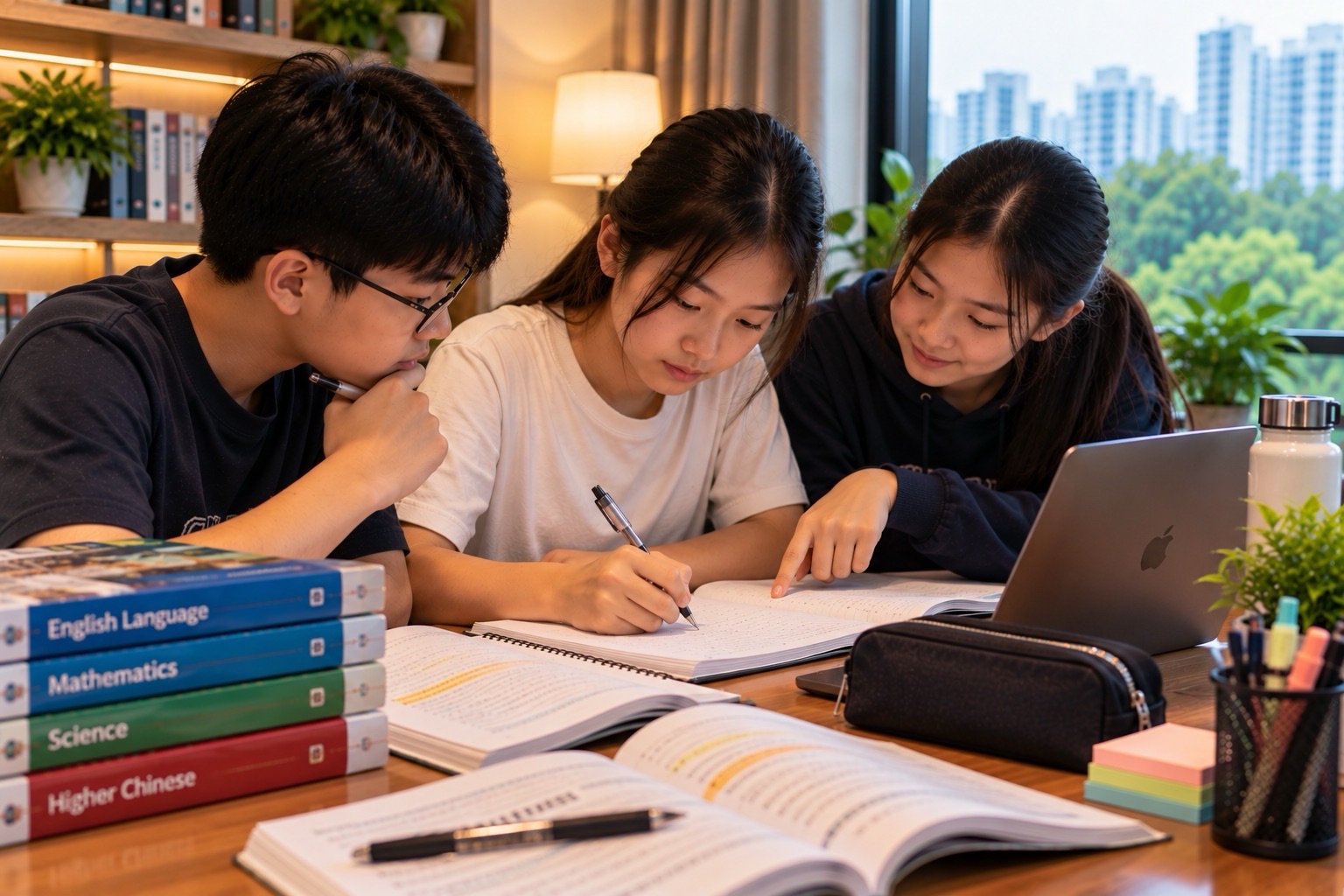
The eduKate ecosystem’s small-group tutoring reference describes a three-pupil, 1.5-hour weekly learning format built around explanation, carefully sequenced practice and close feedback. In a Chemistry-focused session serving Punggol families, that model can make students’ differing misconceptions visible.
For example, one learner identifies every colour change as a chemical reaction. Another gives the correct classification but no reason. A third understands the reaction yet misreads an experimental graph. All can discuss the same core scenario while receiving different individual follow-ups.
The group succeeds only when every student has a chance to explain and to answer a fresh question alone. Nodding while a classmate speaks does not demonstrate transfer.
An illustrative six-week Chemistry-focused Science plan
The school syllabus, student level and current assessments take priority over any printed schedule. With that in mind, a sensible diagnostic progression might be:
- Week 1—Establish the baseline: use recent Science work to locate confusion between physical change, chemical change and evidence.
- Week 2—Repair key classifications: distinguish elements, compounds, mixtures and simple particle representations where relevant.
- Week 3—Reason from observations: compare bubbles, precipitates, colour changes and changes of state without jumping to unsupported conclusions.
- Week 4—Interpret investigations: practise fair tests, open versus closed systems, conservation and accurate graph descriptions.
- Week 5—Apply ideas in unfamiliar contexts: combine multiple concepts without a chapter label and require short explanations.
- Week 6—Retest and plan forward: check whether the learner can distinguish new examples independently and identify priorities for Secondary 3.
The outcome to look for is improved explanation, not the number of worksheets filled in.
What about Sec 3 subject choices?
Chemistry-focused learning can illuminate a student’s interest and readiness, but it should not be used to pressure them into a single academic route. Schools determine subject offerings and eligibility; families should consider the actual school information, the student’s broader workload, aspirations and the scientific understanding demonstrated over time.
Pure Chemistry and Chemistry-containing Combined Science routes have different syllabuses at upper-secondary level. Singapore’s first SEC examinations are in 2027, but a student who is Secondary 2 in 2026 will generally reach Secondary 4 in 2028 on a four-year secondary pathway. Their exact 2028 syllabus and school subject options—not the assumption that every child sits the 2027 papers—should guide future decisions.
For the next stage, the eduKate Punggol explanation of Pure Chemistry tuition gives context on how lower-secondary foundations eventually connect to deeper upper-secondary study.
A parent-friendly way to check readiness
Ask the student to choose one physical change and one chemical change from everyday life. Have them explain why each belongs in its category and what evidence might show a new substance has formed. Then change one detail: what if something melts while it burns? What if bubbles appear only because a liquid is boiling?
A thoughtful student may say, “I need more information to know for sure.” In science, that can be a stronger answer than an unsupported guess. The child is learning to respect evidence rather than simply chase certainty.
If questions are repeatedly missed, bring a few exact examples to the tutor rather than labelling the child “bad at Chemistry.” The first explanation is broad and discouraging; the second gives a teacher something concrete to improve.
Frequently asked questions
Is Secondary 2 Chemistry different from Secondary 2 Science?
Chemistry-related ideas typically sit within lower-secondary Science at this stage. A focused tuition lesson may concentrate on matter and chemical changes, but school coverage and assessment remain broader than standalone Chemistry.
Must a student know every chemical equation before Secondary 3?
No. Knowledge should be sequenced according to the student’s school syllabus and readiness. Conceptual distinctions, scientific evidence and simple correct representations provide a better base than premature memorisation of numerous reactions.
Does bubbling prove that a chemical reaction occurred?
Not on its own. Boiling can create gas bubbles during a physical change. Interpret the supplied conditions, the substances involved and any additional evidence before identifying a chemical reaction.
Is a chemical change always impossible to reverse?
That is not a safe universal definition. The key distinction is whether chemical identities change. Reversibility depends on the conditions and process and should not replace the concept of new substances.
What shows that tuition is helping?
Look for independent classification of unfamiliar examples, clearer conclusions supported by observations, better control of variables and fewer repeated misconceptions when the question wording changes.
Looking ahead: from familiar changes to precise Chemistry
The most satisfying progress in Secondary 2 happens when a student stops guessing what a question “probably wants” and starts explaining what the evidence really supports. The candle, the dissolving solid and the reacting sample become examples of general scientific ideas rather than one-off textbook pictures.
Secondary 2 Punggol Chemistry tuition can earn its place when it produces that kind of reasoning. The understanding built now makes Secondary 3 formulae, acids and salts, bonding and reactions feel like the continuation of a story the learner already understands.
Explore the 2026 eduKate Punggol Chemistry progression: Secondary 1: Science Answers and Experiment Skills · Secondary 2: Chemical Changes and Evidence · Secondary 3: Acids, Bases and Salts · Secondary 4: Electrolysis, Redox and Exam Questions.


