
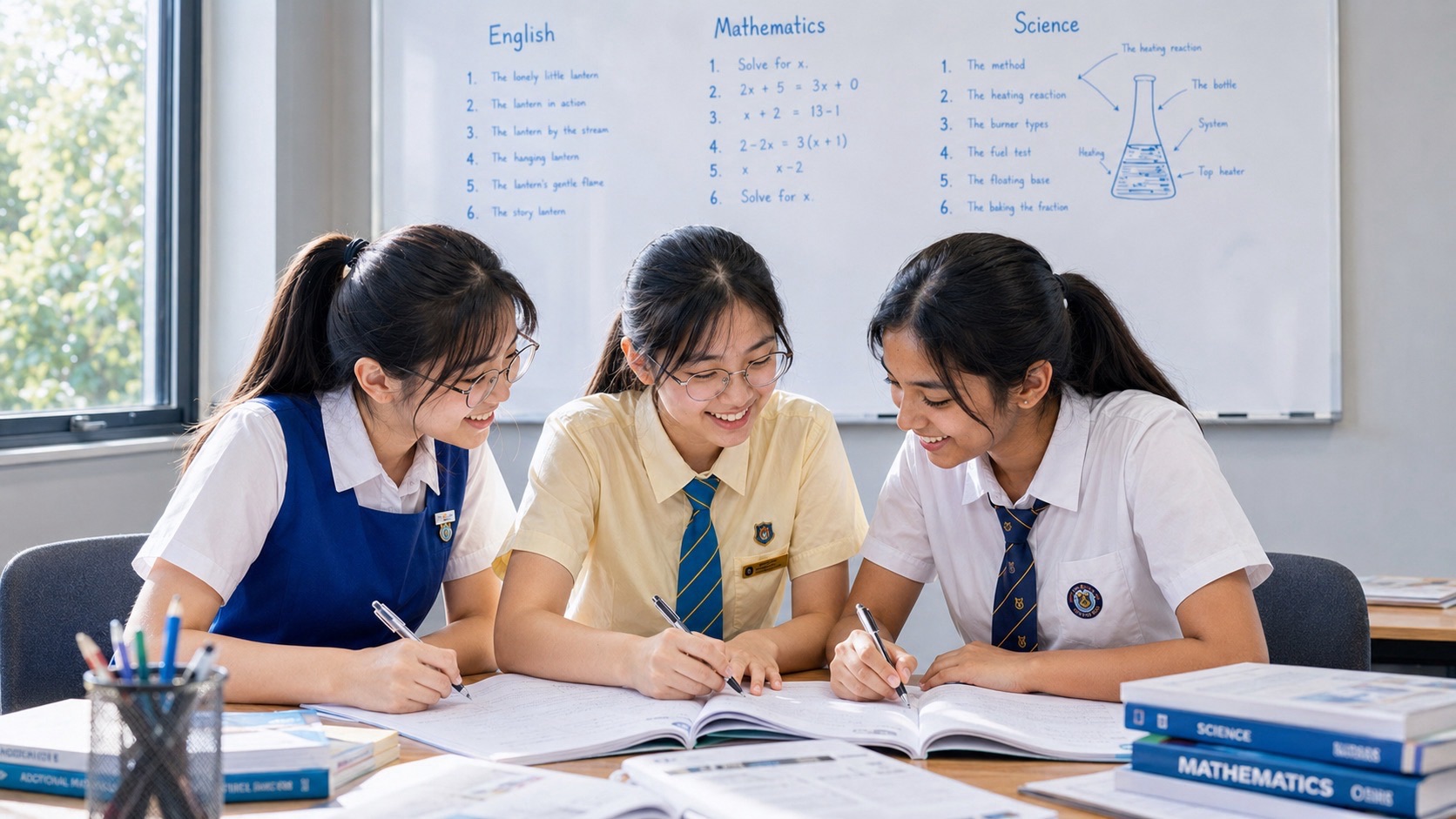
The revision season has a familiar soundtrack in Punggol homes: pages turning, printers humming, somebody asking where the other History notes went, and a student announcing that there are seventeen chapters left. When the pressure rises, it is tempting to measure effort by the height of the paper pile. Unfortunately, paper stacks have never sat an examination.
How Punggol History tuition works for O-Level History revision and 2027 SEC exam preparation is to turn a large syllabus into a sequence of manageable, testable decisions. The tutor verifies the student’s actual course, diagnoses whether marks are being lost through knowledge, source-based reasoning, essay explanation or timing, then plans retrieval, targeted practice, correction and independent transfer. Good revision is not the pursuit of every possible question. It is the development of a dependable method for questions the student has not seen.
This guide is for families searching for O-Level History tuition, History revision timetable, History past-year papers and SEC History exam preparation in Punggol. It includes a realistic revision cycle, a sample six-week timetable, a mistake tracker, guidance for Pure History versus Combined Humanities, and parent-friendly ways to assess readiness without adding unnecessary pressure.
The very first step: confirm which examination is actually ahead
A student preparing for an examination in 2026 must not automatically use a timetable or paper list written for the first SEC examinations in 2027. The subject names may appear similar while their pathway codes and assessment documents differ.
For 2026 GCE O-Level school candidates, SEAB lists standalone History 2174 and Humanities (Social Studies, History) 2261 separately.
For 2027 Singapore-Cambridge Secondary Education Certificate (SEC) school candidates, SEAB lists:
- G3 History: K330 (reference code 2174).
- G3 Humanities (Social Studies, History): K336 (reference code 2261).
- G2 History: K227 (reference code 2195).
- G2 Humanities (Social Studies, History): K230 (reference code 2126).
These codes help families open the appropriate official documents. They do not mean that G2 and G3 students share an identical paper or that every historical question has the same format. Subject level, examination year, taught content and school instructions all matter.
Check SEAB’s 2026 O-Level school candidate syllabus list, 2027 SEC G2 list and 2027 SEC G3 list before a tutor assigns full-paper practice.
Why revision must begin with diagnosis, not a calendar
A beautiful study timetable can fail if it distributes time evenly across problems that are not equally important.
Imagine a fictional Secondary 4 student who scores 60% on a school History paper. The student may know the prescribed events but answer the wrong aspect of an SBQ. They may have excellent source interpretation but leave an essay incomplete. Or they may remember broad themes while forgetting the evidence that makes explanations specific.
Each case deserves a different allocation of practice. A good first session therefore samples content retrieval, source interpretation, explanation and timed execution using the student’s actual materials.
| Diagnosis | What the tutor asks | What revision should prioritise |
|---|---|---|
| Weak historical knowledge | Can the student recall and place key developments without notes? | Brief active recall and contextual rebuilding |
| Weak SBQ inference or comparison | Can the student draw a supported inference from a new source? | Targeted source analysis with transfer tasks |
| Descriptive essays | Does the paragraph explain why or simply retell events? | Causal chains and evidence-to-argument writing |
| Weak evaluation | Does the conclusion weigh explanations against a criterion? | Comparative reasoning and qualified judgement |
| Poor examination timing | Where does time disappear during an appropriate practice task? | Planning efficiency and carefully calibrated timed work |
| Repeated familiar mistakes | Are corrections remembered on later, unseen questions? | Error logs, spaced review and new-question checks |
The aim is to work out which next thirty minutes of practice will make the most difference, not merely fill the diary.
Build the History revision map before writing the timetable
Begin with the school’s current topic list and the year-specific syllabus. Sort content into three categories: secure, partly secure and requires rebuilding. Use recent work and short closed-book questions rather than confidence alone.
For each topic, prepare a compact evidence map: chronology, relevant people and developments, key causes or consequences, and evidence the student may use in an explanation. The map should answer why this knowledge matters for the subject, not become an encyclopaedia.
Where a topic spans several connected events, a timeline can expose whether the student’s confusion is about dates, sequence or causation. Small diagrams are useful when they clarify relationships; elaborate decorations that consume the evening are not revision by themselves.
A tutor should periodically revisit the map. A topic that feels secure after reading notes may become less secure when the student must explain it without notes three days later.
The six-week History revision plan: an adaptable example
The following plan is a sample cycle, not a fixed centre timetable or official SEAB instruction. Compress or extend it according to the time available, school calendar, child’s wellbeing and size of the learning gaps.
| Phase | Main objective | Evidence of progress |
|---|---|---|
| Week 1: Diagnose | Confirm syllabus and sample content, SBQ, essay and timing skills | Named weaknesses and a short prioritised plan |
| Week 2: Repair | Rebuild unstable chronology, source interpretations and explanation moves | Correct answers after prompts have been reduced |
| Week 3: Retrieve | Recall content after delays; mix source types and topics | Accurate knowledge and task recognition without notes |
| Week 4: Apply | Complete unfamiliar SBQ and essay tasks at the right level | Reasoning transfers beyond rehearsed examples |
| Week 5: Integrate | Practise appropriate examination-style sets with calibrated timing | Balanced quality and pacing across tasks |
| Week 6: Consolidate | Review high-value errors and protect effective routines | Fewer recurring errors; readiness without frantic new systems |
A student with serious conceptual gaps may need longer in repair. A student already writing strong answers may benefit from earlier mixed application. The point of the table is the sequence of learning, not a demand that every household follow the same dates.
A weekly tuition cycle that makes revisions stick
A productive revision cycle contains six moves.
1. Recall before rereading
Start with notes closed. Ask for a short timeline, three relevant concepts, an explanation of why an event mattered, or a brief outline of a previously learned argument.
If recall fails, return to the smallest relevant part of the material. Do not automatically restart the entire chapter. This isolates what is actually missing.
2. Teach the unstable concept precisely
Perhaps the student does not understand the political context, how two historical developments are connected, or how an author’s purpose affects interpretation. The tutor repairs that point with a clear explanation and an appropriate short task.
3. Apply the idea with guided practice
The student attempts a source question or essay paragraph while the tutor asks carefully chosen questions. Assistance is deliberately reduced. The tutor watches not just whether the answer is correct, but which step required rescue.
4. Record one or two errors worth tracking
A useful error record is specific. Instead of “bad at History,” write “in comparison questions, discusses Source A and B separately without comparing the same issue.” That creates a teachable target.
5. Test the same skill on unseen material
The student solves a new source, argument or question that uses the same reasoning operation. If the error returns, the method needs reinforcement. If it does not, the tutor increases complexity or mixes the skill with earlier learning.
6. Revisit after a delay
The next lesson includes a short retrieval or transfer check. Learning that survives a delay is more convincing than learning that appears only immediately after a demonstration.
This sequence echoes the first-principles, diagnose-and-rebuild architecture of the immutable eduKateSG teaching reference, adapted specifically to historical inquiry and writing.
How History past-year papers should be used responsibly
History past-year papers are useful when they match the student’s actual course or are clearly labelled as skills practice. They provide practice in interpreting questions, selecting evidence, writing concisely and managing time.
However, not every older paper is a faithful rehearsal for the current examination. The paper may be from a different subject combination, earlier syllabus, G level or historical content scope.
Before using a paper, write four identifiers on the cover:
- Examination year and subject code.
- History or Humanities combination.
- Relevant G level or earlier examination pathway.
- Purpose of the task: exact-format rehearsal or adapted skills drill.
A question from an older syllabus may still be excellent for practising inference. That does not entitle anyone to label it as a current full-paper simulation. School-provided rubrics and official documents must take priority.
Only use lawfully accessible materials and respect copyright on past-year papers, published model answers and third-party resources.
Source-based question revision: one process, many documents
History students often read a lot but practise relatively little actual inference. A strong SBQ revision session makes the student choose the claim, quote relevant evidence, explain the connection and note the conclusion’s limits.
Then add provenance and corroboration where the task calls for them: Who produced the account? When? For whom? Which other source helps test the claim? What remains unknown?
A student who writes “biased, therefore unreliable” may need an entire short lesson on how a partisan source can still be useful evidence of the author’s aims or contemporary attitudes. A student who quotes several lines without answering may need only a tight claim–evidence–reasoning drill.
For a full worked example, use our guide to History source-based questions, inference and reliability.
Essay revision: prepare arguments, not speeches to memorise
Students facing an essay question should select relevant historical knowledge, explain causal connections and, when appropriate, compare alternatives before reaching a supported judgement.
Model essays help reveal what careful explanation looks like. They become less helpful when students memorise entire introductions and conclusions while ignoring the exact new question.
A more transferable routine is to create argument cards. Each card contains a claim, two or three appropriate facts, the mechanism explaining why those facts matter, and one limitation or alternative perspective. The student then practises selecting the relevant cards for an unfamiliar prompt.
For a detailed example, see O-Level History essay writing and structured questions.
What a targeted error log looks like
An effective error log can fit on one page. It is not a diary of shame. It is a record of which costly thinking habits are changing.
| Date / skill | Observed mistake | Repair instruction | Transfer check |
|---|---|---|---|
| SBQ inference | Claimed the source proved what only one witness believed | Limit inference to what the witness said and context permits | New diary source next session |
| Source purpose | Mentioned bias without explaining intended audience or effect | Link message, audience and purpose | Unseen announcement |
| Essay causation | Listed three factors but gave no mechanisms | Add how each factor contributed to the outcome | Different causation prompt |
| Knowledge recall | Confused sequence of two events | Rebuild brief timeline and retrieve later | Closed-book check after several days |
| Timed response | Spent disproportionate time rewriting an introduction | Make a brief plan, draft purposefully, review time use | New school-aligned timed practice |
The tutor should record improvement only after independent transfer. A beautifully corrected original answer is not enough.
What should happen in the final fortnight
Two weeks before an assessment, students often feel pressure to start again from the first page. That may be unnecessary and counterproductive.
The better question is: Which important weaknesses remain, and which are already under control?
At this stage, preserve a balanced mix of short retrieval, selected SBQ questions, concise essay plans, some appropriately timed practice and review of the error log. Do not launch an elaborate new note-making system on the eve of the paper.
Sleeping, eating, moving and managing other subject demands are part of sensible preparation. History tuition should help students make selective decisions rather than compete with every spare hour of their lives.
The difference between lower-secondary and examination-year revision
A Secondary 1 or Secondary 2 student in Punggol needs a different emphasis from a Secondary 4 learner. Lower-secondary History tuition should establish historical inquiry, chronology, basic source interpretation and supported explanation using material that matches school lessons.
At Secondary 3, students often need to strengthen topic foundations and adapt to upper-secondary History or Humanities expectations. At Secondary 4, relevant independent practice, feedback and examination execution become more pressing.
Nevertheless, the core learning cycle remains the same: diagnose, understand, retrieve, practise, transfer and adjust.
Tutors should not automatically give lower-secondary learners O-Level or SEC practice papers. Nor should they treat a G2 student’s paper as a reduced version of G3 without consulting the relevant curriculum. The actual subject and level guide the work.
What parents can do during History revision season
The most helpful parental contribution is not to become an examiner every evening. It is to create an environment where purposeful practice is possible and progress can be discussed honestly.
Ask these four questions once or twice a week:
- “Which History skill are you practising this week?”
- “What did the last correction teach you?”
- “Can you show a different question where you used that correction?”
- “Is the plan leaving enough time for your other subjects and rest?”
Parents can also help assemble the practical information a tutor needs: current school topics, recent marked work, assessment dates and teacher feedback. In Punggol, travel time and study schedules are real constraints; the best revision plan is one the family can sustain.
Avoid grade guarantees and invented improvement timelines. A useful sign of success is that the student can begin unfamiliar questions with less anxiety because they know what to do first.
How to choose a Punggol History tutor for exam preparation
Location and convenience matter, but an effective History tutor near Punggol should be able to explain how they match teaching to the student’s exact subject, G level and assessment year.
Ask for an example of a diagnostic finding and the practice that followed. Ask how source-analysis feedback differs from essay-writing feedback. Ask what happens when a student understands a worked example but fails an unfamiliar one.
If a programme advertises small-group teaching, ask how each child gets meaningful opportunities to reason, write and receive feedback. Class size is a condition that may support good teaching; it is not a substitute for the teaching itself.
Look for honest, observable measures: more accurate recall after a delay; better source inference; clearer causal paragraphs; fewer repeated errors; and improved task completion within the requirements of the actual school paper.
Frequently asked questions about History revision and SEC preparation
How many hours a week should my child revise History?
There is no single responsible figure. The right amount depends on the student’s current gaps, examination proximity, overall subject load, attention and health. Start from specific tasks and review whether learning persists rather than assigning time for its own sake.
Should my child practise History past-year papers every day?
Usually a varied approach is more useful. Alternate active recall, short source questions, essay planning, timed tasks and error reviews. Full papers are best used deliberately, not as an endless pile.
Is the 2027 SEC History examination identical to the 2026 O-Level?
Do not assume so. SEAB publishes year-specific G2 and G3 SEC syllabuses and reference codes. The correct official document and school guidance determine the student’s preparation.
What if my child is strong in History content but weak in SBQ?
That is a useful diagnosis. Protect their knowledge strength while directing practice towards inference, context, corroboration or task recognition, according to the actual error.
What if the student is anxious about forgetting everything?
Reduce the problem to short, testable retrieval exercises and show evidence of what has been retained. If distress is severe or interferes with daily life, coordinate with school and suitable professional support rather than expecting tuition alone to solve it.
Can tuition guarantee a better grade?
No responsible educator should guarantee an external examination outcome. Look for clear diagnosis, suitable materials, deliberate practice, transparent feedback and demonstrable progress.
A calmer definition of examination readiness
An exam-ready learner is not someone who can recite every page under pressure. It is a student who can retrieve relevant knowledge, understand an unfamiliar question, judge what the evidence allows, explain rather than describe, and use the paper’s time sensibly.
That is the point of a worthwhile Punggol History revision programme. It brings the work under control without pretending that examinations can be predicted perfectly. The student earns confidence through a method that continues to function when the tutor is no longer sitting beside them.
Continue the eduKate Punggol History learning route
- How Punggol History Tuition Works: Secondary History Learning Plans
- How Punggol History Tuition Works: Source-Based Questions and Reliability
- How Punggol History Tuition Works: O-Level History Essay Writing
- History Revision Notes and Study Techniques
- History Exam Preparation and Past-Year Papers
- Pure History Tuition
- Combined Humanities: Social Studies and History
- Explore eduKate Punggol
Additional History tuition skill guides: History Timelines and Cause-and-Effect · History Comparison Questions and Cross-Referencing · Historical Significance, Change and Continuity · History Revision Notes, Active Recall and Spaced Repetition
Editorial note, October 2026: All revision schedules, sample scores, time allocations and error-log entries are illustrative, not actual centre schedules or official marking instructions. Official syllabus identification is based on SEAB’s published 2026 O-Level and 2027 SEC school-candidate lists; always verify the student’s precise subject and school requirements.


