
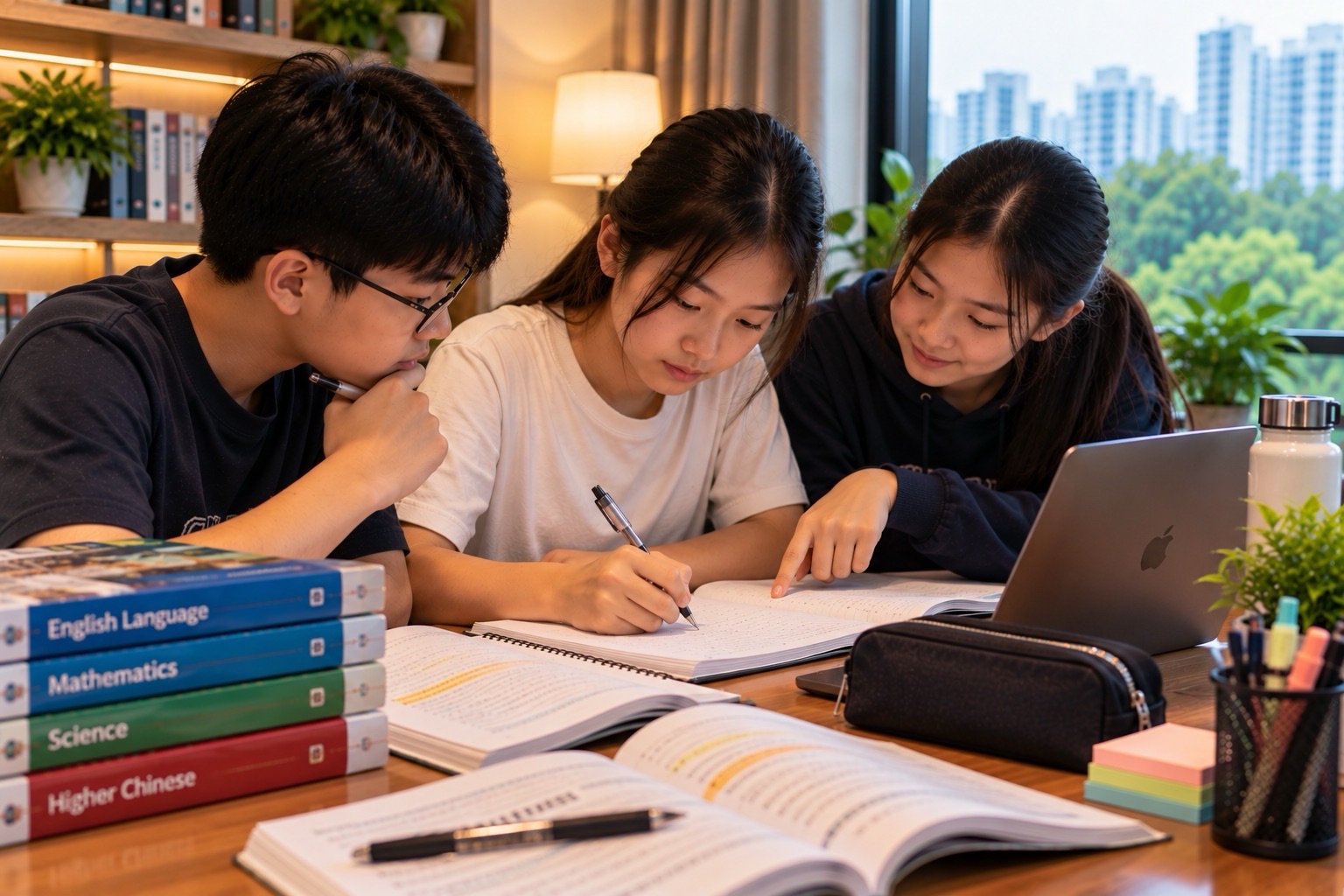
“Pure Biology or Combined Science?” sounds like a question about two course names. In a Punggol kitchen, it is usually a much more practical question. Which textbook is actually on the desk? How deeply must the student explain a process? Which examination will they sit? And why does a worksheet that helped an older sibling not quite match the new cohort’s school notes? The answer begins by checking the route before choosing the revision.
How Punggol Biology Tuition Works for Pure Biology and Combined Science Biology is by matching every lesson to the student’s real syllabus, subject combination, prior knowledge and examination year. A Secondary 3 or Secondary 4 Biology tutor in Punggol should not treat Pure Biology tuition and Combined Science Biology tuition as interchangeable products. Both require clear scientific understanding; the breadth, depth, assessment arrangements and time available for the Biology component can differ. The tuition method begins with a course map, then uses diagnosis, explanation, guided questions and cumulative retrieval to build the learner’s next capability.
Scope and availability: This is a parent-and-student learning guide to the relevant secondary Biology pathways, not an assertion that a particular Biology-only, Pure Science or Combined Science slot is running. eduKatePunggol describes a maximum-three-student, 1.5-hour tuition model; enquire about actual subject support and places via Tuition at eduKatePunggol. The national syllabuses and each school’s arrangements remain the final references.
First, establish the examination route
For students sitting the 2026 Singapore-Cambridge GCE O-Level examinations, SEAB lists Biology (6093), Science (Physics, Biology) (5087) and Science (Chemistry, Biology) (5088) among the relevant subject options. From 2027, the first SEC examinations use G-level codes; SEAB lists G3 Biology K325, G3 Science (Physics, Biology) K327 and G3 Science (Chemistry, Biology) K328. The general name “Biology” on a parent’s calendar is not enough to determine which paper, skills and syllabus should guide the lesson.
Parents can consult SEAB’s 2026 O-Level syllabus directory and 2027 SEC G3 subject directory. Students following G1 or G2 Science should use their own subject-level specification rather than assume G3 Pure Biology expectations. Schools also sequence chapters differently. This is why the first job of a tuition plan is alignment, not an impressive list of topics.
| Student situation | Correct starting question | Teaching implication |
|---|---|---|
| Sec 1–2 studying Lower Secondary Science | Which scientific skills and biological ideas are being covered at school? | Build cells, living systems, inquiry and explanation habits without pretending this is a separate Pure Biology exam |
| Sec 3 on Pure Biology route | Which syllabus and school chapters apply to this cohort? | Develop connected mechanisms and deeper question handling while protecting prerequisite knowledge |
| Sec 3 on Combined Science Biology route | Which Science combination and Biology content are included? | Prioritise the relevant Biology component and coordinate revision across the two Science disciplines |
| Sec 4 in an examination year | Which paper structure, skill targets and assessment dates are current? | Use cumulative retrieval, targeted paper practice and practical reasoning matched to the actual route |
What a Biology diagnostic looks for before teaching begins
Two students can both score 60% on a school Biology test. One understands the syllabus but loses marks because their language is casual: “food goes through the wall” rather than “digested nutrients are absorbed across the epithelium of the small intestine.” The other remembers accurate terms but has no idea why villi, a short diffusion distance and a blood supply matter. The same mark has two different causes.
A useful diagnostic does not begin by declaring a child “weak at Biology.” It checks four things separately: concept knowledge, mechanism and sequence, question interpretation, and independent retrieval. It then adds a fifth: how the student reacts when the question changes. This approach gives the tutor a small, repairable problem rather than an enormous instruction to “revise the whole chapter.”
- Foundations: Can the learner distinguish tissues, organs and systems, and locate cellular processes in the right structures?
- Scientific language: Does the learner use absorb, digest, respire, excrete and transport in their correct contexts?
- Cause and effect: Can the learner explain why a change in temperature, concentration or surface area affects a biological process?
- Data reading: Can the learner identify axes, units, trends, controls and anomalies before writing a conclusion?
- Retention: Can yesterday’s understanding be retrieved next week without copying a model paragraph?
The same Biology topic needs different depth, not different truth
An enzyme is a biological catalyst. That is a reliable central idea for both pathways. But a learner may need a different level of explanation or a different type of examination response depending on the relevant syllabus and question. Good tuition begins with a shared scientifically sound model and then calibrates what the learner must know, infer, calculate and express.
Consider the familiar claim: “The enzyme stops working at high temperature.” It may be adequate as an informal first observation, but it does not yet explain the mechanism. A stronger account distinguishes an increase in reaction rate as temperature first rises from the loss of enzyme activity at sufficiently high temperatures, when the enzyme’s three-dimensional structure can change and the active site’s shape may no longer allow effective substrate binding. The exact detail expected must be checked against the learner’s syllabus.
Now introduce a graph with three enzyme activity curves at different pH values. The student first describes what the graph actually shows before explaining why pH and temperature can affect activity. Avoid presenting a particular optimum temperature as universal to all enzymes. If the data show a different optimum, the scientific answer must honour the evidence.
Pure Biology: expand the network between topics
A Pure Biology learner benefits from connecting concepts across chapters: enzymes and nutrition, membranes and transport, respiration and energy, circulatory systems and exchange surfaces, DNA and inheritance. The task is not simply to memorise a longer list, but to trace how structure produces function and how one process affects another. Lessons should also cultivate scientific inquiry and clear, precise writing.
Combined Science Biology: master the specified component and use time wisely
A Combined Science Biology learner needs the exact Biology topics, terminology and practical or data-response skills in their combined syllabus. They must also allocate study time to the other Science discipline. Tuition can make that trade-off visible: prioritise high-impact misconceptions, revisit fragile concepts briefly but frequently, and distinguish Biology-specific language from more general scientific answer habits shared with Chemistry or Physics.
Neither route is “better” as a label for a child’s intelligence. The appropriate choice depends on the school’s offered subjects, the student’s strengths, interests, broader workload and progression needs. The role of tuition is to serve the selected route well, not sell a subject decision through fear.
How concept teaching turns school notes into a usable model
Picture a Biology diagram of an alveolus beside a capillary. A student memorises “large surface area, thin walls and good blood supply.” Those phrases are useful, but what do they actually explain? The tutor can ask the learner to label the air space, the blood compartment, the diffusion pathway and the concentration gradient. Only then does the familiar list acquire meaning.
The corrected reasoning becomes a chain: many alveoli provide a large total surface area for gas exchange; thin alveolar and capillary walls offer a short diffusion pathway; ventilation and circulating blood help maintain the concentration gradients of oxygen and carbon dioxide. The next question may remove the diagram or introduce exercise. The learner now uses the same mechanism to explain a changed demand.
This structure-function reasoning is repeated in appropriate chapters: root hair cells, intestinal villi, leaf surfaces and transport tissue. The examples are not identical, and students must not force one mechanism onto every organ. However, learning to ask what structure, what function, what gradient, what evidence? gives students a transferable way to enter unfamiliar Biology questions.
An illustrative lesson plan for two different students
A maximum-three-learner group should not become a one-size-fits-all lecture. Imagine two students studying transport. Student A, on a Pure Biology route, knows osmosis but misinterprets a line graph. Student B, on a Combined Science route, can read a simple graph but confuses osmosis and active transport. The tutor can begin with a short shared model of membranes, then prescribe two different tasks while maintaining common discussion.
- Before the lesson: review the learner’s school syllabus and recent question evidence. Do not assume the subject code from age alone.
- Teach the common mechanism: explain how selective membranes and concentration differences matter, using a diagram that does not conceal the important boundary.
- Split the task: give Student A a novel graph to interpret; give Student B a comparison requiring diffusion, osmosis and active transport to be distinguished.
- Correct privately and precisely: each learner writes a repaired response after feedback, rather than only watching a model answer.
- Rejoin through teach-back: ask each to explain a result in simple language, then in disciplined Biology terms appropriate to the syllabus.
- Retest a week later: bring back the concept within a new question. If the learner cannot recover the idea independently, the repair is not yet complete.
The fuller small-group classroom logic is covered in How Punggol Biology Tuition Works: 3-Pax Small Groups and What Is Small Groups Tuition?.
How the weekly plan changes from Secondary 3 to Secondary 4
Secondary 3: build a durable foundation while the syllabus is still unfolding
The first upper-secondary year rewards consistent explanation habits. A few minutes of prior-topic retrieval at the start of each session prevent a student from treating every chapter as a separate box. Diagrams should be drawn and explained rather than traced without thought. School weighted assessments provide feedback, but learning is not restricted to the next test. The tutor checks whether new information can attach to old foundations.
A manageable homework sequence might involve one labelled diagram, a concise mechanism answer, one graph interpretation and a correction of the lesson’s main error. The exact amount should reflect the student’s weekly school commitments. More pages do not automatically equal more learning.
Secondary 4: integrate the syllabus and practise examination decisions
In the final year, students must increasingly retrieve content across topics, interpret unfamiliar contexts and decide how much to write for a particular mark allocation. Past-year questions are useful after understanding is secure, not as a substitute for explanations. Practice papers should be followed by error classification: concept gap, misreading, imprecise term, omitted link, data error or timing mistake.
A full paper without review is mainly a measurement. A reviewed paper that changes the next week’s study plan is an intervention. A student may need a short refresher on genetics today, structured questions tomorrow and mixed retrieval several days later. Plans should become more exam-specific as the date approaches, while leaving enough sleep and routine for performance to remain stable.
What parents should know about Biology practical work
Biology is an experimental science. Students need to understand variables, planning, safety, observations, measurements, tables and conclusions. Tuition can coach experimental reasoning with diagrams, datasets, safe paper exercises and suitable demonstrations, but these do not replace compulsory school practical lessons or supervised laboratory experience. The examination specification for the student’s own cohort decides which practical skills are assessed and how.
A student should be able to say what was changed, what was measured, what was kept constant and whether the evidence supports the conclusion. If an experiment reports a relationship, the learner should distinguish correlation from a claim that has actually been tested. Strong Biology tuition teaches scientific honesty: conclusions cannot be more certain than the data.
Frequently asked questions
Does Pure Biology always require private tuition?
No. Many students succeed through school teaching and consistent independent study. Tuition is most useful when a specific problem remains unresolved: weak foundations, inconsistent application, missing feedback or a mismatch between existing study habits and current demands.
Can Pure Biology and Combined Science students share a small-group session?
It can be workable when the tutor confirms overlapping content and provides separate syllabus-aligned questions, but not all topic sequences or assessment needs match. Suitability, arrangements and places must be confirmed with the centre; a web article is not a timetable.
Do Secondary 1 students need a Pure Biology syllabus?
No. Secondary 1 and 2 learners usually study biological concepts through Lower Secondary Science. The sensible early aim is scientific literacy, secure cell and organism concepts, sound observation and explanation habits, and readiness for later subject choices.
Should I buy a generic O-Level Biology assessment book?
Check the student’s registered route, cohort and current syllabus first. A good question book can provide deliberate practice, but it cannot correct a concept merely by supplying an answer key. Use the book to reveal a particular weak link, then revisit that link after feedback.
How do we check whether tuition is working?
Ask for evidence from independent responses: fewer repeated mechanism errors, more precise vocabulary, better diagrams, retained learning after a delay and improved performance on unfamiliar questions. Track the specific capability rather than interpreting every grade movement as a verdict on the whole student.
Choose the next useful route, not the loudest promise
A good Biology tuition plan begins with an accurate map: the student’s examination route, current foundations, school topics, recurring errors and realistic capacity for practice. It then moves through clear explanation, independent attempts, immediate feedback and delayed retrieval. When the student can choose the correct mechanism, interpret evidence and write it precisely without rescue, the tuition has served its purpose.
Useful routes: Secondary 3 Biology tuition guidance · Secondary 4 Biology examination guidance · Enzymes and digestion · Tuition enquiries. The broader eduKateSG 3-pax tutorial example illustrates a general teaching philosophy in another subject and location; it is not a Punggol Biology timetable.
Read the Complete “How Punggol Biology Tuition Works” Series
3-Pax Small Group Biology Tuition · O-Level Biology Revision and Exam Techniques · Biology Practical Skills and Data-Based Questions. Each article takes one teaching problem further, while the eduKatePunggol tuition route remains the place to verify actual class arrangements.
Topic-by-Topic Biology Tuition Lessons
To see how the same diagnostic small-group teaching system works inside specific Biology chapters, follow these four detailed guides: Cell Structure, Diffusion, Osmosis and Active Transport · Enzymes, Human Nutrition and Digestion · Genetics, Punnett Squares and Inheritance · Homeostasis, Kidney Function and Excretion. Choose a topic to repair or extend rather than assigning every chapter at once.
Continue With Related Punggol Biology Teaching Guides
Photosynthesis and plant transport · Human respiration and gas exchange · Heart and double circulation · Food webs and ecosystems. Choose a route that matches the learner’s next missing concept, then test the understanding using a fresh question.


