
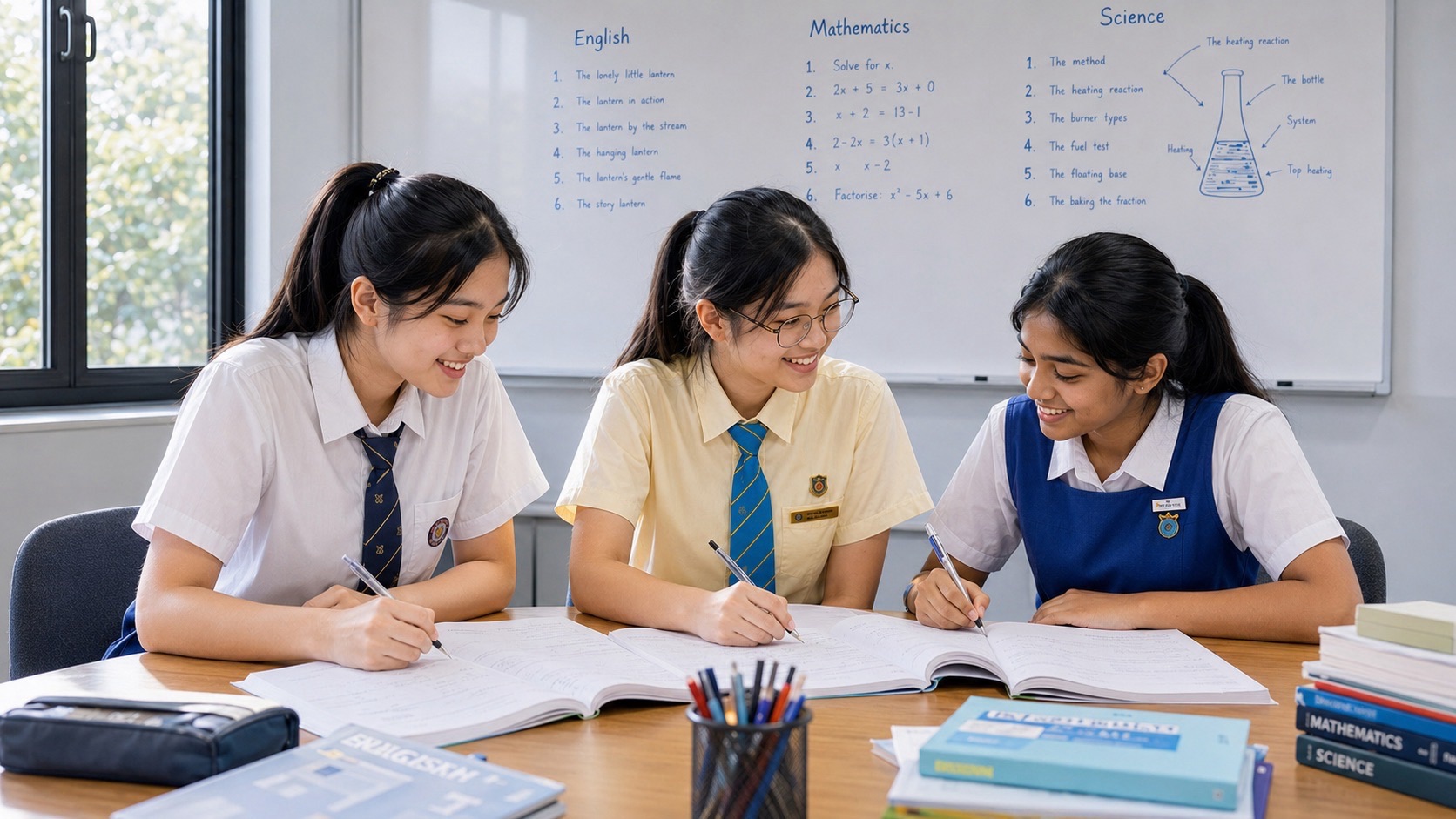
Your child has understood the passage, highlighted plenty of information and written carefully. The summary is still too long. If you are looking at Secondary 2 English tuition in Punggol, the first useful move is to check what belongs in the answer before asking your child to squeeze every sentence.
A Secondary 2 English tutor should separate three possible problems: including information outside the question, repeating the same point, and using more words than the selected meaning needs. Cutting randomly can hide the problem by producing a shorter answer that has lost an important reason or condition.
This guide helps Punggol parents discuss summary writing in Secondary 2 English tutorials through one original example. We will select points, combine related ideas, and then change the question so your child has to choose again. Follow the limit and wording on the actual school task; the practice limit here is a teaching device.
eduKatePunggol · Parent guide
Find the answer closest to your concern
Choose a reading route, open the full contents, or start with the original worked example.
1. Locate the extra words · Chapters 1–2
2. See the selection · Chapters 3–4
3. Shorten safely · Chapters 5–6
4. Review the practice · Chapters 7–8
5. Continue with support · Chapters 9–10
Article contents
Chapters 1–4
Chapters 5–8
An overlong summary can come from good intentions. A student does not want to leave out something important, so they include the setting, every example and a final opinion. Another selects suitable points but writes each one twice in slightly different language. A third knows the points but cannot express them economically.
Ask the child to show which part of the question each sentence answers. If they cannot connect a sentence to the task, investigate relevance. If two sentences make the same contribution, investigate repetition. If every point is useful and distinct, work on expression.
This order matters. A beautifully shortened irrelevant sentence still uses space without answering the question. A heavily compressed answer may also become so vague that the reader cannot recover the original meaning.
Keep the first version. It shows the student’s choices before adult help. Rather than crossing out large sections immediately, ask which sentence they would remove first and why. Their explanation gives the tutor a much clearer starting point.
| Why the answer is long | Evidence in the draft | First repair |
|---|---|---|
| Selection | Background or outcomes outside the task | Apply the question boundary |
| Repetition | Two sentences make the same point | Keep one distinct contribution |
| Expression | Relevant points use unnecessary wording | Shorten while checking meaning |
CHAPTER 2 OF 10 · Locate the extra words
2. Turn the question into a boundary for selection
Before highlighting, identify what the summary asks for. Reasons, benefits, problems and actions are different categories. A passage may contain all of them, while the question asks for only one or two.
Write a short task reminder on rough paper where permitted: ‘problems and responses’, for example. Then inspect each possible point against that boundary. This reminder is a practical support, rather than a replacement for reading the full instruction.
Also check the specified passage section, opening wording and word limit. School tasks can vary. Do not transfer a limit from another worksheet or assume that an online example follows the child’s current assessment requirements.
Selection is a reading decision before it is a writing decision. Once the student has a defensible set of relevant points, compression becomes more purposeful: preserve those meanings in less space, instead of trying to fit the whole passage into a small box.
Original practice text: A school opened a repair corner where students could mend simple faults in their bags and stationery cases. At first, few students came because they did not know where the corner was. The organisers put clear signs near the stairs. Some visitors left without getting help because the only volunteer was busy. The club then assigned an extra volunteer at lunchtime. Students enjoyed learning to mend a zip, and one repaired case was displayed during assembly.
Practice task: Summarise the problems the organisers faced and the actions they took to address them, in no more than 45 words. This limit is chosen for this original exercise; it is not a statement of a Secondary 2 examination rule.
The task needs two problems and their responses: students could not locate the corner, so signs were installed; one busy volunteer could not help everyone, so another was assigned at lunchtime. Enjoyment, the repaired zip and the assembly display do not answer this task.
An overlong draft may retell the entire activity from its opening. Ask the student to underline the sentences that address the requested problems or actions. The remaining background may explain the setting, but it need not all appear in the summary.
Retelling: The school opened a repair corner so students could repair their bags and stationery cases. Few students attended because they could not find it. Signs were placed near the stairs. One volunteer was busy and some students left. Another volunteer was assigned at lunchtime. Students enjoyed mending a zip and a repaired case was shown at assembly.
This version contains relevant points, but it also spends words on the opening purpose and later outcomes. It follows the passage’s order without first applying the question’s boundary. The repair is therefore selection, not merely substituting shorter vocabulary.
Selected answer: Students could not find the repair corner, so the organisers added signs. Some visitors left because the sole volunteer was busy, prompting the club to assign another at lunchtime.
The selected version fits the practice limit while keeping both problem–response pairs. It leaves out details that the question does not request. Treat it as one possible teaching answer, rather than wording that every student must reproduce exactly.
Once points are selected, compare phrases for unnecessary length. ‘Due to the fact that’ can often become ‘because’. ‘At that point in time’ may become ‘then’. These changes are helpful only when the sentence retains its actual meaning and fits the task.
Combining related points can also save space. ‘The volunteer was busy. Some visitors left without help’ becomes ‘Some visitors left because the sole volunteer was busy.’ Here the original passage supports the connection. Do not invent a causal link merely to produce a compact sentence.
Keep conditions that matter. Removing ‘at lunchtime’ from the extra-volunteer point may lose relevant precision. Changing ‘some visitors’ to ‘all visitors’ exaggerates the problem. Shorter language is not automatically more accurate language.
Read the revised answer back against the passage. Ask whether a reader would understand the same problem, action and limitation. The student should be able to defend each change. This develops control over compression instead of a habit of deleting whichever words look expendable.
CHAPTER 6 OF 10 · Shorten safely
6. Change the task before claiming the method has transferred
Use the same repair-corner passage, but change the task: ‘Summarise the positive experiences and publicity associated with the repair corner.’ Now the earlier problems-and-actions answer is largely outside the question.
A suitable selection includes learning to mend a zip and displaying a repaired case during assembly. The student should explain why the signs and extra volunteer belong to the previous task rather than automatically reuse them.
This change is valuable because a student can remember a short model answer without learning how to select. Asking for a different category makes the selection decision visible. Give the student the new instruction before discussing which points fit.
Next, move to a fresh passage with similar categories. Check whether the child identifies the task boundary without a prompt. If selection remains secure but expression becomes long again, the tutor can now work on concision with less uncertainty about what caused the original problem.
CHAPTER 7 OF 10 · Review the practice
7. Build a practice sequence the student can repeat
A useful sequence is: read the instruction, identify its boundary, select distinct relevant points, express them accurately, count according to the task’s rules, and check meaning. The steps are connected; counting comes after there is something relevant to count.
At first, let the student make a brief point list before writing. Ask what each item contributes. Combine duplicates at this stage so the final answer does not inherit repeated content. As the decision becomes more reliable, reduce the amount of support.
Practise on a short passage before using a longer one with competing details. Add complexity deliberately. Otherwise, the child may be trying to repair selection, sentence control and time management at once, making it difficult to see what helped.
Follow the school’s guidance on word counting and any supplied opening words. This article does not set a universal counting convention. If the instruction is unclear, ask the teacher rather than training the child to guess which online convention applies.
‘Too long’ describes the outcome. A useful explanation identifies why: two irrelevant sentences, one duplicated benefit, or a phrase that can be shortened without loss. Ask the tutor to show the difference on the student’s own first attempt.
Then let the student revise. An adult-produced short answer can demonstrate a method, but the child still needs to make the decisions. Keep track of whether they selected the points, combined them and checked meaning independently.
At home, one question can help: ‘Which point does this sentence add?’ If the child cannot answer, return to the task and passage. Avoid replacing the student’s sentences with a full parent-written summary.
Review a small set of comparable attempts. A shorter answer on an easier passage is useful progress, but it does not establish full control on harder tasks. Look for relevance, coverage and accurate expression together, with less prompting over time.
CHAPTER 9 OF 10 · Continue with support
9. Questions parents ask about overlong summaries
Should my child write first and cut afterwards?
Revision is useful, but selection should begin before the full answer. Cutting a complete retelling can be harder than drafting from relevant distinct points.
Should every word be replaced with a synonym?
No. Choose wording that preserves the meaning and follows the task. Forced synonyms can change the sense or produce awkward sentences.
Is a shorter summary always better?
No. It still needs the requested points and accurate relationships. A very short answer may omit essential meaning.
Can the tutor simply give a model to memorise?
A model can support explanation. A fresh task should then check whether the student can select and express points without copying it.
What if my child selects well but writes slowly?
Keep the secure selection method and investigate sentence construction and pace separately. Use the actual school expectations to plan the next practice.
Bring the question, passage and first overlong answer together. Mark where each sentence connects to the task. The tutor can then distinguish excess content from excess wording and choose the first teaching step.
Use Secondary 2 English Tuition at eduKatePunggol for the broader level route. For fuller subject practice, continue to the existing secondary summary-writing guide, matching its advice to the child’s actual task and subject level.
If support is needed, use the consultation route and ask how selection, compression and independent checking would be taught. Confirm current class arrangements, fees and terms directly.
The practical goal is an answer that earns its space. Each sentence should contribute requested meaning, and the student should know why it belongs. That is a more reassuring direction than watching a word count fall while important ideas disappear.


