
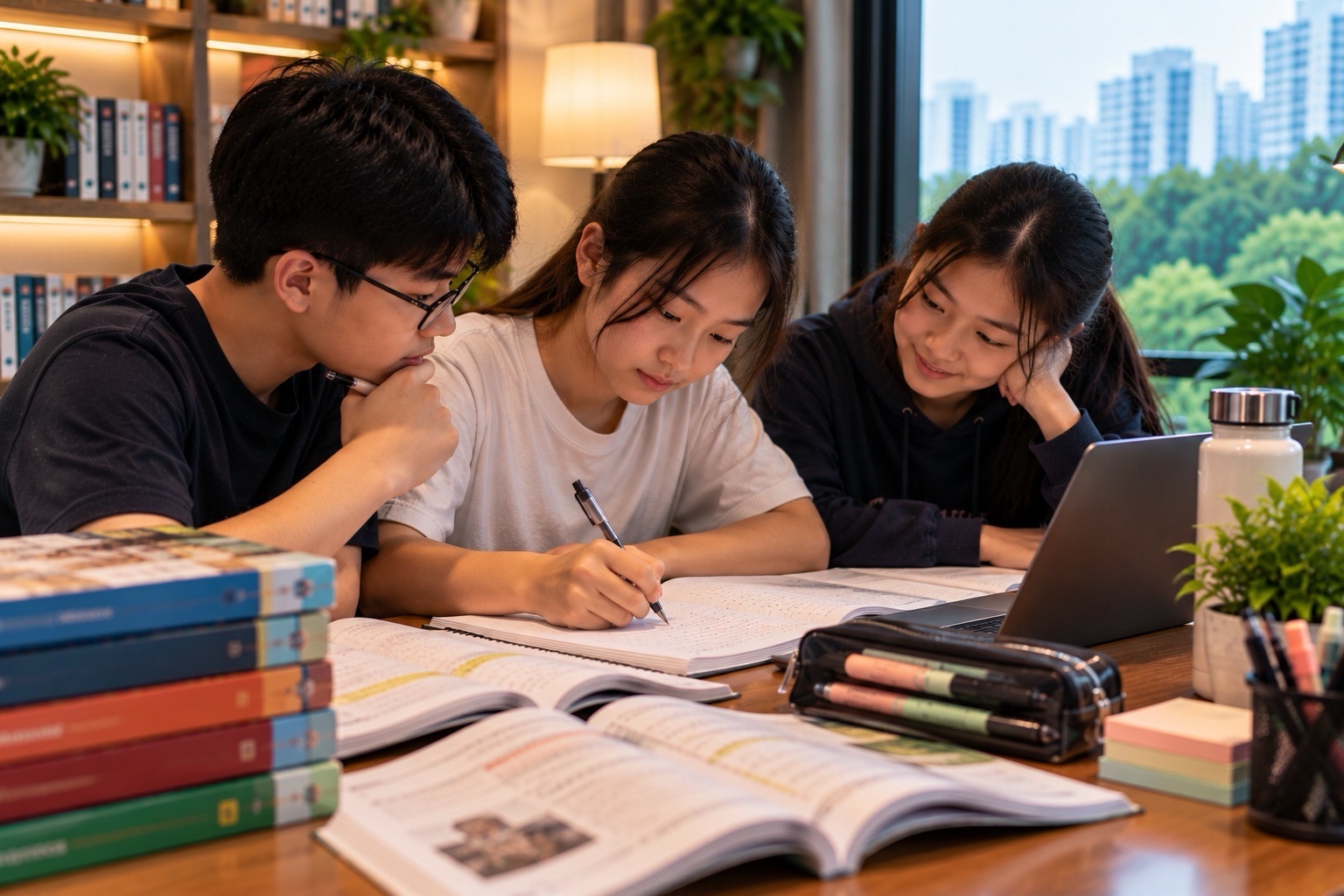
Your teenager gets stuck on Secondary 4 Additional Mathematics homework between tuition lessons, and you wonder whether sending a photograph to the Punggol A-Math tutor would help. Start by asking whether that support is available, which route the provider uses and when feedback normally occurs. Then send a specific question with the learner's own attempt. A useful exchange should help the teenager make the next decision, rather than simply return a finished answer.
A Punggol Secondary 4 Additional Mathematics tutor needs more than a picture of the final number to understand the difficulty. Include the original question, the relevant working and the uncertain line. The teacher may need to distinguish a misread condition from an algebraic error or a missing concept. Clear evidence makes that distinction easier, while an agreed reply routine keeps expectations practical for the family.
For parents comparing Secondary 4 A-Math tuition and tutorials in Punggol, between-lesson help should be discussed as part of the actual programme. Do not assume immediate replies or unlimited marking. Ask what happens after feedback: will your child try a changed task, bring the question to the next session or receive another teaching opportunity? The value of a photograph lies in the learning conversation it makes possible.
Ask about the arrangement before relying on it
Providers can have different support routines. One may review selected attempts before the next lesson, while another may discuss questions during the scheduled session. Confirm the actual arrangement, accepted route and relevant terms directly. A general promise that students can ask questions does not establish when a reply will arrive or how much between-lesson feedback is included.
Ask which kinds of enquiry the routine serves. A single uncertain line, a whole test script and a new chapter explanation involve different amounts of teaching. The provider should explain how each would be handled under its programme. This helps the learner choose the right route and prevents a brief photo question from becoming an assumed request for a complete additional lesson.
If a school deadline matters, state it accurately but do not infer that it changes the reply arrangements. The school determines its own submission requirements. The family should use the appropriate school route where needed. The tutor can address the mathematical question through the agreed support process, including at a later lesson if immediate help is unavailable.
Keep the practical agreement easy for the teenager to use. They should know where a question goes, what evidence to include and when to bring an unresolved attempt back. The family should not need to improvise a new communication plan every time homework becomes difficult. A clear routine makes the photo a useful teaching record rather than a message sent into an uncertain queue.
A photo needs a question attached
An image of a worksheet with “Please help” can leave the tutor unsure where to begin. The learner may understand most of the task and need one transformation explained. A short note can identify the uncertainty: “I can get this derivative, but I do not know which equation gives the point.” That lets the teacher inspect a specific decision.
The teenager does not need to name the topic perfectly. They can mark the last understood line and ask what happens next. The original question and honest attempt supply the context. The tutor can then ask a focused follow-up if needed. The goal is a manageable mathematical enquiry, not a polished report written by the parent on the learner's behalf.
If the learner has no first step, say that clearly and preserve the task wording. The teacher may need to help with recognition rather than correct an executed method. A blank attempt is different from an incorrect middle line. The support should respond to that difference. Supplying a complete answer immediately may hide the decision that needs teaching.
The guide to what parents should send a mathematics tutor covers evidence selection more broadly. Here, the additional question is how a between-lesson exchange becomes a useful teaching cycle. Confirm the reply routine and the next independent task, so the photograph leads somewhere clear.
Keep the whole relevant argument in view
A cropped final line can hide the first error. Include enough preceding work for the tutor to see how the student reached it. Keep the question number and original wording connected to the attempt. The teacher should not have to guess which diagram, condition or instruction belongs to a photographed line. Clear sequence helps the exchange remain focused.
The page does not need to be rewritten perfectly. Keep crossed-out attempts readable where they reveal a decision, and mark the line the student wants discussed. A correction copied from elsewhere should be identified as such. The tutor needs to know which work was independent and what support was used, because that determines the meaning of a correct or incorrect response.
If a task spans more than one page, show their order clearly. A long photograph with tiny writing may be harder to interpret than a small number of legible images under the provider's accepted process. Test whether fractions, exponents and negative signs remain readable. Those details can change the mathematical meaning, so the evidence needs to preserve them.
Parents can help organise the image initially, then let the teenager practise the ordinary routine. The goal is a process the learner can manage while asking about their own work. If adult assistance is repeatedly required for every enquiry, discuss how the sharing method can be simplified within the programme. Useful support should make questions more accessible and help responsibility grow.
Fractions and brackets need enough space
Consider the difference between 1/(x + 3) and 1/x + 3. The denominator in the first includes the whole bracket; in the second, only x is under the fraction. A photo that cuts off the bar or bracket can make the intended expression ambiguous. The tutor should clarify the notation before explaining algebra based on a different reading.
Suppose the student is simplifying 2/(x + 1) + 3/(x + 2). Combining gives [2(x + 2) + 3(x + 1)]/[(x + 1)(x + 2)] = (5x + 7)/[(x + 1)(x + 2)], for x not equal to −1 or −2. If the numerator is cropped from the image, the teacher may be unable to identify where an error occurred.
For a changed check, 3/(x + 1) + 2/(x + 2) gives (5x + 8)/[(x + 1)(x + 2)], with the same excluded values. The changed numerator tests whether the learner multiplies by the correct remaining factors. The tutor should see the student's own combination, not only a typed report that the answer is now correct.
The sharing routine should preserve the layout of this argument. A brief reply can point to the denominator-clearing step, while the follow-up shows whether the explanation transfers. This is a useful example of how legibility and teaching connect. A sharp image is helpful because it gives the teacher accurate evidence, not because attractive presentation substitutes for mathematical reasoning.
The first wrong line matters more than the last answer
For a tangent question, several decisions occur before the line equation appears. Suppose y = x² − 12x + 40 at x = 7. The point on the curve is (7, 5), the derivative is 2x − 12 and the gradient is 2. The tangent is y − 5 = 2(x − 7), or y = 2x − 9.
If the learner uses (7, 2) as the point, the error began when the derivative value replaced the y-coordinate. A photo of only the final tangent could make that harder to identify. Include the substitution into the curve and derivative. The tutor can then separate the point from the slope and explain the specific relationship that needs attention.
A changed task, y = x² + 10x + 4 at x = −3, has point (−3, −17) and gradient 4. The tangent is y + 17 = 4(x + 3), or y = 4x − 5. The learner should obtain and label those quantities independently. A new photo of the attempt can show whether the earlier feedback was used.
The parent can ask the tutor what the exchange revealed. A precise answer about the point-gradient distinction gives a teaching priority. A general statement that the tangent answer was corrected gives less information. Between-lesson support is most useful when it identifies a decision and connects it to another attempt that the student makes themselves.
A reply can be a question rather than a full solution
The tutor may ask the student to expand a proposed factorisation, state a restriction or identify the source of a quantity. That can be purposeful feedback. The question encourages the learner to inspect their own decision. Ask how the programme uses such prompts and what happens if the student still cannot proceed. A prompt should lead to a manageable attempt, with another teaching route where needed.
For x² − 19x + 90 = 0, the factors are (x − 9)(x − 10). If the learner proposes positive brackets, a tutor might ask what their expansion gives. The student can see the middle term has the wrong sign and revise the factors. This develops a checking habit rather than merely supply the desired pair.
For x² − 20x + 91 = 0, the factors are (x − 7)(x − 13), giving roots 7 and 13. A changed independent attempt checks whether the explanation transferred. The tutor should know whether the learner needed another cue. A successful correction of the original photo alone may reflect following the prompt, while the changed response provides stronger evidence of usability.
The teenager should understand the role of the reply. A focused question is not necessarily a refusal to help; it may be the next teaching step. If it remains unclear, the learner can show the new attempt and ask about that line. Confirm the provider's actual process for continuing the exchange or bringing it into the next lesson.
Some questions need a live explanation
A short written response may not be enough for a new concept or several connected misunderstandings. The tutor can identify that need and explain how it will be addressed through the actual programme. The family should know whether the question will be discussed at the next session or whether another arrangement is available. A photograph can locate the issue even when it cannot contain the whole teaching response.
This distinction is important when the learner repeatedly asks about every next line. The missing relationship may need a focused demonstration and an immediate changed attempt. A long chain of messages supplying one step at a time could leave the student dependent on the next reply. The teaching route should help them understand the decision well enough to continue independently.
Ask the tutor what the image suggests and why another format is needed. A specific explanation helps the family judge the proposal. For example, the student may need to compare two representations of a circle or distinguish a tangent point from a derivative value. The live session should still have a clear target and a follow-up task.
For online teaching, the G3 lesson-working guide describes the wider visibility question. Confirm current formats directly. The important principle remains the same across a photo exchange and a live tutorial: the teacher needs the learner's thinking, and the learner needs a chance to use the explanation.
Keep original restrictions beside the candidates
For √(x + 156) = x, squaring gives x² − x − 156 = 0, with candidates 13 and −12. Only 13 satisfies the original equation. If the photo shows only the quadratic and roots, the tutor cannot see whether the learner considered the original condition. Include the original equation and candidate check together.
The right-hand side must be non-negative. That is the reason for rejecting −12, not a universal ban on negative answers. A variation such as √(x + 20) = −x produces candidates 5 and −4 after squaring, with only −4 valid. The student should verify √16 = 4 and −(−4) = 4 in the original relationship.
A useful reply can ask which original condition the candidate must satisfy. The learner can then show the check in their own working. A later changed equation tests whether the reason has become usable. The exchange should not stop at a typed answer that the negative root is rejected, because that phrase may conceal an inaccurate rule applied without understanding.
Parents can help keep the original task connected to the reply. They do not need to teach the restriction themselves. Ask what the feedback is checking and let the teenager perform the next attempt. The photo becomes useful evidence when it preserves the whole relationship and shows whether the learner can interpret candidates independently.
Separate a school marking question from a homework step
A photo of a marked script may raise a different enquiry: why were marks lost despite a correct final answer? Include the question wording, the working and the teacher's comment. The tutor can examine validity and presentation, while the school teacher clarifies a particular school marking decision through the established route. A cropped score is not enough to settle the issue.
The task may specify a method or require a relationship to be shown. The learner should understand that instruction and provide sufficient valid working. Another mathematically sound route does not automatically fulfil every specified task. The tutor should explain the distinction using the actual attempt rather than promise universal credit for an unseen solution.
The school-and-tuition methods article gives further examples. A between-lesson photo can start the clarification, but a longer discussion may be needed. Ask what the learner should retain, what line needs correction and what changed task would test the clarified requirement.
Keep the enquiry calm and specific. “This instruction and this line are unclear” gives the teacher something to address. A broad claim that school rejected the tuition method can obscure the actual issue. The photo should support a precise mathematical conversation and an appropriate clarification route, not become a substitute for reading the task and feedback together.
The teenager should understand the feedback they keep
A saved image of a corrected solution can be useful, but the learner needs to know its purpose. Ask them to identify the decision the reply addressed. They might say that the point comes from the original curve or that a candidate must satisfy the original restriction. That brief explanation helps connect the correction to future work.
If they cannot explain a line, preserve the question rather than treat the exchange as complete. The tutor can inspect the new uncertainty and choose a teaching response. A complete solution file should not pressure the teenager to pretend everything is understood. The learning process remains open until the relationship becomes usable in an appropriate independent task.
Keep the student's original attempt with the feedback. The contrast can reveal what changed and what remains. The A-Math error-log guide covers the broader recording routine. For this exchange, the useful record is concise: the uncertain decision, the explanation and the next check.
Parents can support organisation without building an elaborate archive of every message. The teenager should be able to find the current question and bring it to the next lesson. A manageable system is more useful than a large collection of screenshots with no learning purpose attached. The feedback should help the student decide what to do, not merely increase the amount of saved material.
Agree how unresolved photos reach the next lesson
Sometimes a question remains open after the reply, or the tutor needs to inspect it in person. Confirm how the learner brings that evidence to the next scheduled session. The teacher should know which line remains uncertain and what support was already supplied. This prevents the lesson from beginning with an incomplete account of the exchange.
The student can mark the task and bring the original page. If a changed attempt was completed, include it too. The tutor can compare the work and decide whether the earlier explanation transferred. A short return note may be enough, depending on the programme. The aim is continuity, not a requirement to reproduce every message verbally.
Ask what happens when several questions are waiting. The provider may need a clear priority for the session. Group the uncertainties where they share a relationship, but keep the original tasks available. The teacher can then address a representative decision and select suitable follow-up work. A list of final answers to correct gives less guidance.
If photos repeatedly remain unresolved, discuss the process with the provider. The issue may involve the accepted route, the amount of support included or a teaching need that cannot be handled asynchronously. Bring a specific example and ask what practical adjustment will help. Clear expectations and a usable next teaching opportunity make the routine easier for everyone to sustain.
Do not make a parent the permanent reply interpreter
A parent can help establish the routine, but the teenager should increasingly read and use the feedback themselves. Ask the learner to show what they think the tutor means and which line they will attempt next. If the mathematical explanation is unclear, preserve that question for the teacher rather than have the parent reconstruct the entire lesson.
The tutor may need to adjust the form of feedback for the actual learner. A short diagram, a clearer reference to a line or a live explanation could be useful under the programme's arrangements. The decision should follow what the student can use. A technically correct reply that the learner cannot interpret still needs another teaching step.
Parents can support communication by keeping the enquiry precise and noting any help used. Avoid turning every reply into a long family discussion about effort. The learner's working provides the relevant evidence. The aim is a teenager who knows how to show a question, interpret an explanation and make a fresh attempt, with support appropriate to their current independence.
The quiet-student tutorial article offers wider ways to make questions manageable. In a photo exchange, the same principle applies: the student does not need a polished verbal performance to begin. They need a clear way to show uncertainty and an agreed route for obtaining useful teaching.
Use the next attempt to judge usefulness
A fast reply can be convenient, but its learning value is shown in the student's next work. Can they make the corrected decision in a changed task? Do they preserve the condition without a reminder? Can they identify another uncertainty precisely? Those observations are more informative than the number of messages exchanged or the length of the supplied solution.
For a completed-square task, the tutor might explain that x² + 16x + 69 = (x + 8)² + 5. The learner should verify the expansion and interpret the minimum as 5 at x = −8. A changed expression, x² − 14x + 58, becomes (x − 7)² + 9, with minimum 9 at x = 7. The new attempt checks both transformation and interpretation.
If the learner copies the correct form but misreads the minimum location, the next teaching priority is clear. The teacher can ask when the square is zero and use another appropriate check. The photo exchange has produced evidence about a decision, rather than merely a corrected page. Record the support required accurately when reviewing the result.
A later independent task can test whether the explanation remains usable after the immediate exchange. The tutor should inspect recurring errors and adjust the teaching response. Parents can ask what changed and what remains. Between-lesson support earns its place through this connection to independent application, with practical expectations that the family and provider can actually follow.
A hypothetical exchange shows a useful cycle
Imagine a learner sending a photo of an incorrect tangent equation. This is an illustration, not an account of an actual student. The image includes the curve, substitution, derivative and line. The tutor notices that the derivative value was used as the y-coordinate and asks the student to identify which relationship gives the point on the curve.
The learner revises the coordinate and forms the tangent again. The teacher then selects a changed curve to check the distinction. Suppose the new point and slope are correct but the final rearrangement has a sign error. That becomes a separate teaching question. The response should acknowledge what transferred and identify the remaining line, rather than describe the entire topic as secure or unsuccessful.
At the next scheduled lesson, the student brings both attempts. The tutor can check the rearrangement and use a fresh task to review the whole chain. The between-lesson exchange has made the session more precise because it preserved the original decision and the changed response. It has not replaced the need for continuing teaching and independent practice.
Parents can use this illustration to ask the provider what happens after a photo arrives. The answer should connect evidence, feedback and a new attempt through the actual support routine. A useful exchange gives the teenager a clearer mathematical action and gives the teacher accurate information for the next lesson.
Make a group of photos easy to prioritise
If several questions remain, ask the provider how many can be submitted and how they will be reviewed under the actual arrangements. The learner can identify the most important uncertainty first. A short list of task numbers and the relevant lines can help, with the original questions available. The tutor needs a manageable teaching enquiry rather than an unexplained collection of images that might contain several unrelated topics.
Group questions only where the uncertainty is genuinely shared. Three tasks may involve the same denominator-clearing decision, while another needs a new concept. The teacher can address a representative relationship and select a changed check, then identify which remaining items the learner can attempt independently. Do not assume that one reply resolves every task simply because they came from the same worksheet.
The student should preserve the separate attempts. A tutor may discover that similar final errors arose through different routes. One fraction question might have a wrong numerator, while another uses an excluded value. Those differences affect the explanation. Clear task numbers and working make it easier to connect each piece of feedback to the correct enquiry.
After the reply, the learner can mark what is resolved and what remains for the next lesson. Keep the record simple enough to use. The purpose is to make the teaching sequence visible, not to create another large administrative task. A practical photo routine helps the teenager prioritise questions and arrive at the scheduled tutorial with a clear account of the work still needing attention.
Distinguish a misunderstanding from unclear handwriting
The teacher may need to ask whether a mark is a minus sign, an exponent or part of a crossed-out attempt. That clarification should happen before interpreting the mathematics. A blurry or crowded image can make a valid line look wrong, while neat handwriting can still contain an invalid transformation. The sharing process should preserve the student's actual notation so the feedback responds to the right evidence.
For example, x² − 6x + 9 and x² + 6x + 9 complete into different squares: (x − 3)² and (x + 3)². A faint negative sign can change the whole reading. The tutor can ask the learner to confirm the original expression, then inspect the route. A corrected image or a clear transcription under the accepted process may be needed before useful teaching can proceed.
The learner can also explain what a crowded line was intended to mean. This is different from asking the parent to rewrite the solution perfectly before sending. Preserve the original where it helps and clarify the ambiguous notation. The tutor should know which decisions were independent and which lines were changed after help. Accurate evidence supports a more appropriate follow-up task.
If the same legibility problem recurs, practise the ordinary sharing routine with a short example. Leave enough space for fractions and brackets, connect the task number and check the image before submitting. The goal is a process the teenager can manage reliably. Better presentation helps because the teacher can read the thinking; it does not replace the need to teach and check the relationship itself.
A reply should identify the line it refers to
Feedback such as “Check the signs” may be difficult to apply when the image contains several calculations. Ask the learner which line they think the tutor means. If that is unclear, preserve the question and seek a more specific reference through the agreed process. The teacher can point to the transformation or quantity requiring attention, then let the student make a revised attempt.
Consider a circle equation that becomes (x − 4)² + (y + 3)² = 49. The centre is (4, −3), with radius 7. If the tutor comments on signs, the learner needs to know whether the issue is completing the square or reading the centre. Those are separate decisions. A concise reference to the relevant line makes the feedback easier to use and check.
A changed original equation, x² + y² + 8x − 6y = 0, becomes (x + 4)² + (y − 3)² = 25. The centre is (−4, 3), with radius 5. Let the learner transform and interpret it independently. The new attempt gives evidence about both the algebra and the reading of the representation, without relying on a remembered instruction to reverse every visible sign.
Parents can ask what the feedback is teaching and what the changed task will check. A useful answer names the decision in ordinary language. The family does not need a long transcript of the exchange. It needs a clear connection between the student's line, the explanation and the next attempt. That connection makes a brief between-lesson reply educationally meaningful.
Questions parents often ask
Can we send homework photos between A-Math lessons?
Ask the provider whether that support is included, which route is accepted and when feedback normally occurs. Send the original question, relevant working and a specific uncertainty under the agreed arrangement. A photo can support useful teaching when the next step is clear. The article does not establish immediate replies or unlimited marking as a universal tuition service.
Should a parent or the student send the question?
Follow the provider's arrangements and the learner's current needs. Parents can help organise evidence, while the teenager should increasingly describe their own uncertainty and use feedback. The tutor needs an honest account of the attempt and support already used. The goal is a manageable routine that helps the student participate in their own learning.
Is a photograph of the final answer enough?
Usually the tutor needs the original question and relevant preceding lines to locate the difficulty. A wrong answer can arise from several decisions, and a correct answer can conceal incomplete reasoning. Include enough working to show the route and mark the uncertain line. The teacher can then ask a focused question or explain the appropriate next step.
What if the tutor replies with a hint?
A focused prompt can help the learner inspect their own decision. Let the student attempt the suggested check and preserve any remaining uncertainty. Confirm how the exchange continues or reaches the next lesson if the prompt is insufficient. The useful evidence is whether the learner can apply the explanation in a changed task, not only correct the original photo.
What if the question needs a whole lesson?
The tutor should explain that need and the provider's actual options. A photo may locate the issue while a live session supplies the teaching and immediate follow-up. Ask for the target and next independent check. Confirm availability and terms directly, rather than assume that a between-lesson message includes a complete additional tutorial.
How do we know this support is helping?
Inspect changed independent attempts and the support required. Ask whether the student can use the feedback, preserve conditions and identify new uncertainty. Check that unresolved questions reach a later teaching opportunity. Fast replies and saved solutions can be convenient, but the learner's usable decisions provide more direct evidence of the exchange's educational value.
Review whether the routine is manageable for everyone
After the process has been used, ask the teenager whether they can identify, photograph and explain a question without extensive adult help. Also confirm whether the reply arrives through the expected route and whether unresolved work reaches another teaching opportunity. These observations help distinguish a mathematical uncertainty from a communication problem. The response should follow the actual issue.
If a learner understands feedback but repeatedly sends an incomplete image, improve the sharing routine. If the image is clear but the reply is beyond their current understanding, ask for another teaching response. If the support is outside the programme's agreed terms, clarify the available arrangement. More messages alone will not necessarily resolve any of these different difficulties.
Keep the student's next action visible. They should know whether to revise a line, attempt a variation or bring the question to a scheduled lesson. A reply that leaves them waiting without a learning step may need clarification. The parent can ask about that missing connection calmly, using the specific task and response rather than a broad complaint that communication is unclear.
The aim is a sustainable routine that supports the ordinary school week. A photograph should make the learner's thinking easier for the tutor to inspect and the feedback easier for the teenager to use. When those two benefits are present, the exchange can remain concise while contributing accurate evidence to the continuing programme. Review and adjust the process under the provider's actual arrangements as the learner's independence grows.
Helpful reading and your next enquiry
Use the Secondary 4 Additional Mathematics guide for the programme and the consultation evidence guide to prepare an enquiry. The small-group A-Math guide addresses the scheduled tutorial mechanism. Confirm current between-lesson support and terms directly.
Ask the provider how a specific photographed attempt would be handled: where it goes, when it is reviewed and what your child does afterwards. Keep the original question and honest working together. This makes the proposal concrete and gives the learner a clear route for turning a stuck line into a useful teaching question.
A photograph can be a small but valuable bridge between lessons. Its purpose is to make thinking visible and connect it to an explanation the teenager can use. When the reply routine is clear and a changed attempt follows, the exchange supports something more lasting than a corrected answer: a student who knows how to ask precisely, apply feedback and check their own work.


