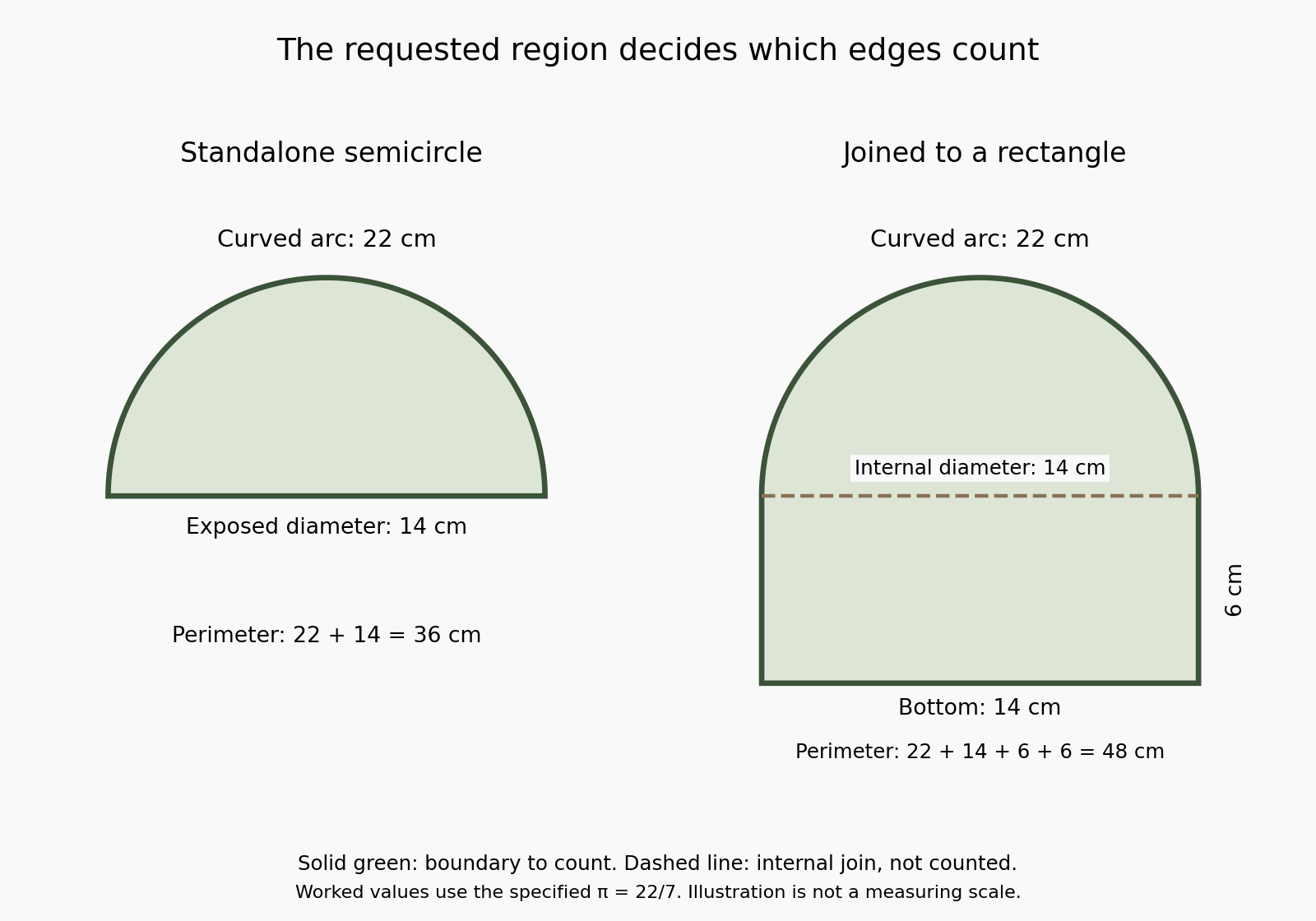
Your child correctly finds half a circle’s circumference, then adds the diameter even though the semicircle is joined to a rectangle. If you are considering PSLE Mathematics tuition in Punggol, start by tracing the boundary of the whole figure. When the entire diameter is shared with the rectangle’s top edge, that line lies inside the joined shape. It does not contribute to the perimeter of the whole shape.
A Punggol PSLE Mathematics tutor should contrast this with a standalone semicircle. Its boundary includes the curved arc and the straight diameter, so both count. The same diameter can be an exposed boundary in one question and an internal joining line in another. The requested shape decides which role it has.
Useful PSLE Maths tutorials connect the calculation to that boundary decision. In an original example with a 14 cm diameter, a rectangle 6 cm high and π specified as 22/7, the joined perimeter is 22 + 6 + 14 + 6 = 48 cm. This guide helps parents distinguish a circle-formula difficulty from an edge-selection difficulty and choose a precise next step in PSLE Mathematics tuition in Punggol.
eduKate Punggol · Primary Mathematics · Parent questions
Find your next learning step
Start with the question closest to your family, or read the full guide in order.
Chapter index
Choose the boundary · Chapters 1–3
Calculate and compare · Chapters 4–7
Inspect the joins · Chapters 8–11
Keep quantities clear · Chapters 12–15
Review independently · Chapters 16–25
- The diagram is not a measuring instrument
- Rotation changes the picture, not the boundary roles
- A short home activity with two paper pieces
- An original practice set with worked answers
- What should a Punggol PSLE Mathematics tutor assess?
- What progress looks like beyond a correct final number
- Parents’ questions about semicircle perimeter
- Keep the correction attached to the route
- A missing rectangle height uses the same boundary inventory
- Where should your family go next?
Before calculating, ask your child to point to the complete region whose perimeter is requested. Is it the semicircle alone, the rectangle alone or the whole joined figure? A diagram may show all three possibilities, but the question asks for one particular boundary. The answer must follow that target.
For the whole joined figure, imagine a thin string placed around its outside edge. The string follows the curved top, travels down one vertical side, crosses the bottom and returns up the other side. It does not travel along the line where the semicircle meets the rectangle because that line is inside the combined region.
For the semicircle alone, the string has a different route. It follows the curved arc and returns along the straight diameter. That diameter now closes the semicircle’s boundary. Its inclusion is correct for this target, even though it would be wrong for the whole joined shape.
This target check is useful when a child says, “My teacher told me to add the diameter.” The instruction may have been correct for a standalone semicircle. Rather than treating the methods as conflicting, compare the shapes being measured. The mathematical rule remains consistent: perimeter measures the complete boundary of the specified region. Different specified regions can have different boundaries within the same drawing.
CHAPTER 2 OF 25 · Choose the boundary
2. A joining line can remain visible without being a boundary
The diameter may still be drawn across the finished figure. It can help show how the shape was constructed, label the circle’s diameter or separate the rectangle and semicircle for an area calculation. A visible line therefore provides useful information without necessarily contributing to the requested perimeter.
Ask whether the joined region continues on both sides of that line. In the rectangle-and-semicircle example, the rectangle lies below it and the semicircle lies above it. The line separates two parts of the same filled region. It is not an edge where the complete region meets the surrounding empty space.
Contrast an exposed bottom edge of the rectangle. The region lies on one side and the exterior lies on the other. That edge belongs to the perimeter. The same test works for the semicircular arc: the joined region lies inside the arc and the exterior lies outside it.
Do not teach “ignore all lines inside the picture” without identifying the requested region. A line that is internal to a larger drawing might be the boundary of a smaller shaded part. The safe question is specific: “Is this line part of the boundary of the region we are measuring?” That condition prevents a useful observation from becoming another overly broad shortcut.
CHAPTER 3 OF 25 · Choose the boundary
3. Trace one complete loop before writing a formula
Choose a starting point on the boundary, such as the lower-left corner. Trace clockwise along the bottom, up the right side, around the semicircular arc and down the left side to the start. Name each section while tracing it. The route contains three straight edges and one curved arc.
Mark the starting point lightly so that the child knows when the loop is complete. This prevents counting an edge twice or stopping before the final side is included. A perimeter calculation is an inventory of one complete boundary, not an invitation to add every length printed nearby.
Write the inventory before inserting numbers: bottom edge, right side, curved arc, left side. The diameter is not on that list for the joined target. It will still be used to calculate the arc, so excluding it from the boundary does not mean ignoring its measurement altogether.
This distinction is often the missing connection. The diameter supplies information about the curve but is not itself a length travelled around the outside. A tutor can ask the child to show its two roles separately: first use it to establish the circle size, then check whether its straight line belongs to the requested boundary. The two decisions need not produce the same inclusion in the final sum.
CHAPTER 4 OF 25 · Calculate and compare
4. Identify radius and diameter before finding the arc
In the original example, the full width where the semicircle meets the rectangle is 14 cm. That straight line is the semicircle’s diameter. The radius is half of it, or 7 cm. A child who uses fourteen as the radius will calculate a circle that is twice as wide as the one described.
For a full circle, circumference can be found as π × diameter or 2 × π × radius. These agree because the diameter is twice the radius. With a diameter of fourteen, the full circumference is 14π cm. Half of that circumference is 7π cm, the semicircular arc length.
The worked question specifies π = 22/7. Using that assigned value, the arc is 7 × 22/7 = 22 cm. Keep the instruction about π attached to the question. The numerical result twenty-two follows from the specified approximation; it is not a claim that π itself equals 22/7 exactly.
Label the result “curved arc: 22 cm.” That label prevents the child from calling it the complete semicircle perimeter. The arc is one section of a boundary. Whether a straight diameter must also be added depends on the region being measured, which we established by tracing before calculating.
CHAPTER 5 OF 25 · Calculate and compare
5. A complete worked perimeter for the joined figure
Original question: “A semicircle with diameter 14 cm is joined along its entire diameter to the top of a rectangle. The rectangle is 14 cm wide and 6 cm high. Find the perimeter of the whole figure. Use π = 22/7.” The joining condition and requested whole figure are explicit.
The curved arc is half the full circumference: ½ × 22/7 × 14 = 22 cm. The exposed straight sections are the rectangle’s bottom edge of fourteen and its two vertical sides of six each. The shared top edge is internal and does not count as a separate boundary section.
Add the boundary lengths: 22 + 14 + 6 + 6 = 48 cm. Write the answer as a length, not an area. The diameter helped determine the arc, and the equal rectangle width helped identify the bottom edge. Neither fact puts the internal joining line into the perimeter sum.
Check against the trace. Four sections were named, and four contributions appear in the calculation. If the child has an additional fourteen in the sum, ask them to trace the section it represents. They will arrive at the internal diameter rather than an uncounted outside edge. That location explains the error more clearly than simply crossing out the number without saying why.
CHAPTER 6 OF 25 · Calculate and compare
6. See the internal diameter and the exposed route
The teaching diagram below shows the standalone semicircle beside the joined figure. In the standalone case, the straight diameter is exposed and completes the boundary. In the joined case, the same diameter is drawn as a dashed internal line. The outside boundary continues around the semicircular arc, two rectangle sides and the rectangle’s bottom edge.

Ask your child to trace the highlighted boundary in each panel. The semicircle’s arc has the same length in both because its diameter has not changed. The difference is the route needed to close the specified region. A straight diameter closes the standalone semicircle; the rectangle’s other three sides close the joined figure.
Using the question’s assigned π value, the standalone perimeter is twenty-two plus fourteen, or thirty-six centimetres. The joined perimeter is twenty-two plus fourteen plus twelve, or forty-eight. The twelve is the contribution of the two vertical sides, not a second diameter or an extra curved section.
This is a teaching illustration with labelled lengths, not a drawing to measure physically on a screen. Display and print settings can resize it. Use the stated dimensions and boundary roles to understand the calculation. The diagram’s job is to make the included and excluded sections visible, while the question supplies the numerical information.
CHAPTER 7 OF 25 · Calculate and compare
7. Why a standalone semicircle includes its diameter
Take a paper circle and cut it along a diameter. Each resulting half has one curved edge and one straight cut edge. If you trace around one half, you must follow both to return to the starting point. The straight edge is part of the boundary of that half-circle region.
For a standalone semicircle with radius seven, the arc is 7π cm and the diameter is fourteen centimetres. Its complete perimeter is 7π + 14 cm. With π specified as 22/7, that becomes thirty-six centimetres. Half the full circle’s circumference gives only twenty-two, so it is incomplete for this target.
This paper demonstration explains why “a semicircle is half a circle” does not mean every measurement is obtained by halving the full-circle answer. Its area is half the circle’s area, and its curved arc is half the circumference. Cutting the circle also creates a new straight boundary along the diameter.
Use that distinction rather than teaching a separate unexplained formula. The child can remember the arc from the half-circle relationship and then inspect the exposed straight edge. When the semicircle is later joined to another region, the same inspection decides whether that edge remains exposed. One boundary principle explains both questions.
CHAPTER 8 OF 25 · Inspect the joins
8. Why adding the two original perimeters double-counts a join
The rectangle in our worked example has a perimeter of 2 × (14 + 6) = 40 cm. The standalone semicircle has a perimeter of thirty-six centimetres using the assigned π value. Adding forty and thirty-six gives seventy-six, not the joined figure’s forty-eight.
The shared fourteen-centimetre line appears in both original perimeters: once as the rectangle’s top edge and once as the semicircle’s diameter. In the joined figure, neither copy belongs to the outside boundary. Subtract both copies, twenty-eight centimetres, from seventy-six to obtain forty-eight.
This add-and-remove approach is valid when the two pieces join along exactly the stated shared edge and do not otherwise overlap. The direct boundary trace is often simpler for a primary learner because it counts only the sections that belong in the answer. The alternative approach can serve as a check when its assumptions are clear.
Ask the child where each removed copy came from. “Two times fourteen because the line was counted in both separate shapes” is a meaningful explanation. Merely memorising “subtract two joins” may fail when pieces touch only at a point or when the diagram has a different shared length. The geometry of the join supplies the correction.
Our original example joins the entire diameter to a rectangle edge of the same length. A different figure might join only part of a straight edge or leave part of a wider rectangle’s top exposed. In that case, those exposed sections can belong to the perimeter. The complete-join condition cannot be silently carried into every diagram.
For an original example, attach a semicircle of diameter fourteen centrally along the top of a rectangle twenty centimetres wide and six high. The remaining top sections together measure twenty minus fourteen, or six centimetres. They are exposed, so they count alongside the bottom, two sides and semicircular arc.
Using π = 22/7, the perimeter is 20 + 6 + 6 + 6 + 22 = 60 cm. The grouped six for the exposed top is the sum of two sections. Central placement would make each three centimetres, but their combined contribution is six regardless of where that fourteen-centimetre join sits along the twenty-centimetre top without extending beyond it.
Trace the wider figure before calculating. The child can see why ignoring the entire top edge would now omit genuine boundary. The useful rule is not “joined semicircles have no straight top lines.” It is “exclude the shared internal portion and include every remaining exposed section of the requested boundary.”
CHAPTER 10 OF 25 · Inspect the joins
10. A concave cut-out can also contribute a curved boundary
Suppose a semicircular notch is cut from the top of a rectangle fourteen centimetres wide and ten high. The notch’s diameter spans the whole top, and its radius is seven. The remaining region is still connected below the notch because the rectangle’s height exceeds that radius.
The perimeter of the remaining region includes its bottom edge, two outer vertical sides and the inward-curving notch. It does not include the removed straight top line. With π specified as 22/7, the boundary length is 14 + 10 + 10 + 22 = 56 cm.
The original rectangle perimeter was forty-eight. Removing a fourteen-centimetre straight section and replacing it with a twenty-two-centimetre arc increases the perimeter by eight. A cut-out can therefore increase boundary length even while decreasing area. “Some material was removed” does not by itself mean every measurement became smaller.
This example is a transfer check, not a new circle formula. The semicircular arc calculation is unchanged. Its location is inward rather than outward, and the target is the remaining region. Tracing the concave edge helps the child recognise that a boundary need not bulge outward to count. Follow the arrangements used in the child’s current school work before adding more complicated cut-outs.
CHAPTER 11 OF 25 · Inspect the joins
11. Two semicircular ends still need the exposed straight sides
Imagine a rectangle fourteen centimetres wide and six high with a semicircle attached along the entire top and another along the entire bottom. Both semicircles have diameter fourteen. The two shared diameter lines are internal. The exposed boundary consists of two semicircular arcs and the two six-centimetre vertical sides.
The two arcs together form the length of one full circumference, 14π cm. With π assigned as 22/7, that curved contribution is forty-four centimetres. Add the twelve centimetres from the two straight sides to obtain a perimeter of fifty-six centimetres.
An answer of forty-four counts both curves correctly but omits the straight sides. An answer that also includes two fourteen-centimetre diameters counts internal joins. The boundary inventory makes both errors visible without requiring the child to remember a special name for this rounded-end shape.
Turn the figure sideways and trace again. The pieces have the same sizes and the perimeter stays fifty-six. Words such as top, bottom and side describe the drawing’s orientation, not an instruction to include or exclude an edge. The exposure test remains valid after rotation, which is why it is more dependable than memorising which-looking line is usually a diameter.
CHAPTER 12 OF 25 · Keep quantities clear
12. A quarter circle has two straight boundary sections
A standalone quarter circle contains one quarter of a full circumference as its curved arc. Its boundary also has two radii meeting at the centre. For radius seven and π specified as 22/7, the arc is eleven centimetres and the two radii contribute fourteen. The perimeter is twenty-five centimetres.
This contrasts with the standalone semicircle, whose straight section is one diameter. The total straight contribution happens to be fourteen in both examples because a diameter is two radii. Their arc contributions differ: twenty-two for the semicircle and eleven for the quarter circle.
Do not use that numerical coincidence to treat the shapes as interchangeable. Trace the quarter circle’s two straight sections and identify their endpoints at the centre. Trace the semicircle’s one straight section across the full width. The boundaries are organised differently even though their total straight length matches for the same radius.
When a quarter circle is joined to another region, inspect which radius edges remain exposed. Some may become internal and some may stay on the boundary. The same target-first method applies. Parents can keep the first lesson focused on the rectangle-and-semicircle join, then use the quarter circle as a later contrast if it matches the child’s current work.
CHAPTER 13 OF 25 · Keep quantities clear
13. Area calculations may use an internal line that perimeter excludes
For the original joined shape, area can be found by adding the rectangle’s area and the semicircle’s area because they meet along a line without overlapping interiors. The rectangle area is 14 × 6 = 84 cm². The semicircle area is ½ × π × 7² cm².
With π specified as 22/7, the semicircle area is seventy-seven square centimetres. The total joined area is 84 + 77 = 161 cm². The internal diameter helps establish the rectangle width and semicircle radius, but its length is not added as an area contribution.
Perimeter asks about boundary length, so it follows a different decomposition: arc plus bottom plus two sides. A child who uses every labelled measurement in both calculations may not have separated the requested quantities. Ask whether they are measuring the space inside or the distance around.
The unit provides a check. Area uses square centimetres, while perimeter uses centimetres. Writing cm² after an arc-plus-sides sum does not make that sum an area calculation. Writing cm after rectangle-plus-semicircle areas does not make those areas lengths. Interpret the quantity first, choose a corresponding method and then attach the unit that matches the work.
CHAPTER 14 OF 25 · Keep quantities clear
14. Keep the numerical value of π consistent within the question
If a question says use π = 22/7, use that value in its circle calculations. If it supplies another approximation or a calculator instruction, follow that instruction. Do not change the value halfway through the calculation because another example used a different one.
For the original joined shape, the symbolic perimeter is 26 + 7π cm: fourteen for the bottom, twelve for the two sides and 7π for the arc. Using 22/7 gives forty-eight. Using 3.14 instead would give 47.98. The small difference comes from the chosen approximation, not from a different boundary.
Parents should therefore inspect both the method and the instruction before deciding an answer-key difference reveals a misconception. If the child’s boundary inventory is correct but the π value differs from the specified one, repair that instruction-following step. If the child includes an internal diameter, the boundary selection needs attention even if the chosen π value matches.
Avoid claims about exact marking or permitted calculator use unless they are verified for the relevant task. This article’s original examples specify their π value so that the worked answers are reproducible. Current assessment instructions should be read directly when preparing a child for a particular paper or school exercise.
CHAPTER 15 OF 25 · Keep quantities clear
15. Do not round the arc before adding the other sections
Keep sufficient precision through the calculation and round the final requested answer according to the question. Prematurely rounding an arc can change a later sum. This is separate from choosing the correct boundary: both the included sections and their numerical lengths need to be handled accurately.
For a semicircle with diameter ten centimetres, joined to a ten-by-four rectangle, the boundary is the arc plus ten plus eight. Using π = 3.14 as specified in that original example, the arc is 15.7 and the perimeter is 33.7 cm. Rounding the arc to sixteen before adding would produce thirty-four, changing the result early.
If the task requests the final perimeter to the nearest centimetre, thirty-three point seven rounds to thirty-four. The final numerical result happens to match in this example, but that does not justify rounding every intermediate value in every problem. Other dimensions or several curved sections may expose the difference.
Parents can use a simple written distinction: arc calculation, complete boundary sum, final requested rounding. The child does not need to discuss numerical analysis to preserve those stages. Clear working shows whether an error began with a missing edge, a wrong radius or a premature approximation, allowing the next lesson to target the actual cause.
CHAPTER 16 OF 25 · Review independently
16. The diagram is not a measuring instrument
A printed semicircle may look flatter or taller than expected, and a screenshot may stretch the whole figure. Use the stated dimensions and shape properties rather than estimating lengths from appearance. A labelled diameter of fourteen remains fourteen in the mathematical question even if the displayed image is resized.
This does not mean every unclear picture should be ignored. The diagram must still show which regions join and which boundary is requested. If shading or a joining line is unreadable, obtain a clearer copy or ask for clarification. Numerical labels can resolve lengths, but they cannot always resolve an ambiguous target region.
When sending a question to a tutor, include the full diagram and the sentence naming the required perimeter. A cropped arc may omit the rectangle below it and make the diameter appear exposed. A cropped instruction may conceal that only one shaded part is being measured.
Keep the child’s original working too. An extra fourteen in the sum is useful evidence only when we can see which line the child meant to count. A precise explanation can then connect the original representation to the correction. Replacing the whole question with a tidier but different sketch may remove the feature that produced the mistake.
CHAPTER 17 OF 25 · Review independently
17. Rotation changes the picture, not the boundary roles
Rotate the original joined figure so that the semicircle bulges to the right instead of upwards. The shared diameter is now vertical in the drawing. It is still internal to the whole region, so it remains excluded from the perimeter. The exposed arc and the rectangle’s other three sides still contribute.
This is a valuable transfer check because some children learn that horizontal diameter lines should be ignored or that vertical lines should be counted as sides. Those shortcuts depend on orientation rather than geometry. A rotation exposes the difference while preserving all lengths.
Ask the child to mark the requested boundary before calculating again. If the inventory remains one arc, one fourteen-centimetre rectangle edge and two six-centimetre edges, the total stays forty-eight using the assigned π value. There is no need to repeat the arithmetic if the purpose is to check edge selection.
Parents can praise the specific reasoning: “You checked whether it was shared, not whether it was horizontal.” That action is reusable. A tutor may gradually reduce the tracing prompt once the child can identify the boundary independently in different orientations. The aim is a dependable selection process, not a page full of memorised diagrams that all face the same way.
CHAPTER 18 OF 25 · Review independently
18. A short home activity with two paper pieces
Use a rectangle and a semicircle whose diameter matches the rectangle’s width. Place them apart first. Trace each boundary with a finger. The semicircle includes its curved edge and diameter; the rectangle includes all four sides. The two pieces have separate perimeter routes.
Now place them together along the matching straight edges without overlapping their interiors. Trace the outside of the combined region. The two matching edges disappear from the exposed route. Point to the join and ask why it was counted before but is not counted now.
Move the pieces apart again. The diameter becomes exposed, and the rectangle’s top becomes exposed. Nothing about their lengths changed. Their role in the requested boundary changed because the target moved from separate pieces to a joined region. This movement makes the condition concrete without needing difficult arithmetic.
Finish with a drawing of the joined figure and let the child list its boundary sections. If the child still adds the diameter, return to the paper trace. If they list the right sections but calculate the arc incorrectly, practise radius and circumference separately. One short activity can distinguish those learning needs before another full worksheet is assigned.
CHAPTER 19 OF 25 · Review independently
19. An original practice set with worked answers
Question A: a standalone semicircle has diameter fourteen centimetres. Use π = 22/7. Its curved arc is twenty-two and its exposed diameter is fourteen, so the perimeter is thirty-six centimetres. An answer of twenty-two names the arc only.
Question B: the same semicircle is joined along its full diameter to a fourteen-by-six rectangle. Find the whole perimeter. The arc contributes twenty-two, the bottom fourteen and the two sides twelve. The answer is forty-eight centimetres. The shared diameter does not count.
Question C: attach that semicircle along part of the top of a twenty-by-six rectangle, with no overhang. The remaining exposed top sections total six. The boundary sum is twenty-two plus twenty plus twelve plus six, giving sixty centimetres.
Question D: remove a semicircular notch of diameter fourteen from the full top of a fourteen-by-ten rectangle. The remaining-region perimeter is twenty-two plus fourteen plus twenty, giving fifty-six centimetres. Question E: a standalone quarter circle has radius seven. Its arc is eleven and its two radii total fourteen, so its perimeter is twenty-five centimetres. All five questions use the stated π approximation and distinct boundary targets.
CHAPTER 20 OF 25 · Review independently
20. What should a Punggol PSLE Mathematics tutor assess?
The tutor can begin with a boundary-only task, without asking for numerical calculations. Can the child trace a standalone semicircle and a joined semicircle-and-rectangle figure? Can they identify which diameter is exposed and which is internal? This separates edge interpretation from circle arithmetic.
Next ask for radius and arc length from a given diameter. If the child identifies the correct boundary but treats fourteen as the radius, the next lesson concerns circle dimensions. If the arc calculation is accurate but the final sum includes the join, the boundary selection needs further support.
Finally use a fresh contrast, such as a wider rectangle with exposed top sections or a rotated join. A child who succeeds only with the original equal-width drawing may be remembering its inventory rather than interpreting the new boundary. Ask them to explain one included and one excluded section.
When discussing Punggol PSLE Mathematics tuition, bring the complete question and the child’s first calculation. Ask how boundary selection will be observed and how a fresh diagram will test independence. Confirm current arrangements directly. This guide does not promise a score, timetable, class size or fixed number of lessons needed to resolve the difficulty.
CHAPTER 21 OF 25 · Review independently
21. What progress looks like beyond a correct final number
The child may begin identifying the requested region before calculating. That is meaningful progress because a correct circle formula cannot compensate for measuring the wrong boundary. A short statement such as “the whole joined shape” helps keep the target stable through the working.
A second sign is a labelled inventory. Arc, bottom and two sides describe the four contributions in the original example. The child can explain why the internal diameter is absent even though its fourteen-centimetre measurement was used to find the arc. That explanation connects information use with boundary selection.
A third sign is transfer. The child includes exposed top sections on a wider rectangle, recognises the inward arc of a notch or keeps the shared diameter excluded after rotation. These contrasts show that the method follows the shape rather than a fixed orientation or one remembered answer.
A fourth sign is a structural check. The child can trace each term in the final sum back to a boundary section and confirm that the route closes once. Try a small fresh example on another day. Independent edge selection then is stronger evidence than immediate success while the parent’s highlighted trace remains in view.
CHAPTER 22 OF 25 · Review independently
22. Parents’ questions about semicircle perimeter
“Should I always add the diameter?” Add it when it is an exposed part of the boundary being measured, such as a standalone semicircle. Exclude it when the complete diameter is shared internally within the requested joined region. Partial exposure requires inspecting the particular diagram.
“Can I add the original shape perimeters?” You can use that method when you account correctly for shared edges and the pieces’ arrangement. For the simple complete join, the shared length appears in both original perimeters and both copies must be removed. Direct tracing is often clearer for a learner who is still identifying the boundary.
“Does a cut-out always reduce perimeter?” No. Replacing a straight edge with a longer curved boundary can increase it while removing area. Check the actual route. The fourteen-centimetre semicircular notch example replaces fourteen centimetres with a twenty-two-centimetre arc under the assigned π value.
“What if my child knows the formulas?” Ask them to explain what each term in the final sum measures. Formula retrieval and boundary interpretation are separate skills. A child can calculate an arc accurately and still include the wrong straight edge. Useful tuition should preserve the correct arithmetic while repairing the selection that makes it unsuitable for the question.
CHAPTER 23 OF 25 · Review independently
23. Keep the correction attached to the route
If your child includes an extra fourteen, say, “Show me the edge this fourteen measures.” Let them point to the diameter. Ask whether a string around the complete joined figure would travel there. The region continues above and below it, so the line lies inside the route.
Then trace the genuine outside loop together. Ask the child to match each section to the terms already written. The twenty-two arc, fourteen bottom and two sixes account for the loop. The additional fourteen does not have an exposed section left to represent.
If the child feels confused because a previous semicircle question included the diameter, place the two targets side by side. The standalone route needs that straight section. The joined route does not. The contrast resolves the apparent contradiction without asking the child to forget a correct earlier method.
Praise the useful check: “You matched the number to the boundary.” That action can be repeated in many perimeter problems. Keep the first correction manageable and return to a fresh contrast later. The aim is to make the route understandable, not to make the child feel that every circle drawing contains an unpredictable exception.
CHAPTER 24 OF 25 · Review independently
24. A missing rectangle height uses the same boundary inventory
Once the boundary selection is secure, change the unknown rather than the shape. Original question: “A semicircle of diameter fourteen centimetres is joined along its full diameter to a rectangle of the same width. The whole perimeter is fifty centimetres. Find the rectangle's height. Use π = 22/7.” The outside route still contains one arc, one bottom edge and two equal vertical sides.
The semicircular arc is twenty-two centimetres. The bottom edge is fourteen. Those known boundary sections contribute thirty-six centimetres, leaving fifty minus thirty-six, or fourteen, for the two vertical sides together. Each side is seven centimetres, so the rectangle's height is seven.
Check by reconstructing the complete perimeter: 22 + 14 + 7 + 7 = 50 cm. Every term has an exposed boundary section, and the route closes once. The internal diameter supplies the arc's size but remains absent as a separate contribution. The unknown height has not changed that condition.
This example helps distinguish total remaining length from the length of one side. A child who answers fourteen may have correctly removed the known sections but stopped before splitting the remaining total between two equal sides. A child who subtracts an extra diameter has removed a length that never belonged to the outside boundary. Those are different errors and need different follow-up questions.
Ask the child to point to what the remaining fourteen describes before dividing. It represents both vertical sides together. A quick labelled sketch can make the final division visible. Use this backwards example after the forward calculation is understandable; its purpose is to check whether the child can keep the same boundary relationship while the requested quantity changes.
If the child includes internal joins, continue with paper pieces and boundary inventories. If they omit the exposed diameter of a standalone semicircle, compare the arc with the complete boundary. If radius or π handling causes the error, practise that calculation separately. Let the observed difficulty determine the next task.
For the wider topic, read circles, area, circumference and mensuration. For a later bridge, see composite perimeter after PSLE. These existing guides broaden the subject rather than replace this focused parent question about the shared diameter.
The MOE Primary Mathematics syllabus includes perimeter of semicircles, quarter circles and composite figures in Primary Six. Use current school materials for the child’s practice range and the actual question’s numerical instructions. These original examples explain the boundary decision; they do not predict a PSLE question or establish a marking rule.
A precise question for a Punggol PSLE Mathematics tutor is, “My child calculates the curved arc correctly but still adds the internal diameter after the semicircle is joined to a rectangle. Can we compare the standalone and joined boundaries?” That gives the lesson a clear purpose and gives the child a route they can trace, explain and check.