
Unfamiliar Additional Mathematics questions are designed to look less like the examples students have already seen. That does not mean they require completely new Mathematics. Usually the challenge is to recognise a familiar relationship under a new surface, connect two topics, or choose a representation that makes the structure visible.
The 2027 SEC G3 Additional Mathematics assessment emphasises problem solving and making connections across topics, so students need practice with questions that do not announce the chapter. The goal is not to memorise more exotic patterns. It is to become better at reducing novelty into known Mathematics.
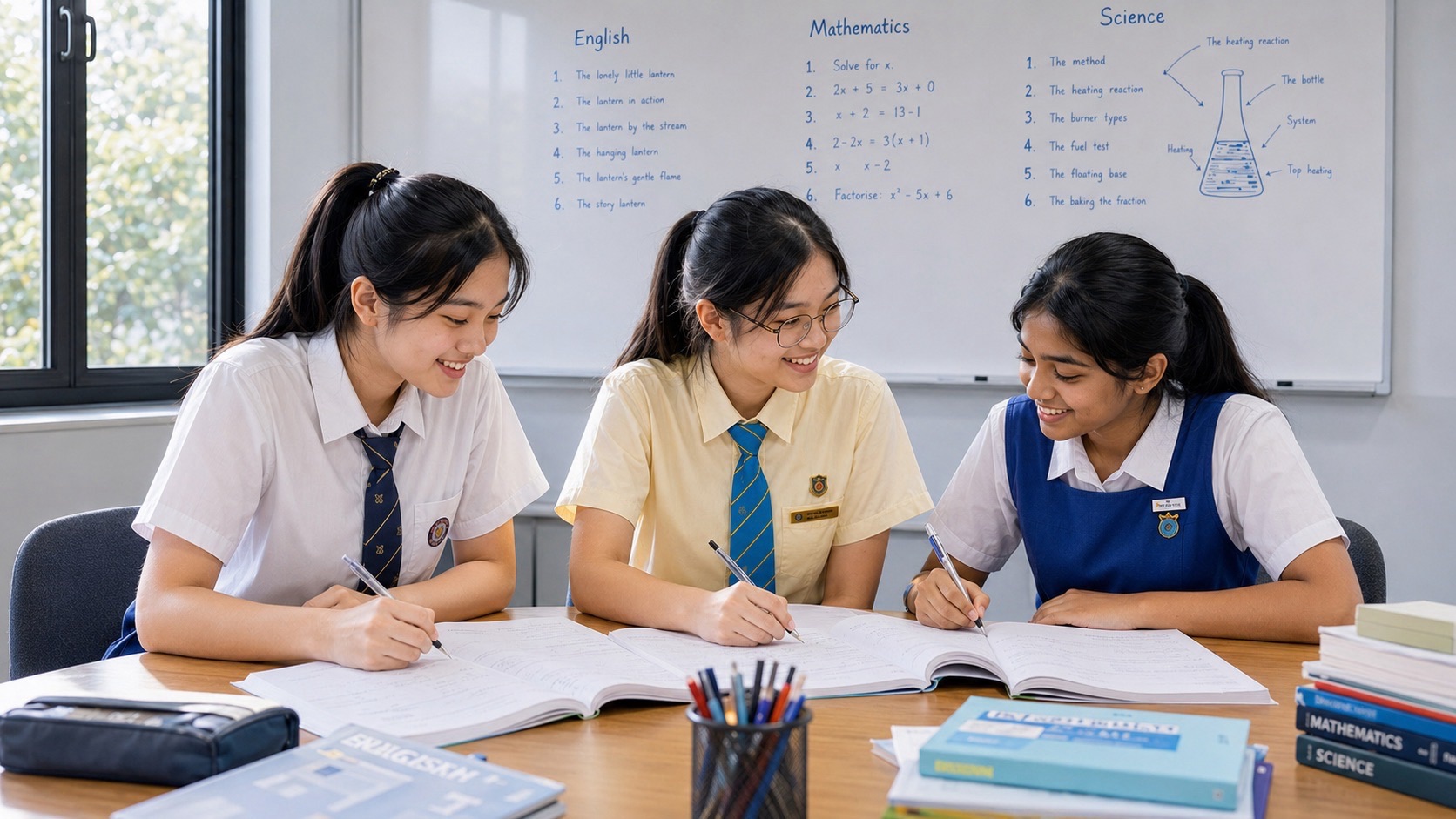
At eduKate Punggol, Mathematics tutorials are held at 83 Punggol Central, Singapore 828761, near Punggol MRT and Waterway Point, in small groups of up to three students. Unfamiliar problems are useful because the tutor can see whether the student truly owns the method or only recognises familiar worksheet layouts.
The unfamiliar-question protocol
- Read the target before manipulating anything.
- Mark all givens and restrictions.
- Name the mathematical object.
- Write one fact that is definitely true.
- Choose one representation.
- Take one valid first step.
- Reassess after that step.
Reduce novelty into structure
A strange-looking diagram may still be a similarity problem. A wordy context may still be quadratic modelling. A parameter may still reduce to a discriminant condition. The surface changes; the underlying relationship often does not.
Use representation changes
If the Algebra looks opaque, sketch the graph. If the diagram is confusing, assign coordinates. If the word problem feels vague, define variables and write an equation.
Use Translate Graphs and Diagrams Into Equations.
Do not wait to see the whole solution
Students often freeze because they cannot see all ten steps. They only need one mathematically justified next step.
One useful transformation can expose the route.
Look for invariants
Ask what must remain true regardless of the unfamiliar wording: equal gradients at tangency, discriminant conditions, identity relationships, derivative meaning, geometric angle facts or conservation of a stated quantity.
Use a route library, not a template library
- Tangency → repeated root or equal gradient depending on context.
- Unknown exponent → logarithmic thinking may help.
- Maximum/minimum → completed square or calculus depending on context.
- Intersection → simultaneous equations.
- Area between curves → intersections + graph order + integration.
- Periodic equation → trig graph/identity + interval control.
The route is a relationship, not a memorised page.
Worked example: unfamiliar tangent condition
A question may not use the word “tangent.” It may say a line meets a curve at exactly one point. The student should translate “one intersection” into a repeated-root condition after forming the intersection equation.
Worked example: unfamiliar optimisation
A geometry context may produce an expression in one variable, then ask for the greatest possible area. Once the model is built, the unfamiliar context becomes a maximum/minimum problem.
The non-routine error taxonomy
- Surface panic — the question looks new, so the student assumes the method is new.
- Formula hunting — random formulas are tried before structure is identified.
- Over-reading — too much time is spent rereading without writing a fact.
- Representation lock — the student stays in one form even when another would help.
- Route abandonment — a productive first step is discarded too early.
The 3-minute recovery rule
If stuck, spend three focused minutes writing givens, target, one representation and one known relationship. If no productive route appears, move temporarily and return later.
A 60-minute unfamiliar-question lesson
- 10 minutes: rapid structure-identification drills.
- 15 minutes: changed-surface Algebra question.
- 15 minutes: unfamiliar graph/geometry question.
- 15 minutes: mixed synthesis question.
- 5 minutes: route reflection.
How to know unfamiliar-question skill is improving
- The student writes earlier instead of staring longer.
- Novel wording causes less panic.
- Known relationships are identified faster.
- Representation changes happen more naturally.
- More questions receive at least a valid first step.
- The student can explain why a method was selected.
Continue the Mathematics Improvements in Punggol lane
- A-Math Multi-Part Questions.
- How to Choose the Best A-Math Method.
- Using Earlier Sub-Part Results Correctly.
- A-Math Modelling and Applications.
Unfamiliar A-Math questions are usually familiar mathematics wearing unfamiliar clothing. Strip away the surface, name the object, choose a representation and take one valid first step. Transfer grows when the student learns to recognise relationships instead of templates.
Official reference: SEAB 2027 SEC G3 Syllabuses — Additional Mathematics K341.


