
Chemical equations become easier when students understand that reactions rearrange atoms instead of creating or destroying them. In Punggol Secondary Science and Chemistry, this single idea connects observations in the laboratory to particle diagrams, word equations, symbol equations, balancing, reaction types and conservation of mass.
Parents searching for chemical reactions, balancing chemical equations, law of conservation of mass, reactants and products, chemical change or Secondary Chemistry equations are often trying to solve a symbolic-language problem. The student may recognise fizzing or colour change but fail to explain which atoms are present before and after the reaction.
This upgraded Science Improvements In Punggol owner follows the same foundational model used in current middle-school Chemistry resources. Khan Academy’s chemical-equations material explains that atoms are conserved in reactions and are rearranged into new substances, which is why coefficients are used to balance equations. This page also connects to Atoms, Elements, Compounds and the Periodic Table, Acids, Bases and pH and Chemical Reaction Rates.
The reaction reasoning system
- Identify the reactants.
- Identify the evidence that a chemical change may have occurred.
- Identify the products.
- Write the word equation.
- Translate to formulas where required.
- Count each type of atom on both sides.
- Adjust coefficients until atom numbers match.
- Check that formulas themselves were not altered.
Chemical change creates new substances
In a chemical reaction, the atoms present in the reactants are reorganised into different combinations. The products have different chemical identities and often different properties from the reactants.
This distinguishes chemical change from a physical change such as melting, freezing, dissolving or cutting, where no new chemical substance is necessarily formed.
Evidence of reaction is not the reaction itself
Students often memorise signs of a chemical reaction: colour change, gas formation, temperature change, precipitate formation or light emission. These observations are useful evidence, but they do not define every reaction by themselves.
A temperature change can occur during a physical process too. Gas bubbles can be caused by boiling. Strong reasoning uses the observation together with knowledge of the substances and process.
Reactants are the starting substances
Reactants appear on the left side of a conventional chemical equation. Products appear on the right. The arrow means “reacts to form,” not “equals.”
This simple distinction prevents students from treating chemical equations as ordinary algebraic equations.
Conservation of matter is the balancing rule
In ordinary chemical reactions, atoms are not created or destroyed. The same number of atoms of each element must therefore appear before and after the reaction.
Khan Academy’s current chemical-equations guide explicitly frames balancing around this law: count the atoms on both sides and use coefficients so each element is conserved.
Coefficients and subscripts do different jobs
A subscript is part of a chemical formula and tells us how many atoms of an element are present in one formula unit or molecule. A coefficient tells us how many units of the whole formula participate.
When balancing equations, students change coefficients—not subscripts—because changing a subscript changes the identity of the substance.
Example: hydrogen reacting with oxygen
The unbalanced equation is:
H₂ + O₂ → H₂O
There are two oxygen atoms on the left but only one on the right. Placing a 2 before water gives:
H₂ + O₂ → 2H₂O
Now there are four hydrogen atoms on the right, so place a 2 before hydrogen:
2H₂ + O₂ → 2H₂O
The equation is now balanced: four hydrogen atoms and two oxygen atoms on each side.
Balancing is accounting, not guessing
A useful method is:
- write correct formulas first;
- count atoms of each element;
- choose one unbalanced element;
- change a coefficient;
- recount all affected elements;
- repeat until every element matches;
- simplify coefficients to the smallest whole-number ratio where appropriate.
Mass is conserved even when a gas escapes
Students sometimes think mass disappears when a reaction produces gas because the measured mass of an open container can decrease. The gas has left the measured system; matter has not been destroyed.
In a closed system, total mass before and after an ordinary chemical reaction remains the same within measurement uncertainty.
Closed-system thinking matters
When analysing mass data, define the system boundary. Is gas allowed to escape? Is something entering from the air? Was every product captured?
This connects chemical reactions to the broader Systems and Cycles framework.
Word equations come before symbol equations
If a student cannot state the correct reactants and products in words, symbolic balancing will not repair the conceptual mistake.
Use this progression:
- describe the observation;
- name the reaction type;
- write reactant and product names;
- write formulas;
- balance the equation.
Reaction families reduce memory load
Many school reactions belong to familiar families.
- acid + base → salt + water;
- acid + reactive metal → salt + hydrogen;
- acid + carbonate → salt + water + carbon dioxide;
- combustion reactions involving oxygen;
- decomposition reactions where one compound forms simpler substances;
- displacement reactions where a more reactive element replaces another.
The family predicts likely products, but formulas still need to be correct for the actual substances involved.
Particle diagrams should agree with the equation
A balanced equation and a particle diagram are two representations of the same conservation rule. If the equation shows two molecules of hydrogen reacting with one molecule of oxygen, the particle model should show the corresponding numbers of atoms before and after.
Students improve when they translate between words, symbols and particles.
Reaction equations connect to quantitative Chemistry
Balanced coefficients eventually support mole ratios and stoichiometric calculations. The coefficients tell us relative reacting amounts, not simply how many symbols to write.
This is why equation balancing needs to be conceptually secure before more advanced calculation begins.
Secondary G1, G2 and G3: symbolic depth changes
Different subject levels require different amounts of symbolic Chemistry. Some students may focus on word equations and simple conservation; others progress into formula writing, ionic equations, redox, mole calculations and stoichiometry.
The foundation remains constant: atoms are rearranged, not created or destroyed.
A 30-minute chemical-equation drill
- Classify five examples as physical or chemical change.
- For three chemical changes, list observable evidence.
- Write word equations.
- Translate them into formulas.
- Count atoms on both sides.
- Balance using coefficients.
- Draw one matching particle diagram.
- Explain how mass is conserved if gas is produced.
- Identify the system boundary.
Common chemical-equation misconceptions
- atoms disappear during reactions;
- products contain completely new kinds of atoms;
- subscripts can be changed to balance an equation;
- the reaction arrow means equals;
- mass is not conserved when gas escapes;
- every colour change proves a chemical reaction;
- balancing equations changes the chemical formulas;
- coefficients and subscripts mean the same thing.
How to diagnose an equation error
If formulas are wrong, repair element symbols and compound composition first. If formulas are right but balancing fails, count atoms systematically. If conservation is misunderstood, use particle diagrams and closed-system mass examples. If word equations fail, classify the reaction family before returning to symbols.
When Science tuition in Punggol adds value
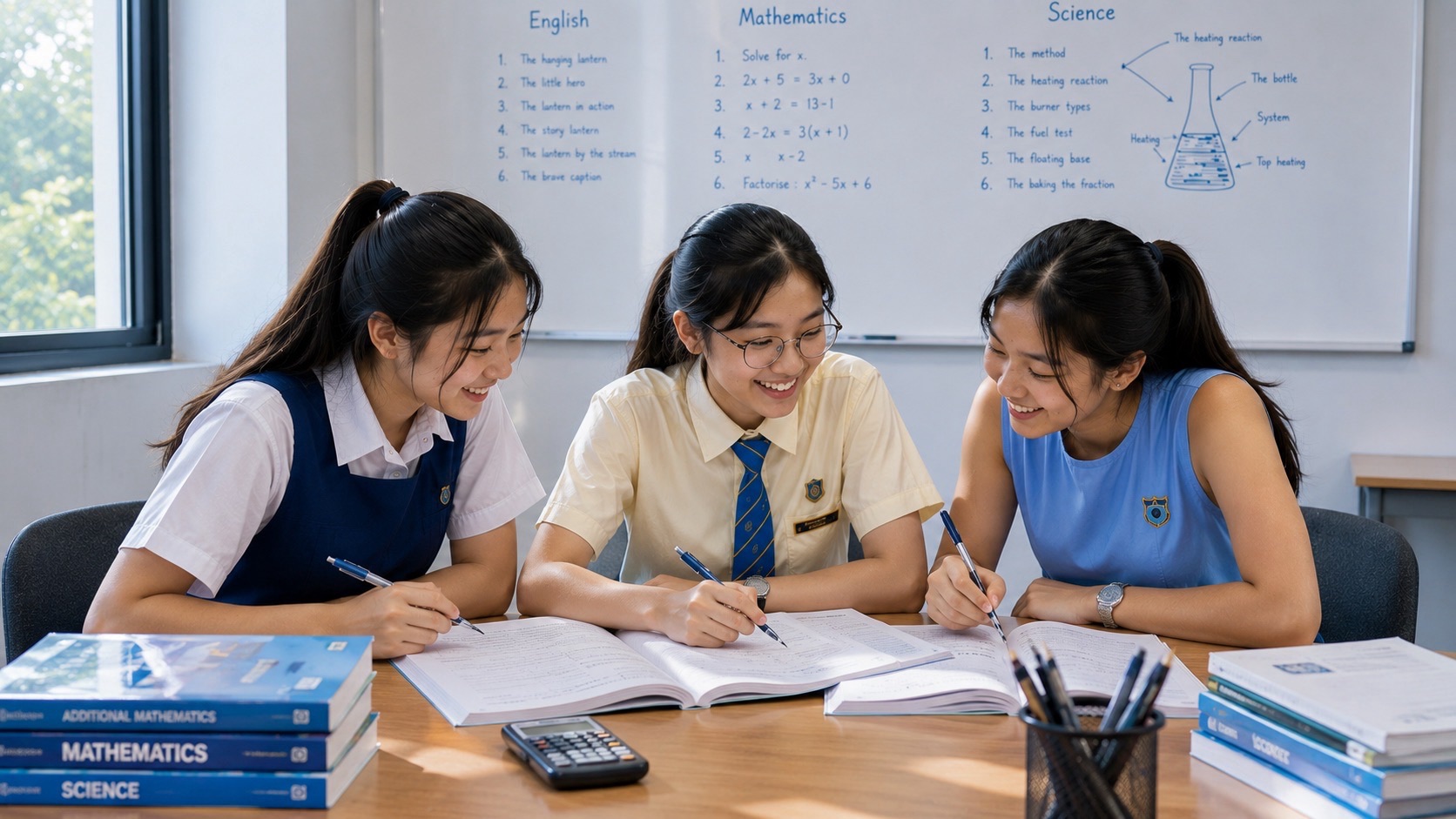
Chemical equations reveal whether students can coordinate words, formulas, particles and conservation. In eduKate Punggol’s three-student Science tutorials, one learner can identify reactants/products, another balance the symbols and another audit atom conservation, making the weak link visible immediately.
Parents can review Science Tuition Punggol, Secondary 3 Chemistry Tuition Punggol, or the Science Article Index.
Conclusion: balance the atoms because matter is conserved
Chemical equations are compact models of atom rearrangement. Name the reactants and products, write correct formulas, count atoms and use coefficients to preserve every element. Once conservation becomes the reason for balancing, equations stop feeling like arbitrary symbol puzzles.


