
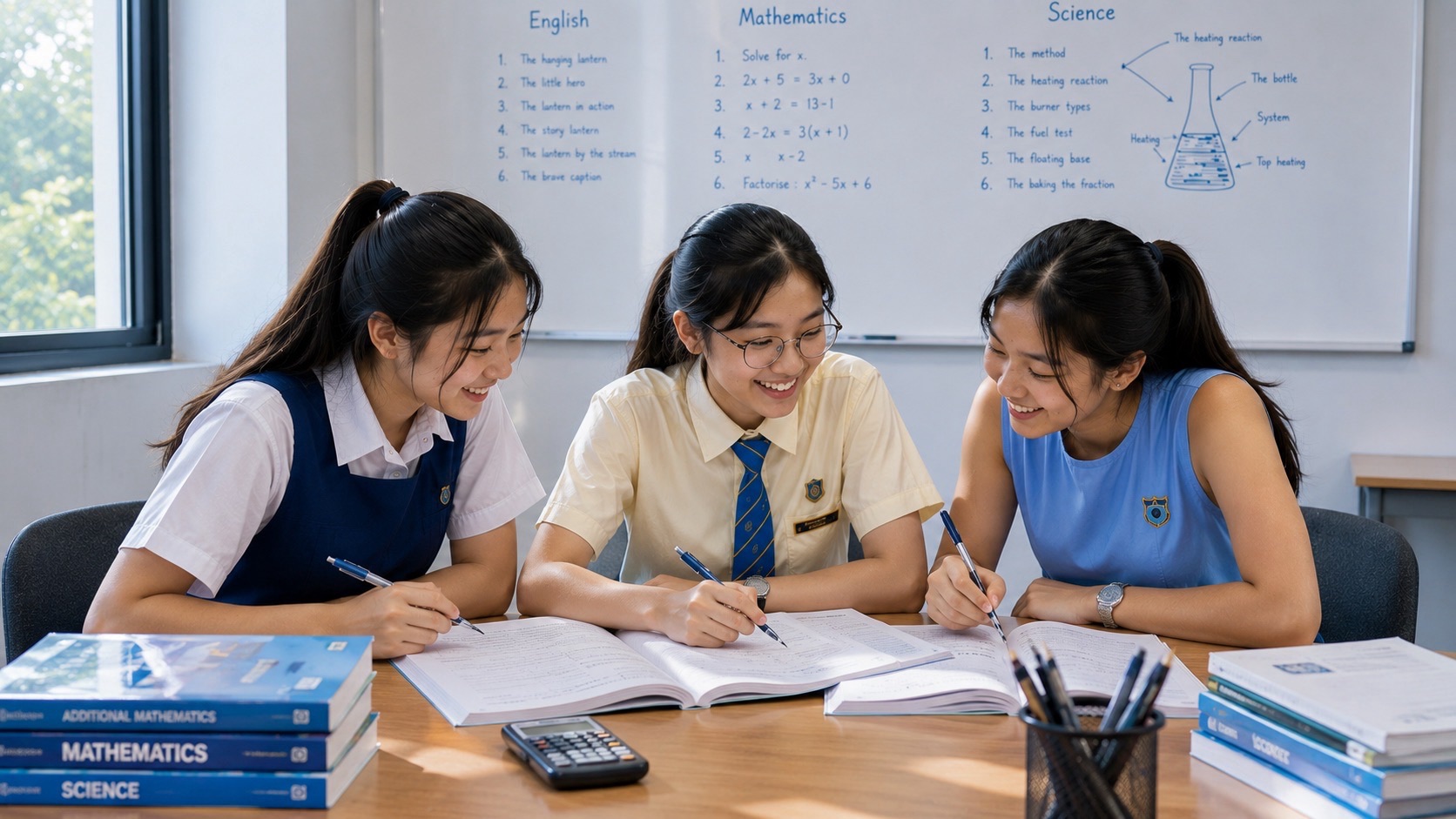
Holiday tuition in Punggol in 2027 should not be treated as a default programme that every child must attend. The June and year-end school holidays create something more useful than extra teaching time: they create a temporary change in the learner’s environment. School pressure drops, the weekly timetable opens, and a family can decide whether the child should pause, repair, consolidate, prepare ahead or simply recover. The right choice depends on what the learner actually needs.
For families searching for June holiday tuition in Punggol, December tuition in Punggol or a school-holiday programme near Punggol MRT and Waterway Point, the most important question is not “Which intensive course should we book?” It is what educational job would justify using part of the holiday for tuition? A Primary 5 student preparing for the PSLE runway, a Secondary 3 A-Math student with one broken algebraic dependency and a Primary 3 child who simply needs rest should not receive the same holiday plan.
This page is the cross-subject school-holiday owner for eduKatePunggol. It does not claim that every 2027 holiday class, date or seat has already been confirmed. Exact 2027 school-term dates should be checked against MOE’s official calendar when published, and actual eduKatePunggol class availability should be confirmed through Book a Tuition Consultation. The specialist holiday routes remain separate: English, Mathematics and Science.
The five legitimate holiday decisions
| Decision | When it makes sense | What the holiday should achieve |
|---|---|---|
| Pause | The learner is progressing, the school term was heavy, or tuition has become low-value repetition. | Recovery, reading, sleep, family time and a clean restart. |
| Repair | A specific weak link is already blocking later work. | Fix the prerequisite while the calendar is less crowded. |
| Consolidate | Learning is broadly correct but fragile or easily forgotten. | Retrieval, mixed practice and independent re-use. |
| Prepare ahead | The next school stage introduces a genuinely new demand and foundations are already secure. | Build orientation and useful readiness, not race through the future syllabus. |
| Intensive exam block | A major examination is near and the learner has stable knowledge that now needs transfer, timing and paper control. | Turn capability into reliable examination performance. |
The bad holiday plan begins with available class slots and tries to fit the child into them. The better plan begins with the learner’s current state and then asks whether a class is even necessary.
June and December are not the same kind of holiday
The middle-of-year and year-end breaks create different opportunities.
June: repair while the year is still alive
The June break arrives after several months of school evidence. The child has completed assignments, class tests and ordinary classroom work. There is enough information to see patterns, but there is still enough year left for repair to matter.
- Which errors have repeated since Term 1?
- Which topics never became stable?
- Which subject is consuming too much homework time?
- Which corrections disappear after a week?
- Which school expectations will become harder in the second half of the year?
June is therefore often an excellent audit-and-repair window. It is less suitable for indiscriminate acceleration. If a Primary 5 Mathematics learner is still fragile in fractions, ratio and percentage, racing into every Primary 6 topic can enlarge the problem instead of solving it.
Year-end: transition, recovery and selective preparation
The November–December period is different because the school year has ended. There is more space, but the break is also longer and psychologically important. A child should not finish the academic year and immediately enter another full school timetable disguised as “holiday enrichment”.
Year-end work is strongest when it has a clear transition job:
- repair one unresolved weakness before it becomes next year’s prerequisite;
- build reading or retrieval habits that can continue independently;
- prepare a Primary 2 learner for the arrival of Science in Primary 3 without teaching the whole Science syllabus early;
- help a Primary 5 learner begin the P6 year with stable upper-primary systems;
- help a post-PSLE learner understand what changes in Secondary 1;
- help a Secondary 2 learner prepare for upper-secondary subject complexity;
- rebuild a workable weekly routine after a difficult year.
Do not confuse “intensive” with “effective”
A holiday intensive can be useful. It can also compress too much work into too little time and create an illusion of progress because the learner performs well while the material is still fresh.
Three questions help separate real learning from short-term familiarity:
- Can the learner retrieve it after several days without re-reading?
- Can the learner use it when the question, wording or context changes?
- Can the learner begin without the tutor reproducing the first step?
If the answer is no, the holiday course may have produced successful lessons without durable learning.
PunggolOS: the holiday is a change of conditions
PunggolOS uses the loop Observe → Identify → Repair → Practise → Transfer → Recheck. School holidays are valuable because they change the conditions around this loop.
| During term time | During the holiday | What the change makes possible |
|---|---|---|
| New school content keeps arriving. | The incoming load slows or stops. | Repair old weaknesses without constantly falling another chapter behind. |
| Homework deadlines dominate. | Scheduling becomes more flexible. | Use spacing and delayed retrieval rather than next-day completion. |
| The learner is reacting to school. | The learner can revisit the system. | Teach planning, checking and independent study routines. |
| Assessment urgency can hide causes. | Time pressure can temporarily reduce. | Diagnose the first weak link more accurately. |
This is why a holiday programme should not simply reproduce the school term with longer worksheets. The environment has changed; the teaching should use that change.
Holiday decision 1: Pause
Pausing is not the same as giving up. Sometimes the most educationally useful holiday intervention is less intervention.
Consider a pause when:
- the learner has been progressing independently;
- school plus tuition has produced chronic tiredness;
- the child has not had enough unstructured reading, play or recovery;
- the current tuition programme is repeating already-secure content;
- the family is travelling and an artificial make-up schedule would create more stress than value.
A pause can still include light learning: reading, games, journalling, practical Mathematics, museum visits, conversations, cooking, cycling, observing nature and ordinary family life. Not all learning has to arrive as a worksheet.
Holiday decision 2: Repair
Repair is the strongest reason to use holiday tuition. A blocked prerequisite is expensive during the school term because every new lesson tries to build on it.
Examples:
- A Primary 4 English learner reads accurately but too slowly for comprehension.
- A Primary 5 Mathematics learner can calculate percentages but cannot identify the base quantity in word problems.
- A Primary 5 Science learner knows keywords but cannot build a complete cause-and-effect explanation.
- A Secondary 2 student enters upper-secondary Mathematics with weak algebraic manipulation.
- A Secondary 3 A-Math student has learnt several topics but factorisation and symbolic control remain unstable.
A good repair block is narrow. It identifies one or two dependencies, teaches them properly, creates independent attempts, retests after delay and stops once the repair is holding.
Holiday decision 3: Consolidate
Some learners do not have a dramatic gap. They have many fragile pieces. They can complete work immediately after teaching but forget the route later or fail when topics are mixed.
Consolidation uses:
- retrieval after delay;
- mixed-topic practice;
- error review;
- re-writing or re-solving without notes;
- changed examples;
- short cumulative quizzes;
- student explanation of method or reasoning.
The holiday gives enough spacing to find out whether the learning still exists when the original lesson is no longer fresh.
Holiday decision 4: Prepare ahead
Preparing ahead can be useful when the learner is already stable and the next stage introduces a genuine shift. But “teach next year early” is too crude a goal.
Better preparation focuses on the structure of the next stage:
- P2 → P3: prepare the habits and language that support the first formal year of Science.
- P4 → P5: strengthen upper-primary reading, multi-step problem solving and Science explanation before the PSLE runway.
- P5 → P6: consolidate dependencies and establish examination-year routines.
- P6 → Sec 1: prepare for increased independence, subject complexity, Full SBB and new Mathematics representation.
- Sec 2 → Sec 3: prepare for subject combinations, upper-secondary depth and A-Math where relevant.
The aim is orientation, not bragging rights about being chapters ahead.
Holiday decision 5: Intensive examination preparation
An intensive block becomes most useful when a major examination is approaching and the student already has enough stable knowledge to make examination practice informative.
For PSLE or upper-secondary examination students, a holiday block may focus on:
- mixed-paper method selection;
- time allocation;
- question triage;
- error classification;
- checking routines;
- oral practice;
- writing under time;
- Science explanation under unfamiliar contexts;
- recovery after a difficult question.
This is different from using an “intensive course” to introduce large amounts of unfamiliar content immediately before an examination.
English holiday tuition in Punggol
English benefits from holidays because language can live outside worksheets. A good holiday English plan can combine formal tuition with reading, conversation, writing and real-world observation.
Possible jobs include:
- rebuild reading fluency and stamina;
- repair a recurring comprehension question type;
- develop vocabulary through reading and use rather than memorisation alone;
- improve composition through idea generation, structure, feedback and rewriting;
- increase oral confidence through live discussion;
- prepare a P5 or P6 learner for PSLE English without converting the entire holiday into full papers.
Continue to English Tuition in Punggol | School Holidays: Continue, Pause or Use a Short Intensive Block?.
Mathematics holiday tuition in Punggol
Mathematics holiday work is strongest when it repairs dependencies or changes the conditions of practice.
- Lower-primary number fluency can become more automatic.
- Upper-primary fractions, ratio, percentage and rate can be connected rather than practised as isolated chapters.
- PSLE learners can move from topical practice into mixed method selection.
- Secondary students can repair algebra before graphs, quadratics or A-Math become harder.
- Strong students can work on proof, representation, alternate methods and unfamiliar problems rather than simply accelerating.
Continue to Mathematics Tuition in Punggol | School Holiday Math Plan.
Science holiday tuition in Punggol
Science holidays should not become vocabulary dumps. The time is better used to connect concepts, mechanisms, evidence and unfamiliar situations.
- repair misconceptions that keep recurring;
- build causal explanations;
- practise reading experiments and data;
- compare observation, inference and prediction;
- learn how to identify variables and fair-test conditions;
- build confidence in open-ended answer structure;
- prepare for the transition into Secondary Science without racing through the whole future syllabus.
Continue to Science Tuition in Punggol | School Holiday Science Plan.
Creative writing during the holidays
The holiday can be especially useful for creative writing because the child has more real life to write from. Walks, family outings, travel, neighbourhood observations, conversations, books and ordinary experiences can become source material.
The point is not to collect decorative phrases. It is to notice:
- how people move when they are rushed, tired or excited;
- how a place changes from morning to evening;
- what a real argument sounds like;
- which small object can create a meaningful consequence;
- how a decision changes what happens next;
- which detail tells the reader something important about a character.
For the complete writing owner, use Primary Composition Tuition & Creative Writing Class in Punggol.
The holiday should not create a new dependency
A learner can become more dependent during holidays because there is time for adults to supervise every step. That produces smooth-looking work but can weaken the evidence we need about independence.
A useful holiday programme deliberately creates unsupported intervals:
- start the task without the tutor’s first prompt;
- retrieve from memory before opening notes;
- write or solve independently for a fixed period;
- mark what feels uncertain instead of immediately asking;
- attempt correction before receiving the answer;
- return to the skill several days later.
The holiday is successful when the child enters the next term needing less external machinery, not more.
How many holiday lessons are enough?
There is no universal number. The correct dose depends on the job.
| Job | Possible structure | Exit condition |
|---|---|---|
| One narrow repair | A short block plus independent reattempts between lessons. | The repaired capability survives a delayed and changed task. |
| Consolidation | Spaced sessions across the break rather than daily massed practice. | Knowledge remains available after time and in mixed work. |
| Transition preparation | A small orientation block near the end of the holiday. | The learner understands the new demand and has a workable starting routine. |
| Exam intensive | More frequent sessions may be justified for a limited period. | Paper execution improves without sleep loss or collapse in independent work. |
If nobody can state the exit condition, the family may be buying time rather than an intervention.
A four-week year-end model
A long year-end holiday does not need four identical weeks.
Week 1 — decompress and observe
Sleep. Read. Move. Let the child come down from the school year. Look at the year’s work only enough to identify recurring patterns. Do not immediately replace school with a full new timetable.
Week 2 — repair the narrowest high-value weakness
Choose one meaningful issue. Make the repair small enough to test properly.
Week 3 — consolidate and transfer
Change the questions. Return after delay. Use independent attempts. Make sure the improvement did not depend on the exact exercise used during teaching.
Week 4 — orient toward the next stage
Introduce the shape of the next year: routines, expectations, a small amount of future vocabulary or representation, and a realistic January restart plan.
This is a model, not a mandatory schedule. Travel, family commitments and the learner’s needs may make a lighter plan better.
A June holiday model
June is shorter and sits inside an active school year. The sequence can therefore be tighter:
- Audit: read Term 1 and Term 2 evidence.
- Prioritise: choose the smallest set of problems that will matter in Semester 2.
- Repair: teach the missing dependency.
- Retrieve: wait, then test again.
- Transfer: change the task.
- Restart: enter Term 3 with one or two simple routines.
The older eduKatePunggol June-holiday guide already owns deeper examination-revision mechanics: How to Use the June Holidays for PSLE and Secondary Exam Revision.
Punggol family logistics
Holiday tuition changes family logistics. The child may no longer be travelling directly from school. Parents may be at work. Student care arrangements can change. Family travel may interrupt the month. Siblings can have different schedules.
That makes local convenience useful—but not sufficient. A class near Punggol MRT or Waterway Point can reduce travel friction, but it still needs the right educational job. The local route is Tuition Near Waterway Point / Punggol MRT.
Family example 1: pause is the right answer
A Primary 4 student has performed steadily all year, already reads daily and has two enrichment commitments. The family sees holiday advertisements and worries that doing nothing will cause the child to fall behind.
There is no clear weak link. The child is tired. A pause with reading, family activity and ordinary revision is a rational decision. Tuition does not become necessary merely because a holiday exists.
Family example 2: June is used for one repair
A Primary 5 Mathematics learner loses marks across ratio, percentage and rate. The visible problems look different, but the common weakness is failure to identify the base quantity and relationship between parts.
A June block focuses on representation and ratio structure. The learner then returns to percentage and rate questions several days later. By the end of the break, the family has evidence that the repair transfers. That is more useful than covering five new chapters.
Family example 3: year-end becomes a transition plan
A Primary 6 student has finished PSLE. The family considers immediate Secondary 1 tuition in every subject.
The better plan begins with recovery and orientation. Mathematics may introduce algebraic notation and representation gradually. English can return to wider reading. Science can reconnect concepts to curiosity. The student learns what Secondary school will require without being forced into another exam cycle in October.
Family example 4: the exam student needs an intensive block
A Secondary student is approaching a major examination. Knowledge is broadly secure, but full papers expose poor timing, question-order decisions and recovery after one difficult item.
A short intensive block can be justified because the educational job is clear and temporary. It should train paper behaviour and then end. The family is not buying a permanent increase in weekly tuition.
What to ask before joining a holiday programme
- What exact problem is this programme designed to solve?
- Is it repair, consolidation, acceleration or exam practice?
- Which school levels and subjects is it actually built for?
- What should the learner already know before joining?
- How many sessions are there and how are they spaced?
- How much homework is expected between sessions?
- Will the student complete independent attempts?
- How will progress be rechecked after a delay?
- What happens if the family travels or misses a session?
- Does the programme continue automatically after the holiday?
- What would make you recommend that a child does not join?
The last question is particularly useful. A provider that believes every child needs every programme has stopped diagnosing.
Holiday tuition fees and value
Holiday programmes may be billed per lesson, as a short package, or as part of an existing monthly arrangement. Families should compare the complete cost and avoid assuming that an “intensive” block is better value merely because more hours are bundled together.
For current market context and eduKatePunggol’s published fee baseline, use Tuition Fees in Punggol 2027. Exact 2027 holiday programme fees and availability should be confirmed before enrolment.
What this page does not own
This page owns the cross-subject holiday decision. It does not replace:
- Punggol School Holiday Guide — family activities and the wider year-end break.
- English holiday tuition.
- Mathematics holiday tuition.
- Science holiday tuition.
- June examination revision.
Frequently asked questions
Should my child continue tuition during the June holidays?
Continue when the programme has a clear job that benefits from the break: repairing a weak link, consolidating fragile learning or preparing for an approaching examination. Pause or reduce when the child is already progressing and recovery would be more valuable.
Should my child have tuition in December?
Only if the year-end plan has a useful purpose. December can be good for transition preparation, one narrow repair or spaced consolidation. It does not need to become an early version of next year’s full school timetable.
Should we prepare ahead for next year?
Prepare ahead when foundations are stable and the next stage introduces a meaningful new demand. Orientation is usually more valuable than racing through large amounts of future content.
Is an intensive course better than weekly tuition?
They solve different problems. An intensive block can help when the target is narrow and time-limited. Weekly tuition is more suitable when learning needs repeated spacing, feedback and transfer across a longer period.
Should a weak student study every day during the holidays?
Not automatically. A weak student may need better diagnosis more than more hours. Daily work can be useful in short, manageable forms, but volume without a correct repair can practise the wrong route repeatedly.
Should a strong student join holiday tuition?
Only if the programme adds something the learner cannot already do independently: deeper feedback, transfer, advanced reasoning, examination calibration or a new transition demand. Strong students do not need extra work simply to remain classified as strong.
Are 2027 holiday dates and eduKatePunggol programmes confirmed?
This planning guide does not treat future dates or class availability as confirmed unless they have been published. Check MOE’s official school-term calendar for 2027 dates when available and confirm eduKatePunggol’s current class schedule directly before making plans.
Official-date rule for 2027
School-term and school-holiday dates are official administrative facts and can change from year to year. Use the Ministry of Education’s current school calendar when planning travel, tuition blocks and family commitments. Do not infer exact 2027 dates from the 2026 calendar.
MOE reference: Ministry of Education calendar and school-term information. Checked 26 September 2026.
Choose the next holiday route
- English holiday tuition — continue, pause or use a short intensive block.
- Mathematics holiday tuition — repair, consolidate or prepare ahead.
- Science holiday tuition — concept repair, explanations and next-stage preparation.
- Creative Writing Class in Punggol — composition, idea generation, structure and writing transfer.
- PSLE Tuition in Punggol — when to start and what a PSLE year looks like.
- Book a Tuition Consultation — confirm the learner’s need, schedule and actual availability.
- Punggol Atlas V2.0 — return to the full family learning map.
The school holiday is not empty space that must be filled. It is a different learning environment. Use it deliberately. Pause when rest is the job. Repair when a weak link is blocking progress. Consolidate when learning is fragile. Prepare ahead when the next stage genuinely demands it. Use an intensive block when the examination problem is clear and temporary. Then return the time to the child.
Back to the tuition map: Tuition Article Index · Tuition at eduKatePunggol.
Return to the tuition map: Tuition Article Index connects this page to fees, class format, subject routes, PSLE planning, weekly routines, results, switching and stopping tuition.


