
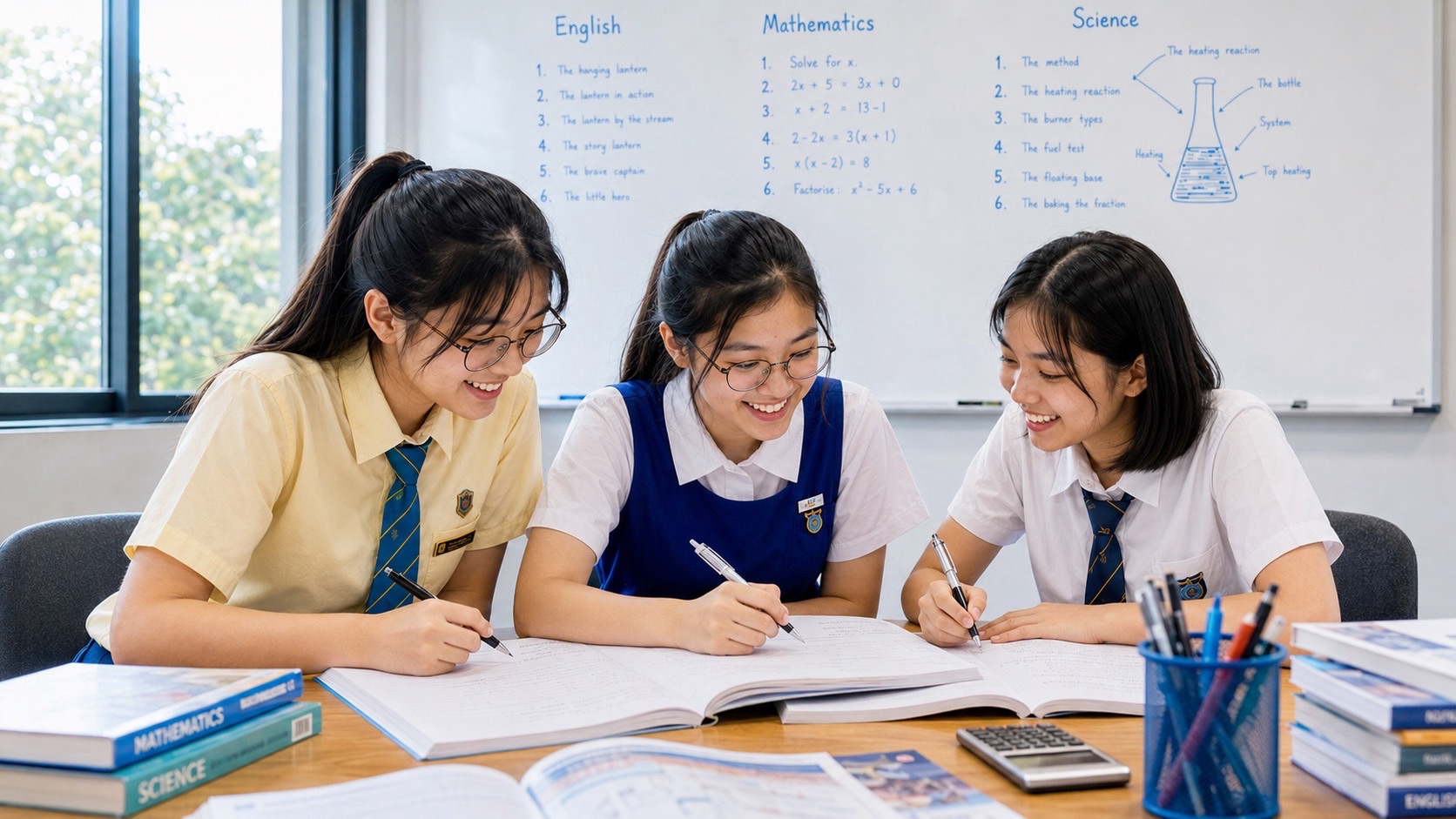
Parents searching for how to revise writing, redraft composition, improve a first draft, rewrite paragraphs or English tuition in Punggol are often looking at the step students skip most quickly. Many children treat the first draft as the final product. They correct spelling, change one adjective and call the writing revised. Real revision asks a bigger question: is the writing doing its job?
Revision and proofreading are different. Revision changes ideas, order, development, clarity and structure. Proofreading checks surface accuracy such as grammar, spelling and punctuation. From upper primary through PSLE and into Secondary English, students need both. A clean sentence can still be irrelevant. A grammatically correct paragraph can still be weak.
This guide is the revision-and-redrafting improvement owner inside the English Improvements In Punggol lane. It sits beneath How to Improve English Writing Skills and complements How to Improve English Editing and Proofreading.
The 50-Second Parent Answer
Revision asks:
Did I answer the task?
Is the order clear?
Is each paragraph doing useful work?
Where is development thin?
What can be removed?
What needs to be rewritten?
Proofreading comes later.
Do not polish a paragraph that needs replacing.
Revision Versus Proofreading
Revision:
ideas;
structure;
relevance;
development;
clarity;
order.
Proofreading:
grammar;
spelling;
punctuation;
capitalisation;
surface errors.
Students should learn the difference.
Why Students Resist Revision
Revision can feel like admitting the first draft failed.
That is the wrong model.
Professional writing improves through revision.
The first draft is evidence.
Revision is the next decision.
Primary 3
Keep revision small.
Write three sentences.
Choose one to improve.
Add a reason.
Replace one vague word.
Move one sentence if order is wrong.
The child learns that writing can change.
Primary 4
Introduce paragraph revision.
Ask:
Which sentence is the main point?
Which sentence does not belong?
What detail is missing?
Revision becomes structural.
Primary 5
Students can begin comparing draft one and draft two.
The purpose is not to rewrite everything.
The purpose is to make specific improvements visible.
Primary 6 and PSLE
Timed writing limits how much redrafting can happen during the examination.
That is why revision habits should be trained before exam conditions.
The child learns to plan better because past revisions reveal common problems.
Use the current SEAB PSLE examination-format page for the relevant year.
Secondary 1 and Secondary 2
Revision should increasingly focus on paragraph purpose and development.
Ask:
What claim is this paragraph making?
What evidence supports it?
What sentence is repetitive?
What could be more precise?
Secondary 3 and Secondary 4
Students should revise argument architecture.
Position.
Order of claims.
Evidence quality.
Counterargument.
Qualification.
Conclusion.
This is higher-level revision.
G1, G2 and G3
The level of complexity varies.
The revision principles do not.
Purpose.
Relevance.
Clarity.
Development.
Order.
Accuracy.
The Six-Pass Revision System
Pass one: task fulfilment.
Pass two: overall structure.
Pass three: paragraph purpose.
Pass four: development and evidence.
Pass five: sentence clarity.
Pass six: proofreading.
Do not do all passes at once.
Task Fulfilment
Return to the original prompt.
Did the writing answer it?
Use How to Interpret English Questions Correctly.
Revision often exposes that the draft answered a related question rather than the actual one.
Structure
Does the order make sense?
Would moving one paragraph improve logic?
Does the narrative turning point arrive too late?
Does the argument repeat itself before reaching the strongest point?
Order is revisable.
Paragraph Purpose
Use How to Write Better Topic Sentences.
Every paragraph should have a job.
If the writer cannot name the job, revision is needed.
Development
Use How to Use Evidence in English Writing and How to Develop Better Examples in English Writing.
A thin paragraph may need:
reason;
example;
mechanism;
consequence;
evidence;
qualification.
Cutting
Revision is not only adding.
Remove:
repetition;
irrelevant detail;
empty phrases;
sentences that restate the same point.
Shorter can be stronger.
Reordering
Sometimes all the necessary content exists but appears in the wrong sequence.
Move the reason before the example.
Move the context before the consequence.
Move the strongest argument later if it creates a better progression.
Rewriting
Some sentences should not be patched.
Rewrite them.
Students need permission to discard weak wording.
The goal is the final meaning, not protecting the first version.
Distance
Writers often miss their own problems immediately after drafting.
When possible, create distance.
Wait.
Read aloud.
Change font or medium.
Print the paragraph.
Distance helps the brain see what is actually there.
Compare Drafts
Keep draft one.
Write draft two.
Ask:
What changed?
Why?
Did the change improve the reader’s understanding?
This makes revision visible and teachable.
Teacher Feedback
Feedback should tell the student what to do differently.
“Develop this point.”
“Evidence does not match claim.”
“Paragraph repeats previous idea.”
Then the student must make the change.
Feedback without a revised attempt is incomplete learning.
Worked Example: Irrelevant Detail
Maren writes a story about responsibility.
One paragraph spends six sentences describing a classroom window.
The description is fluent but irrelevant.
Revision removes most of it and develops the decision that shows responsibility.
The story improves by cutting.
Worked Example: Weak Development
Iona writes:
“Reading is important because it helps students.”
The teacher asks for mechanism and example.
Revised paragraph explains vocabulary exposure and gives a concrete reading example.
The core idea stays.
Development changes.
Worked Example: Poor Order
Leonie presents her strongest evidence before the reader understands the issue.
The teacher moves context earlier.
No new content is added.
The argument becomes clearer through order alone.
A Three-Student Tutorial
Student A reads for task fulfilment.
Student B reads for paragraph purpose.
Student C reads for development.
The writer chooses what to revise.
Peers detect.
The writer remains responsible.
A 30-Minute Revision Workshop
Five minutes: reread task.
Five minutes: mark paragraph jobs.
Ten minutes: revise one weak paragraph.
Five minutes: cut repetition.
Five minutes: proofread.
This is more useful than rewriting the entire piece blindly.
Revision and Editing
Use How to Improve English Editing and Proofreading.
Revision happens before proofreading.
First make the writing worth polishing.
Then polish it.
Revision and Transitions
Use How to Improve Transitions and Cohesion once published in this batch.
Sometimes a transition problem is really an order problem.
Do not add “however” when the ideas themselves do not connect.
What Parents Can Do at Home
Ask the child to revise only one paragraph.
Questions:
What is this paragraph doing?
What is missing?
What can be removed?
What would make it clearer?
Focused revision is less overwhelming.
What Not to Do
Do not confuse revision with neat copying.
Do not correct every sentence for the child.
Do not add adjectives as the default improvement.
Do not proofread before checking relevance.
Do not require a full rewrite when one targeted revision would teach more.
How to Measure Improvement
Draft two is meaningfully better than draft one.
Paragraphs become more relevant.
Development strengthens.
Repetition decreases.
Feedback transfers into later writing.
The student begins revising independently.
That is revision growth.
When English Tuition in Punggol Is Useful
Tuition may help when students produce drafts but do not know how to improve them independently.
The commercial route remains English Tuition Punggol.
Frequently Asked Questions
What is the difference between revision and editing?
Revision changes ideas, structure and development. Editing and proofreading focus more on language accuracy and surface errors.
Should children rewrite whole compositions?
Sometimes, but targeted paragraph revision is often more efficient for learning.
Why does feedback not seem to work?
The student may read the feedback without making and retesting the correction.
When should we consider tuition?
When the learner can produce a draft but cannot diagnose and improve it.
Read Next on eduKate Punggol
For editing, use How to Improve English Editing and Proofreading.
For topic sentences, use How to Write Better Topic Sentences.
For broad writing, use How to Improve English Writing Skills.
Continue Through the English System
Explore the Punggol English reading library for related guides.


