
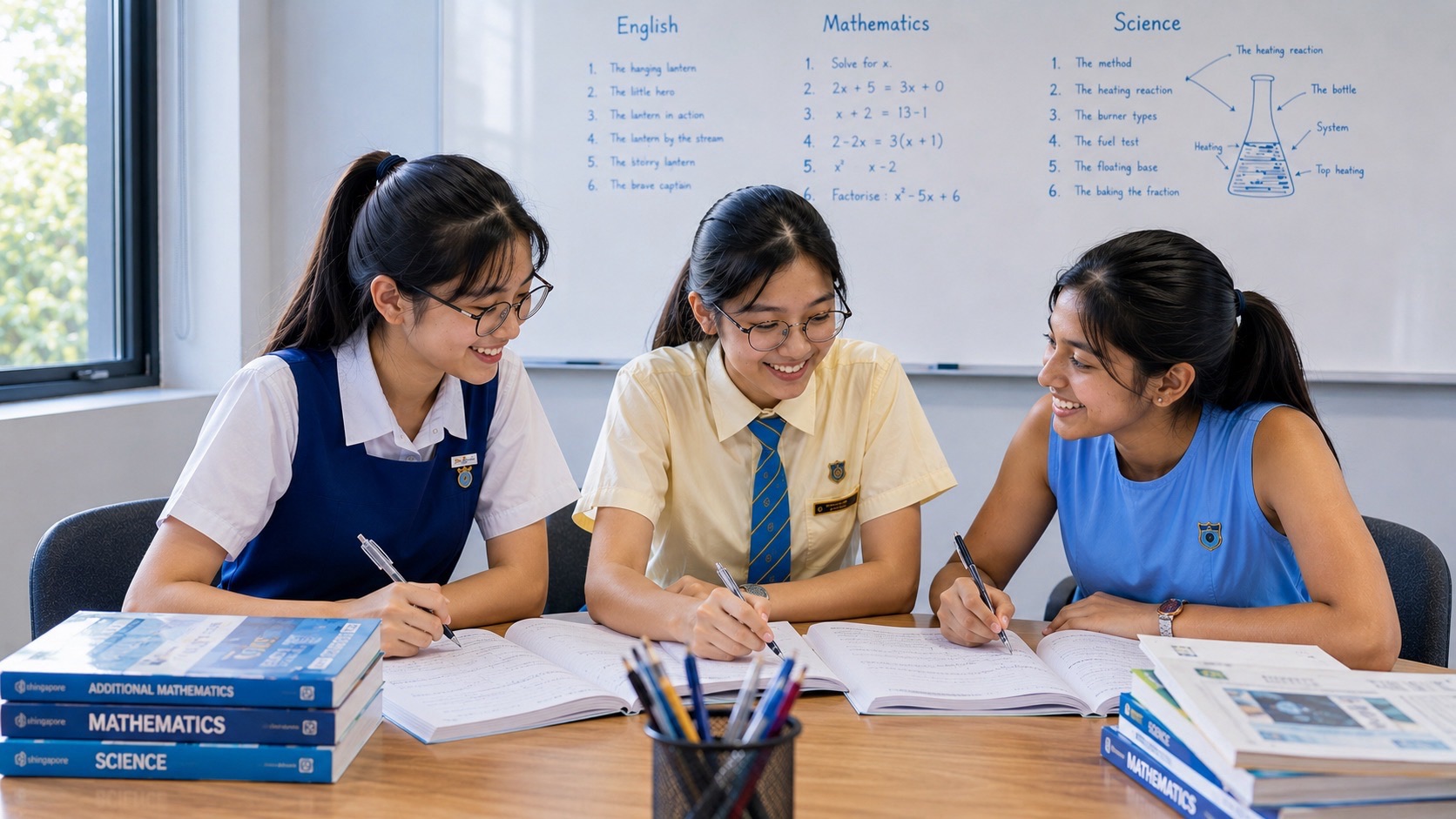

Science tuition in Punggol can become unnecessarily complicated because families accumulate too many materials. School notes. Tuition notes. Assessment books. Topical worksheets. Past-year papers. Model answers. Flashcards. Online videos. AI explanations. By the time a child sits down to revise, the first problem is no longer Science. It is deciding what to use.
Parents searching for Primary Science assessment books, PSLE Science papers, Science revision notes, Science tuition Punggol, Secondary Science tuition, Science worksheets or how to revise Science often assume that better materials will produce better results. Materials matter, but they have different jobs. A school note explains what was taught. An assessment book provides practice. A past paper tests integration and execution. A correction record tells the student what repeatedly fails. Using the wrong material for the wrong job creates busy revision without much learning.
This guide explains how Punggol parents can build a simpler Science materials system from Primary 3 through PSLE and Secondary G1, G2 and G3: learn from notes, practise with questions, diagnose from marked work, and test with papers. The aim is not to own the largest stack. It is to know which resource should be opened next.
The Four Material Jobs: Learn, Practise, Diagnose, Perform
Most Science materials fit one of four jobs.
1. Learn
School notes, textbooks, tutor explanations, diagrams and reliable educational resources help the student build the concept.
2. Practise
Topical worksheets, assessment books and selected questions help the student apply the concept repeatedly and encounter variations.
3. Diagnose
Marked school work, corrections, error logs and tutor observations reveal why marks were lost.
4. Perform
Mixed papers, past-year or school-style examination papers and timed sets test whether learning survives realistic conditions.
The mistake is using one resource for all four jobs. A child who only reads notes never tests retrieval. A child who only completes assessment books may practise without repairing misconceptions. A child who only does full papers may repeatedly expose the same gap without rebuilding it.
School Notes Should Be the First Reference Point, Not the Only Revision Method
School notes matter because they reflect the concepts, vocabulary, representations and examples the student’s teacher is using. When parents are unsure how a concept is currently being taught, school materials are the natural first reference.
But notes become weak revision tools when they are only reread.
A better way to use notes is:
- Read a short section once.
- Close it.
- Explain or draw the idea from memory.
- Reopen the note and compare.
- Correct only what was missing.
- Use the idea in a question.
This turns notes from something the child looks at into something the child retrieves from.
Assessment Books Are Useful When the Student Knows Why the Question Was Chosen
Assessment books are popular because they provide volume. Volume is useful when the practice target is correct. It is less useful when the child simply starts at Page 1 and works forward regardless of need.
A better parent question is: what does this page train?
- concept recall;
- MCQ discrimination;
- open-ended explanation;
- data interpretation;
- experiments and variables;
- mixed-topic selection;
- timed execution.
If the child repeatedly loses marks on variables, an assessment book can supply a cluster of experiment questions for targeted practice. If the issue is old-topic retrieval, purely topical practice may be the wrong choice.
The resource should follow the diagnosis.
Do Not Buy a New Assessment Book Every Time Marks Fall
A falling mark often creates a shopping response: perhaps the current book is too easy, too hard, too old or simply not the “right” brand. Sometimes a new resource genuinely fills a gap. Often, the existing materials already contain enough questions.
Before buying another book, ask:
- Has the child finished the corrections in the current book?
- Can the child explain why the wrong answers were wrong?
- Have corrected questions been retested after a delay?
- Has the child attempted mixed practice?
- Does the new book solve a specific missing question type?
- Will adding another book create more clutter than useful practice?
A smaller set of deeply used materials can outperform a shelf of partially completed books.
Primary 3: Use Fewer Materials and Make the Concepts Concrete
Primary 3 is the first formal Science year. At this stage, children benefit more from clear concept formation than from owning many assessment books.
A practical P3 resource stack can be simple:
- school notes or textbook;
- one well-chosen practice source;
- the child’s marked school work;
- simple real-world examples or observations.
Parents should prioritise whether the child can observe, classify, compare and explain. The question bank is secondary to the thinking habits.
See Primary 3 Science Tuition at eduKate Punggol.
Primary 4: Choose Questions That Force Relationships, Not Just Recall
At Primary 4, materials should begin testing whether facts can become explanations. A workbook dominated by simple recall may produce high completion rates without preparing the child for more demanding application.
Look for questions that require the student to:
- use evidence from a diagram;
- compare conditions;
- explain a causal chain;
- predict what happens when one variable changes;
- distinguish between similar concepts.
The best resource is not necessarily the one with the most difficult questions. It is the one that reveals whether the student can use the concept.
See Primary 4 Science Tuition at eduKate Punggol.
Primary 5: Start Mixing Materials Because the PSLE Will Mix Knowledge
Primary 5 is where purely topical resources become less sufficient. The student needs to retrieve older Science while learning new content.
A good P5 materials system therefore includes:
- current-topic notes;
- targeted topical practice for new concepts;
- mixed-topic retrieval sets;
- marked school papers for diagnosis;
- an error ledger that records recurring failure types.
The mixed sets are important because they remove the chapter label. The child has to identify which concept belongs to the problem.
For P5, use Primary 5 Science Tuition at eduKate Punggol.
Primary 6 and PSLE: Past Papers Are Tests, Not Textbooks
Past papers and school examination papers are valuable in Primary 6 because they test integration, question selection, time and stamina. But they are poor teaching tools when a major misconception has already been identified.
A full paper should answer a question such as:
- Can the student retrieve across the whole syllabus?
- Can the student maintain accuracy under time?
- Which error types dominate?
- Does performance fall late in the paper?
- Are MCQ and open-ended sections equally stable?
After the paper, the work should become more targeted. If the student repeatedly confuses variables, stop doing full papers long enough to repair variable reasoning. Then return to another paper and see whether the repair transfers.
That creates the loop: paper → diagnosis → targeted repair → fresh paper.
For PSLE preparation, see Punggol PSLE Science Tuition and PSLE Science Mock Papers | When Full Papers Help and When They Do Not.
Model Answers Should Be Used for Comparison, Not Copying
A model answer is useful after the student has attempted the question. It can show missing evidence, vocabulary or mechanism. It becomes dangerous when the child copies it before understanding the scientific relationship.
A better correction sequence is:
- Attempt independently.
- Identify what the question required.
- Compare with the model answer.
- Underline the scientific relationship that was missing.
- Close the answer.
- Rewrite in the student’s own words.
- Answer a fresh question using the same idea.
This converts the model answer from a script into feedback.
Science Notes Made by the Student Can Be Useful—If They Are Generated From Memory
Beautiful copied notes can create the feeling of productivity. Student-generated notes become more powerful when they are reconstructed from memory and then checked.
Useful formats include:
- concept maps;
- process diagrams;
- cause-and-effect chains;
- comparison tables;
- variable templates;
- error lists;
- flashcards for precise terms.
The companion owner is Science Improvements In Punggol | How to Make Science Notes, Concept Maps and Flashcards That Actually Help.
Secondary Science: One Resource Stack Should Serve Physics, Chemistry and Biology Differently
Secondary Science becomes more disciplinary. The resource job can vary by subject.
Physics
Useful materials often include worked examples, diagrams, graphs, unit practice and questions that require selecting the correct relationship rather than merely substituting numbers.
Chemistry
Students benefit from clear particle models, symbolic representations, reaction patterns and questions that connect observable changes to unseen mechanisms.
Biology
Diagrams, process maps, systems, vocabulary and causal explanation become particularly important. Large amounts of text are less useful when the student has no structure for organising it.
The resource system should therefore follow the disciplinary learning job rather than use one generic revision method everywhere.
G1, G2 and G3 Science: Make Sure the Materials Match the Subject Level
Under Full Subject-Based Banding, students may take subjects at G1, G2 or G3 levels. Revision materials should match the actual subject level and syllabus.
The SEAB SEC syllabus portal is the appropriate current reference for subject syllabuses as Singapore moves into the SEC era.
Parents should be careful with generic online resources because similar topic names can hide different expected depth. A question can be scientifically relevant but poorly calibrated to the student’s current course.
How to Build a Minimal Science Resource Stack
For many students, a strong resource system needs only five things:
- School notes or textbook for the core concept and current representation.
- One main practice source for targeted questions.
- Marked school work for real evidence of performance.
- An error ledger for recurring failure mechanisms.
- Mixed or examination papers for integration and performance testing.
Everything else is optional. Add a new resource only when it does a job the current stack cannot do.
The Material Escalation Rule: Do Not Increase Difficulty Until the Failure Is Understood
Parents sometimes respond to a weak result by buying a harder book. Harder work is useful only when the student is ready for the extra complexity.
If the child cannot explain a basic causal mechanism, an Olympiad-style or “advanced” question does not repair that weakness. It adds more variables around it.
A better escalation sequence is:
- understand the basic model;
- apply it in a familiar example;
- change one feature;
- mix with a competing concept;
- use an unfamiliar context;
- perform under time where appropriate.
Difficulty should increase because the student’s capability increased, not because the previous book produced disappointing marks.
How 3-Pax Science Tuition Uses Materials Differently
At eduKate Punggol, the material is not the lesson. It is the instrument used to make the student’s thinking visible.
The same Science question can be used differently for three students:
- one student may need concept repair;
- one may need scientific-language precision;
- one may need a harder transfer question after answering correctly.
A small group lets the tutor keep a common learning object while varying the next move. This is why buying more worksheets is not the same as creating more learning.
Families can see the programme route at Science Tuition at eduKate Punggol.
What Parents Should Ask Before Buying Another Science Resource
- What problem does this resource solve?
- Does it match the child’s current level and syllabus?
- Is the child missing explanation, practice, diagnosis or exam simulation?
- Will the child actually finish and correct it?
- Does the current resource already contain enough relevant questions?
- How will we check whether the practice transfers?
If the answer to the first question is unclear, the new book is probably not yet necessary.
Frequently Asked Questions
How many Science assessment books does a Primary student need?
There is no fixed number. One well-used book plus school work can be enough for many students. Add resources when a specific question type or level of challenge is missing.
Should P6 students do past papers every day?
Not automatically. Full papers are useful for integration and timing, but repeated papers can be inefficient when the same weakness needs targeted repair first.
Are tuition notes better than school notes?
They have different roles. School notes keep the student aligned with current teaching. Tuition notes can reorganise or clarify concepts. The student should not need to maintain two contradictory Science systems.
Should my child make their own Science notes?
Yes, if note-making requires retrieval, organisation and explanation. Copying pages neatly is much less useful than reconstructing a process or concept from memory and then checking it.
Are difficult assessment books better?
Only when the student has the foundations to benefit from the difficulty. Challenge should expose deeper application, not simply create repeated failure around an unrepaired gap.
What should we keep from old Science papers?
Keep the questions that reveal recurring errors, useful corrections and important transfer problems. The value is not the paper as an object; it is the learning evidence it contains.
Can AI replace assessment books?
AI can generate explanations and practice questions, but generated content should be checked for syllabus fit and scientific accuracy. School materials and official syllabus information remain important anchors. AI is most useful as a flexible supplement, not an unquestioned answer source.
The Best Science Resource Is the One That Produces the Next Useful Piece of Evidence
Science revision becomes simpler when every material has a job.
- Notes help build the model.
- Questions help apply it.
- Marked work reveals what failed.
- Error logs reveal what repeats.
- Papers test whether the whole system works under realistic conditions.
For the wider Science route, see Science Tuition in Punggol | The Parent Roadmap. For study methods, see How to Study Science Effectively With Active Recall, Spaced Practice and Interleaving.
Do not ask which Science book is best until you know what the child needs the book to do. Learn, practise, diagnose or perform. Once the job is clear, the material choice becomes much easier.
A Worked Example: The Same Primary 6 Child With Four Different Resource Needs
Imagine a Primary 6 student, Ethan, who has just received a disappointing Science result. The instinct might be to buy a harder assessment book. But the right material depends on what the paper reveals.
Scenario A: The concept is missing
Ethan cannot explain the underlying Science even after the test pressure is removed. The next resource should be explanatory: school notes, textbook diagrams, tutor teaching or a carefully chosen concept summary. A past paper is premature because it will only reproduce the same failure.
Scenario B: The concept is known but retrieval is weak
Ethan understands immediately after review but forgets a week later. The best resource may be a small set of flashcards, retrieval prompts or mixed questions scheduled over time. Another thick assessment book does not automatically solve the spacing problem.
Scenario C: Open-ended explanations are incomplete
Ethan knows what happened but omits the mechanism. The best material is a curated set of open-ended questions with good feedback, not a general full-syllabus workbook.
Scenario D: Knowledge is strong but papers are unstable
Ethan can solve individual questions but loses time in full papers. Now examination papers become useful because the problem is integration and execution.
The child did not change. The resource decision changed because the failure mechanism changed.
How to Read an Assessment Book Before Buying It
Parents do not need to judge a book by brand, thickness or the number of “challenging” labels on the cover. Open it and inspect the learning design.
- Are questions arranged only by topic, or are there mixed sections?
- Does the book include diagrams, graphs and experimental scenarios?
- Are open-ended questions varied enough to require real reasoning?
- Do solutions explain the mechanism or only show the final wording?
- Does the difficulty increase gradually?
- Can the book be used selectively, or does it encourage page-by-page completion?
- Does the level actually match the child’s current syllabus?
The best book is not the one that appears hardest. It is the one whose question design matches the student’s next training need.
Why Too Many Science Materials Can Lower Revision Quality
Resource overload creates switching costs. The child begins one workbook, abandons it for another, receives tuition worksheets, downloads school papers and saves online notes. Each resource may be reasonable, but together they create fragmentation.
Fragmentation causes several problems:
- Corrections are scattered across different books.
- Repeated errors are harder to notice.
- The child spends time deciding what to revise.
- Parents mistake unfinished resources for insufficient effort.
- Old material is replaced before it is deeply used.
- The student’s knowledge becomes organised by worksheet source rather than by concept.
A smaller system makes patterns visible. That visibility is one reason an error ledger is often more valuable than a fifth assessment book.
How to Use School Papers as a Diagnostic Library
Old school papers are not only for redoing before exams. They are a record of how the student actually performed under school conditions.
Parents can build a diagnostic library by tagging questions:
- concept gap;
- misconception;
- comparison;
- graph or table;
- experiment;
- open-ended explanation;
- MCQ distractor;
- time or checking.
When one category repeats, pull several examples from different papers. This creates a customised practice set using evidence the child already generated.
How to Use Past Papers Without Memorising the Past
Past papers are valuable because they contain authentic combinations of topics and question forms. But students can overlearn specific paper patterns if they repeat the same material too often.
Use past papers in cycles:
- Attempt under appropriate conditions.
- Classify the errors.
- Repair the highest-value weakness using targeted material.
- Wait long enough that the correction is not simply short-term memory.
- Use a different paper or fresh question to retest.
This keeps the paper as an assessment instrument rather than turning it into another set of memorised examples.
How to Decide Between Printed and Digital Science Resources
Both can work. The better choice depends on the task.
- Printed materials are useful for annotation, diagrams, timed paper practice and seeing the whole page at once.
- Digital resources are useful for quick retrieval, interactive explanations, videos, simulations and flexible question generation.
The risk with digital Science revision is distraction and endless searching. The risk with print is passive page completion. Parents should choose the medium that supports the learning job and the child’s attention habits.
How AI Fits Into the Science Resource Stack
AI can be useful as an explanation and practice generator, especially when a child needs a simpler example, a changed context or a quick vocabulary clarification. It should not become the unquestioned authority for syllabus-specific Science.
A disciplined AI workflow is:
- Attempt the original question first.
- Identify the exact point of confusion.
- Ask AI for an explanation or a parallel example, not simply the final homework answer.
- Check important claims against school materials or authoritative sources.
- Close the AI response.
- Return to the original problem independently.
This makes AI a temporary scaffold rather than a replacement for retrieval.
The Resource Rule for Strong Students
Strong students do not necessarily need more books. They may need better question selection.
Instead of completing another 100 routine questions, choose ten that require:
- distinguishing between two plausible models;
- transferring a concept to an unfamiliar context;
- evaluating an experiment;
- interpreting data with uncertainty;
- combining two topics;
- explaining a common misconception.
Depth can create more growth than volume once the foundations are secure.
The Resource Rule for Struggling Students
A struggling student often needs fewer simultaneous resources. Choose one clear explanation source and one practice source. Add only what is necessary.
If the child receives school notes, tutor notes, three assessment books and several online worksheets for the same topic, it becomes difficult to know whether the problem is understanding or overload.
Simplification can be an intervention.
How Parents Can Organise Science Materials at Home
A simple system reduces friction:
- Core: current school notes and textbook.
- Practice: one active assessment source.
- Evidence: marked papers and corrections.
- Memory: error log, flashcards or concept map.
- Performance: mixed papers reserved for testing.
Everything should have a home. When a new resource arrives, decide which category it belongs to. If it duplicates an existing category without solving a new problem, it may not need to be added.
A Monthly Resource Audit
Once a month, parents can spend ten minutes reviewing the Science stack.
- Which resource is actually being used?
- Which one generates useful corrections?
- Which one is mostly unfinished?
- Which recurring weakness still lacks good practice?
- Are full papers being used too early or too often?
- Can one resource be removed?
This keeps the system lean and prevents material accumulation from becoming a substitute for a learning plan.
What a Tutor Should Do With the Student’s Existing Materials
A good Science tutor should not need to replace every school resource with a proprietary set before meaningful teaching can begin. The student’s existing materials contain useful evidence: how the school phrases questions, which diagrams are familiar, what the teacher has already corrected and where misunderstandings keep appearing.
The tutor can then decide whether an additional worksheet, note set or question bank genuinely adds something. Sometimes it does. Sometimes the highest-value move is to use the child’s own marked paper more intelligently.
The “One More Book” Test
Before adding another Science assessment book, ask the child to complete this sentence: “I need this book because…”
Useful answers are specific:
- “…I need more mixed-topic practice.”
- “…I need more experiment questions.”
- “…my current book has very few open-ended explanations.”
- “…I need questions at my current G2 or G3 level.”
Weak answers are vague: “because Science is weak”, “because exams are coming” or “because everyone has this book”. A vague reason usually means the learning problem has not yet been diagnosed.
How to Retire a Science Resource
Parents do not need to keep every workbook active until every page is completed. A resource can be retired when its job is finished.
- The targeted weakness is now stable across fresh questions.
- The remaining pages repeat skills the student already controls.
- A new school level or syllabus makes the material poorly calibrated.
- The book is creating clutter without producing useful corrections.
Retiring a book is not wasting it. It means the family is treating materials as tools rather than obligations.
The Best Resource Stack Gets Smaller as the Student Gets Better at Diagnosing
As students mature, they should become more capable of choosing the resource that matches the problem. A Secondary student who knows “I need to revise graph interpretation” should not need an adult to assign an entire chapter. A P6 student who knows “my open-ended answer missed the mechanism” can select a small number of relevant questions and retest the skill.
This is the deeper goal of Science tuition: not to provide an endless supply of materials, but to teach the student how to decide what kind of learning work is needed next.
A Final Parent Rule for Science Materials
Before opening or buying any Science resource, name the job in one word: learn, practise, diagnose or perform. If the material does not match the job, choose something else.
This simple rule prevents a common problem in Science revision: using more materials to compensate for not knowing what the student actually needs. Once the job is clear, the choice between school notes, an assessment book, marked work and a past paper becomes much easier.
Over time, the student should learn to make that decision independently. That is the point at which revision stops being a pile of resources and becomes a learning system.
One Last Check Before Revision Begins
Put the available Science resources on the table and ask the student to choose what should be used first. If the child cannot explain the choice, the revision problem is still being managed entirely by adults. A mature learner should increasingly be able to say, “I need the school note because I do not understand the model,” “I need mixed questions because I keep choosing the wrong concept,” or “I need a full paper because my timing is the weak point.”
That ability to select the right learning tool is itself part of Science independence. The best resource system therefore becomes simpler over time, because the student gets better at matching the tool to the problem.


