
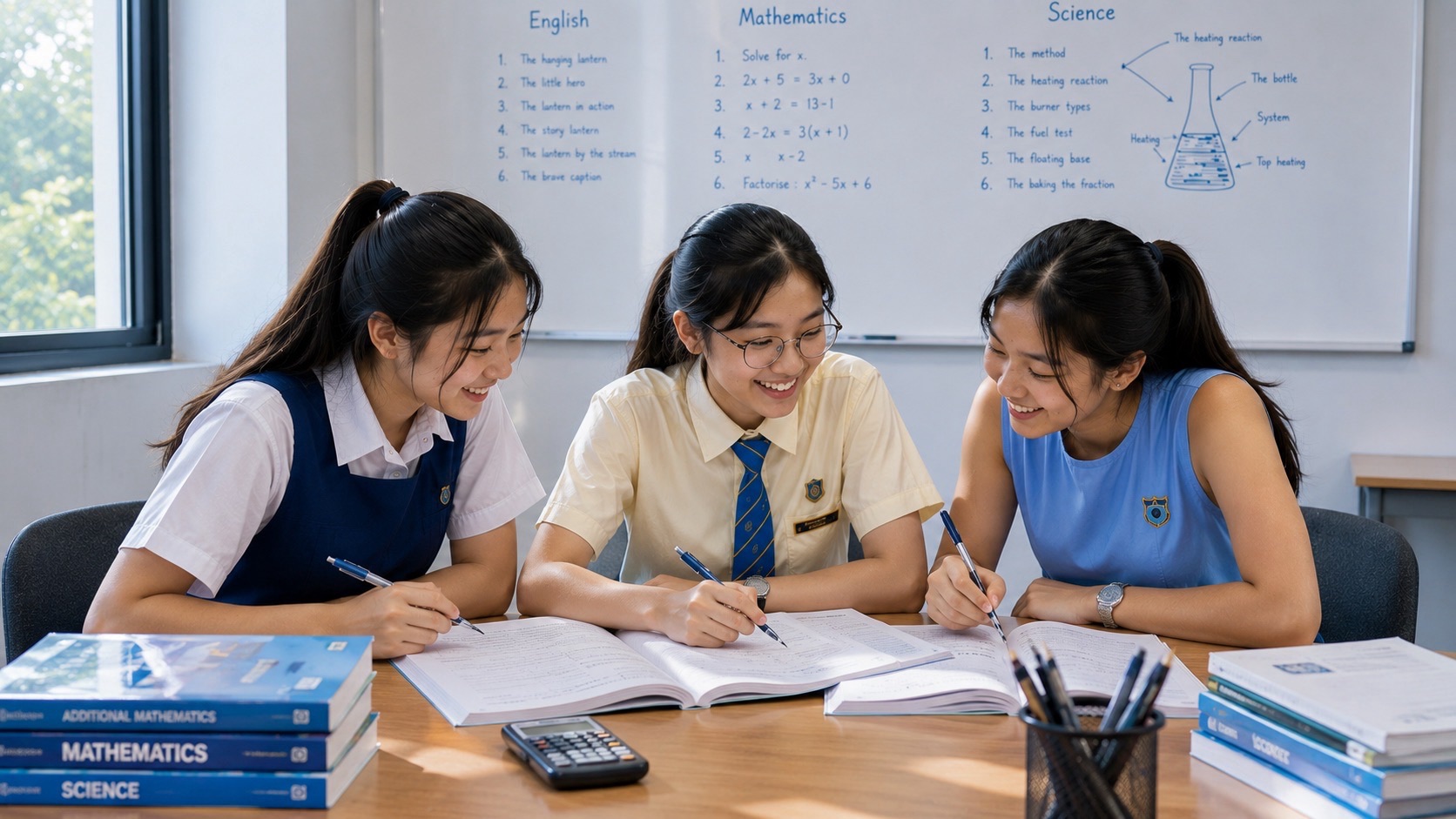
When Science marks are falling in Punggol, the fastest useful response is not automatically more worksheets, another assessment book or more hours of tuition. The first job is diagnosis. A falling Science score can come from weak concepts, poor question reading, missing scientific vocabulary, weak data interpretation, incomplete open-ended explanations, experimental-design errors, forgotten older topics or exam execution. Each problem needs a different repair.
Parents searching for how to improve Science marks, why my child is weak in Science, Science exam mistakes, PSLE Science improvement, Secondary Science improvement or a Science tutor in Punggol are often looking at the same symptom: the mark. But the mark is an output. To improve it reliably, we need to identify the mechanism that produced it.
This guide is part of the Science Improvements In Punggol lane. It connects to Science Tuition Punggol, the Science Article Index and the newer guide on reading Science questions, diagrams, graphs and technical vocabulary. The purpose here is narrower: show parents how to find the first weak link when performance starts to slide.
The 50-second parent diagnostic
- Marks fell only on one topic: suspect concept or vocabulary gaps first.
- Marks fall on unfamiliar questions: suspect transfer and application.
- MCQ is stronger than open-ended: suspect explanation precision.
- Homework is strong but tests are weak: suspect retrieval, timing, pressure or over-reliance on prompts.
- Graphs and tables are weak: suspect evidence reading and representation skills.
- Experiments are weak: suspect variables, fairness, measurement or evaluation.
- Older topics disappear: suspect revision architecture and retrieval.
- The child says “I knew it” after seeing the answer: recognition may be stronger than independent recall.
- Many errors are called “careless”: classify them properly before deciding what to train.
A Science mark is evidence, not a diagnosis
A mark tells us how many marks were awarded under a particular set of questions and conditions. It does not tell us, by itself, why the marks were lost. One 65% paper can hide several different learners.
- Student A misunderstood two major concepts.
- Student B knew the concepts but misread conditions.
- Student C lost open-ended marks because answers stopped before the causal mechanism.
- Student D forgot older topics and could not retrieve them under time pressure.
- Student E understood at home but could not manage the paper’s pacing.
Giving all five students the same worksheet pack is inefficient because the visible score is shared but the underlying cause is different.
Weak link 1: the concept is not actually understood
Concept weakness is the most obvious explanation, but it is also frequently misdiagnosed. A student may remember a definition yet still lack the model needed to use the idea. Ask the child to explain the concept without the textbook, draw it, give an example and predict what changes when one condition changes.
If the explanation collapses as soon as the example changes, the child may possess verbal familiarity rather than functional understanding. The repair is not “memorise the definition harder.” Rebuild the concept through examples, non-examples, diagrams, cause-and-effect relationships and changed-condition questions.
For the deeper mechanism, see How Science Misconception Repair Works.
Weak link 2: the student reads Science as English prose instead of evidence
Science questions contain conditions, variables, diagrams, labels, units and command words. Students who read quickly for the general story can miss the exact detail that changes the answer.
- What changed?
- What stayed the same?
- What is being measured?
- What does the axis or unit say?
- Which two cases are being compared?
- What is the command word asking the student to do?
Before concluding that the child “does not know Science,” check whether the child is extracting the evidence correctly. The dedicated local reading guide is How to Read Science Questions, Diagrams, Graphs and Technical Vocabulary.
Weak link 3: vocabulary is recognised but not usable
Science is full of words that carry precise relationships. Students may know that a term “sounds familiar” but still use it incorrectly in a sentence. That matters because a vague or incorrect word can change the scientific claim.
A useful vocabulary check has three levels:
- Recognition: does the student know the term when shown it?
- Explanation: can the student explain it in plain language?
- Production: can the student use it correctly in a new Science answer?
Marks often fall at Level 3 even when Levels 1 and 2 look fine.
Weak link 4: the student cannot retrieve older Science
Science is cumulative. A topic that looked secure in March can become unavailable in August if it was never retrieved again. This is especially important in Primary 5–6 and Secondary Science, where new material arrives while older material remains examinable or becomes prerequisite knowledge.
Recent learning research continues to emphasise retrieval practice as a useful way to strengthen access to learned material. Edutopia’s 2026 discussion of retrieval practice also stresses that retrieval works best when it is used thoughtfully and matched to what learners have already been taught.
The repair is short cumulative recall across weeks, not emergency rereading before the test. See How Science Retrieval and Memory Work.
Weak link 5: the answer has the fact but not the mechanism
This is a common reason open-ended marks fall. The child writes the correct topic word and perhaps even the correct outcome, but the explanation does not connect the two.
A useful diagnostic scaffold is:
- Evidence: what detail from the question matters?
- Concept: what scientific idea applies?
- Mechanism: how does the condition produce the change?
- Outcome: what happens because of that mechanism?
If the answer jumps from concept to outcome without explaining the middle, the child may need explanation training rather than more content. See How Science Explanation Works.
Weak link 6: experimental questions are being treated as memorised rituals
Students often learn phrases such as “keep variables constant,” “repeat and average” or “use more readings” without understanding when those moves are appropriate. Practical Science improves when the learner understands the evidence problem each design choice solves.
Science Buddies’ guidance on conducting a Science experiment emphasises careful procedure, consistent measurements, detailed observations and recording data. Its experimental-procedure guidance also explains the logic of changing an independent variable while controlling other relevant conditions.
A student should be able to answer: What is changed? What is measured? What stays similar? What evidence would support the claim? What limitation weakens the conclusion?
Weak link 7: transfer fails when the context changes
One of the clearest signs of fragile learning is this: the student can answer a familiar worksheet question but fails when the same Science appears in a new object, diagram or story.
The repair is variation. Keep the scientific relationship stable while changing the surface form. Use different organisms, materials, numbers, diagrams or everyday examples. Ask the student to identify what remains scientifically the same.
See How Science Transfer Works.
Weak link 8: the student cannot convert graphs, diagrams and tables into language
Science often requires representation switching. A student reads a diagram, describes a pattern, applies a formula or explains a graph in words. Weakness in any switch can depress marks even when the underlying concept is partly understood.
Train the conversion explicitly:
- diagram → labelled verbal explanation;
- table → trend statement;
- graph → relationship plus evidence;
- equation → scientific meaning;
- paragraph → sketch or system model.
Weak link 9: exam execution is unstable
Sometimes the child knows enough Science but cannot deliver it reliably in a timed paper. Symptoms include rushing early, spending too long on one hard question, leaving easy marks incomplete, skipping units, changing correct answers without evidence or running out of time.
This is not solved by reteaching the chapter. It needs exam execution training: pacing, triage, checking and recovery. Useful supporting guides include Exam Time Management and Checking Answers in Exams.
Weak link 10: one bad result is being mistaken for a trend
Not every mark drop means a major learning failure. One paper can be unusually difficult, poorly timed or concentrated on a weak topic. The parent should compare several pieces of evidence before changing the child’s whole programme.
- Is the fall repeated across two or more assessments?
- Do the same error categories recur?
- Is classwork also becoming less secure?
- Can the child still explain the concepts orally?
- Was the paper completed?
- Did the child’s school recently change topic or assessment style?
The useful question is not “Was this mark bad?” It is “What does the pattern of evidence say?”
Primary 3–4: what usually falls first
At Primary 3–4, marks often fall because formal Science introduces unfamiliar vocabulary, diagrams and explanation demands. The child may need help organising concepts and learning how to read a scientific situation.
Use the Primary 3–4 Scientific Method, Concepts and Better Explanations guide for the earlier repair system.
Primary 5–6 and PSLE: what usually falls first
At Primary 5–6, cumulative load and open-ended precision become more expensive. A student can know many facts but lose marks because retrieval is slow, concepts are not connected or unfamiliar applications defeat the memorised answer.
Use the Primary 5–6 and PSLE Science Revision, Open-Ended Answers and Application guide for the PSLE runway.
Secondary G1, G2 and G3: what usually falls first
At Secondary level, abstraction increases. Students must work with models, formulae, graphs, practical reasoning and more specialised language. Marks can fall even when the learner was strong in Primary Science because the subject has changed its operating demands.
Use the Secondary Science G1, G2 and G3 Study Skills, Practical Work and Exam Readiness guide.
A seven-step repair after a weak Science test
- Do not start with the total score. Start with the lost marks.
- Classify each loss. Concept, reading, evidence, vocabulary, explanation, practical, transfer or execution.
- Count recurring categories. Find the largest cluster.
- Repair one bottleneck. Use a short focused lesson or practice set.
- Retest with a fresh question. Do not simply repeat the same item from memory.
- Revisit after a delay. Check whether the repair survives.
- Only then expand. Move to mixed questions and timed practice.
What not to do when Science marks fall
- Do not buy five new assessment books immediately.
- Do not call every lost mark “careless.”
- Do not copy model answers without understanding the mechanism.
- Do not turn every evening into a full-paper session.
- Do not assume the child needs tuition solely because of one result.
- Do not assume tuition can help if the child is already overloaded and exhausted.
- Do not focus only on the chapter title; inspect the type of thinking that failed.
When Science tuition in Punggol becomes useful
Tuition adds value when the family can identify a recurring bottleneck but cannot repair it reliably at home, or when the child needs more immediate feedback than school and independent practice can provide.
At eduKate Punggol, three-student tutorials allow the tutor to inspect how each student reached an answer. One child may need concept reconstruction, another vocabulary precision and another timed-paper control. The purpose of the small group is not simply a smaller class; it is to keep the student’s reasoning visible enough to diagnose.
Parents can review the local route at Science Tuition Punggol or use the Primary Science tuition sign-up page if live feedback is the missing component.
FAQ
Why are my child’s Science marks suddenly falling?
Possible causes include a new topic, cumulative forgetting, weak question reading, incomplete explanations, practical/data difficulties or unstable exam execution. Compare several marked tasks and classify the lost marks before deciding.
Should I give more Science worksheets when marks fall?
Only if the worksheet targets the diagnosed weakness. Extra practice can reinforce the wrong process when the underlying problem has not been identified.
How quickly can Science marks recover?
That depends on the bottleneck. A vocabulary or question-reading issue may improve faster than a large conceptual gap. Look for evidence of better reasoning and fewer recurring errors before judging recovery by one score.
When should a parent consider Science tuition?
Consider it when the same weakness persists despite sensible home correction, when the student cannot explain why answers are wrong, or when school feedback indicates a gap that needs more frequent guided practice.
Conclusion: fix the first weak link, not the loudest symptom
A falling Science mark feels urgent because it is visible. But the mark itself is rarely the thing to train. The training target sits underneath it.
Find whether the learner is failing at concept, retrieval, reading, evidence, vocabulary, explanation, experimental reasoning, transfer or execution. Repair the first weak link. Retest it with fresh questions. Then expand.
That is how Science improvement becomes a system rather than a reaction.
Explore the Punggol Science reading library for related guides.


