
Science misconceptions in Punggol are dangerous because they can look like understanding for a long time. A student may remember the correct keywords, complete familiar worksheets and still carry an internal model that predicts the wrong result when the question changes. Those hidden wrong models often become visible only in open-ended questions, experiments, graphs or unfamiliar contexts.
Parents searching for Science misconceptions, common Science mistakes, why my child keeps getting Science wrong, conceptual understanding in Science or how to improve Science concepts are usually trying to solve more than a memory problem. The child may genuinely believe an explanation that is plausible, intuitive and scientifically wrong.
This article continues the Science Improvements In Punggol lane. It links to the deeper owner How Science Misconception Repair Works, the local guide on Science Test Corrections and Error Logs, and Science Tuition Punggol.
The misconception repair loop
- Elicit: find out what the student actually believes.
- Predict: ask what the student’s model expects to happen.
- Test: use evidence, a diagram, an experiment or a counterexample.
- Compare: show where the original model fails.
- Rebuild: construct the better scientific model.
- Retest: use a fresh question in a changed context.
- Revisit: check whether the old misconception returns later.
Why telling the correct answer is often not enough
A misconception is not simply an empty space. It is an existing explanation. If the student believes heavier objects always fall faster, or that plants obtain food directly from soil, or that a larger force always means greater speed, the wrong model can continue operating underneath a memorised correction.
The learner may even repeat the teacher’s wording correctly and then return to the old model when faced with a new context. That is why correction should make the conflict visible.
Start by asking for a prediction
Prediction is one of the fastest ways to expose a hidden model. Ask what the student expects before showing the result. The prediction reveals the causal story the learner is using.
Useful prompts include:
- What do you think will happen next?
- Which setup should produce the larger result?
- What will the graph look like?
- What happens if this condition is removed?
- Why do you expect that?
Use evidence that the wrong model cannot easily explain
A powerful repair uses evidence that creates productive conflict. If two explanations both fit the easy example, choose a case where they predict different outcomes. The learner can then see why one model has greater explanatory power.
This is better than simply saying “your answer is wrong” because it gives the student a reason to replace the model.
Contrast cases make boundaries visible
Present two cases that look similar but require different reasoning, or two cases that look different but use the same Science. Ask what feature matters.
- melting versus dissolving;
- heat versus temperature;
- mass versus weight;
- observation versus inference;
- fair comparison versus confounded comparison;
- correlation versus cause.
The exact contrasts depend on the learner’s level, but the method is universal: make the boundary explicit.
Ask students to explain why the old answer fails
A corrected answer is more durable when the learner can explain the error mechanism. Ask: “What was wrong with your first model?” and “What evidence forced you to change it?”
This develops a habit of model revision rather than answer replacement.
Primary 3–4: misconceptions often begin as reasonable everyday ideas
Younger children build explanations from daily experience. That is a strength, but everyday language can sometimes create scientific confusion. Use concrete examples, simple experiments and clear contrasts rather than long abstract correction lectures.
Ask the child to draw or act out the original idea, then compare it with evidence. The goal is to replace one understandable model with a better one.
Primary 5–6 and PSLE: misconceptions hide inside model answers
Upper-Primary students may learn successful phrases without a secure mechanism underneath. This becomes visible when the question changes.
Use fresh questions that preserve the concept but vary the surface details. If the student returns to the old error, the misconception is not yet repaired.
The unfamiliar-questions and transfer guide is useful for this stage.
Secondary G1, G2 and G3: misconceptions become more abstract
Secondary Science introduces models of particles, forces, energy, cells, reactions and systems that cannot always be directly observed. Students can therefore carry internally coherent but incorrect models for longer.
Use multiple representations to test the model. Ask the student to explain the same idea as words, a diagram, a graph or an equation where appropriate. Contradictions between representations often reveal the misconception.
Misconception versus careless mistake
A careless execution mistake is usually inconsistent: the student knows the idea and can reproduce it correctly elsewhere. A misconception is systematic: the same wrong reasoning appears across several questions.
Use an error log to track recurrence. If the wrong explanation appears repeatedly across different contexts, treat it as a model problem rather than a one-off slip.
The fresh-question rule
Never prove misconception repair using only the original corrected question. The student may simply remember the answer.
- first use a near-transfer question;
- then change the context;
- then mix the concept among other topics;
- finally revisit it after a delay.
A 20-minute misconception clinic
- Choose one recurring wrong answer.
- Ask the student to explain the original reasoning.
- Turn that reasoning into a prediction.
- Present evidence or a contrast case.
- Ask what the old model cannot explain.
- Build the better model.
- Answer a fresh question.
- Schedule a delayed retest.
Common failed repair methods
- copying the correct answer;
- telling the child to “remember the keyword”;
- doing ten nearly identical questions immediately;
- correcting the surface wording without changing the model;
- moving on before a fresh retest;
- calling every repeated wrong idea “careless.”
When Science tuition in Punggol adds value
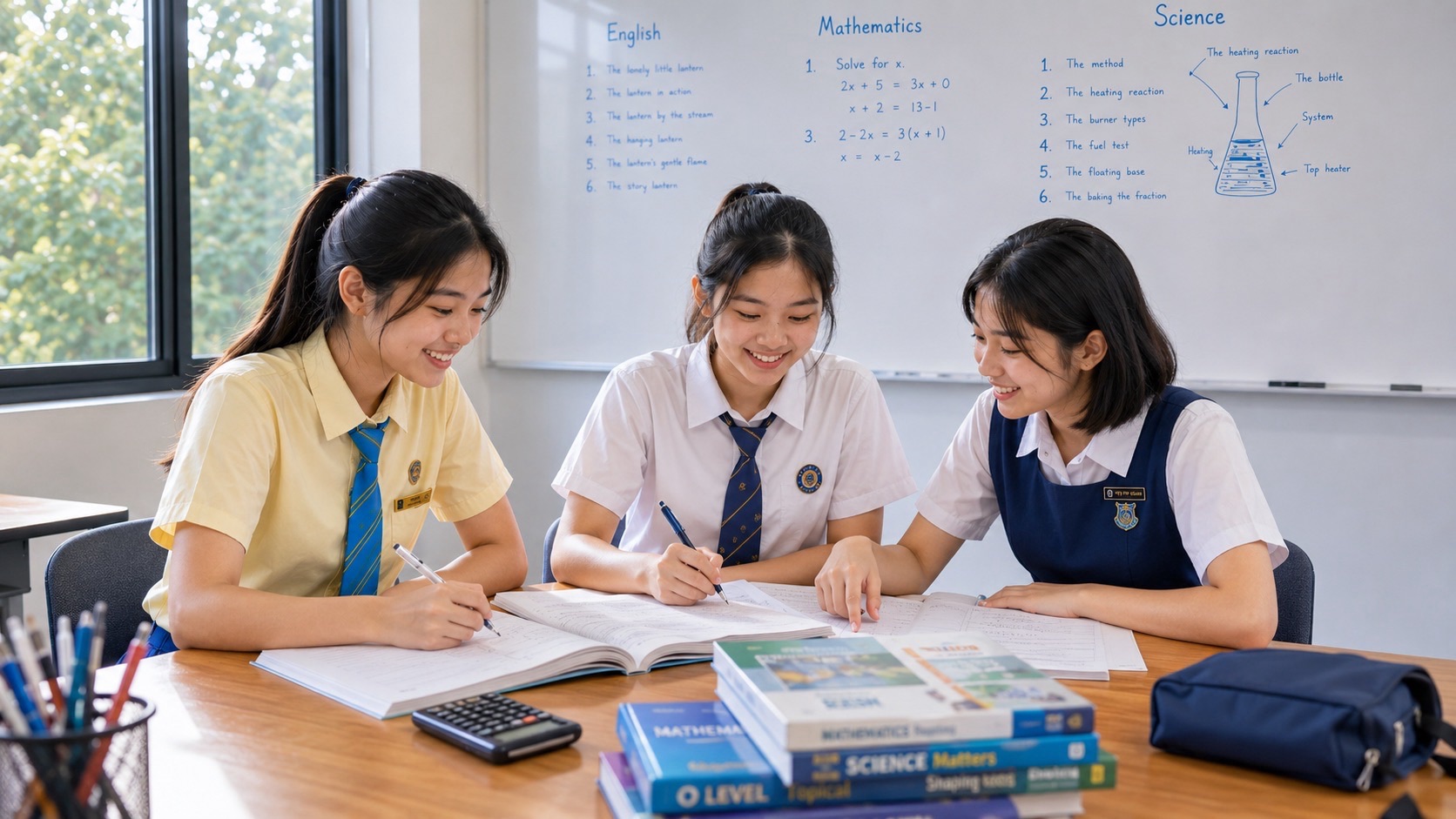
Misconceptions are difficult to detect from completed worksheets because the tutor needs to hear the reasoning before it disappears into the final answer. Small-group teaching allows more questioning, prediction and immediate follow-up.
In eduKate Punggol’s three-student Science tutorials, a tutor can ask one student to predict, another to challenge the evidence and a third to explain the revised model. The aim is not to embarrass wrong thinking. It is to make it visible enough to repair.
Parents can review Science Tuition Punggol or the Science tuition sign-up route.
FAQ
What is a misconception in Science?
It is an incorrect internal explanation or model that the student uses consistently, even when the learner may know some correct vocabulary.
How do you fix a Science misconception?
Elicit the student’s model, make it predict something, compare the prediction with evidence, rebuild the better model and retest with a fresh question.
Conclusion
Misconceptions improve when students are given a reason to change their model. Find the belief, make it predict, test it against evidence and build the stronger explanation. Then prove the repair in a new context.
Explore the Punggol Science reading library for related guides.


