
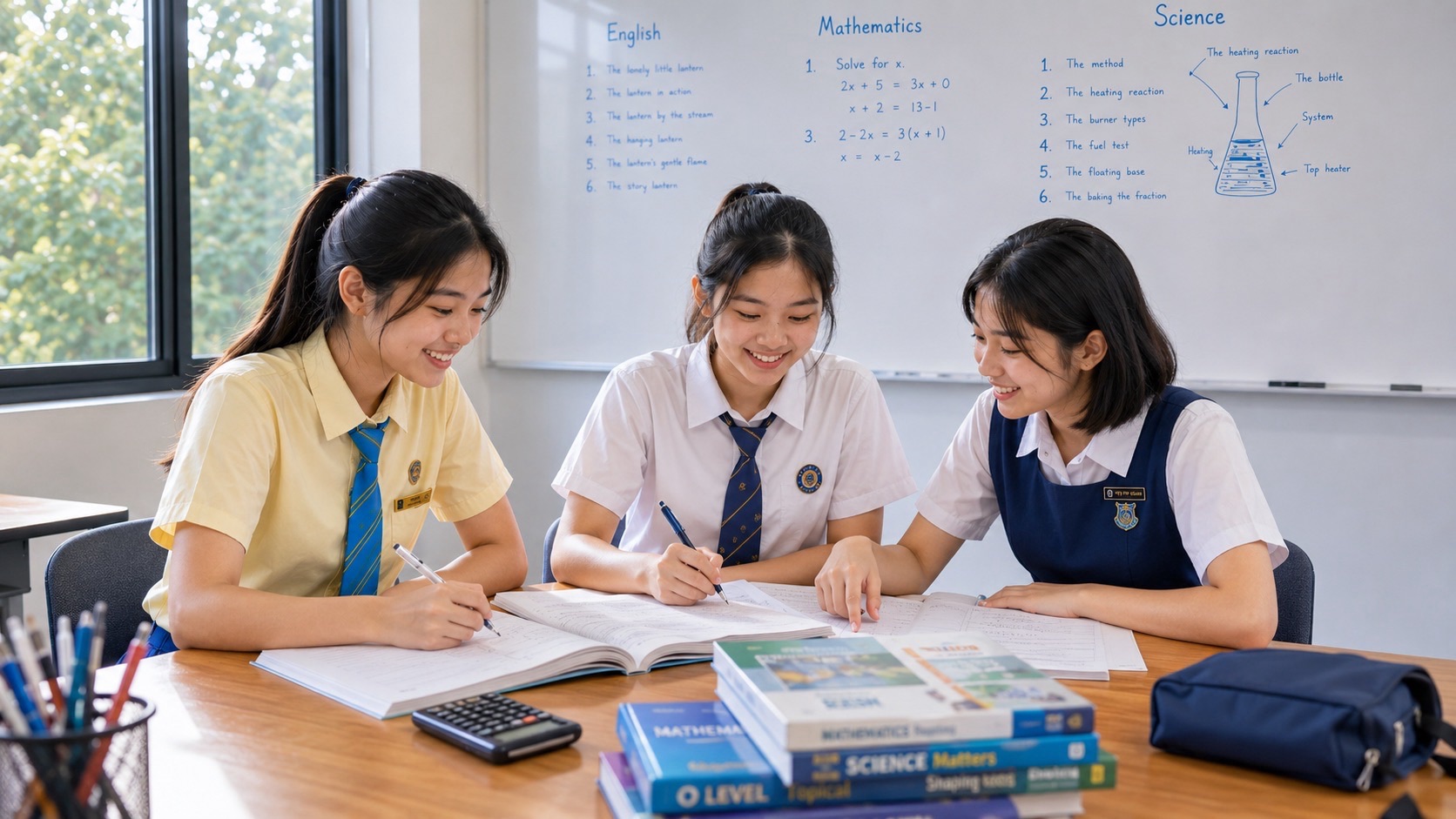
Topical practice or full past-year Mathematics papers? Parents searching for PSLE Math past year papers, topical Math practice, yearly practice papers, Math revision papers, PSLE Math revision or Mathematics tuition in Punggol are choosing between two different training tools. Topical practice builds or repairs one skill at a time. Full papers test whether many skills can be selected and executed together under examination conditions.
Current Singapore revision guidance makes the distinction clearly: topical practice is most useful for learning, strengthening and repairing a specific chapter, while yearly or full-paper practice is most useful for mixed-topic retrieval, exam stamina, timing, strategy and realistic performance testing. The strongest preparation uses both at the right stage rather than treating one as universally superior.
At eduKatePunggol, Mathematics is taught in focused groups of up to three students in 1.5-hour lessons near Punggol MRT. The useful question is: does this student currently need to learn and repair a skill, or prove that the skill survives inside a complete paper?
The short answer: topical first for repair, full papers later for integration
Use topical practice when:
- the concept is new;
- a particular chapter is weak;
- a repeated error needs concentrated correction;
- the student needs enough examples to stabilise a procedure;
- the tutor is diagnosing exactly where the method breaks.
Use full papers or yearly papers when:
- most major topics are reasonably stable;
- the student needs mixed-topic selection;
- timing needs training;
- paper strategy needs rehearsal;
- exam stamina needs testing;
- the tutor needs a broad error map.
Why topical practice works
Topical practice reduces noise.
If the student is learning ratio, the tutor can focus on ratio without unrelated geometry or data questions interrupting the sequence.
This allows the child to:
- understand the concept;
- see several forms of the same relationship;
- practise a method accurately;
- receive immediate correction;
- build fluency.
Topical work is efficient for repair because every question can target the same bottleneck.
Why topical practice can create an illusion of mastery
A worksheet titled “Percentage” tells the student which topic is being tested.
That removes part of the decision-making.
The student may become very good at percentage questions when percentage is announced and still fail to recognise percentage inside a mixed examination paper.
This is why topical practice must eventually be followed by mixed practice.
Why full papers work
A full paper asks the student to coordinate the complete examination system.
- retrieve knowledge;
- identify the topic;
- choose a method;
- manage time;
- use the calculator correctly where allowed;
- recover after difficult questions;
- check before submission.
That makes full papers powerful assessment tools.
Why too many full papers can waste good exam material
A student who repeatedly completes papers without repairing the exposed weaknesses can rehearse failure.
Suppose three papers all show the same ratio-unit error.
The fourth paper is unlikely to fix the ratio unit.
Stop.
Return to topical repair.
Then use a fresh paper to test whether the repair transferred.
The best revision loop
- Topical learning. Build or repair the concept.
- Topical variation. Change wording and representation.
- Mixed practice. Remove the topic label.
- Timed section. Add performance pressure.
- Full paper. Test integration.
- Error audit. Classify losses.
- Return to topical repair.
- Retest with a fresh full paper.
This loop turns papers into evidence rather than consumption.
Primary 3 and Primary 4: topical practice should dominate
Younger upper-primary students are still building the system.
Topical work on multiplication, division, fractions, decimals, factors and word problems is usually more educational than excessive full-paper drilling.
Mixed tests can still be used to check transfer.
Primary 5: begin integrating without turning the year into endless PSLE papers
Primary 5 is a good time to combine topical repair with increasingly mixed revision.
The student should begin seeing how fractions, percentage, ratio and rate interact.
Selected exam-style questions are useful.
Full-paper volume should not replace foundation building.
Primary 6: full papers become more important, but not sufficient
By Primary 6, full-paper rehearsal becomes central because PSLE performance requires timing, stamina and paper strategy.
But every full paper should change what happens next.
If the paper reveals:
- weak ratio;
- percentage errors;
- speed-unit confusion;
- poor Paper 1 fluency;
- calculator mistakes;
- time-management failure;
the next training block should address that pattern.
Secondary Mathematics: topical and yearly papers still do different jobs
The same logic applies in Secondary G1, G2 and G3 Mathematics.
Topical practice strengthens algebra, equations, graphs, geometry or statistics.
Full papers test whether the student can select and execute across the entire syllabus under time pressure.
How many full papers should a student do?
There is no useful universal number.
The better question is whether each paper produces new evidence.
If the student’s error pattern is unchanged because nothing between papers is being repaired, adding paper number twelve may have low value.
If the student is now stable and needs stamina, timing and exam familiarity, more complete papers can be justified.
The correction ratio matters
Parents often count how many papers a child completes.
Count corrections too.
A useful revision system spends enough time understanding errors that the next paper has a chance to be different.
Past-year papers should remain fresh enough to test transfer
If a child repeatedly sees the same paper, familiarity can inflate performance.
Use fresh questions or parallel forms after correction.
Otherwise the student may remember the answer rather than retrieve the skill.
Frequently asked questions about topical and past-year Math practice
Are past-year papers enough for PSLE Mathematics?
No. Full papers are excellent for integration and exam rehearsal, but persistent topic gaps should be repaired with targeted topical work before the next paper.
When should a P5 student start full papers?
Selected full-paper or paper-style practice can be introduced once enough of the syllabus is stable. The year should still prioritise foundation and proportional reasoning rather than nonstop PSLE simulation.
Should weak students do more topical practice?
Usually, targeted topical work is efficient for repairing specific gaps. It should eventually be followed by mixed and timed practice to confirm transfer.
Mathematics Tuition in Punggol: use topical practice to build; use full papers to prove
Learn topically.
Mix the topics.
Test under time.
Audit the paper.
Repair the repeated loss.
Then retest with something fresh.
Families who want to discuss whether their child currently needs topical repair or full-paper practice can WhatsApp eduKatePunggol.
Useful current reference
TuitionLah | Topical vs Yearly Practice Papers: Which Is Better?


