
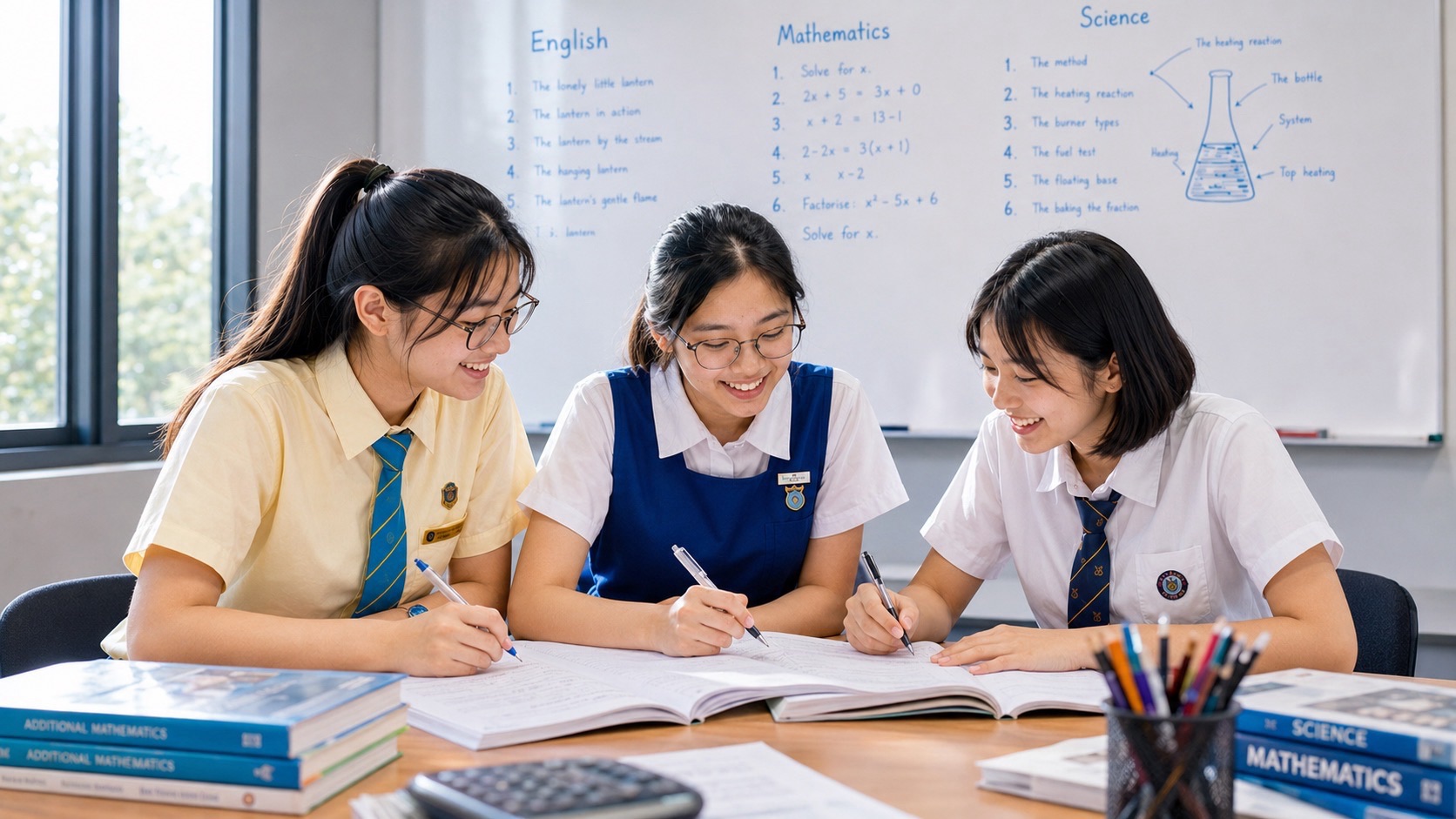
Calculator or mental Mathematics? Parents searching for calculator use in PSLE Math, mental Math tuition, should my child use a calculator, calculation speed or Mathematics tuition in Punggol are often treating two useful tools as if one must replace the other. Strong students need both: mental number sense for estimation and efficient decisions, and accurate calculator use where the examination or task permits it.
For the 2026 PSLE Mathematics examination, SEAB states that calculators are not allowed in Paper 1 and allowed in Paper 2. SEAB also maintains an approved-calculator list for national examinations. That structure makes the teaching principle clear: Primary 6 students must be able to work without a calculator and must also learn to use one accurately when it is permitted.
At eduKatePunggol, Mathematics is taught in focused groups of up to three students in 1.5-hour lessons near Punggol MRT. The useful question is not “calculator or no calculator?” It is: which calculations should the student control mentally, which should be written, and when does a calculator reduce unnecessary arithmetic without replacing mathematical judgment?
The short answer: use the lightest reliable tool
A strong student should be able to choose among:
- mental calculation;
- written working;
- calculator use.
The best tool depends on the numbers, the examination rules and the risk of error.
Mental Mathematics is valuable for:
- basic facts;
- number bonds;
- estimation;
- simple fraction-decimal-percentage links;
- checking magnitude;
- recognising unreasonable calculator answers.
Calculators are valuable when:
- the arithmetic is long enough to distract from the real problem;
- decimal operations are cumbersome;
- the paper allows calculator use;
- speed and accuracy improve without hiding conceptual weakness.
Mental Mathematics is the student’s reasonableness system
A calculator can produce a precise wrong answer.
If a student keys 38 × 17 incorrectly, the machine will not know the intended calculation.
Number sense provides the check.
38 × 17 should be a little less than 40 × 17 = 680.
An answer of 64.6 should therefore look suspicious immediately.
Estimation is the bridge between mental Mathematics and calculator discipline.
Do not use the calculator to hide weak foundations
A child who cannot work out simple multiplication facts should not use a calculator to avoid building them.
A child who does not understand percentage should not be taught only a calculator sequence.
The tool should reduce unnecessary arithmetic after the relationship is understood.
PSLE Paper 1: no calculator means fluency matters
For 2026 PSLE Mathematics, Paper 1 does not allow calculator use.
Students therefore need:
- reliable multiplication and division facts;
- fraction operations;
- percentage relationships;
- estimation;
- mental decomposition;
- accurate written calculation.
This is why calculator dependence can become expensive even for a student who seems fast at home.
PSLE Paper 2: calculator use should still be estimated and checked
Paper 2 allows calculator use, but the calculator does not decide:
- what the problem means;
- which operation is required;
- which numbers should be entered;
- whether a unit conversion is needed;
- whether the final answer is reasonable.
The student still owns the Mathematics.
The three-step calculator routine
- Estimate. Know roughly what size the answer should be.
- Calculate. Enter the expression carefully.
- Verify. Compare the display with the estimate and context.
This routine prevents many calculator-entry errors from surviving into the final answer.
When mental Math becomes inefficient
Mental Mathematics is not a performance trick.
Some students attempt complicated arithmetic mentally because they want to appear fast.
If the mental load becomes large, written working or calculator use may be safer.
The correct choice is the method that protects accuracy, clarity and time.
Secondary Mathematics: calculators do not replace algebra
As students move into Secondary G1, G2 and G3 Mathematics, calculator use becomes part of a larger symbolic system.
The student still needs to:
- simplify expressions;
- solve equations;
- interpret graphs;
- understand geometry;
- estimate numerical answers;
- show sufficient working.
A calculator can assist arithmetic. It cannot replace algebraic reasoning.
Frequently asked questions about calculators and Math tuition
Can calculators be used in PSLE Mathematics?
For the 2026 PSLE Mathematics examination, SEAB states that calculators are not allowed in Paper 1 and are allowed in Paper 2.
Should my child practise without a calculator?
Yes. Mental and written calculation remain important for number sense, estimation, Paper 1 and checking.
Should the tutor allow a calculator for every hard calculation?
Only when calculator use matches the learning objective and examination rules. If the concept being trained is multiplication fluency or fraction arithmetic, the calculator can remove the skill the lesson is trying to build.
Mathematics Tuition in Punggol: train judgment, not calculator dependence
Estimate mentally.
Write when structure matters.
Calculate when the tool is allowed and useful.
Then verify.
Families who want to discuss calculation fluency, PSLE paper strategy or calculator use can WhatsApp eduKatePunggol.


