
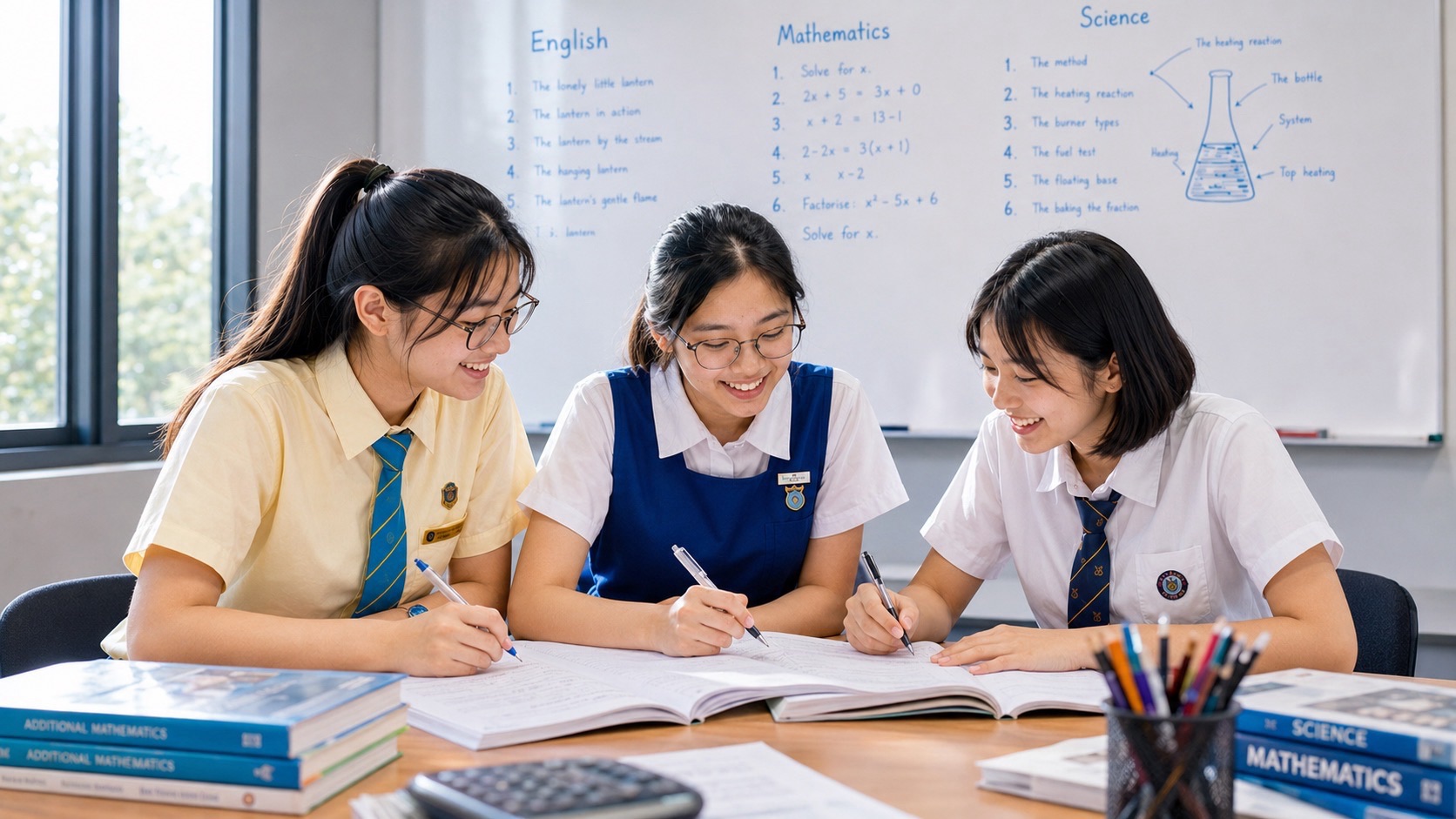
Linear equations and inequalities are central Secondary Mathematics skills because they convert relationships into solvable symbolic statements. Students often learn equation solving as a sequence of moves, then struggle when brackets, fractions, negative coefficients or inequality signs appear. The more reliable method is to preserve equality or inequality while isolating the unknown step by step.
This Mathematics Improvements in Punggol guide narrows the broader Algebra lane into linear equations and inequalities. Major Mathematics resources such as Khan Academy organise these topics around inverse operations, equivalent equations, variables on both sides, distributive structure and inequality reasoning. The important idea is not “move and change sign”; it is performing valid transformations that preserve the set of solutions.
At eduKate Punggol, Mathematics tutorials are held at 83 Punggol Central, Singapore 828761, near Punggol MRT and Waterway Point, in small groups of up to three students. A small group makes equation errors visible because the tutor can see whether a student understands equality, handles signs, expands brackets, clears fractions, or knows when an inequality sign must reverse.
An equation states that two expressions are equal
In 3x + 5 = 20, the left and right sides have the same value for the solution x. Solving means finding the value that makes the equality true.
Every transformation should preserve that equality.
Use inverse operations to isolate the unknown
For x + 7 = 19, subtract 7 from both sides. For 5x = 30, divide both sides by 5. These are not visual moves; they are operations applied consistently to preserve equality.
Worked example: two-step equation
Equation: 4x + 3 = 27.
Subtract 3 from both sides: 4x = 24. Divide by 4: x = 6. Check by substitution: 4(6) + 3 = 27.
Variables on both sides
For 5x + 2 = 3x + 14, subtract 3x from both sides to obtain 2x + 2 = 14. Then subtract 2 and divide by 2 to get x = 6.
The goal is to gather variable terms and constants in a way that preserves equality.
Brackets inside equations
For 3(x + 4) = 24, either divide by 3 first or expand the bracket. Both valid routes lead to x + 4 = 8 and x = 4.
Comparing methods helps students see that algebra allows more than one valid route.
Equations with fractions
Fraction equations become easier when denominators are cleared carefully. For x/4 + 3 = 8, subtract 3 first to get x/4 = 5, then multiply by 4 to obtain x = 20.
Students should avoid changing the equation in ways that affect only one side.
Always check by substitution
Substitution turns an abstract solution back into the original equation. If both sides match, the value is confirmed.
This is especially useful after sign-heavy or fraction-heavy work.
Inequalities compare rather than equate
An inequality may state that one quantity is greater than, less than, greater than or equal to, or less than or equal to another.
The solution is often a range of values rather than one number.
Solving simple inequalities
For x + 5 > 11, subtract 5 from both sides to get x > 6. Any value greater than 6 satisfies the inequality.
Why the inequality sign reverses
When multiplying or dividing both sides of an inequality by a negative number, the direction reverses. For example, −2x > 8 becomes x < −4 after dividing both sides by −2.
This is not an arbitrary exception. Multiplying by a negative reflects values across zero, reversing their order on the number line.
Represent inequality solutions on a number line
Number lines make solution sets visible. Open circles represent strict inequalities such as x > 3; closed circles represent inclusive inequalities such as x ≥ 3.
The shading direction shows which values satisfy the condition.
Worked example: inequality with a negative coefficient
Inequality: −3x + 2 ≤ 11.
Subtract 2: −3x ≤ 9. Divide by −3 and reverse the inequality: x ≥ −3.
Equation versus inequality checking
For an equation, substitute the exact solution. For an inequality, test one or more values from the solution region and one value outside it.
This helps students detect sign-reversal mistakes.
The linear-equation error taxonomy
- Equality error — an operation is applied to only one side.
- Sign error — negative terms are lost during rearrangement.
- Bracket error — distribution is incomplete.
- Fraction error — denominators are handled inconsistently.
- Inverse-operation error — the wrong operation is used to isolate the variable.
- Checking error — the solution is never substituted back.
The inequality error taxonomy
- Direction error — the sign is reversed when it should not be.
- Negative-operation error — the sign is not reversed after multiplying or dividing by a negative.
- Boundary error — strict and inclusive inequalities are confused.
- Number-line error — the solution is shaded in the wrong direction.
How to translate words into equations and inequalities
“Five more than twice a number is 19” becomes 2x + 5 = 19. “A number is at least 12” becomes x ≥ 12.
Translation should be practised separately from solving because forming the mathematical statement is a distinct skill.
How this links to word problems
Many Secondary word problems are solved by defining a variable, forming an equation and then interpreting the answer. The companion Problem-Solving guide develops the wider translation process.
How this links to graphs
A linear equation can represent a straight-line relationship. Inequalities can also be represented visually on number lines and, at later levels, in graphical regions where relevant.
The Coordinates and Linear Graphs guide develops that connection.
A reliable solving routine
- Simplify both sides if necessary.
- Expand brackets carefully.
- Collect variable terms strategically.
- Collect constants.
- Isolate the variable with inverse operations.
- For inequalities, reverse the sign only when multiplying or dividing by a negative.
- Check the solution.
How to practise effectively
Begin with one-step equations, then two-step equations, variables on both sides, brackets and fractions. Add inequalities only after signed-number fluency is stable. Finally mix equations, inequalities and word problems so the student must recognise the structure independently.
How to know the skill is improving
- Students preserve equality correctly.
- Sign errors decrease.
- Brackets and fractions are handled systematically.
- Solutions are checked by substitution.
- Inequality signs reverse only when mathematically required.
- Number-line representations match the symbolic solution.
- Word relationships translate into equations more accurately.
How small-group tuition can help
One student may understand equations but lose negatives; another may solve symbolically but fail word translation; another may forget the inequality reversal rule. A three-student group allows targeted next questions inside a shared Algebra lesson.
Frequently asked questions
Why not teach “move across and change sign”?
Because it hides the equality-preserving operation underneath the step. Understanding inverse operations is more reliable when equations become complex.
Why does the inequality sign reverse?
Multiplying or dividing by a negative reverses number order on the number line.
Why should students check equations?
Substitution confirms whether the proposed value actually satisfies the original relationship.
Continue the Mathematics Improvements in Punggol lane
- How to Master Indices, Powers, Roots and Standard Form.
- How to Improve Algebraic Expressions, Expansion and Factorisation.
- How to Solve Simultaneous Equations.
- How to Improve Algebra From Variables and Equations to Graphs.
Linear equations and inequalities become reliable when students preserve relationships rather than memorise visual moves. Use inverse operations, protect signs, expand carefully, check solutions, and treat inequality reversal as a consequence of negative scaling rather than an isolated trick.
Further learning: Khan Academy Linear Equations · Khan Academy Linear Inequalities.


