
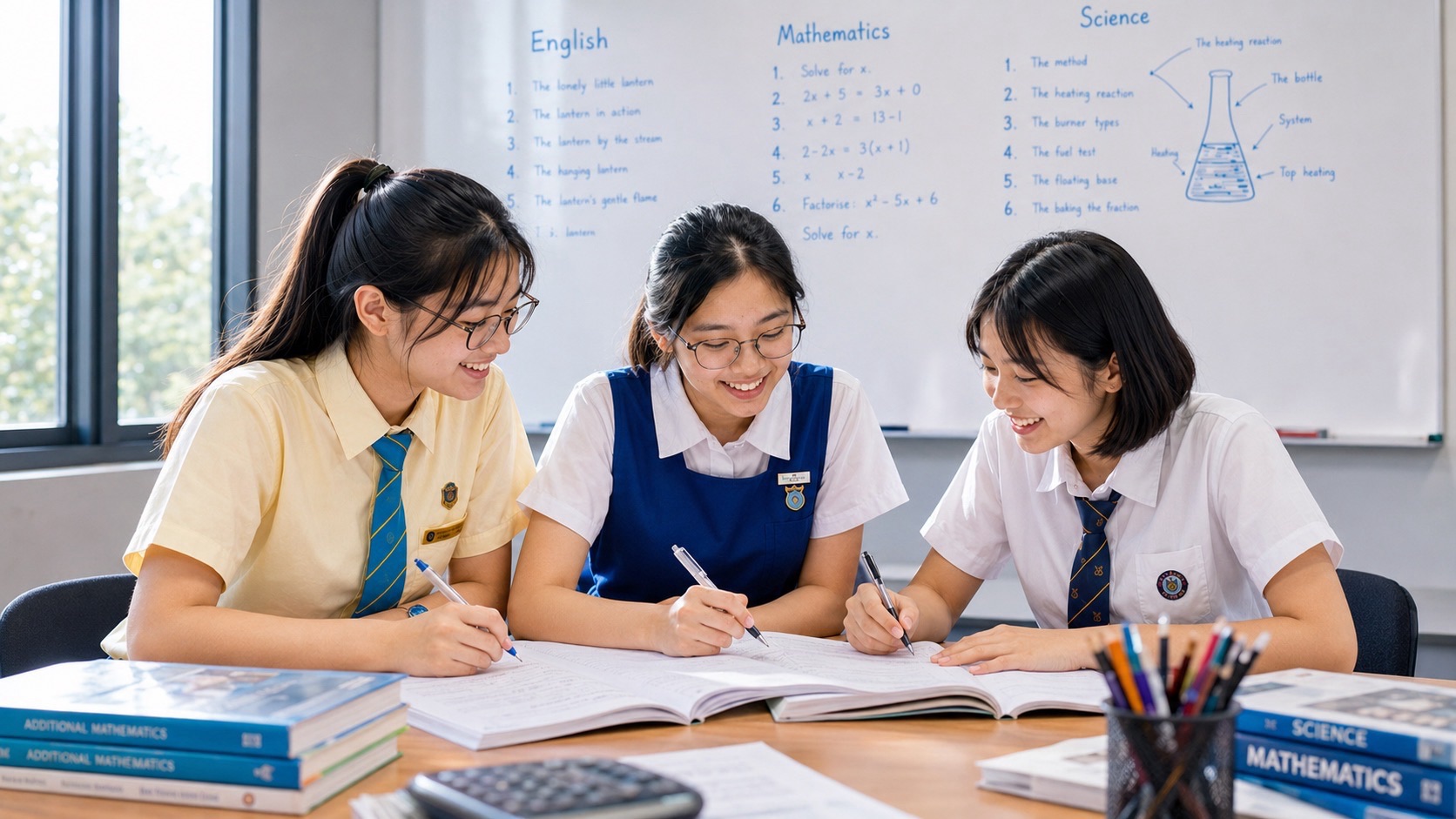
Parents comparing English tuition in Punggol often look at the notes, model compositions, vocabulary lists and answer keys a programme provides. Good materials are useful. They can show structure, expose language patterns and give students something to review. But materials do not teach by themselves. English improvement depends heavily on what happens when the student attempts a task, makes a decision, receives feedback and then tries again.
A polished model answer can show what strong writing looks like. It cannot automatically tell the learner why their own paragraph failed, which sentence created ambiguity, why a comprehension answer is too broad, or how much support the student still needs. That requires live diagnosis and feedback. The strongest tuition therefore uses notes and model answers as tools inside a teaching loop rather than as substitutes for the loop.
This page is a material-quality satellite inside English Tuition at eduKatePunggol. It complements Feedback and Repair Loops in English Education, which owns the deeper learning mechanism.
Model answers are useful when students study decisions, not copy language
A model answer can help a learner notice organisation, paragraph purpose, evidence use, vocabulary, tone or sentence structure. The useful question is not “Can I memorise this?” but “What did the writer do, and can I use the same principle in a different task?”
For composition, that might mean noticing how a turning point is built. For situational writing, it might mean noticing how tone changes with audience. For comprehension, it might mean studying how a complete answer includes both inference and evidence.
The danger of model-answer dependence
Students can become good at recognising quality without being able to generate it. They know a strong answer when they see one, but cannot begin when the prompt changes.
That is why every model should be followed by a variation task. Change the prompt, context or evidence and make the learner reconstruct the decision independently.
Notes help memory only if the learner retrieves from them
Beautiful notes can create familiarity. The child reads them and thinks, “I know this.” The stronger test is closed-book retrieval: can the learner explain the rule, vocabulary distinction or comprehension process without looking?
Notes should therefore become a launch point for retrieval, not a storage system the child rereads passively.
Live feedback is where hidden errors become visible
A tutor can hear whether a student’s oral answer lacks development, see whether writing becomes vague under time, notice whether a child guesses at inference, and distinguish a vocabulary gap from an answer-expression gap. That diagnostic information does not exist inside a generic answer key.
Useful feedback is specific enough to change the next attempt:
- “Your answer has the feeling but not the evidence.”
- “This paragraph contains three events but no clear cause.”
- “Your vocabulary is accurate, but this word is too formal for the audience.”
- “You know the tense rule, but it disappears when you write quickly.”
Feedback should shrink over time
If the tutor always rewrites the sentence, the student may never learn to self-correct. Good feedback begins more explicitly when necessary, then becomes lighter as the learner gains control.
- Direct correction.
- Specific hint.
- Guiding question.
- Error marker only.
- Independent self-check.
The direction is toward independence.
Primary 1–2: feedback should be immediate and simple
Young learners benefit from short feedback connected directly to the action: hear the sound again, reread the sentence, add the missing subject, check the full stop. Long notes are less useful than clear guided practice.
Primary 3–4: models can teach structure
At these levels, model paragraphs and comprehension answers can help children see how stronger responses are organised. The tutor should then remove the model and ask the student to apply the pattern elsewhere.
Primary 5–6: model answers should not become PSLE scripts
During the PSLE runway, students may collect model compositions and standard answer forms. These can be useful references, but over-reliance creates fragility. The examination prompt will not reproduce the model exactly.
The stronger preparation is to extract reusable moves—relevance, causality, evidence, paragraphing, register—and practise them on fresh tasks.
Secondary: notes should support reasoning, not replace it
Secondary students need increasingly flexible reading and writing. Notes on tone, argument, register or editing are useful, but the learner has to apply them to unfamiliar texts. A student who can quote the note but cannot decide what a writer is implying has not yet transferred the knowledge.
A parent comparison table
| Tool | Useful for | Weak when |
|---|---|---|
| Model answer | Showing structure and quality | Memorised instead of analysed |
| Notes | Organising concepts and revision | Only reread passively |
| Answer key | Checking correctness | Does not explain mechanism |
| Live feedback | Diagnosing individual decisions | Creates dependence if never faded |
| Fresh transfer task | Testing whether learning survives change | Skipped because original task looked successful |
What parents should ask about materials
- How are model answers used?
- Does the child have to apply the same principle on a new task?
- Are notes tested through retrieval?
- Does writing feedback identify recurring individual errors?
- Does feedback become lighter as the child improves?
- Can the student eventually perform without the notes or tutor?
At eduKatePunggol, materials are useful when they make teaching more precise. The 3-pax format allows the tutor to compare student attempts, use models selectively and give live feedback while each learner remains visible. The strongest resource is not the thickest set of notes. It is a learning loop that turns information into independent capability.
Explore the Punggol English reading library for related guides.


