
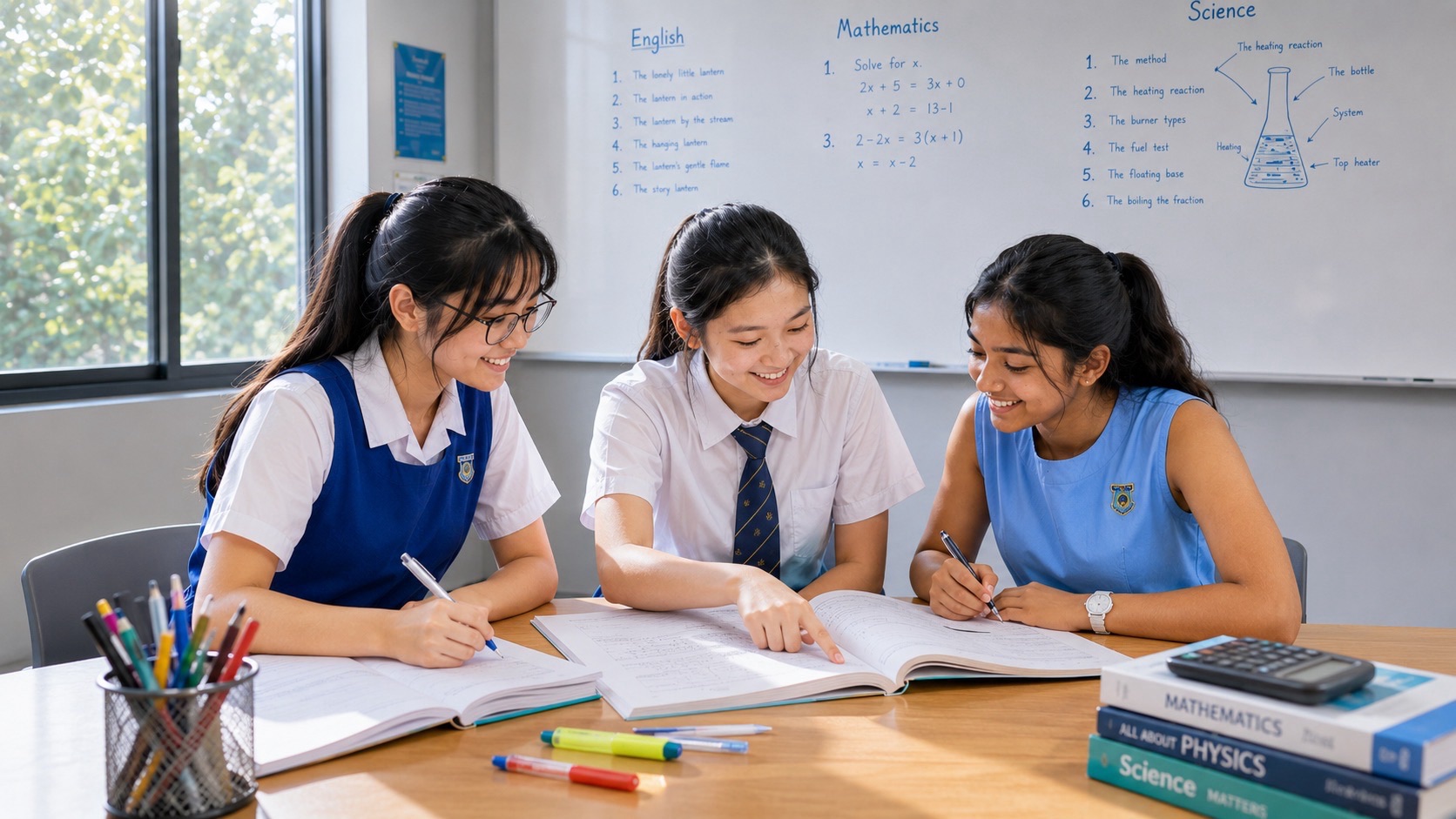
A student does not learn in one place.
There is the classroom.
There is home.
There may be tuition.
There is independent study.
There are school tests, homework, CCAs, bus rides, meal times, siblings, phones, weekends, late evenings and the ordinary unpredictability of family life.
Training has to move through all of them.
A training environment is the set of places, cues, people, routines and constraints that shape whether a capability can actually grow and survive.
This matters because a learner can look excellent in one environment and weak in another.
Mira solves Mathematics accurately beside the tutor but hesitates at home. Jonas writes well when a sentence frame is supplied but not in school. Nadia explains Science clearly during discussion but loses the relationship when she meets unfamiliar examination wording.
The problem is not always knowledge.
Sometimes the environment has been doing part of the work.
Quick Read: Four Environments, Four Jobs
A coherent training system can give different environments different roles.
- School: primary teaching environment, curriculum progression, peer context and authentic assessment evidence.
- Tuition: diagnosis, targeted repair, additional explanation, focused practice and close feedback where extra support is genuinely needed.
- Home: recovery, routines, short retrieval, homework, reading and growing independence.
- Independent study: the place where the learner increasingly owns selection, retrieval, checking, planning and return.
The environments should not simply duplicate one another.
They should form a return path.
School → Evidence → Targeted Training → Independent Return → School
The Environment Can Hide Weakness
Imagine a student doing algebra at tuition.
The chapter title is visible. The teacher has just demonstrated the method. The worked example remains on the whiteboard. The learner can ask for help instantly.
Performance may be strong.
Now change the environment.
Two days later, the school worksheet mixes several topics. No heading identifies the method. The tutor is absent. The example is gone.
If performance collapses, the learner may not have lost knowledge.
The original environment was carrying hidden scaffolding.
A good training environment therefore changes over time. Support can be high during acquisition, but it must eventually resemble the conditions where the learner needs to perform.
School Is Not Merely the Place That Produces Marks
School work is one of the richest sources of training information.
It shows what happens when the learner operates outside the tuition room.
Marked school work can reveal:
- recurring errors;
- new curriculum demands;
- timing problems;
- answer-format expectations;
- transfer failures;
- which earlier repairs survived;
- which support is no longer necessary.
A coherent tuition programme should listen to that evidence rather than run a completely separate curriculum simply because materials have already been prepared.
Tuition Should Add Something School and Home Are Not Already Providing
Extra teaching only makes sense when it creates extra value.
That value can come from:
- closer diagnosis;
- smaller-group observation;
- targeted repair;
- more feedback cycles;
- different explanation;
- additional transfer practice;
- examination calibration;
- structured return after delay.
If tuition merely duplicates school worksheets at higher volume, the environment may be busier without being more intelligent.
This is why How Tuition Works at eduKatePunggol treats tuition as a specific intervention rather than a generic second school.
Home Should Not Become a Permanent Second Tuition Centre
Parents often help because they care.
They remind, explain, correct, check, pack, schedule and sit beside the child.
Some support is entirely appropriate, especially for younger learners.
But the home environment should gradually release responsibility.
Ask:
- Can the child begin without being told?
- Can the child identify what is due?
- Can the child attempt before asking for rescue?
- Can the child describe where the difficulty starts?
- Can the child check basic completion?
- Can the child return to yesterday’s correction?
As these capabilities grow, parent support can fade.
That is not parental withdrawal.
It is successful training of independence.
Independent Study Is the Destination
At some point, the learner must be able to continue without immediate external direction.
Independent study means more than sitting alone.
It requires the learner to own increasingly difficult decisions:
- what to practise;
- what to retrieve;
- what counts as an error;
- when to check;
- when to ask for help;
- when to return to a topic;
- when a capability is stable enough to move on.
The whole training architecture should gradually transfer these decisions to the learner.
Environment Design Begins With Friction
Training becomes less likely when starting requires too many unnecessary decisions.
The book cannot be found. The laptop is uncharged. The worksheet is in another bag. The desk is covered. Nobody knows which correction should be redone. The student spends twenty minutes deciding what to start.
This is environmental friction.
Reduce low-value friction:
- keep materials in predictable places;
- record the current priority clearly;
- make the first task obvious;
- prepare required tools before the session;
- separate focused training from administrative clutter.
The goal is not to make learning effortless.
The goal is to reserve effort for the capability that matters.
Useful Difficulty vs Environmental Noise
Training sometimes needs difficulty.
But difficulty should come from the learning job, not from a chaotic environment.
Retrieving a formula from memory can be useful difficulty.
Trying to retrieve it while three phones are playing videos beside the learner is environmental noise.
Interleaving similar Mathematics problems can create useful discrimination.
Searching through six unlabelled worksheets to discover which one the tutor assigned does not.
The training environment should remove irrelevant difficulty so productive difficulty can do its job.
Attention Is Partly Environmental
We often describe attention as if it were only a character trait.
“Focus harder.”
But environments create attention demands.
A learner working with constant notifications must repeatedly decide whether to switch. A learner studying in a high-traffic family space may experience frequent interruption. A tuition room where every student is doing unrelated noisy activities can increase switching costs.
The solution is not absolute silence for every learner.
It is deliberate environmental design:
- protect short focused blocks;
- reduce unnecessary notifications;
- choose a location appropriate to the task;
- keep interruptions predictable where possible;
- match demanding reasoning work to periods of better alertness.
The Environment Should Change as Training Progresses
Early learning benefits from protection.
The example is visible. The task is isolated. The teacher is close. Time is generous.
Later learning needs reduced protection.
The example disappears. Related methods mix. Timing enters. The trainer steps back. The context changes.
This connects directly to Training Progression.
The environment itself becomes a progression variable.
Home Should Contain Retrieval, Not Only Completion
Homework easily becomes a completion system.
Finish the page.
Tick the box.
Pack the file.
A better home environment also creates short moments of retrieval.
- redo one correction from memory;
- explain one Science relationship without notes;
- retrieve three formulae and use one;
- write one paragraph without the original sentence frame;
- summarise yesterday’s reading before reopening the book.
These small returns connect home to the larger training cycle.
Tuition Should Generate Transfer Tasks
A capability that works only in tuition has not fully returned to life.
So tuition should deliberately create transfer tasks:
- fresh school-like wording;
- mixed questions;
- home retrieval without the tutor;
- later school-paper comparison;
- reduced prompting;
- authentic time conditions.
Recent 2026 research on variability and transfer learning reinforces the importance of designing changes in examples so learners recognise underlying structure rather than memorising the training surface.
School Should Return Evidence to Training
The loop closes when school performance returns information.
A correction trained in tuition appears in the next school assignment.
Good.
The same error returns under timing.
Useful.
A different weakness becomes more important.
Update the priority.
This is why Training Signals and Training Priorities belong inside the environment architecture.
A Mathematics Environment Example
Mira learns a new algebraic method at school.
At tuition, three fresh questions reveal that she understands the method but loses signs during rearrangement.
The tutor repairs that one mechanism.
At home two days later, Mira completes a ten-minute retrieval task without notes.
Next week, school work mixes the method with another topic.
The sign error does not return.
The environments have formed a coherent loop.
An English Environment Example
Jonas receives school feedback that his paragraphs repeat ideas.
At tuition, he compares two paragraphs and learns to identify what new relationship each sentence adds.
At home, he plans one short paragraph from a fresh topic without the model.
In the next school assignment, his teacher notes stronger development but identifies imprecise vocabulary.
The training priority changes.
School, tuition and home are not duplicating one another.
They are passing evidence around the loop.
A Science Environment Example
Nadia knows a Science concept well in familiar textbook examples.
A school test introduces unfamiliar apparatus and she loses the relationship.
Tuition does not simply repeat the chapter.
It trains variable recognition and evidence mapping across several changed setups.
At home she explains one fresh experiment aloud without notes.
The next school task shows successful transfer.
Again, the environments have different jobs but one direction.
The Three-Student Tuition Environment
A small group creates useful environmental variation.
Students see alternative methods, hear different explanations and encounter errors they did not make themselves.
But the room should still preserve individual diagnosis.
Mira, Jonas and Nadia can share one problem while carrying different training priorities.
This is where the 3-pax model becomes a training environment rather than merely a class size. The tutor has enough visibility to notice different learner states while the group still generates useful contrast.
See Why eduKatePunggol Chooses 3-Pax Small Group Tuition.
Environment and Motivation
A learner is more likely to engage with training when the environment makes progress legible.
Instead of “do more Mathematics,” the current target is visible.
Instead of “you are weak at English,” the family knows the current paragraph-development goal.
Instead of “revise Science,” Nadia knows that the next ten minutes are for evidence-based explanation.
Clarity reduces the emotional size of the task.
Environment and Recovery
Training happens in a human body.
Sleep, meals and recovery therefore belong in the environment.
A theoretically excellent study plan that consistently pushes important work into exhausted late-night hours may be poorly designed.
Sometimes the better environment decision is to stop, sleep and return when attention is usable.
This is especially important for families trying to coordinate school, tuition and CCAs without turning every evening into an academic emergency.
Environment and Devices
Digital tools can support training.
They can provide retrieval prompts, explanations, practice, timing, dictionaries, simulations and access to information.
They can also fragment attention.
The useful question is not “technology or no technology?”
It is:
What job is the device doing during this training block?
If the device is the tool, use it deliberately.
If it is merely an interruption source, reduce its role temporarily.
Environment and Transfer
A capability becomes stronger when it survives environmental change.
Can the learner solve at school, home and tuition?
Can the learner write without the familiar desk?
Can the learner retrieve without the usual notebook?
Can the learner perform when the cueing environment changes?
Not every skill needs deliberate location variation. But when performance is overly dependent on one context, changing the environment can reveal hidden support.
The Family Training Map
A family can map one important capability across the week:
- School: where did the weakness appear?
- Tuition: what mechanism was diagnosed and repaired?
- Home: what short independent return will happen?
- School again: did the improvement transfer?
This map is simple enough to use and strong enough to prevent disconnected work.
What a Coherent Environment Avoids
- school teaches one method while tuition insists on an incompatible shortcut without explanation;
- parents correct work before the child has attempted;
- tuition repeats large volumes of already-stable material;
- homework adds quantity but no delayed retrieval;
- every environment provides permanent cues;
- school errors never return to the training plan;
- stable capabilities never exit intensive practice;
- the learner has no unassisted environment in which independence can be observed.
The Environment Should Become Less Necessary
This sounds paradoxical.
We build an excellent training environment so the learner can eventually function beyond it.
The tutor becomes less necessary for a mastered process.
The parent needs to remind less.
The worked example disappears.
The learner can carry the capability into school, examinations and later life.
That is successful environmental design.
A Parent’s Environment Audit
- Does each learning environment have a clear job?
- Are school errors feeding back into training?
- Is tuition adding diagnosis or merely duplicating work?
- Does home contain short independent return?
- Are prompts gradually fading?
- Is the learner practising under conditions that increasingly resemble real performance?
- Are devices serving the task or fragmenting it?
- Is the schedule compatible with sleep and recovery?
- Can the learner operate in at least one environment without immediate rescue?
- Does improvement eventually return to school?
The Deeper Principle: Environments Pass Capability Forward
School introduces and tests.
Tuition diagnoses and repairs where additional support is justified.
Home provides return, routine and recovery.
Independent study takes ownership.
Then the learner returns to school with more capability.
School → Tuition → Home → Independent Return → School
The arrow is more important than the place.
Training should move.
Continue Through How Training Works
- Training Architecture
- Session Design
- Progression
- Exit Criteria
- Training Signals
- Training Priorities
- Training Cycles
For the broader family and school routes, continue through How Studying Works, How Tuition Works at eduKatePunggol, The Primary Pathway, The Secondary Pathway and Singapore Education Pathway.
Research Foundations
This article treats environment as part of training design rather than as a single instructional technique. Relevant evidence includes the broad literature on spacing and retrieval practice, the 2026 testing-effect research perspective, the 2026 systematic review of evidence-based study strategies in STEM education, and recent work on variability and transfer learning. The practical conclusion is that a strategy only becomes educationally useful when it survives the contexts in which learners must later retrieve and apply it.


