
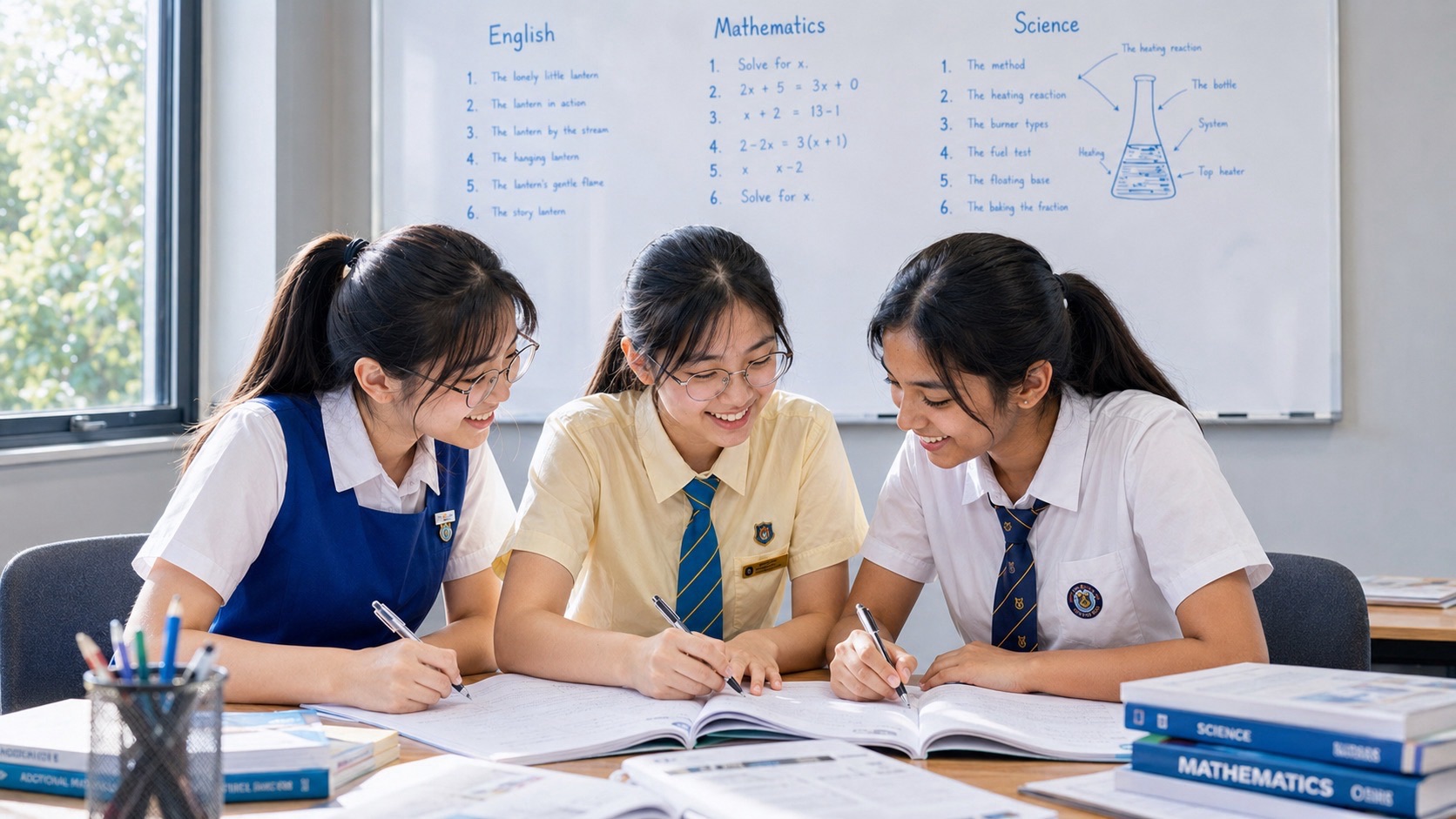
Growing up beside an AI district may become one of the strangest advantages of Crazy Rich Punggol. Punggol children can now grow up near a district where AI, robotics, cybersecurity and fintech are not abstract future-career words but visible parts of the local economy, while Singapore’s schools are simultaneously making AI literacy, coding, source validation and deepfake awareness more ordinary parts of education.
Did you know? On 3 March 2026, Singapore’s Ministry of Education said AI literacy would be strengthened throughout students’ education journey, with developmental milestones across curriculum, co-curriculum and self-directed learning. MOE also said the Code for Fun programme would be refreshed to strengthen AI skills and made available to all schools in 2027, while Cyber Wellness lessons now include validating generative-AI information and identifying deepfakes. At the same time, Punggol Digital District is being built as a 50-hectare hub for AI, robotics, cybersecurity and fintech, with capacity for about 28,000 jobs and 12,000 SIT students.
The Crazy-Rich Idea: Future Readiness Is Not Learning Today’s Tool Faster
AI tools will change faster than children grow up. That makes “learn this app” a weak education strategy. The richer strategy is to build capabilities that survive interface changes: reading closely, checking evidence, asking better questions, reasoning mathematically, understanding systems, communicating clearly, learning independently and noticing when confident-looking output is wrong.
The child who can think well with AI will usually be better prepared than the child who merely knows where the buttons are.
Punggol Makes the Future Less Abstract
A young person can learn about robotics in Science and then see autonomous machines being tested nearby. They can study data and encounter a district built around digital twins and sensor networks. They can hear about startups and know LaunchPad @ PDD is part of the same town. They can learn about applied education and see SIT embedded directly beside industry.
That local visibility matters. Careers become easier to imagine when the work has a station, a building and people doing it nearby.
AI Literacy Is Wider Than Prompt Writing
- Verification: Can the student check whether an AI claim is actually supported?
- Source judgment: Can they distinguish evidence from confident language?
- Deepfake awareness: Can they recognise that realistic media can still be false?
- Problem framing: Can they define the real question before asking a tool to help?
- Mathematical sense-checking: Can they recognise when an answer is numerically implausible?
- Writing: Can they revise machine-generated language into something accurate, purposeful and genuinely theirs?
- Ethics: Do they understand privacy, attribution, fairness and responsibility?
- Agency: Can they decide when not to use AI?
That last skill may eventually be the most luxurious one.
The Future Job Is Probably a Combination
Punggol Digital District makes it tempting to imagine neat job labels—AI engineer, robotics specialist, cybersecurity analyst. Real work is usually messier. A healthcare worker may use AI. A building engineer may supervise autonomous systems. A teacher may evaluate AI-supported student work. A business analyst may need enough technical understanding to question a model. A designer may work with robotics teams.
The strongest preparation is therefore not “pick one future job early”. It is to become someone who can combine knowledge across domains without losing depth.
Keep the Search Intent Clean
For the local jobs-and-industry picture, use Crazy Rich Punggol | Punggol Digital District, Smart City Technology and the Future of Work. For the university-industry pathway, use Crazy Rich Punggol | SIT Punggol Campus, Applied Learning and the Luxury of Opportunity Nearby. For autonomous robotics, use Crazy Rich Punggol | Physical AI, Autonomous Robots and the Future of Everyday Work.
This page keeps the education question: what capabilities should a Punggol child build when AI becomes normal?
Current 2026 Sources
- MOE — Committee of Supply 2026: AI literacy, Code for Fun and Cyber Wellness
- JTC — Punggol Digital District
- JTC — Physical AI testbed at PDD, 20 May 2026
The crazy-rich educational advantage is not access to more AI. It is growing up close enough to the future to learn that technology changes—and therefore judgment, curiosity, evidence, language and the ability to keep learning matter even more.
A child in Punggol can now grow up beside a district where robots are being prepared to share lifts, buildings are read through thousands of sensors, and startups can test software against real streets and doors.
At the same time, Singapore’s Ministry of Education is making AI literacy a more normal part of schooling. In its March 2026 announcements, MOE said AI literacy is being integrated across curriculum, co-curriculum and self-directed learning, while an updated Code for Fun programme will be available to all schools from 2027. Cyber Wellness lessons now include checking information produced by generative AI and recognising deepfakes.
The obvious conclusion is that children need more AI.
The obvious conclusion is incomplete.
The tool will change faster than the child can specialise
Ten years is a long time in childhood and an absurdly long time in software.
A Primary 1 child in 2026 will reach adolescence in a technological environment we can describe only loosely. Interfaces will change. Models will improve. Some skills now treated as advanced will become ordinary functions built into everyday tools. Entire job descriptions may change shape.
This makes premature specialisation a poor substitute for preparation.
A seven-year-old does not need a career strategy for an industry whose boundaries will move before secondary school.
They need foundations strong enough to keep learning when the interface changes.
AI makes old capabilities more visible, not less important
If a machine can produce fluent prose, reading carefully matters because fluency is no longer evidence of truth.
If a machine can produce an answer quickly, mathematics matters because someone still has to know whether the relationship makes sense.
If an image can be generated convincingly, scientific habits matter because appearance is not evidence.
If software can suggest a decision, language matters because people still need to state the problem, inspect assumptions, explain consequences and disagree precisely.
The new tool does not abolish foundational capability.
It makes weak foundations harder to hide.
Then there are capabilities school subjects do not own alone
An AI-facing future places unusual weight on a set of cross-subject habits:
- Question quality: knowing what needs to be found before asking a tool to find it.
- Evidence judgement: distinguishing a plausible answer from a supported one.
- Model awareness: understanding that every representation leaves something out.
- Transfer: carrying an idea into a problem that does not look exactly like the example.
- Revision: changing a conclusion when the world disagrees.
- Human judgement: recognising that efficiency is not the only value in a decision.
None of these belongs exclusively to Computing.
English, Mathematics, Science, Humanities, Art, Design and ordinary life can all develop them.
That is encouraging. It means preparing for an AI-transformed future does not require turning the entire childhood curriculum into technology training.
Punggol gives abstract questions a physical address
The advantage of living beside Punggol Digital District is not that every child should eventually work there.
It is that families can sometimes see the questions in the street.
Why does the robot stop there? What does a building sensor measure? Who decides whether a machine may enter a lift? What information does a smart district need? Why is Coney Island deliberately less optimised? What happens if a system makes the wrong decision?
These are technical questions and human questions at the same time.
A child who notices that may already be learning something important about the future: technology does not arrive from another world.
It enters this one and becomes accountable to it.
Parents do not need to chase every future skill
There will be no shortage of courses promising to prepare children for the age of AI.
Some will be excellent. Some will teach useful tools. Some children will discover a real interest and should be given room to pursue it.
But anxiety is a poor curriculum designer.
The calmer question is whether the child is becoming more capable of understanding unfamiliar things, testing what they are told, making something, explaining it, working with other people and recovering when an answer fails.
Those capabilities will still matter if today’s AI tools look quaint by 2036.
Perhaps that is the quiet advantage of growing up beside a fast-changing district.
The child gets to watch the future arrive—and learn not to confuse arrival with permanence.
Source note. MOE’s current direction is described in its 3 March 2026 Committee of Supply announcements, including stronger AI literacy, an updated Code for Fun available to all schools from 2027, and Cyber Wellness content on generative-AI information and deepfakes. PDD’s current robotics and testbed activity is documented by JTC’s May 2026 Physical AI announcement.


